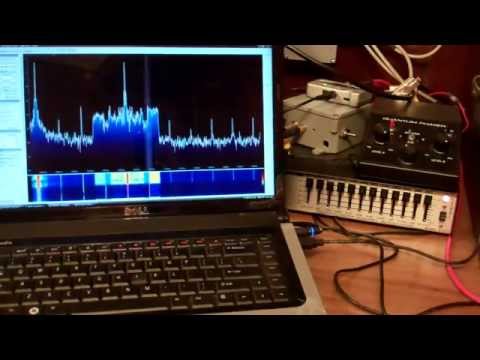
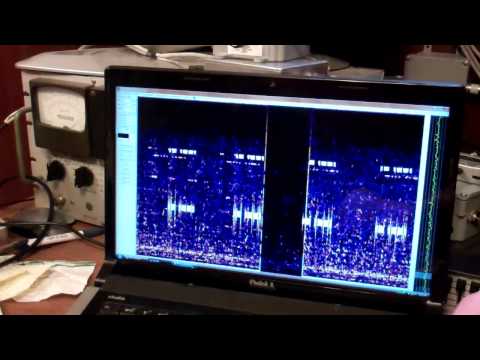
Over on YouTube user KP4MD has uploaded a video showing how she uses an RTL-SDR together with SDR#, a program called Visual Analyzer and an AEA PK-232 Terminal Node Controller to measure the frequency deviation of a Yaesu FT-8800R Transceiver. She writes:
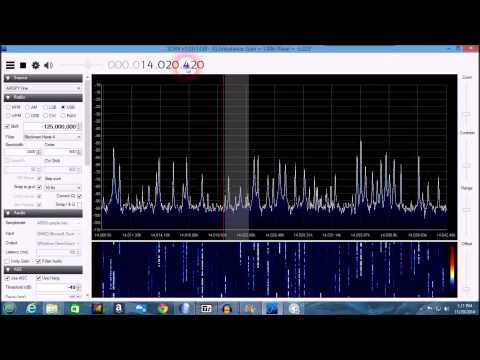
The SDR# receiver is tuned to 145.050 MHz and the bandwidth set to 20 kHz.
The deviation level of the 1200 Hz tone is increased until a null appeared on the carrier frequency.
This is called a Bessel Zero and occurs at various predicted modulation indices (2.4, 5.52, 8.66, etc).
The Modulation Index is defined as the peak frequency deviation divided by the modulation frequency.
This Bessel Zero occurred at a modulation index of 2.4 corresponding to a frequency deviation of ±2.88 kHz (2.4 x 1.2 kHz).
The oscilloscope indicates that a peak to peak amplitude of 54.3% corresponds to ±2.88 kHz deviation.
The 1200 Hz tone modulation is increased to yield a peak to peak amplitude of 66%.
This corresponds to the desired ±3.5 kHz frequency deviation.
Frequency Deviation Measurement with an RTL-SDR Dongle
Tim’s system uses a powerful Odroid XU3 which is a Linux based mini embedded computer that sells for $179 USD. The Odroid XU3 has dual quad core ARM CPUs which is enough power to run rtl_power with 5 RTL-SDR dongles simultaneously. Rtl_power is an RTL-SDR tool which allows you to scan and record the power levels in the frequency spectrum. By using 5 dongles he is able to scan the 49 MHz, 50 MHz, 144 MHz, 222 MHz and 432 MHz bands simultaneously.
The idea behind this project is to be able to MAP real-world Geo-tagged noise floor readings. This can be used for the primary purpose I intended for this application (mapping of problematic sources of RF Noise related to power lines in the area so that I can approach the local power company to resolve them) or any other sort of RF signal MAPPING. Such as cellphone/cellsite coverage or FM broadcast coverage (and dead spots) among other things.
RTL dongles are CHEAP, and reliable, although not 100% stable (they drift a bit for the first 5 minutes of warm up) they can be used to measure changes in the RF Noise Floor (once warmed up). While they don’t really seem to be able to be calibrated to anything less than -87db all we’re really looking for are relative changes to the noise floor while driving around a particular location (there is probably some complex math that could applied to these measurements that could be calibrated). So for this project these inexpensive receivers are really just fine.
While rtl_power is scanning, the Odroid uses a GPS receiver to tag the timestamped noise readings with GPS coordinates. Then by driving around with the system and combining the GPS coordinates with the noise floor readings from rtl_power he is able to create a heatmap showing exactly where in his neighbourhood noise levels peak, indicating a power line RF noise problem to be fixed by the power company.
Some more information about the hardware build of his system can be found on a previous post.
Powerline Noise Heat Mapped with RTL-SDRs and GPS LoggingThe insides of the driveby system
Tim also has uploaded a video to YouTube showing his system running a stationary test demonstrating the hardware and some of his custom software before everything was boxed up.
The tutorial shows the entire set up process from installing the required dependencies to running DSD 1.7 with GQRX by piping audio through UDP into DSD. He also shows how to run DSD 1.7 on a Raspberry Pi.
Note that DSD v1.7 also runs on Windows, and this previous post links to a precompiled Windows binary file.
Recently a reader of rtl-sdr.com, DO2BJK wrote in to let us know about his project where he used GNU Radio to decode Oregon Scientific V1 and V2 weather station messages. To receive the weather station messages which are sent in the ISM band at 433 MHz, DO2BJK used a USRP B210, but he writes that other SDRs such as an RTL-SDR or HackRF will also work. To decode the signal, DO2BJK took the usual steps of recording the signal and looking at the audio waveform in Audacity. From the waveform he was able to determine the bit string and discover the preamble, sync and data parts of a packet. He then used GNU Radio and wrote a Python program to receive the signal and automatically detect the preamble and extract the temperate data. His code is available on GitHub at https://github.com/bkerler/OregonDecoder/.
Recently RTL-SDR.com reader DE8MSH wrote in to let us know about his experiments with receiving WSPR with his RTL-SDR. WSPR is an acronym for “weak signal propagation reporter” and is a software program and RF protocol designed for very weak signal radio communications between ham radio users. With less than 5W of transmitting power, a WSPR signal could potentially be copied all over the world.
To receive WSPR, DE8MSH used a direct sampling modified RTL-SDR dongle together with a 9:1 unun, 10m RG58 coax cable from RTL-SDR to unun and a 12m wire antenna outside his house. Then by using SDR# together with the WSPR software he is able to copy signals from all over Europe and Canada/USA from his home in Germany.
Some Received WSPR LocationsWSPR Report InformationThe WSPR Software
Over on YouTube user BSoD Badgers has uploaded a video showing his reception of FreeDV digital speech at 14 MHz. He uses SDR# combined with the FreeDV software to decode the signal.
FreeDV is a open source software application that allows digital speech to be sent at HF frequencies in a 1.25 kHz wide signal. The same software can be used on the receiving end to decode the signal into speech.
Over on YouTube user BSoD Badgers has uploaded a video showing reception of Hellschreiber on HF at 20m. To receive the HF frequencies he used a ham-it-up upconverter. He used SDR# to receive the signal and the Fldigi decoding software to decode the signal.
Hellschreiber is a fax-like communications mode used by amateur radio hobbyists.
Over on YouTube user Java’s Toys has uploaded a video showing a demo of his reception of a BPSK63 signal using his RTL-SDR and the Ham-it-up upconverter. BPSK63 is a text based digital communications mode used by ham radio enthusiasts to make contacts. It is twice as fast compared to the more commonly used BPSK31 mode.
Java’s toys used HDSDR together with Fldigi to receive and decode the signal.