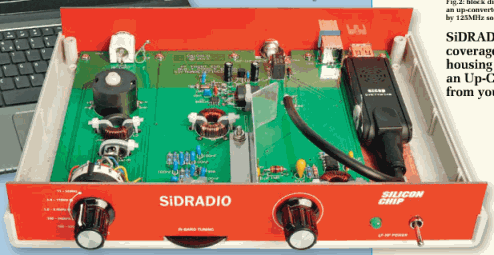
The High Performance Software Defined Radio (HPSDR) project is an open source SDR project that aims to create a modular SDR for ham radio use. The idea is that users only need to include the specific HPSDR hardware that they need for their particular application.
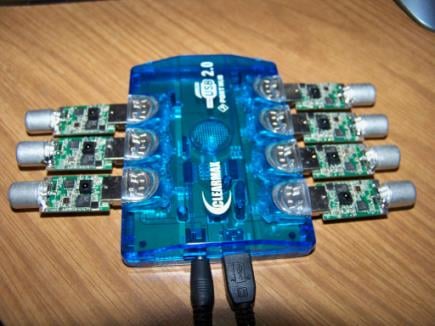
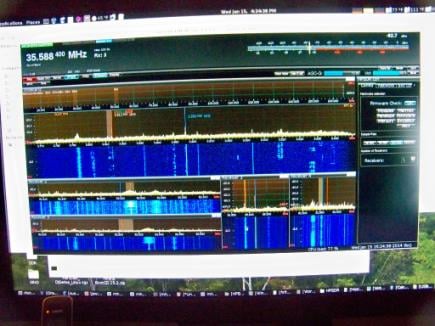
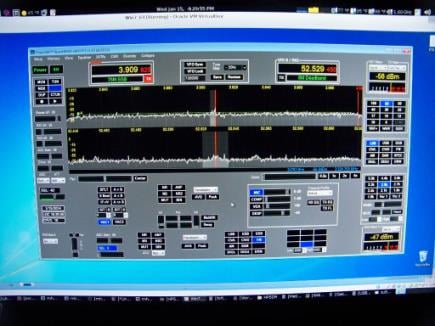
Using his tool Richard was able to get seven R820T RTL-SDR dongles running simultaneously on an EKB311 Quad core ARM Cortex A9 based mini-pc using a USB 2.0 hub with a modified power supply to provide 5V@2A.
Seven RTL-SDR USB SetupFive RTL-SDR Dongles used with RTL_HPSDR and csSDR64Two RTL-SDR dongles running on PowerSDR
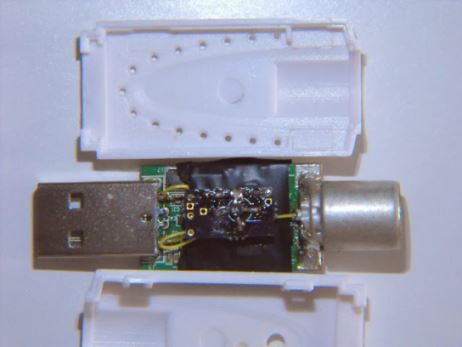
Revision 5 promises to be lower priced as it will run using the direct sampling mod instead of using an upconverter which would require more components. It will also use a Mini-Circuits MAR 8 wideband amplifier to improve weak signal performance.
There is an amateur radio group in Germany known as DL0SHF which transmits a 10 GHz (QRG = 10.368.025 MHz) beacon at the moon whenever it is visible at their site. The goal of this transmission is to detect the very weak beacon reflection.
Amateur radio hobbyist Rein (W6SZ) has written in to let us know about his, DK7IJ’s and the DL0SHF groups success with receiving the beacon using the RTL-SDR. He writes
DL0SHF transmit a signal to the moon when the moon is visible at the site. The run 2 modes 50 and 500 W output, 20 seconds on, 40 seconds off.
Last night, I managed to detect the beacon with a very simple receiving package. Amazing enough, using WSJT moon tracking data, the signal appeared right away when the moon appeared here above the trees.
The signal lasts only 20 seconds but then 40 seconds later, it returned! By the books.
I use a simple 10 GHz receiver here that I use for scouting signals on 10 GHz terrestrial as member of the San Bernardino Microwave Society.
It consists of a RTL Dongle IF block tuned to 618 MHz as IF.
Front-end is a PLL LNB, not modified, running with 9.750 GHz LO
The LNB is powered with 12 Volts by means of a Bias Tee.
Both items can be acquired for about USD 25.- on eBay and other places.
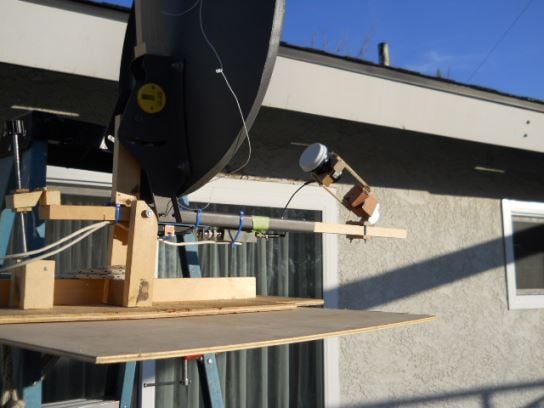
The antenna is a standard 18 inch satellite off-set dish.
The antenna has some elevation control and the feed ( LNB ) can be rotated for polarity control.
Every variable is manually operated.
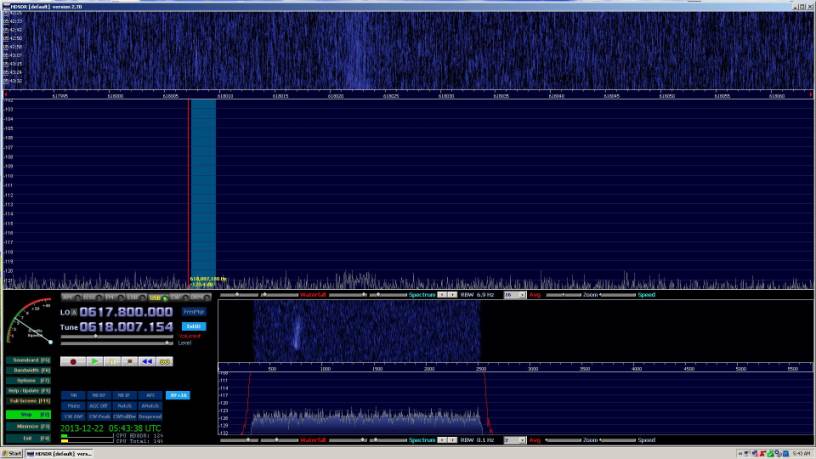
At times I measured the beacon as high as 15 dB above the noise using HDSDR as DSP processor software.
The beacon was running in the 500 W output mode during these observations.
Moon bounce visible on the waterfallMoonbounce Equipment Setup
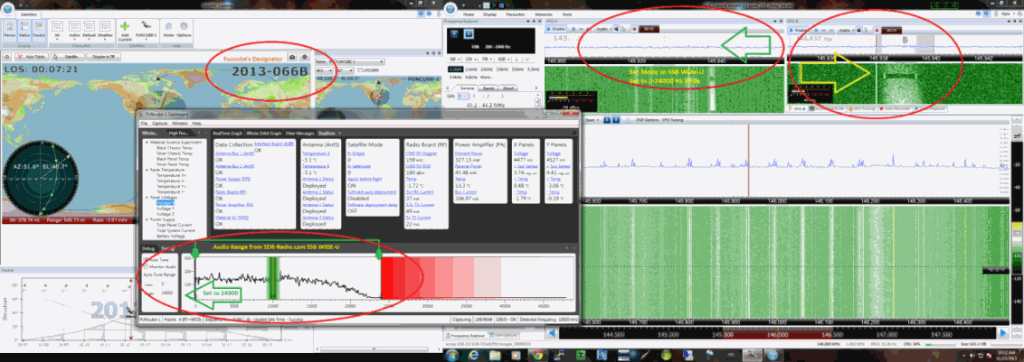
Recently, the FUNcube-1 satellite was successfully launched. The FUNcube is a CubeSat (a low cost miniature 10cm cube sized satellite) which is intended mainly for educating young people about radio, space, physics and electronics, but has also piqued the interest of amateur radio hobbyists.
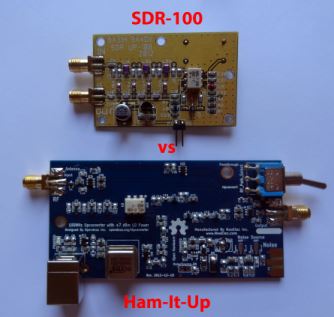
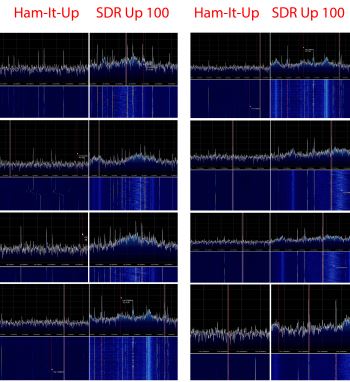
For each test he used a gain of 0dB and the same 20 foot random wire antenna. Interestingly, his results show that the SDR Up 100 significantly outperforms the Ham-it-up upconverter. We believe that this may be as the SDR Up 100 has an LNA built into it whereas the Ham it up does not.
Update: Akos has now included comparisons with various RTL gain settings.
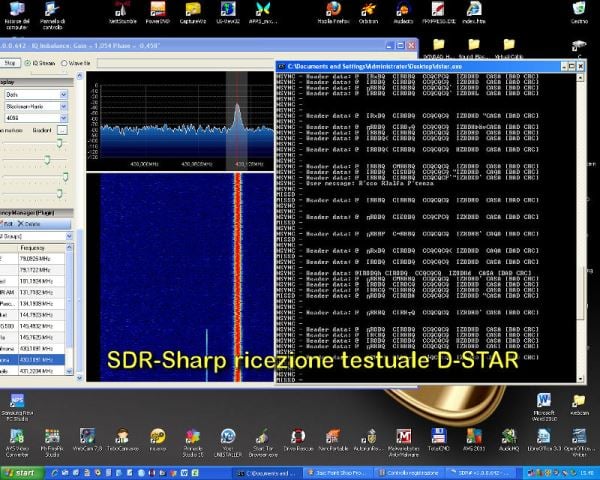
D-STAR or Digital Smart Technologies for Amateur Radio is a digital voice and data protocol used in amateur radio. I was tweeted a link earlier which shows how the RTL-SDR can decode D-STAR text messages and headers (link is in Italian but Google translate can help, and the pictures show more than enough information). By using SDRSharp and stereo mix you can tune to a D-STAR signal, and pass the audio to a command line based decoding program (dstar.exe) which can be downloaded from the above link, which will then decode D-STAR text messages.
Here is also an older video showing D-STAR decoding with HDSDR in action.
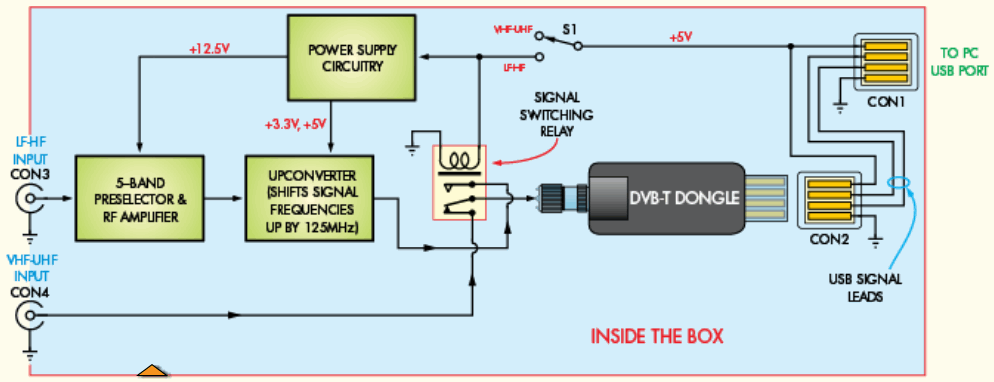
Akos from the SDR for mariners blog has written a review on the SDR UP-100 upconverter. The SDR UP-100 is a 50 USD upconverter for the RTL-SDR and similar software defined radios which is made by the same person behind the LNA4ALL low noise amplifier. Upconverters allow the RTL-SDR to receive between 0 and 30 MHz, where ham radio, military, marine and many other interesting signals exist.
In the review Akos tests the SDR UP-100 with a 6 meter random wire antenna and an RTL-SDR. His results show that the upconverter works well as expected. In the future he hopes to compare the SDR UP-100 with the Ham-It-Up Upconverter from Nooelec.