Category: Amateur Radio

Receiving a 10 GHz Reflected Moon Beacon with the RTL-SDR

There is an amateur radio group in Germany known as DL0SHF which transmits a 10 GHz (QRG = 10.368.025 MHz) beacon at the moon whenever it is visible at their site. The goal of this transmission is to detect the very weak beacon reflection.

Amateur radio hobbyist Rein (W6SZ) has written in to let us know about his, DK7IJ’s and the DL0SHF groups success with receiving the beacon using the RTL-SDR. He writes

DL0SHF transmit a signal to the moon when the moon is visible at the site. The run 2 modes 50 and 500 W output, 20 seconds on, 40 seconds off.

Last night, I managed to detect the beacon with a very simple receiving package. Amazing enough, using WSJT moon tracking data, the signal appeared right away when the moon appeared here above the trees.

The signal lasts only 20 seconds but then 40 seconds later, it returned! By the books.

I use a simple 10 GHz receiver here that I use for scouting signals on 10 GHz terrestrial as member of the San Bernardino Microwave Society.

It consists of a RTL Dongle IF block tuned to 618 MHz as IF.
Front-end is a PLL LNB, not modified, running with 9.750 GHz LO

The LNB is powered with 12 Volts by means of a Bias Tee.

Both items can be acquired for about USD 25.- on eBay and other places.

The antenna is a standard 18 inch satellite off-set dish.

The antenna has some elevation control and the feed ( LNB ) can be rotated for polarity control.

Every variable is manually operated.

At times I measured the beacon as high as 15 dB above the noise using HDSDR as DSP processor software.

The beacon was running in the 500 W output mode during these observations.

Moon bounce Visisble on the waterfall
Moon bounce visible on the waterfall
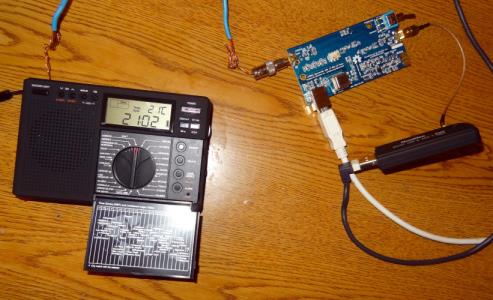
Moonbounce Equipment Setup

Using the RTL-SDR to listen to the Funcube Satellite

Recently, the FUNcube-1 satellite was successfully launched. The FUNcube is a CubeSat (a low cost miniature 10cm cube sized satellite) which is intended mainly for educating young people about radio, space, physics and electronics, but has also piqued the interest of amateur radio hobbyists.

Amateur radio hobbyist N4JTC’s has shared on his blog his experiences with receiving the FUNcube-1’s telemetry using his RTL-SDR dongle. By using the RTL-SDR to receive the telemetry beacon as the satellite passes overhead, he was able to use the FUNcube Dashboard software to record and decode and view the satellites telemetry data.

Receiving the FUNcube-1 Satellite

SiDRadio: RTL-SDR Kit including Preselector & Upconverter

The Australian Silicon Chip magazine has written an article about a kitset for a 100KHz to 2 GHz receiver based on the RTL-SDR that they are selling. Note, you will need to pay in order to be able to read the entire article.

Completing the kit gives you a radio with two antenna inputs, a 5-band preselector, an RF amplifier and an upconverter for the HF bands.

SiDRADIO Overview
SiDRADIO Overview
SiDRADIO
SiDRADIO


Upconverter Comparison: Nooelec Ham it Up vs SDR Up 100

A few weeks ago Akos from the SDR for Mariners blog did a review of the SDR Up 100 Upconverter, and he promised to compare it with the Nooelec Ham-it-up Upconverter when it arrived. He has now done the comparison, and written about it on his blog.

For each test he used a gain of 0dB and the same 20 foot random wire antenna. Interestingly, his results show that the SDR Up 100 significantly outperforms the Ham-it-up upconverter. We believe that this may be as the SDR Up 100 has an LNA built into it whereas the Ham it up does not.

Update: Akos has now included comparisons with various RTL gain settings.

upconverterCompare
SDR Up 100 vs Ham It Up
Nooelec vs Up 100 comparison
Comparison Images

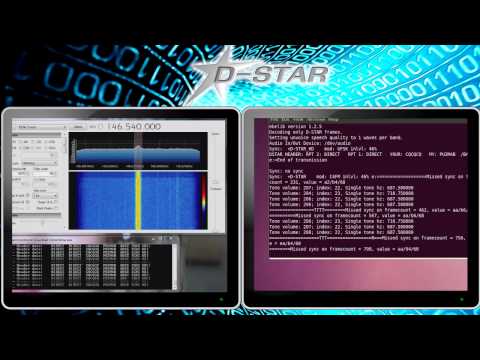
Decoding D-STAR Headers with the RTL-SDR

D-STAR or Digital Smart Technologies for Amateur Radio is a digital voice and data protocol used in amateur radio. I was tweeted a link earlier which shows how the RTL-SDR can decode D-STAR text messages and headers (link is in Italian but Google translate can help, and the pictures show more than enough information). By using SDRSharp and stereo mix you can tune to a D-STAR signal, and pass the audio to a command line based decoding program (dstar.exe) which can be downloaded from the above link, which will then decode D-STAR text messages.

dstar7

Here is also an older video showing D-STAR decoding with HDSDR in action.

Review of the SDR UP-100 Upconverter

Akos from the SDR for mariners blog has written a review on the SDR UP-100 upconverter. The SDR UP-100 is a 50 USD upconverter for the RTL-SDR and similar software defined radios which is made by the same person behind the LNA4ALL low noise amplifier. Upconverters allow the RTL-SDR to receive between 0 and 30 MHz, where ham radio, military, marine and many other interesting signals exist.

In the review Akos tests the SDR UP-100 with a 6 meter random wire antenna and an RTL-SDR. His results show that the upconverter works well as expected. In the future he hopes to compare the SDR UP-100 with the Ham-It-Up Upconverter from Nooelec.

SDR UP-100

Rain Scatter 10 GHz Reception with the RTL-SDR

YouTube user feri67000 who last month showed us that the RTL-SDR can receive 10 GHz signals with a cheap avenger LNB PLL now shows an interesting experiment where he uses a technique known as rain scatter to receive a 10 GHz beacon with his satellite dish pointed in the opposite direction of the beacon transmitter.

Usually communications at 10 GHz are line of sight only, but by using the rain scatter technique, the 10 GHz signal can be bounced off a precipitation cloud and received with line of sight to the cloud, rather than the transmitter.

rain scatter 10ghz LX1DB beacon

Setting up an APRS iGate with the RTL-SDR

Over on Pawel Janowski’s blog (SQ7MRU) a writeup on how to set up an APRS iGate receiver with an RTL-SDR and cubieboard mini computer has been posted. The article has been written in Polish, but can be translated using Google Translate.

APRS stands for Automatic Packet Reporting System and is usually used by Amateur radio operators to broadcast the current GPS coordinates of something such as a transmitter site/car/boat or high altitude amateur balloon. These APRS packets are received by an iGate and then put onto the internet. Check out aprs.fi for an example.

To create an APRS iGate, Pawel runs a RTL-SDR compatible python program called pymultimonaprs which is used to receive and broadcast the APRS data on to the internet.

aprs_fi_rtlsdr