DragonOS is a ready to use Ubuntu Linux image that comes preinstalled with multiple SDR program. The creator of DragonOS, Aaron, uploads various YouTube tutorials showing how to use some of the preinstalled software. This month one of his tutorials covers how to use a SDRplay RSP1A or a HackRF to receive and decode FT8 with the preinstalled software WSJT-X or JS8Call. Aaron also notes that an RTL-SDR could also be used as the SDR.
In the video he covers how to set up a virtual audio cable sink in Linux for getting audio from GQRX into WSJT-X, setting up rigctld to allow WSJT-X to control GQRX, configuring GQRX, CubicSDR and WSJT-X, and finally downloading and using GridTracker.
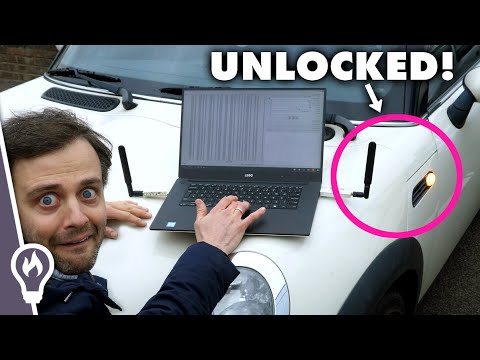
Over on YouTube popular science content creator Steve Mould has uploaded a video showing how he was able to open his own car using a HackRF software defined radio. In the video Steve first uses the Universal Radio Hacker software to perform a simple replay attack by using his HackRF (and also an RTL-SDR V3) to record the car's keyfob signal away from the car and replay it near the car.
Steve goes on to note that most cars use rolling code security, so a simple replay attack like the above is impractical in most situations. Instead he notes how a more advanced technique called "rolljam" can be used, which we have posted about a few times in the past. Later in the video Steve interviews Samy Kamkar who was the security researcher who first popularized the rolljam technique at Defcon 2015.
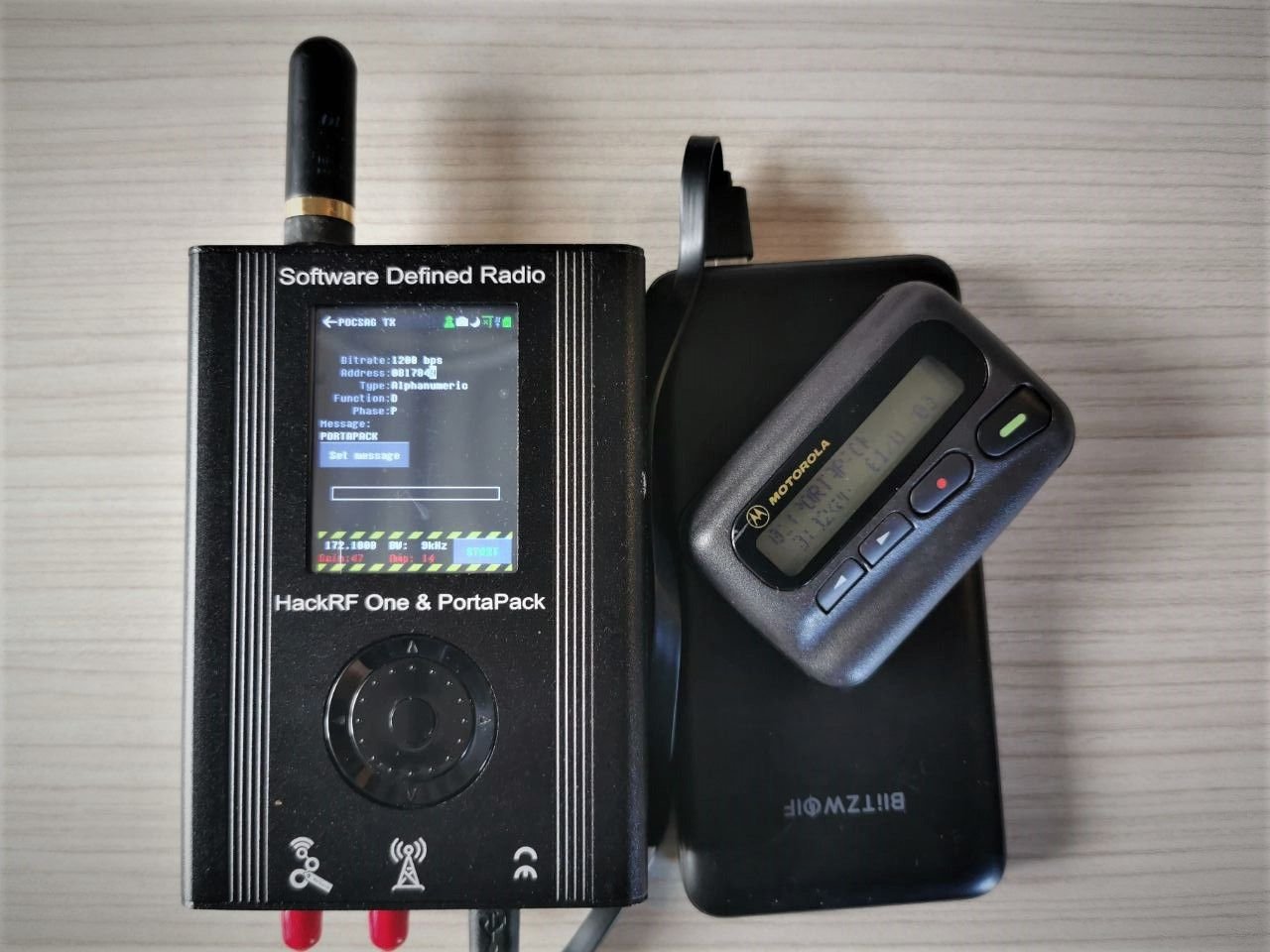
The Portapack is an add on for the popular HackRF SDR which allows the HackRF to be used portably without a PC. Recently the cost of this hardware duo has come down to below US$150 due to low cost Chinese clones now being available on the market. Generally the clones are of good quality too.
Once you have the hardware it is possible to install third party custom firmware such as "Mayhem" on the Portapack which enables many features such as the ability to receive and transmit various different types of RF protocols. Back in 2018 we did a review of Mayhems predecessor which was known as the "Havok" firmware. More recently Tech Minds did a video overview of Mayhem.
Now over on his blog A. Petazzoni has started a new blog series which aims to introduce the basics of the Mayhem firmware, including installation and some hands on testing with RF spoofing, denial-of-service (DoS) and replay attacks. Currently only his first post is out, and in the post he show how to install Mayhem onto the Portapack, then goes on to briefly overview some applications such as RF replay attacks, replicating wireless remote controls, receiving and transmitting POCSAG, receiving and transmitting ADS-B, and creating a jammer.
Obviously a lot of what you can do with a Portapack and the Mayhem firmware is extremely illegal and very dangerous, so please do be careful with what and where you transmit especially if you are new to RF hobby. These signals should remain in your test area only, and not leak out into the wider environment.
The Search for Extraterrestrial Intelligence (SETI) is an ongoing project that aims to detect radio signals originating from intelligent species somewhere in the universe. Recently Alberto Caballero, a SETI researcher has been proposing a distributed search (project pdf document) with amateur and/or professional radio telescopes. The idea is that multiple stations around the world would monitor a single star for a period of time in order to collect data 24/7. To participate the requirements are a dish 2.1 meters or larger, a motorized mount, and a feed, LNA and radio system able to receive 1 - 4.5 GHz.
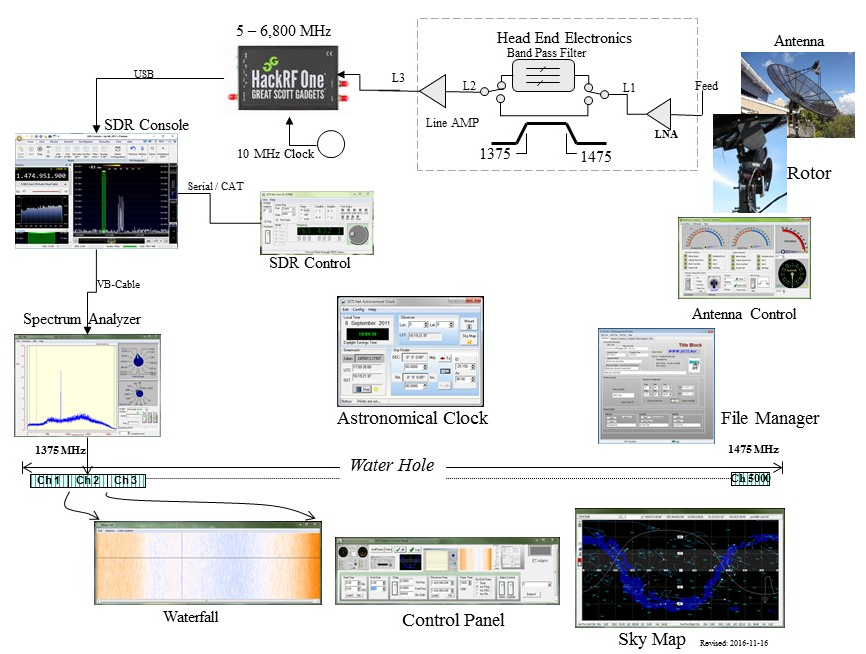
An example of a SETI station can be found at SETI Net. Here the owner has a 3M dish on a rotor connected to a HackRF. An LNA and band pass filter are also used at the feed end. SDR Console or SDR# is used to monitor a specific frequency, and the audio is sent into a special automatic SETI analysis program as well as spectrum analysis software. If an interesting signal is detected the software notifies the user, then further analysis can be undertaken.
If you have a suitable radio telescope available and want to participate, you can contact the SETI project via their contact form.
Over on her YouTube channel, SignalsEverywhere, Sarah has uploaded a new video showing how she uses a PlutoSDR, HackRF and mixer to transmit DVB-S digital amateur TV to a standard satellite set top box. In this video the idea is to get a little more range by using the PlutoSDR to transmit in the 70cm band, then upconverting that to the 23cm band right at the satellite receiver. Transmitting at the lower frequency yields a higher power output from the PlutoSDR and less cable loss. The mixer consists of a passive mixer chip and a HackRF is used as the mixer LO signal source as a temporary test solution.
Digital TV Transmitter 70cm ATV to 23cm Satellite Receiver Using a Mixer/Upconverter
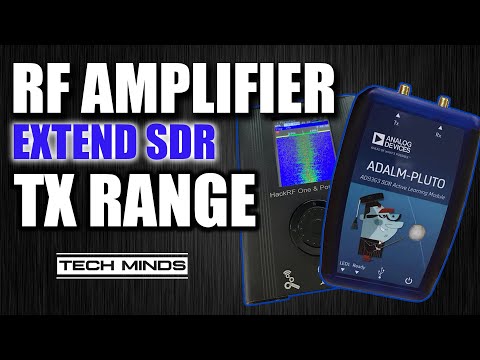
Over on his YouTube channel TechMinds has uploaded a new video showing how to use RF amplifiers to extend the transmit range of transmit capable SDRs like the LimeSDR, HackRF and PlutoSDR. Whilst they are transmit capable, most low cost SDRs like those mentioned above can only transmit at very low power levels typically much less than 30 mW. In the video TechMinds tests a wideband SPF5189Z and filtered 2.4 - 2.5 GHZ CN0417 based amplifier, and shows the output power obtained using an inline power meter.
He also notes that these wideband amplifier will also amplify harmonics so filtering is recommended. At the same time we note that you should only transmit if you are licenced to do so (for example with a ham radio licence), especially if you are amplifying the output.
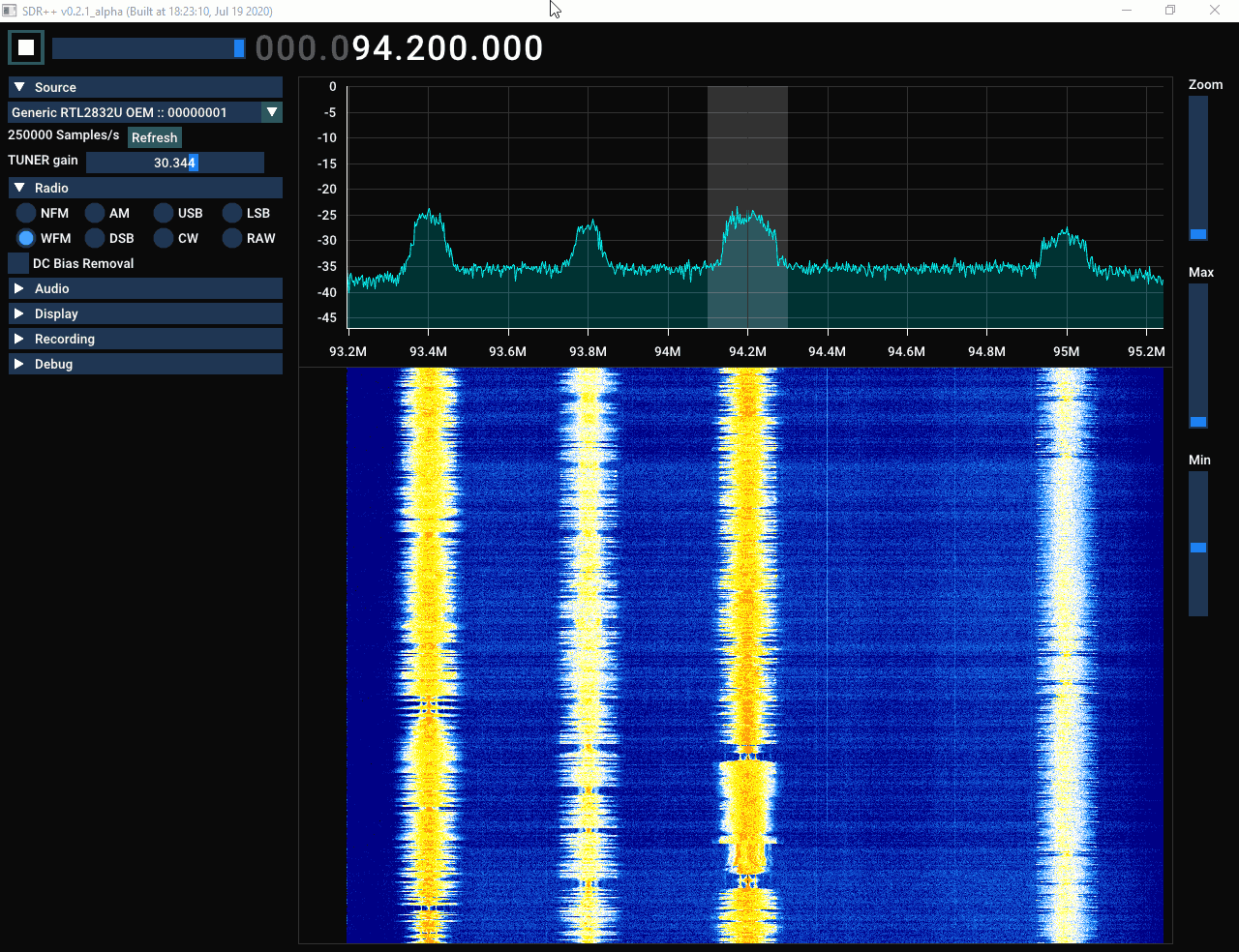
In order to use SDR++ on Windows you will first need to have installed PothosSDR for the SoapySDR and volk support. To do this you can follow the instructions here. Thanks to the SoapySDR support it is able to run with most SDRs including the RTL-SDR.
To start the program, select your SDR from the source menu, change the sample rate (which is set to the minimum value by default), then click the play button. We tested it with both an RTL-SDR and HackRF, and both units worked just fine, although at lower sample rates the waterfall was a bit choppy. We do note that the software is very much in the alpha phase with only a few features implemented, and most menu items do not work yet. But the main features including WFM, FM, AM, SSB, CW demodulation as well as the spectrum and waterfall are all functional. Unfortunately there do seem to be a few stability issues as we experienced frequent crashes on our PC.
We'll be watching this software with interest to see how it progresses.
Current Features
Uses SoapySDR for wide hardware support
Hardware accelerated graphics (OpenGL + ImGui)
SIMD accelerated DSP (parts of the DSP are still missing)
Cross-platform
Full waterfall update when possible. Makes browsing signals easier and more pleasant
Coming soon
Multi-VFO
Plugins
Digital demodulators and decoders
Quick replay (replay last n seconds, cool if you missed a short signal)
Small things to add
Switchable bandwidth for demodulators
Switchable audio output device and sample rate
Recording
Light theme (I know you weirdos exist lol)
Waterfall color scheme editor
Switchable fft size
Bias-T enable/disable
other small customisation options
Save waterfall and demod settings between sessions
"Hide sidebar" option
Input filter bandwidth option
Known issues (please check before reporting)
Random crashes (yikes)
Gains aren't stepped
The default gains might contain a bogus value before being adjusted
Clicks in the audio
In some cases, it takes a long time to select a device (RTL-SDR in particular)
Min and Max buttons can get unachievable values (eg. min > max or min = max);
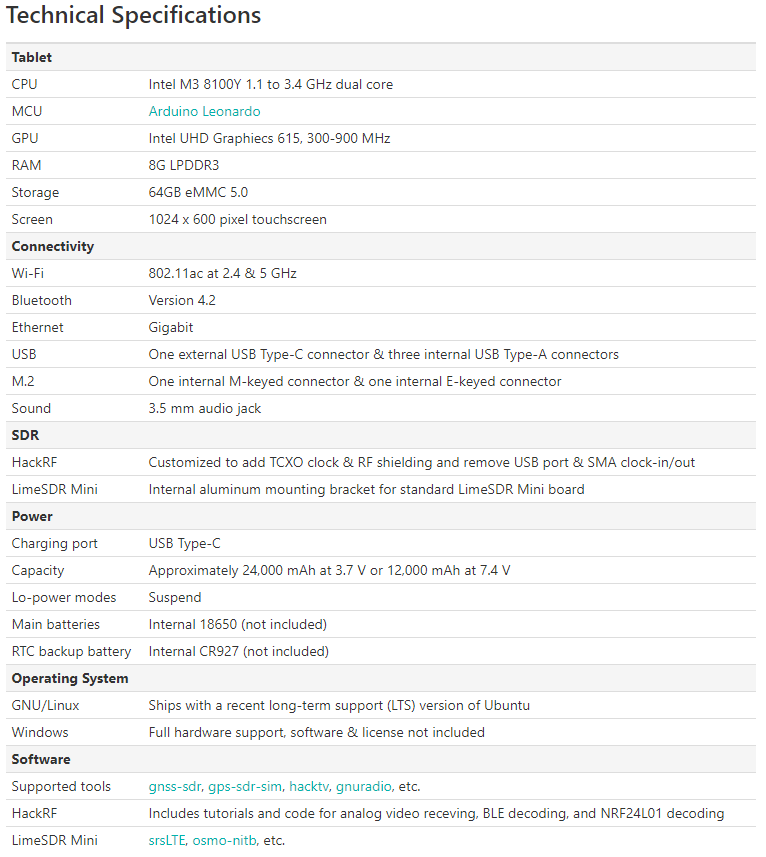
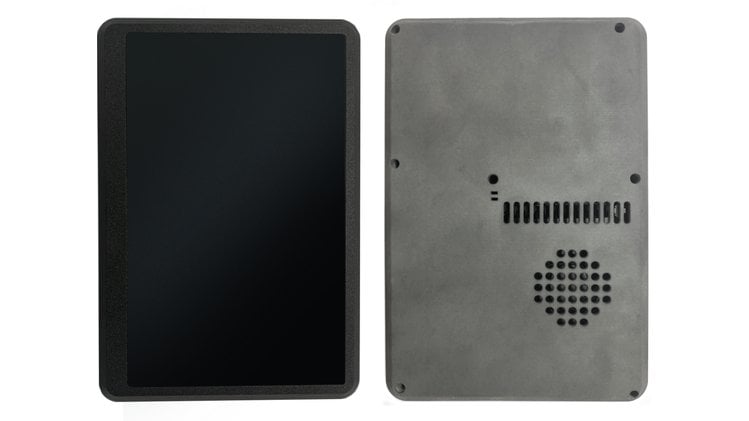
A new project called "RadioSlate" has recently been announced by Yian IT, a Chinese IoT company. RadioSlate will be an SDR-enabled tablet designed to be used with a HackRF or LimeSDR software defined radio that will be mounted internally behind the screen under some metal shielding. The tablet uses a 1024 x 600 touchscreen and runs an Intel M3 8100Y 1.1 to 3.4 GHz dual core CPU with 8GB of RAM, 64GB of storage and it supports both Linux and Windows. Batteries will not be included, but it supports batteries in the standard 18650 form factor which can be purchased anywhere.
RadioSlate is a sturdy aluminum tablet with an industry-favorite software-defined radio (SDR) board—your choice of HackRF or LimeSDR—tucked away behind its touchscreen. Whether you’re a Ham radio operator, a network engineer, a mobile base station designer, a security auditor, or some other variety of SDR enthusiast, RadioSlate lets you do your thing, even if that thing requires you to go outside and walk around, get unusually close to transmitters and receivers, keep one hand free for other tasks, or manage all of the above without drawing undue attention to yourself.
Explore the spectrum, while on the go, without having to drag along your laptop, an SDR board, and cables.