Category: HackRF

Using a HackRF to Investigate Why WiFi on the Raspberry Pi 4 Doesn’t work when Running HDMI at 1440p

The Raspberry Pi 4 launched with it's fair share of problems, but a new problem seems to have been recently discovered and documented. It turns out that the Pi 4's WiFi stops working when running at a screen resolution of specifically 1440p.

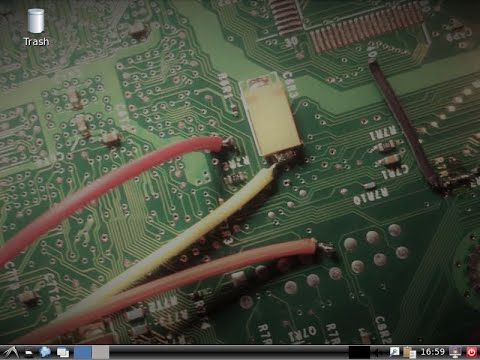
Suspecting interference generated by the HDMI clock, Mike Walters (@assortedhackery) used a HackRF and a near field probe antenna to investigate. By placing the near field probe on the Raspberry Pi 4's PCB and running a screen at 1440p resolution he discovered a large power spike showing up at 2.415 GHz. This interferes directly with 2.4 GHz WiFi Channel 1.

An article by ExtremeTech article notes:

There’s a giant spike that could easily interfere with Channel 1 of a Wi-Fi adapter. So why is this happening? Because a 2560×1440@60Hz has a pixel clock of 241.5MHz and has a TMDS (transition-minimized differential signaling) clock of 2.415GHz, according to Hector Martin (@Marcan42). And what frequency does the RBP4 use for Wi-Fi? 2.4GHz. Which means… outputting on HDMI over 1440p can cause interference in a Wi-Fi channel.

The ExtremeTech article also notes that this problem is not unique to the Raspberry Pi 4 only. It turns out that USB 3.0 hardware is to blame, and this problem has occurred before with USB3.0 hard driver and on some MacBooks.

While the interference appears to be localized to the near field around the Pi4 PCB, we suspect that you could use TempestSDR to remotely eavesdrop on the Pi 4's video output if the interfering signal was boosted.

Investigating Problems with the Tesla HomeLink RF Signal with a HackRF and GNU Radio

Tesla vehicles have a feature where they can copy and mimic a garage door remote via a built in transmitter on the car itself. This frees you from having to carry around a garage door key fob, and you can simply open your garage door by pressing a button on the car's LCD screen.

However, some people have reportedly been having a little trouble with this feature as in some cases the garage door would begin opening, and then suddenly stop opening as if the keyfob button had been pressed twice.

Over on YouTube CWNE88 decided to investigate this problem using his HackRF and GNU Radio. From a simple waterfall he was able to determine that the Tesla actually transmits the mimic'd garage door signal for a full two seconds.

As a keypress from the original keyfob would typically result in a much shorter transmission, CWNE88 believes that the long two second transmission could in some cases be seen as two transmissions by the garage door, resulting in an open, and then close command being detected. 

Tesla HomeLink RF Signal

Tutorial on Performing a Replay Attack with a HackRF and Universal Radio Hacker

Over on YouTube channel Tech Minds has uploaded a short tutorial video that shows how to perform a replay attack with a HackRF and the Universal Radio Hacker software. A replay attack is when you record a control signal from a keyfob or other transmitter, and replay that signal using your recording and a TX capable radio. This allows you to take control of a wireless device without the original keyfob/transmitter. This is easy to do with simple wireless devices like doorbells, but not so easy with any system with rolling codes or more advanced security like most car key fobs.

In the video Tech Minds uses the Universal Radio Hacker software to record a signal from a wireless doorbell, save the recording, replay it with the HackRF, and also analyze it.

Universal Radio Hacker - Replay Attack With HackRF

SDR in the Local Newspaper: Investigating an RF Dead Spot for Car Key Fobs

Reddit user [SDR_LumberJack] writes how he was recently featured in his local newspaper [Part2] in Ontario, Canada thanks to his efforts in helping to hunt down the cause of an RF deadspot with an SDR. He began his journey by reading a story in his local newspaper called the [Windsor Star]. The story was about locals having found a ‘dead-spot’ for car key-fobs. In the dead-spot key-less cars wouldn’t start, key-fobs wouldn’t unlock cars, and alarms would go off.

Being intrigued by the story [SDR_LumberJack] investigated by driving around with an RTL-SDR, HackRF and a laptop running SDR#. Eventually he found that there was what appeared to be a WBFM Broadcast radio station interfering at 315 MHz. This frequency happens to fall into the ISM radio band that used by car remotes and key-fobs. The exact source of the interference hasn’t been nailed down just yet though.

While it’s possible a broadcast station is at fault it is also possible that his SDR was just overloading, causing broadcast FM imaging. Perhaps a WBFM filter could be used to prevent signal imaging that could interfere with the investigation.

Hopefully [SDR_LumberJack] will continue his investigation and we’ll get an update on this story.

If you’re interested, back in 2016 we posted a very similar story about the exact same thing happening at a car park in Brisbane, Australia. The conclusion to that story was that the dead-spot only occurred in particular locations in the car park, and this was due to the shape of surrounding building causing the RF signals to reflect off the walls and distort the signal.

SDR_LumberJack in the local newspaper

An Introduction to Pagers with the HackRF PortaPack and an RTL-SDR

Over on YouTube user HackedExistence has uploaded a video explaining how POCSAG pager signals work, and he also shows some experiments that he's been performing with his HackRF PortaPack and an old pager.

The Portapack is an add on for the HackRF SDR that allows the HackRF to be used without the need for a PC. If you're interested in the past we reviewed the PortaPack with the Havok Firmware, which enables many TX features such as POCSAG transmissions.

POCSAG is a common RF protocol used by pagers. Pagers have been under the scrutiny of information security experts for some time now as it is common for hospital pagers to spew out unencrypted patient data [1][2][3] into the air for anyone with a radio and computer to decode.

In the video HackedExistence first shows that he can easily transmit to his pager with the HackRF PortaPack and view the signals on the spectrum with an RTL-SDR. Later in the video he explains the different types of pager signals that you might encounter on the spectrum, and goes on to dissect and explain how the POCSAG protocol works.

Intro to Pagers - POCSAG with HackRF

Exploring the Limits of General Purpose SDR Devices

Back in August 2019 the Chaos Communication Camp was held in Germany. This is a 5 day conference that covers a variety of hacker topics, sometimes including SDR. At the conference Osmocom developer Harald Welte (aka @LaF0rge) presented a talk titled "The Limits of General Purpose SDR devices". The talk explains how general purpose TX capable SDRs like HackRFs and LimeSDRs have their limitations when it comes to implementing advanced communications systems like cellular base stations.

If you prefer, the talk can be watched directly on the CCC website instead of YouTube.

Why an SDR board like a USRP or LimeSDR is not a cellular base station

It's tempting to buy a SDR device like a LimeSDR or USRP family member in the expectation of operating any wireless communications system out there from pure software. In reality, however, the SDR board is really only one building block. Know the limitations and constraints of your SDR board and what you need around it to build a proper transceiver.

For many years, there's an expectation that general purpose SDR devices like the Ettus USRP families, HackRF, bladeRF, LimeSDR, etc. can implement virtually any wireless system.

While that is true in principle, it is equally important to understand the limitations and constraints.

People with deep understanding of SDR and/or wireless communications systems will likely know all of those. However, SDRs are increasingly used by software developers and IT security experts. They often acquire an SDR board without understanding that this SDR board is only one building block, but by far not enough to e.g. operate a cellular base station. After investing a lot of time, some discover that they're unable to get it to work at all, or at the very least unable to get it to work reliably. This can easily lead to frustration on both the user side, as well as on the side of the authors of software used with those SDRs.

The talk will particularly focus on using General Purpose SDRs in the context of cellular technologies from GSM to LTE. It will cover aspects such as band filters, channel filters, clock stability, harmonics as well as Rx and Tx power level calibration.

The talk contains the essence of a decade of witnessing struggling SDR users (not only) with running Osmocom software with them. Let's share that with the next generation of SDR users, to prevent them falling into the same traps.

The Limits of General Purpose SDR devices

Using a HackRF SDR to Sniff RF Emissions from a Cryptocurrency Hardware Wallet and Obtain the PIN

At last years Chaos Communication Congress (35C3) Conference, leveldown security presented their findings on multiple security vulnerabilities present in cryptocurrency hardware wallets.  Cryptocurrency is a type of digital asset that relies on computers solving cryptographic equations to keep the network trusted and secure. Popular cryptocurrencies include Bitcoin, Ethereum and Ripple. To access your cryptocurrency funds on a computer, a software application called a wallet is used.

However, if a computer holding a wallet is compromised, it is possible that the wallet could be opened by a hacker and funds transferred out. To improve security, hardware wallets are available. These are USB keys that require you to enter a PIN on the key before the funds can be accessed. If the USB key is not inserted and activated by the PIN, the wallet cannot be opened.

All electronic devices including hardware cryptocurrency wallets unintentionally emit RF signals. One possible attack against a hardware wallet is to analyze these RF emissions and see if any information can be obtained from them.  The team at leveldown found that the Ledger Blue cryptocurrency wallet in particular has a flaw where each PIN number button press emits a strong RF pulse. By using a HackRF and machine learning to analyze the unintentional RF output of each button press, the team was able to retrieve the PIN number with only RF sniffing from more than 2 meters away.

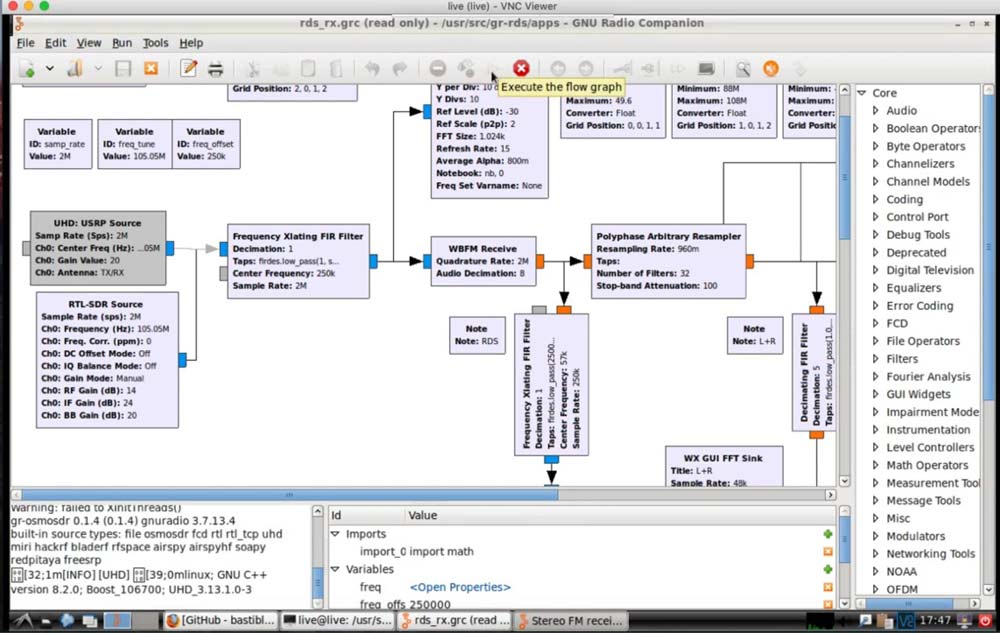
To do this they created a GNU Radio flowchart that records data from the HackRF whenever an RF pulse is detected. A small Arduino powered servo then presses the buttons on the wallet hundreds of times, allowing hundreds of RF examples to be collected. Those RF samples are then used to train a neural network created in Tensorflow (a popular machine learning package). The result is a network that performs with 96% accuracy.

If you're interested in exploring other unintentional RF emissions from electronics, check out our previous post on using the TempestSDR software to spy on monitors/TVs with unintentionally emitted RF, and the various other posts on our blog on this topic.

Andreas Spiess Explains Software Defined Radio in YouTube Video

Over on YouTube Andreas Spiess has uploaded a video titled "How does Software Defined Radio (SDR) work under the Hood?". The video is an entertaining introduction to how software defined radio works and begins from the beginning by explaining how basic analogue radios work with components such as modulators, demodulators, frequency generators, mixers and filters. After the basics he goes on to explain the digitization of radio signals that occurs in SDRs, and gives an introduction ADCs and how IQ sampling works.

Later in the video Andreas shows various applications for SDRs, discusses various SDRs on the market like RTL-SDR, HackRF, SDRplay, LimeSDR and PlutoSDR and introduces GNU Radio Companion and other SDR programs from our big list of software post.

#286 How does Software Defined Radio (SDR) work under the Hood? SDR Tutorial