Category: News

New GNU Radio Beginners Tutorials Available

A new set of beginners tutorials for the GNU Radio platform have been released on the GNU Radio Wiki.  GNU Radio is an open source development toolkit for signals processing and is commonly used to build software demodulators and decoders for Software Defined Radios including the RTL-SDR.

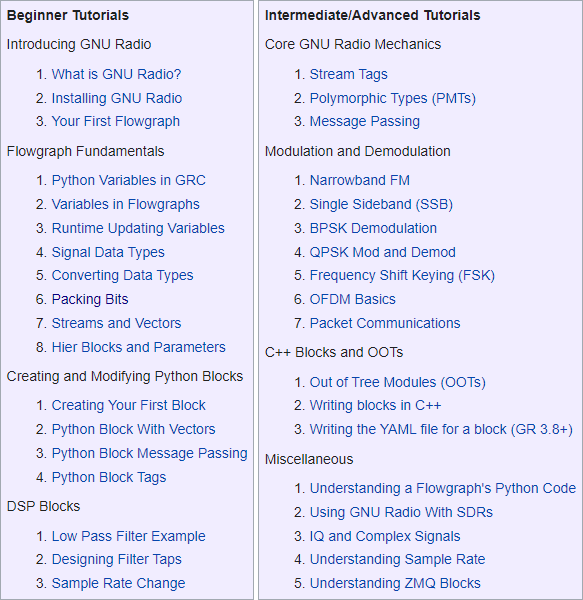
The tutorials lead you through topics such as understanding flowgraphs, creating custom Python blocks, using DSP blocks, GNU Radio core mechanics, modulation and demodulation and more.

We are pleased to announce a new set of beginner-level tutorials, as well as a new tutorials landing page, you can check them out here

A big thank you to NumFOCUS for sponsoring the work and to Matt from wavewalkerdsp who did the bulk of the work!

These beginner-level tutorials walk a new user through starting GRC and creating a simple flowgraph, all the way up to creating custom blocks and using tags and message passing.

We would like to create follow-up tutorials that the GNU Radio community needs so please leave feedback in the Discuss tab of the main Tutorials page, here are some suggestions:

  • Do you have ideas for future tutorials you’d like to see made?
  • What doesn’t make sense in GNU Radio, or what is hard to understand?
  • Where are the sticking points? What is hard to remember?
  • What is hard to use?
  • Are there any points in the current tutorials you’d like to see in more detail?
  • What would you change about the tutorials?

You can also access the tutorials using the Tutorials link on the left hand sidebar of the GNU Radio wiki, from any page.

GNU Radio Tutorial Topics

If you're interested in these tutorials you might also want to check out Michael Ossmann's set of video tutorials for the HackRF, which features GNU Radio usage heavily.

A Warning to Ukraine Based RTL-SDR Hobbyists

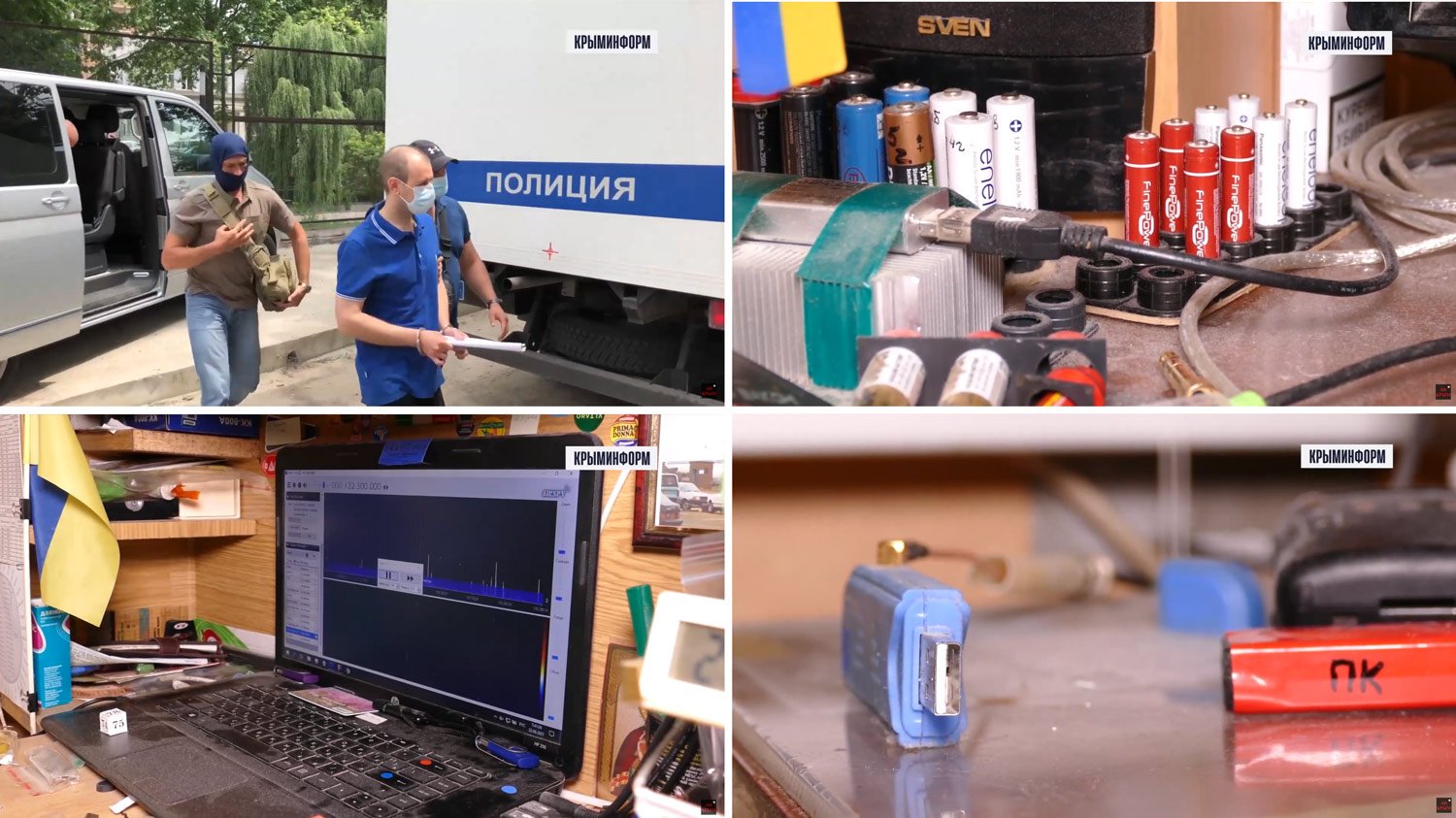
While we usually don't encourage politics on this blog, with the possibility of a Ukraine invasion by Russia we just wanted to issue a general warning to Ukrainian SDR owners. Last year we saw Stanislav Stetsenko a resident of Crimea arrested by the Russian Federal Security Service under suspicion of being a Ukrainian informant. The evidence against him was that he was an aviation and plane spotter hobbyist who used RTL-SDRs for listening in to aircraft communications - something of which many of us do in safety. 

Back in June 2021 Stanislav was facing 25 years in prison. We still don't know what has happened to him. If anyone local has heard any updates please let us know. (UPDATE: US1GBF in the comments below knew Stanislav personally and has provided an update: Stanislav was reportedly transferred from Crimea to a Moscow prison. The Ukrainian authorities are working on the exchange of Stanislav. However, the exchange has already been postponed many times because of the refusal of the Russians to diplomacy. Work continues.)

From our website and sales statistics we know that there is a sizable RTL-SDR community in the Ukraine. We don't know what will happen if there is an invasion, but it's possible that, like in Crimea, Russian security forces will see SDR hobbyist activities as a threat, so we urge Ukrainian residents to have a plan to take down any web feeds and antennas should it come to the worst.

EDIT: This post has stirred up quite the discussion. As long as comments remain civil comments will remain open. This post is not intended to take sides. Whilst many Ukrainians in the amateur radio community already know to keep their activities safe during conflicts, we are aware of many young Ukrainian STEM students and hobbyists that may be somewhat insulated or not care about geopolitical events, who read our blog and copy activities that are safe to perform in most countries, but may not be safe in the Ukraine during times of conflict.  

Crimean resident arrested for RTL-SDR use in June 2021

A Review of the Soon to be Released Malahit-DDC Portable SDR

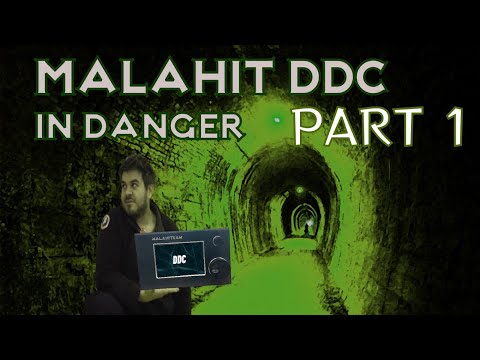
The Malahit DDC is the latest in portable SDR packages coming out of the Russian designer and manufacturer known as 'Malahiteam'.  In the past they released the hugely successfull Malhit-DSP. We want to thank Manuel Lausmann for sending us a video and review that comprehensively looks at one of the first Malahit DDC devices that have been received. Manuel writes:

Differences between Malahit DSP and Malahit DDC

The comparison results for the main characteristics are summarized in the table. The worst result of the comparison is marked in red, the best or neutral result is blue.

The comparison took into account the results from the DDC versions with two ADC versions - AD9649 and MDRA1A16FI.

1) the sensitivity is about the same, there is no difference.

2) The dynamic range blocking is a big difference in favor of DDC. It is caused by the properties of the radio reception path and not by the difference in the classes of radio receivers. This has the practical advantage that a radio receiver with large antennas can be used under difficult conditions, for example when it is necessary to receive a weak signal in the presence of a strong interfering one.

3) The dynamic range of third order intermodulation is a big difference in favor of DDC. It is caused by the properties of the radio reception path and not by the difference in the classes of radio receivers. The practical advantage of this is the lack of parasitic or false reception channels.

4) The frequency range is different. This is the difference to specific design solutions. And the DDC has to catch up with the DSP version due to the additional board developed with converters. The additional board is already under development.

5) The type of antenna input - everything is the same here, the receivers can receive signals with both the telescope and external antennas.

6) Band values ​​/ frequency values. The DDC version is the undisputed leader here. In addition, these figures have actually already been confirmed.

7) Side channels of reception. As mentioned above, these are better in DDC. The difference lies in the classes of radio receivers.

8) The capacity of the ADC. I will go into this characteristic in a little more detail. Very often the ADC bitrate is used as a marketing ploy that is misleading the user. It is logical that the more the better. But as we see, even with a 14-bit DDC, a better dynamic than 16-bit DSP. And that's why not only the ADC capacity is important for classic or analog SDRs, but also the properties of the ADC radio path. If you use 24- or 32-bit ADCs in the Malachite DSP series, the radio receivers do not get any better - MSI001 does not allow this, in which case it limits the connection. So, you need to carefully analyze the build of radio receivers and not trust misleading promotions - many bits are certainly good, but you shouldn't forget the location of the ADC either. The main properties of radio receivers are determined in particular by the first input stages.

9) Overall dimensions. Everything is the same here.

10) audio output. And everything is the same here.

11) PC connection. And this is where the big difference in favor of DDC lies. A faster type of USB interface is used, the quadrature width is increased to almost 2 MHz, and the QUISK program also has the option of viewing the spectrum up to 38 MHz against the background of radio reception.

12) Power consumption. The power consumption is not the strength of the DDC - the digital technology eats up a lot of energy. In comparison, there is one more characteristic - the prices. With the DDC, the price is significantly higher due to the more expensive components

From February you can also expect an optional additional board where reception on 6ghz is possible with additional filters. A 16 bit ADC will also be built into the Malahit DDC from February.

The video review below is in German, however you can use the YouTube autogenerated English captions below, or wait a little as Manuel indicates that English subtitles will be added soon. 

Malahit DDC in Gefahr Teil 1

GNU Radio Conference 2021 Talks Now Available on YouTube

The GNU Radio YouTube channel has recently finished uploading the talks from GRCon21, this years annual GNU Radio Conference. GNU Radio is an open source development toolkit for signals processing and is commonly used to build software demodulators and decoders for Software Defined Radios.

The GNU Radio conference talks are generally about cutting edge SDR research topics and the YouTube playlist contains 67 videos covering a gambit between what changes have been made in new releases of GNU Radio to presentations and demonstrations focusing on topics such as reverse engineering smart power meters and 5G cell detection among many others.

Some of the talks from this years conference that we found most interesting include:

GRCon21 - Keynote: Joe Gibbs Racing Team

Is the Titus II Portable Android Tablet Shortwave SDR Close to Release?

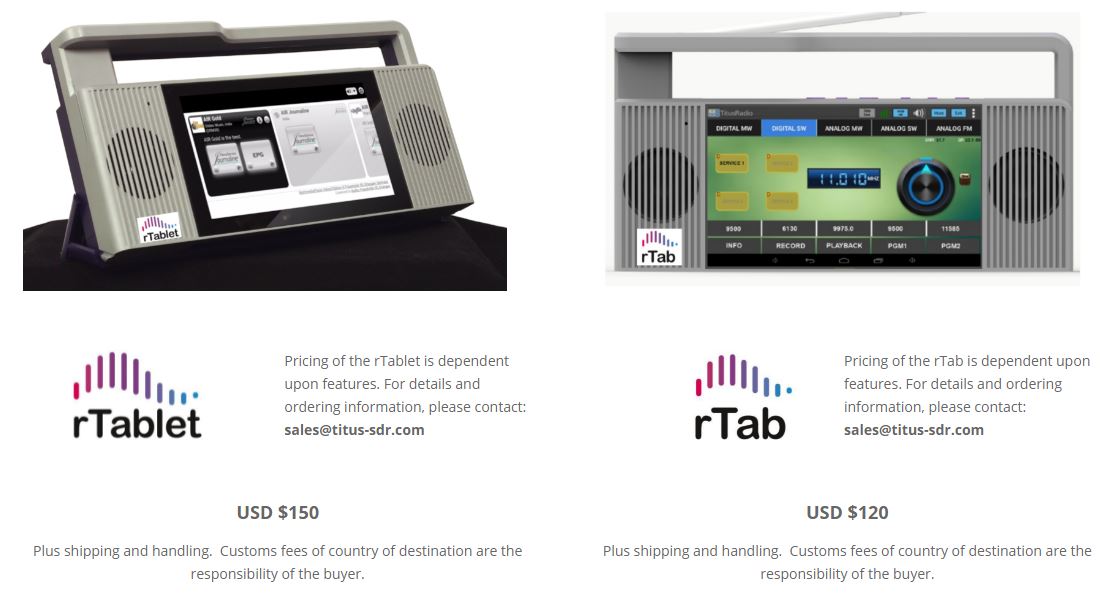
The PatronX Titus II SDR is something we've been posting about several times since 2016, but in the end it was never released and assumed to be vaporware. However, we found that the website for the Titus II SDR was updated only a few weeks ago, and pricing details have been added advertising $120 and $150 for two versions of the product. But on the new website there is no store, just an email link to contact sales for ordering information. We contacted that email two weeks ago for more information but have not received a reply back yet.

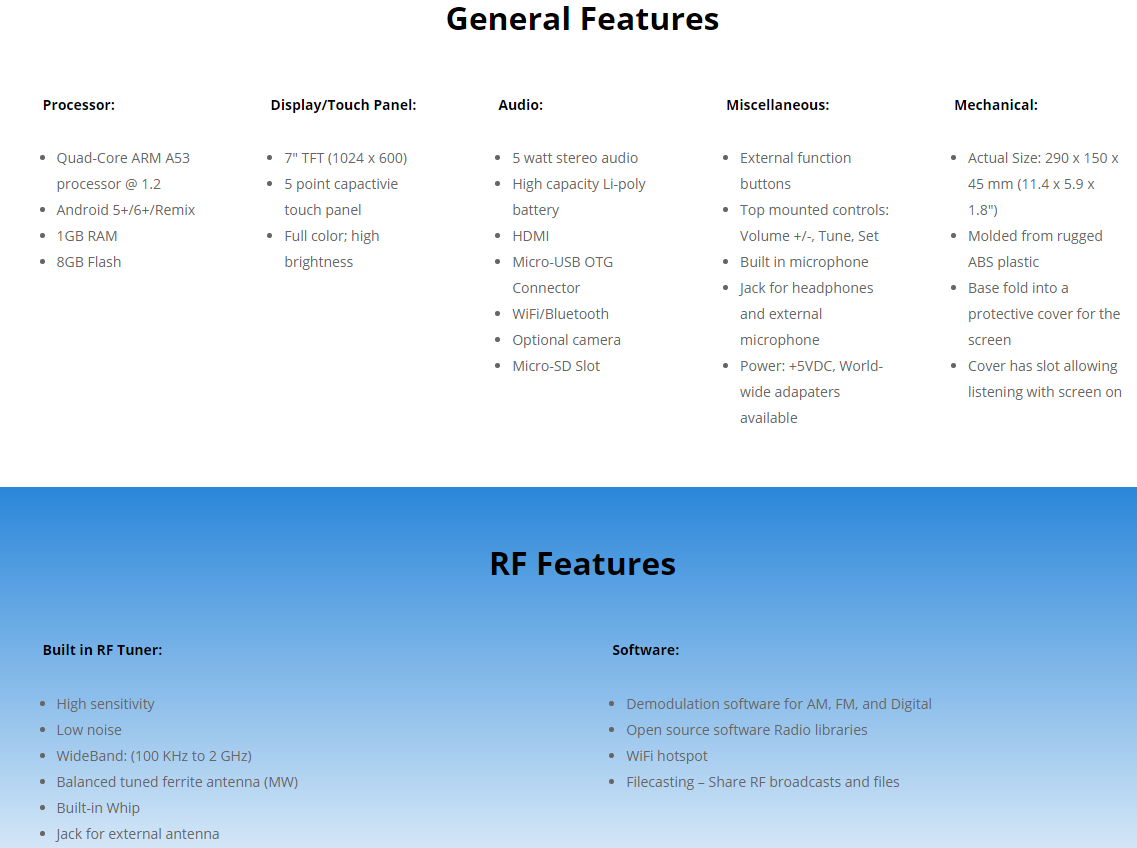
The PantronX Titus II was advertised to be a portable Android tablet based SDR that would feature a 100 kHz - 2 GHz tuning range, and software that focuses on HF digital DRM decoding, as well as DAB on VHF. Computer rendered images show the tablet housed in a portable carry enclosure with two speakers. Their new website writes:

The design of rTablet / rTab defined radio receiver started in 2014. It soon became evident that electronic products available on the market could not be modified to incorporate the advanced features requested by potential buyers. This initiated the process of the innovative design of the Titus SDR (Software Defined Radio) unit. The engineering team started with a general purpose computer unit and embedding it in a broadband radio receiver module.

All types of applications, including RF software, could be installed. For example, DRM capabilities could be added as DRM is an open source. Dream Linux app was converted to run under Android mobile operating system.

The Titus rTablet / rTab being introduced to the market, is a low cost, high performance platform with many RF and PC factory installed applications.

Key feature of rTablet / rTab is the compatibility with analog (SW, AM, FM) and digital standards (DRM, DRM+, DAB, DAB+, HD). Consequently the market of rTablet / rTab is global.

The updated website with pricing and an ordering email makes us think that it might be finally on the way, but the lack of email reply is concerning. If anyone has any further information about the rTab/Titus II please be sure to share with us in the comments!

Titus II SDR updated website
Titus II Specs

Reminder: GNU Radio Conference 2021 to be held Sept 20-24 with Virtual and In-Person Events

Just a reminder than GNU Radio Conference 2021 (GRCON21) will be going ahead on Sept 20 - 24 with virtual and in-person events. It is free to register for virtual attendance and you will be able to view all talks live via streaming. If you wish to attend workshops virtually, the registration fee is $50. All links for YouTube live streaming can be found on the virtual attendance page as well. Be sure to use the YouTube "set reminder" feature to be notified when the streams begin.

GNU Radio Conference (GRCon) is the annual conference for the GNU Radio project and community, and has established itself as one of the premier industry events for Software Radio. It is a week-long conference that includes high-quality technical content and valuable networking opportunities. GRCon is a venue that highlights design, implementation, and theory that has been practically applied in a useful way. GRCon attendees come from a large variety of backgrounds, including industry, academia, government, and hobbyists.

The yearly GNU Radio Conference (GRCon) is a conference all about the development of GNU Radio and projects based on GNU Radio. GNU Radio is an open source digital signal processing (DSP) toolkit which is often used in cutting edge radio applications and research to implement decoders, demodulators and various other SDR algorithms. 

Check out the list of upcoming talks here to see if there is anything that interests you, and perhaps check out last years GRCon20 video playlist too

RTL-SDR Blog Active L-Band Patch Antenna for Inmarsat, Iridium, GPS Back in Stock

Just a quick note to say that the second batch of our Active L-Band Patch Antenna for receiving Inmarsat, Iridium and other L-Band satellites is now in stock, available to be shipped from our warehouse in China from early next week. Amazon will be stocked within the next 1-2 months as the freighter will take time to arrive.

Please see our store for ordering details.

Apologies as we've had to temporarily suspend sales of this product as a manufacturing defect has been discovered in this batch. The defect is that on a number of units the plastic around the screws is cracking, and this was caused by a factory worker over torqueing a pneumatic screwdriver.

The antenna itself will work fine, and it probably won't even affect weather tightness, but it is certainly a defect. If your unit already shipped out and your unit has these cracks, please let us know at [email protected] and we will get the factory to ship you a replacement enclosure. For unshipped units we will be issuing a refund within the next few days.

Update: The units have been repaired and are available for shipping again.

Pricing remains the same at US$49.95 including free worldwide shipping to most countries. A reminder to EU customers: please order from our Aliexpress or eBay stores as due to the new IOSS laws we need to now use those marketplaces to collect and remit VAT upon your purchase, instead of upon import at the border.

This second batch comes in a gray color as feedback from the previous batch indicated that a lighter color is preferred to avoid excess heating from the sun.

If you are hearing about this patch antenna for the first time, please see our original release post for more information. In short this is an amplified patch antenna designed to be used with bias tee capable SDRs that can provide 3.3V - 5V power, such as our RTL-SDR Blog V3 dongle, Airspy, SDRplay or HackRF.

The antenna allows for reception of L-band satellites that transmit between 1525 - 1660 MHz, such as Inmarsat, Iridium and GPS. Please note it is *not* for receiving weaker signals like HRPT and GOES which require a dish antenna.

The patch comes with useful mounting accessories including a window suction cup, bendable tripod and 3M RG174 coax cable. The patch and active circuitry is enclosed in a weather proof enclosure.

What can you do with this antenna?

SDRA2021 Talks: Electrosense, Neural Network Signal Classification, gr-rpitx, Radio Astronomy and More

The 2021 Software Defined Radio Academy conference was held online this year on June 26/27 and the talks have been recently uploaded to YouTube. There are some interesting talks this year including a presentation on various SDR related topics including Electrosense, gr-rpitx, 21cm radio astronomy with low cost SDR hardware, and using deep learning neural networks for automatic signal identification. Our favorite talks and blurbs are collected below for easy access, and the full set of talks can be found on their YouTube channel.

Dr. Henning Paul: Building a flexible Multi-Antenna-capable SDR using open Source

The availability of Open Source software components enables the ambitious hardware hacker to design their own powerful SDR. This talk is the follow-up to the talk on Scientific SDR and recapitulates the steps towards the current design of a Homebrew SDR based on a Xilinx Zynq SoC using the Linux kernel and other Open Source components. Furthermore, one of its applications, receiving shortwave radio with antenna diversity is presented.

SDRA2021 - 04 - Dr. Henning Paul: Building a flexible Multi-Antenna-capable SDR using open Source

Jean-Michel Friedt: GNURadio compatible gen. purpose SDR emitter using RasPi4 PLL

GNU Radio, the Raspberry Pi single board computer and Digital Video Broadcast Terrestrial receivers make an awesome combination for educational purposes of Software Defined Radio. gr-rpitx aims at complementing these tools with emitting capabilities, combined with the flexibility of GNU Radio.

SDRA2021 - 08 - Jean-Michel Friedt: GNURadio compatible gen. purpose SDR emitter using RasPi4 PLL

Sreeraj Radjendran: Knowledge extraction from wireless spectrum data

In this half-hour talk, the need for large scale wireless spectrum monitoring will be discussed. A short introduction to a large scale wireless spectrum monitoring framework, Electrosense, will be given. Furthermore, how anomaly detection and signal classification can be performed using the collected data will also be discussed. Insights to the major problems with state-of-the-art machine learning models will also be discussed in this context.

SDRA2021 -11- Sreeraj Radjendran: Knowledge extraction from wireless spectrum data

Stefan Scholl, DC9ST: Classification of shortwave radio signals with deep learning

Automatic mode classification of radio signals in the HF band is a valueable tool for band monitoring, operation of rare transmission modes and future applications of cognitive radio. In recent years, machine learning has established as a general and very powerful approach to classification problems. The presentation first provides an introduction to neural networks and deep learning. Then neural nets are applied to the task of radio signal classification. The result is an experimental deep convolutional neural net (CNN), that can distinguish between 18 different transmission modes occurring in the HF band, such as AM, SSB, Morse, RTTY, Olivia, etc.

Additional Links: Stefan Scholl's post on this topic 

SDRA2021 -12- Stefan Scholl, DC9ST: Classification of shortwave radio signals with deep learning

Marcus Leech: Mapping the sky at 21cm: Gnuradio and Radio Astronomy

We show the results of a year-long sky survey at the 21cm hydrogen line, producing an intensity map of the sky covering a declination range from -35 to +75DEG. We discuss the software tools used, Gnu Radio signal flows, and the hardware aspects of the instrument.

SDRA2021 -14- Marcus Leech: Mapping the sky at 21cm: Gnuradio and Radio Astronomy