Category: Other

Android App: Phonetic Alphabet Trainer

Thank you to Manuel DO5TY who wrote in and wanted to share his Android App that helps you to memorize the ham radio phonetic alphabet. The phonetic alphabet is a way to avoid confusion when speaking out similar sounding English letters such as "p" and "b". Instead of "pea" and "bee" these are spoken as "papa" and "bravo". The phonetic alphabet is commonly used in all sorts of radio communications, so it is a good skill to learn for potential hams, radio operators or even for people just listening in to radio communications.

The Phonetic Alphabet Trainer is an App you can easily learn the Alphabet that is used in the Military and on Hamradio contacts. The App has different options for you to learn and memorize the Alphabet. Your current Skill Level is displayed on the main screen and indicates how good you are at the Phonetic Alphabet.

Alphabetlist
Take a look at the Phonetic Alphabet and see what words are used for each Character.
You can also hear how the words are spoken out with a simple button click.

Train with random Strings
Let the App generate random Strings and translate them into the Phonetic Alphabet.
With that you can memorize the Alphabet and learn how to write them correctly at the same time. The String gets one Character longer each time you got Five in a row correct.

Train with Hamradio
The App generates a random Callsign and speaks it out loud in the Phonetic Alphabet. Your Task is it to Write down the correct Callsign. You only have one try to get it right, your score is how many you recognize correctly in a row.

Phonetic Alphabet Trainer - App Promo

High End Per Vices Cyan Software Defined Radio Released

This blog is mostly concerned with software defined radios that are affordable to most hobbyists, but if you've ever wondered what the cutting edge is, take a look at the recently released Per Vices Cyan. This is a US$73,500 one channel RX/TX SDR with a tuning range from 100 kHz up to 18 GHz, ADC resolution of up to 16 bits, a maximum instantaneous bandwidth of up to 1 GHz (with 16 GHz if all channels are required), and an on board Stratix 10 FPGA. There are also higher end Cyan's, with the Cyan Mid having 8 RX/TX channels for USD$149,500, and the Cyan Pro with 16 RX/TX channels for USD$289,000.

Obviously Cyan is aimed at the research, industrial and possibly military market, but maybe this is the sort of capability we will all have in 10-20 years.

Their press release reads:

Per Vices Releases New High Bandwidth, Compact Software Defined Radio Platform

Ontario, Canada- February 20th, 2019

Per Vices, an industry leader in wireless platforms in North America, has been developing Software defined radio (SDR) solutions since 2006, offering customers high performance solutions. Continuing to grow their influence in the wireless communications, radar, signals intelligence, defence, medical imaging, and test and measurement markets. Their newest product, Cyan, is the best SDR available on the market, offering the highest bandwidth on a compact radio platform. Cyan continues to fulfill the company’s legacy by providing the market with the highest performance radio solutions.

Cyan is designed to offer users with a customizable number of independent, phase coherent radio channels, up to 16 total, each offering a standard 1GHz instantaneous RF bandwidth. Featured on a high channel count, ultra wide band, high gain direct conversion quadrature transceiver and signal processing platform. Cyan provides the highest RF and digital bandwidth with an onboard DSP in a compact form factor.

On the digital front, the platform is designed around an Intel Stratix 10 FPGA SoC enabling significant DSP resources for a variety of applications. The platform also features 4 x 40 Gbps digital backhaul enabling ultra-high data throughput while maintaining low latency for applications that require raw radio data to be transferred to another platform.

To learn more about Cyan, Per Vices, or their other product offerings, contact Brandon Malatest at    +1 (647) 534-9007, or email [email protected], or visit the website at www.pervices.com

Per Vices Cyan High End Software Defined Radio

MIT Radio Society Lectures on Radio Technology Now Freely Available on YouTube

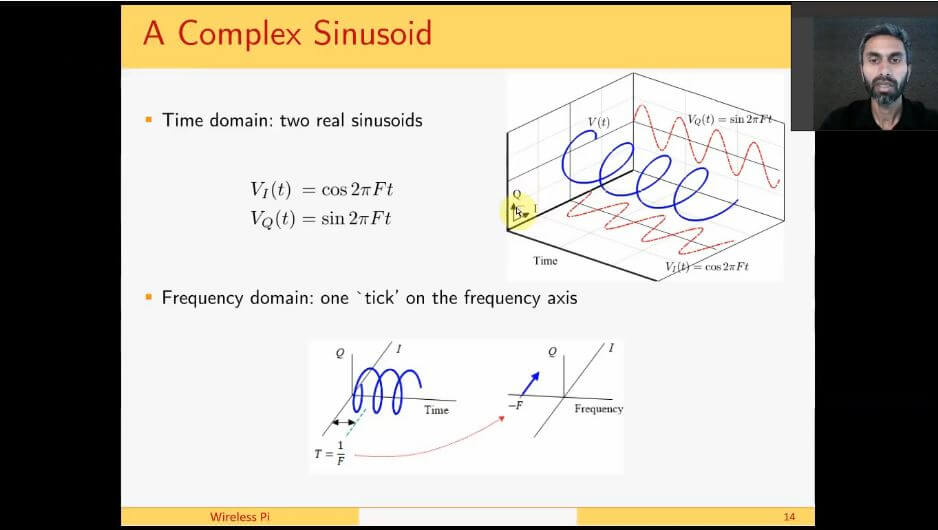
At the beginning of this year the MIT Radio Society held a series of nine lectures all about radio. The lectures cover topics like the history of radio, radio technology, signal modulation and phasor analysis, software defined radio, ionosphere, shortwave radio, propagation, radio astronomy, low frequency radio astronomy for the observation of exoplanets, principles of radar, space weather and 5G cellular comms and the future of radio. The lectures have all been uploaded to YouTube for free viewing, and can be found on their playlist.

If you're interested in learning more about radio this series of lectures is an excellent start, and lecture three specifically focuses on software defined radio.

[Also seen on Hackaday]

An Introduction to Radio Experimentation, Technology, and History

ExaGear x86 Emulator for ARM To be Discontinued

ExaGear is an x86 emulator for ARM computing devices. In the past we posted about ExaGear as together with WINE, it was an affordable solution that allowed Windows SDR apps to run on ARM devices like the Raspberry Pi 3. With ExaGear and WINE we were able to get Windows only SDR programs like Unitrunker, WinSTD C, DSD+, MultiPSK, PC-HFDL, Orbitron and Sondemonitor to run smoothly. In another previous post, DE8MSH was also able to use ExaGear to get Speclab running on his Raspberry Pi 3.

Unfortunately it appears that ExaGear is to be discontinued from February 28 onwards although they note that all previously purchased licences will continue to work. No reason has been given other than noting that it is their business decision. For now the downloads and ability to purchase licences is still active until February 28, so if ExaGear was a product you were interested in, you have just over a week to obtain it.

ExaGear to be discontinued

SDR Talks from FOSDEM 2019: EM Attacks with RTL-SDR and Neural Networks, Radio Telescopes, GNU Radio in 2019 and more!

FOSDEM is a large yearly conference where thousands of open source developers gather in Brussels. This years FOSDEM was held between 2-3 February, and within the last few days the talks have been uploaded to YouTube. Below we post some SDR/Radio related talks that we've found interesting.

Performing Low-cost Electromagnetic Side-channel Attacks using RTL-SDR and Neural Networks

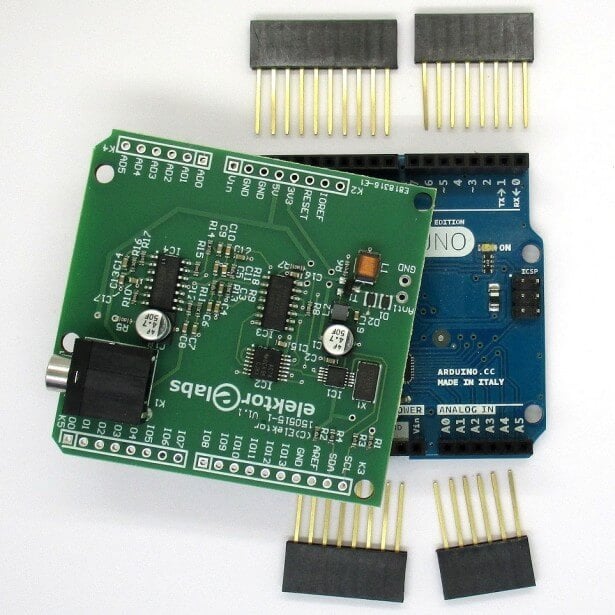
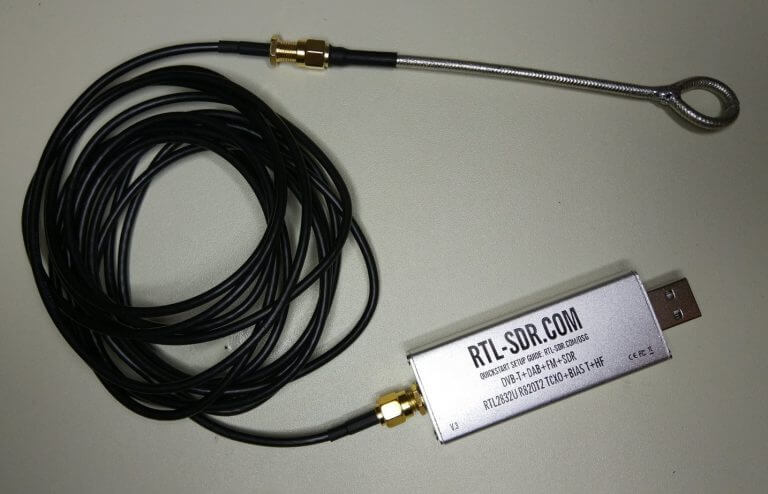
Electromagnetic (EM) side-channel attacks exploit the EM radiation that inherently leaks from electronic systems during various computations. Patterns in the amplitude or frequency of this radiation can be analyzed to break even theoretically secure cryptographic algorithms such as RSA and AES. In this presentation, we will cover the various challenges involved with successfully performing EM side-channel attacks using relatively low-cost Software Defined Radios (SDRs) and EM probes. More concretely, we will discuss the measurement setup, trace capture process, trace alignment / filtering, and Correlation Electromagnetic Attack (CEMA) for a scenario in which an Arduino Duemilanove is executing a software AES algorithm with an unknown key. Finally, we will see how artificial neural networks can be used to reduce the complexity of performing successful EM side-channel attacks. In present-day communications systems, cryptographic algorithms (ciphers) provide confidentiality and integrity of data through secret pieces of information (i.e. shared or private keys) known only to the communicating parties. However, as shown in numerous previous works, measuring the physical properties of hardware during executions of a cipher can reveal information about its current state. When sufficient information leaks through these so-called "side-channels", an adversary can compute the key. In this presentation, we will examine the EM side channel, which originates from electromagnetic radiation leaking from a device.

Performing EM side-channel attacks used to require rather expensive oscilloscopes with high sample rate ADCs. With the advent of inexpensive SDRs such as the RTL-SDR and advances in AI, the bar to perform such attacks has been adequately lowered. We will learn how to use the open-source ElectroMagnetic Mining Array (EMMA) tool to capture leakages emanated by an Arduino Duemilanove during the execution of an AES encryption operation. Next, a standard CEMA attack will be performed. This attack correlates the measured amplitude of a signal with the hamming weight of part of the key in order to determine which key was used during the execution of the cipher. Finally, we will examine applications of neural networks to side-channel analysis. Both traditional deep Convolutional Neural Networks (CNNs) as well as a novel "correlation optimization" (CO) method using shallow neural networks will be discussed.

Performing Low-cost Electromagnetic Side-channel Attacks using RTL-SDR and Neural Networks

The Dwingeloo radio telescope goes SDR

The Dwingeloo radio telescope is a historic instrument in the Netherlands. At its opening in 1956, the 25m dish was the largest fully steerable radio telescope in the world. These days it is run by a group of volunteers, who have restored and rejuvenated the instrument. It is used for radio astronomy and amateur radio, but also for outreach and art projects, to name a few of our activities.

We perform observations of pulsars, the hydrogen line of our own Milky Way and other galaxies, have a SETI project, and have recently participated in our first VLBI observation. We are increasingly using Software Defined Radio and in particular GNU Radio to perform our measurements. This allows for rapid development of new signal processing chains, and a lot of flexibility in how we process the incoming data.

In this presentation I will present some of the signal processing that is useful for radio astronomy, the flowcharts we have developed, and the astronomical results that we obtain with them.

The Dwingeloo radio telescope goes SDR

GNU Radio in 2019: Facts and Plans An overview of where GNU Radio is going this fine year

GNU Radio is one of the biggest and most widely adopted SDR framework in the free software world. In this talk, we will lay out how we intend to keep it going for the next year, and beyond. GNU Radio is one of the biggest and most widely adopted SDR framework in the free software world. It's history is pretty interesting, and spans multiple decades at this point. However, we're far from being done! We will talk about how we intend to keep the samples flowing in 2019, and beyond.

GNU Radio in 2019: Facts and Plans An overview of where GNU Radio is going this fine year

SDR Makerspace sdrmaker.space

SDR Makerspace (https://sdrmaker.space) is a collaboration between the European Space Agency and Libre Space Foundation with the objective of bringing innovative open-source SDR technologies to space communications. Makers, open-source hackers, SDR enthusiasts, and researchers are brought together to work on small SDR hardware and software projects, focusing on rapid prototyping and development of reusable open-source SDR components for future CubeSat missions. In this presentation, we give an overview of the current activities and present the results achieved so far.

SDR Makerspace (https://sdrmaker.space) is a collaboration between the European Space Agency and Libre Space Foundation with the objective of bringing innovative open-source SDR technologies to space communications. Makers, open-source hackers, SDR enthusiasts, and researchers are brought together to work on small SDR hardware and software projects, focusing on rapid prototyping and development of reusable open-source SDR components for future CubeSat missions. In this presentation, we give an overview of the current activities and present the results achieved so far.

SDR Makerspace sdrmaker.space

gr-soapy: A handy SDR hardware interface module for GNU Radio

gr-Soapy is an OOT module for the GNU Radio platform to configure and manage a plethora of SDR devices through the SoapySDR API. It provides easy to use source and sink blocks with various parameter fields, enabled according to the capabilities of the device specified by the user. With the emergence of various low cost SDR devices that anyone can experiment with, ham radio community continues to expand and create fascinating open source projects. Aside from the ham radio community, also researchers and professionals study and develop protocols and applications for the radio spectrum with the use of SDR devices.

To facilitate the interface of users with SDR devices, in this short talk we will present the gr-Soapy OOT module for the GNU Radio platform. gr-Soapy tries to simplify the process of configuring and using SDR devices inside the popular platform of GNU Radio, without omitting functionalities needed by more experienced users. It uses the open source SoapySDR project for the management of the devices. SoapySDR is an active, expanding and robust API, enabling gr-Soapy to be up to date without the need to actively update it with every new SDR device that becomes available.

gr-soapy: A handy SDR hardware interface module for GNU Radio

Other Talks

GNU Radio with a Rusty FPGA Experiment building FPGA accelerated blocks with Rust bindings

Protect your bits: Introduction to gr-fec A look into the error-correction capabilities of GNU Radio

GNU Radio meets Scapy

libsigmf: Human Tools for Extra-Terrestrial and AI Radios

More Talks from GNURadio Con 2018

Last week we posted about some videos of talks from the 2018 GNU Radio Conference which had been release on YouTube. This week a few more videos have been released and we display a small selection below. The full collection of videos can be found on their YouTube channel.

RF Ranging with LoRa Leveraging RTL-SDRs and GNU Radio

Wil Myrick discusses the use of RTL-SDRs and GNU Radio to create a low cost LoRa RF ranging prototype, to aid in the localization of IoT transmitters.

GRCon18 - RF Ranging with LoRa Leveraging RTL SDRs and GNU Radio

Using GNU Radio and Red Pitaya for Citizen Science

Robert W McGwier discusses the use of Red Pitaya SDRs and GNU Radio for use in citizen science ionosphere measurement experiments.

GRCon18 - Using GNU Radio and Red Pitaya for Citizen Science

SETI Breakthrough Listen

Steve Croft discusses the Search for Extraterrestrial Intelligence (SETI) project and how software defined radio is being used in the search.

GRCon18 - SETI Breakthrough Listen

Demonstration of Aircraft Scatter Prediction with Air Scout

Over on the SWLing post, Thomas has shared an interesting video showing aircraft scatter reception in action. Alps DX [FR] shows on his YouTube channel a broadcast FM signal coming in clearly as a plane passes by, then fading away to nothing as it leaves. This effect is due to the scattering of radio waves that occurs when radio waves reflect off aircraft.

In order to predict when the scattering occurs he uses the free AirScout software which allows you to do the following:

  • Calculate a propagation path as a cross circle path between two QSO – partners
  • Calculate a path profile between both QSO – partners using a Digital Elevation Model
    (DEM)
  • Calculate the mutual visibility of an aircraft from both QSO – partners for each point on the path using their elevation and any possible obstruction between them
  • Calculate a “hot area” in which an aircraft is mutually visible from both QSO –
    partners where a reflection is theoretically possible
  • Show calculated path and aircrafts in real time on a map
  • Predict Aircraft Scatter potential for each single aircraft according to position, track and altitude
AIRCRAFT SCATTER RECEPTION ELAD S2 / SDR# /AIRSCOUT

We also saw another interesting video of a 23cm QSO being made by predicting when aircraft scatter will happen with Air Scout.

2013_10_05_1.2G_G3XDY_DL0GTH_final_HD

moRFeusQT Updates: Automatic Tracking Generator Plotting with Airspy

Outernet's moRFeus is a signal generator and frequency mixer that can be controlled either by it's built in LCD screen, or via software on a Windows or Linux PC. It can generate a clean low phase noise tone anywhere between 85 to 5400 MHz. Because it can be computer controlled it is possible to use moRFeus as a tracking generator for characterizing filters and measuring antenna SWR. A tracking generator is just a signal generator that can be set to output at the same frequency that the measurement receiver is tuned to.

In the past we've posted about some software developed by Ohan Smit, which allows a moRFeus to be controlled on a Windows/Linux PC via a nice GUI. Recently he's updated the software and it can now draw power (dbFS) graphs for characterizing filters when combined with an Airspy and TCP comms to GQRX. Ohan writes:

So when you press sweep, it detects if there is any TCP servers on port 7356 and if so tunes the radio and gets a power measurement and after the sweep is done, morfeusqt renders a graph on the fly.

It now also supports multiple devices, no configurations required. It just opens another window for the second device.

These features thus far work on both Windows 10 and Ubuntu 18.04.1, these are my two testing environments with GQRX and the Airspy.

Ohan also notes that he's working on several new features such as the ability to plot VSWR, remote control of the moRFeus via TCP, support for multiple SDR TCP protocols such as rtl_tcp, soapytcp etc, threading and progress bars, as well as possibly support for cheap Osmo-FL2K devices as a tracking generator.

You can follow his developments live on the Outernet forums.

moRFeus used as a tracking generator with an Airspy with the morfeusQT software