Conference Talk: Linux, Raspberry Pi, RTLSDR, LAME and Open Source (A Recipe For Responding to Natural Disasters)

The SCaLE conference on open source and free software was recently held on March 10 in Pasadena, California. One of the talks by Ben Kuo AI6YR was titled "Linux, Raspberry Pi, RTLSDR, LAME and Open Source (A Recipe For Responding to Natural Disasters)". This talk was streamed live, and is archived on YouTube.

In the talk Ben discusses how RTL-SDR's can be useful in disaster response by putting radio communications onto online audio streaming sites like Broadcastify. He notes how difficult it was for residents affected by the California wildfires to get up to date information on how close the fire was to their house from news stations and authorities. In contrast information on the internet came in much faster and more accurately. He notes in particular how listening in to firefighter radio communications via online streams uploaded by RTL-SDR users can give the fastest and most up to date information to concerned residents.

Ben also mentions how it can also useful to track the movement of fires via the ADS-B flight tracking data transmitted by fire fighting aircraft. By watching the aircraft movements the spread of the fire can be determined.

In the YouTube video stream, Ben's talk starts at about 3:31:00 and the video below should start at that time. The three other talks recorded in this stream are all ham radio related and may also be of interest to you.
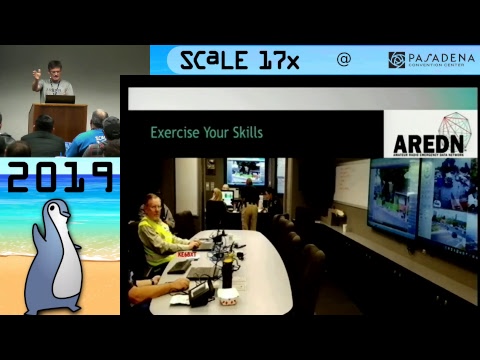
Room 212 Sunday Mar. 10 - SCaLE 17x

A Vacuum Tube Based Shortwave Software Defined Radio

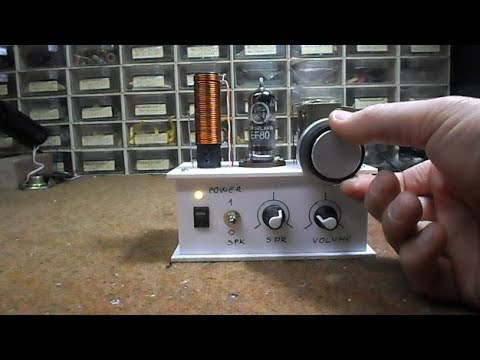
Vacuum tubes are not typically found in software defined radios, but this interesting mix of old and new technology by Mirko Pavelski uses one in it's front end. The way it works is that the analogue radio circuit receives a small range of spectrum, and then the tube acts as a mixer, converting that spectrum down into audio frequency range which can be heard by a computer sound card.

The sound card acts as the ADC, digitizing the signal, and then the "SDRadio" software performs the final filtering and demodulation of a narrowband signal in software. This is the same concept used by other HF sound card SDRs such as the Softrock, although those of course do not use tubes in their design. Mirko writes:

Simple to build receiver made according to the instructions of Burkhard Kainka : http://www.b-kainka.de/bastel100.htm. I made it with EF80 tube instead EL95 and it works great. It is powered by a 7.4V lithium-ion battery followed by a 7806 stabilizer, so we get 6v for tube heating and there are no problems with 50 Hz hum. Тhe resonant circuit is made of strong coil with 20 turns of 1.5 mm thick wire wound on a PVC tube with 18 mm diameter. At the cold end of the resonant circuit is an antenna coil with two turns. At the output of the radio, I connecт 2 transistor preamplifier and cheap amplifier module in D class. So we get battery powered tube АМ radio. Using the potentiometer we can select between AM or SDR mode of operation.

In SDR mode, we need to connect the output of the radio to "line in" in sound card of the computer. Then we use some of the free software for example "SDRadio" from Alberto I2PHD. Тhe receiver has very good frequency stability which drifts less than 1 Hz per minute. Тhis is important if we want to decode DRM signals. In good HF propagation conditions I receive BBC World service DRM radio (3995MHz) with 16dB SNR here in Ohrid (41.1231° N, 20.8016° E). This little radio, with a long wire antenna and good grounding, gives us a lot of fun.

Hackaday also recently posted an article about this build.

DIY one tube shortwave + SDR radio

SDRplay Release SDRUno V1.3 – Now with Frequency Scanning Feature

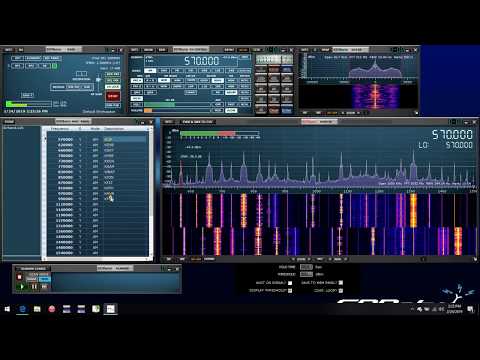
SDRplay have just released a major upgrade to SDRUno, the official software for SDRplay RSP software defined radios. Along with various bug fixes, the most interesting new feature in version 1.3 is the frequency scanner. This allows SDRuno to automatically tune to active signals between a set frequency range. SDRplay writes:

Major new features include:

Frequency Scanning (for both frequency ranges and stored memory panel lists)

I/Q → Audio Output (for CW Skimmer for example)

A new configurable IF AGC scheme

For a full list of additions/changes and bug fixes, please see the release notes at: https://www.sdrplay.com/docs/SDRplay_SDRuno_Release_Notes.pdf

This release of SDRuno uses a new version of the Windows Service based API (3.02) and so users that also used other applications such as dump1090 and HDSDR with the previous version of the Windows Service based API (3.01) will need to download and install the latest versions of API, dump1090 and the ExtIO plugin from our website at https://www.sdrplay.com/downloads

We have produced two new video guides which describe the use of the Frequency Scanner and I/Q Output functions. Links to these videos along with many others can be found by going to the SDRplay Applications and support catalogue on https://www.sdrplay.com/apps-catalogue/  , and on our Youtube Channel on https://www.youtube.com/c/SDRplayRSP

However, the two new videos can be viewed directly by going to:  

https://youtu.be/ndMWIK1JLbQ (New Features in SDRuno 1.3 - Scanning and AGC)

https://youtu.be/w_pH56aOdE0   (SDRuno IQ output and CW Skimmer guide)

Using the new integrated SDRuno Frequency Scanner:   https://youtu.be/ndMWIK1JLbQ (This video also covers the new IF AGC scheme)

Using SDRuno with CW Skimmer via the I/Q Output function:  https://youtu.be/w_pH56aOdE0

The ExtIO version of SDRuno can still be downloaded from our downloads page and is included in the SDRuno 1.22 release. Make sure to install it in a different directory to 1.3 otherwise it will stop 1.3 from working.

For any questions  or help regarding this new release, please contact SDRplay support via our dedicated support system at: https://www.sdrplay.com/support

For any other suggestions, please email [email protected]

Finally, we recommend that all users join our community forum where there is a wealth of knowledge and help available for using our products and software in a wide range of applications and circumstances. This forum can be found at: https://www.sdrplay.com/community

New Features in SDRuno 1.3: Scanning and AGC

Transferring Files via the BlockStream Satellite with Lightning Network Payments and RTL-SDR + Transacting Bitcoin over HF

The Blockstream satellite API is now live on the main Bitcoin network. Blockstream satellite is a project that aims to use geosynchronous satellites to strengthen the Bitcoin network by continuously broadcasting the Bitcoin blockchain all over the world. This allows people without internet access (or with censored internet) to receive Bitcoin. Setting up a Blockstream satellite receive station is a matter of building an RTL-SDR based receiver (or other GNU Radio compatible SDR) with a small satellite dish and LNB.

The API was also updated and this has enabled a feature that allows you to upload a file of up to 10 kB via the internet, which will then be transmitted via the satellites to anyone who is running a Blockstream RTL-SDR satellite receiver. Payment for the transmission is taken via the Bitcoin Lightning Network and transmissions appear to work on a priority basis, with larger payments receiving higher priority. The file is distributed to all receivers, so they note that private messages would need to be encrypted with public keys distributed to recipients in other ways. This service is similar to what the Othernet (prev. Outernet) network offered in the past with the ability to transmit data, tweets and APRS messages over their satellite network. We think that cheap small data satellite transmissions could have some interesting applications in remote control.

In related news on CryptoNewsZ it has been reported that a bitcoin lightning network transaction was completed over the 20M amateur radio band. The transaction was completed with the JS8 digital mode, which is similar to FT8 but designed for weak signal usage. The message was sent via the help of twitter, with @eiaine first sending money to @nvk via the internet. @nvk then sent the Lightning Network invoice over 21 JS8 messages via the 20M band to @eiaine who received it, thus confirming that the transaction was completed.

Demonstration of Two SatNOGS Rotators

Thank you to IZ5RZR for writing in and sharing his two SatNOGS rotator builds with usSatNOGS is an open source project that aims to make it easy for volunteers to build and run RTL-SDR or other SDR based RF ground stations that automatically monitor satellites, and upload that data to the internet for public access.

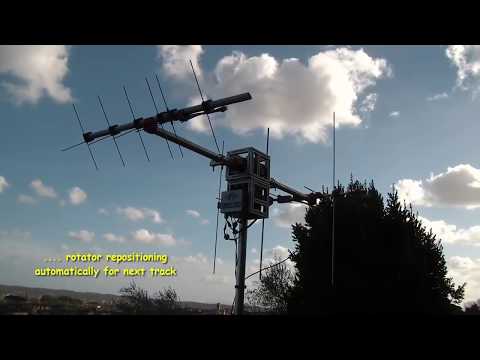
IZ5RZR writes that he's now made two rotators and one was modified to use a 5:18 stepper motor (which is upgradable to 50:1) to give more torque so that heavier antennas can be turned smoothly. His rotators are powered by a 12V battery charged by solar, and they can be controlled over WiFi with a PC/tablet/phone. He's also tested the rotators with a 24 dB parabolic grid antenna and found that the rotator could handle it even without a counterweight. He also notes that together with IK5XWA they've fixed a "Meridian Flip" bug in the firmware.

The video below shows the two rotators in action.

IZ5RZR Two SatNOGS Satellite Rotators

DIY Software Defined Ham Transceiver With eBay Parts

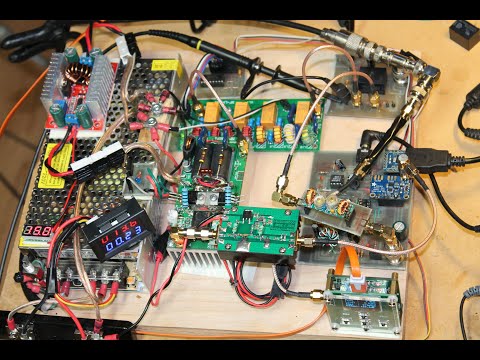
YouTuber jmhrvy1947, has recently uploaded a number of videos giving an overview of how he built his own HF SDR transceiver using what he calls the “Lego build method”. The idea of the Lego build method was to build a transceiver with parts picked and pulled from eBay so that it could be easily reproduced by others. There are a few scratch made components however those designs are available on his GitHub page. The SDR only functions within about 100 kHz of spectrum at a time however for amateur radio HF work this is more than sufficient. Bare bones the radio puts out a mere 100 mW and although the output power is small, he’s made contacts up to 450 miles away using CW (Morse code). You also have the option of adding an amplifier on  your output if you are looking for more power than that. His final revision currently puts out 100 Watts.

Using modified versions of fldigi and Quisk he is able to easily work various digital modes and sync the transmitter and receiver together. The only real down side to this radio is that you must switch out your receive and transmit filters whenever you wish to operate on different bands, a process that really only takes a moment or two.

Check out his videos on the project – it’s really amazing to see what can be done with a small budget these days in radio and with how far software defined concepts have brought us.

DIY SDR CW Xcvr Project

In the video below you’ll see an explanation of the software involved in this build.

DIY SDR CW Software


A Worldwide Map for HRPT Weather Satellite Receive Stations

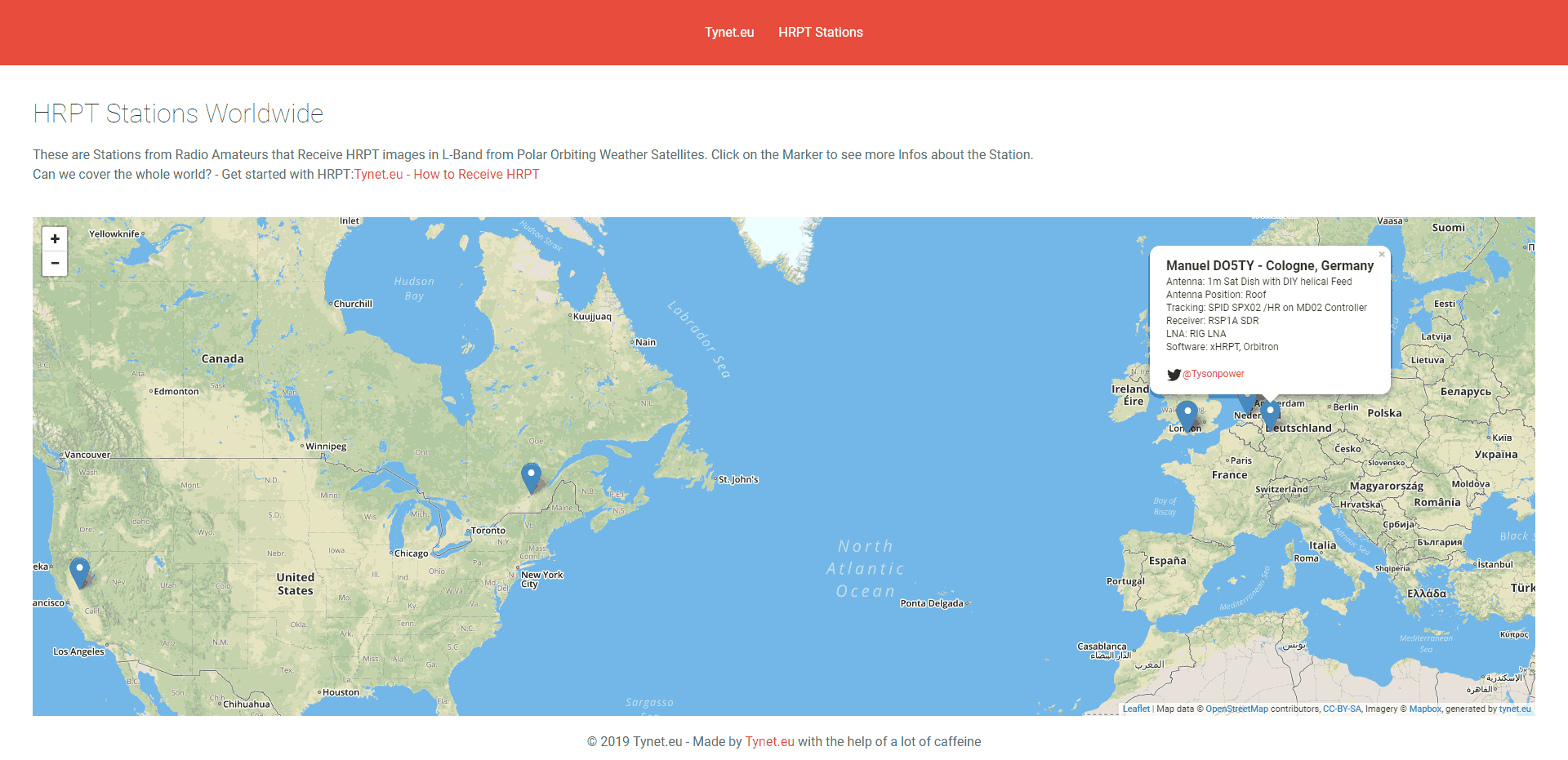
Recently Manuel (DO5TY aka Tysonpower from YouTube) wrote in and wanted to share his website that shows HRPT weather satellite receive stations from around the world on a map, and links to their Twitter pages where you can see the latest images that have been uploaded. The database also describes the SDR and antenna equipment used by each station. Currently there are 10 stations on the map, and Manuel encourages other people to submit their stations to the map database too. If you are interested in contributing your station to the map, please see Manuel's blog post for more information.

Since the satellite broadcasts a live image of what is currently being seen by the weather camera, each receiver location receives a live view of their part of the earth only. The end goal of Manuel's HRPT station map is to crowd source and collect multiple images of different parts of the earth to create a large HRPT composite image. In a previous post, Manuel who is based in Germany was able to create a beautiful composite image covering Germany, the Atlantic Ocean and Canada with the help of a station in Canada. With more contributors larger and more complete composite images of the Earth could be created.

HRPT is a high resolution weather satellite image signal that is broadcast from the same NOAA satellites that provide the more commonly received low resolution APT images at 137 MHz. HRPT is also broadcast from the Feng Yun and Metop-A satellites. However, HRPT transmits at 1.7 GHz, so a high gain dish antenna with motorized tracking mount, LNA and high bandwidth SDR like an Airspy is required to receive it.

HRPT Station Map
HRPT Station Map

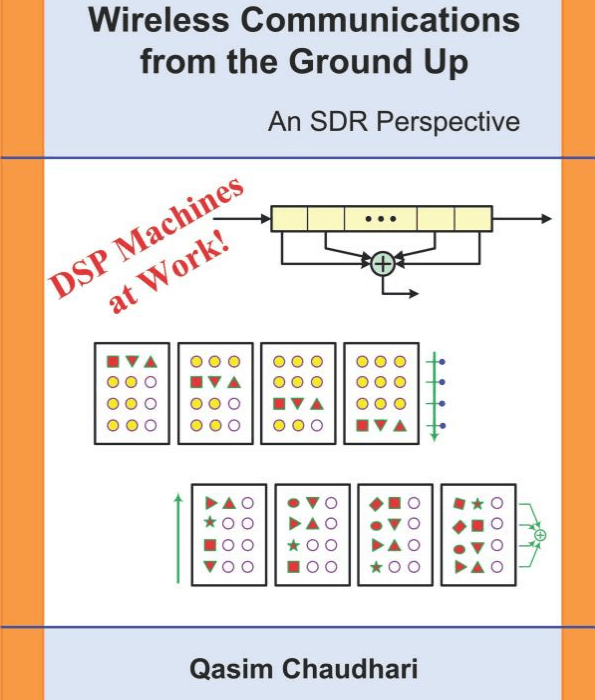
New Technical Textbook on SDR and Communications: “Wireless Communications From the Ground Up – An SDR Perspective”

Thanks to author Qasim Chaudhari for writing in and sharing with us that his new book titled "Wireless Communications From the Ground Up - An SDR Perspective" has been released. Qasim is a research fellow in the Electronic and Telecommunications Engineering department at RMIT University in Australia and has been giving presentations and talks each month at Cyberspectrum Melbourne for more than 3 years.

His book covers University level wireless communications and digital signal processing (DSP) topics with a focus on SDR. Qasim writes that most DSP books that he's seen in the past were written for professional academics which made them difficult to for other technical (but non-mathematical) persons to understand. You can't explain DSP without equations, but Qasim notes that his book aims to keep the math content at school level only, and with plenty of figures to help with visualization. The description reads:

There are different angles from which this book contributes to the understanding of wireless communication systems from the perspective of a Software Defined Radio (SDR).

  1. In my opinion, any language, including that of mathematics, is an unnatural mode of communication. For example, I can write the words darwaza, porte, puerta, umnyango, ovi and only certain people will understand what I mean. However, if I show you an image of a door, almost every single person on the planet will immediately get the concept. A figure imprints a massive amount of parallel information in our brains that is much easier to process and recall later. Since a human mind handles images very well, I try to visualize equations through beautiful figures which you will encounter throughout the text with logical and intuitive explanations.
     
  2. If you are not a pure wireless communications academic, you would have found that the mainstream textbooks on this topic are filled with heavy mathematical details which makes this field an exclusive membership club for those who can understand several types of frequency variables and their corresponding Fourier transforms, probability and random processes and detection and estimation theories. While this is true for becoming a master, the Software Defined Radio (SDR) revolution and subsequent projects like GNU Radio have made it possible for anyone to sit down and construct their own unique radio by writing code. Many even do not need to know most of the above mentioned topics. All they need to understand is why an algorithm does what it does so that they know how to write its code, or modify it in an even better way. For this purpose, I have only relied on school level mathematics to explain all the concepts. You will not find any e or j of complex numbers here, nor will you encounter any integrals, probability theory and detection or estimation theory. The only things to know are a sine, cosine and a summation as well as a derivative (which I have occasionally used).
     
  3. The best books written on implementing digital communication systems using Digital Signal Processing (DSP) algorithms are by fred harris (Multirate signal processing for communication systems) and Michael Rice (Digital communications – A discrete-time approach). As often happens with the grandmasters, they walk on a trail without exactly clarifying it for others. After reading their books, I started to feel that fred harris has mainly focused on `how' of communication systems in an unprecedented detail while Michael Rice has mainly covered `what' of communication systems in his simple and beautiful style. In this process, there were many `why' generated in my mind for which I had to find satisfactory answers. This book is a collection of those simple answers.
     
  4. An extra little bonus is a one page summary of the crux of Rx algorithms, clarifying the role of particular parameters in the signal waveform. Most of the algorithm design can be understood by just grasping the concepts on this one page.

A common theme in this text is that some concepts seem easier in time domain and some others are simpler in frequency domain, while their mathematical derivations reinforce the idea. It is fun to grasp a concept covering all three sides. Finally, the book contains a few examples from GNU Radio that explain how to set the parameters in some blocks (e.g., Costas loop, band edge FLL, polyphase clock sync, etc.).

The book is currently available on Amazon, and on Amazon you can see a preview of some pages from the book. Qasim also has a website for the book here.

Wireless Communications from the Ground Up: An SDR Perspective by Qasim Chaudhari