Tagged: radio astronomy

New SDR# Plugin: Radio-Sky Spectrograph Data Stream

Edit: If you downloaded an older version of the plugin please note that it has now been updated. The update fixes some stability issues which would previously hang SDR#. The updated .dll file can be downloaded directly from https://goo.gl/0dPzOL.

Radio-Sky Spectrograph is a radio astronomy software program which is often used together with the RTL-SDR or other similar SDRs. It is best explained by the author:

Radio-Sky Spectrograph displays a waterfall spectrum. It is not so different from other programs that produce these displays except that it saves the spectra at a manageable data rate and provides channel widths that are consistent with many natural radio signal bandwidths. For terrestrial , solar flare, Jupiter decametric, or emission/absorption observations you might want to use RSS.

Usually to interface an RTL-SDR with Radio-Sky Specrtograph a program called RTL-Bridge is used. However, now SDR# plugin programmer Alan Duffy has created a new plugin that allows SDR# to interface with Radio-Sky Spectrograph via a network stream. This allows it to work with any SDR that is supported by SDR# plugins. Alan Duffy writes:

I wrote the plugin after becoming interested in amateur radio astronomy. The plugin allows you to use any of the software defined radios supported by SDR# to feed the Radio-Sky Spectrograph program with wide-band data. The plugin shows the frequency, bandwidth, and FFT resolution and has a user selected "Number of Channels" that are sent to the spectrograph program with an allowable range of 100 to 500. This number can only be edited when the data stream is not enabled. Also if certain key parameters change, such as the frequency or decimation, the network stream will stop as the spectrograph would no longer be capturing the same data. If this happens, simply click the start button on client side software (i.e. Radio-Sky Spectrograph). As long as the Enable box is checked on the server side, the plugin will listen for a connection and start transmitting data after RSS makes a new request for data.

We note that the software might also be useful for simply capturing a long term waterfall for finding active frequencies or looking for meteor scatter or aircraft scatter echoes. 
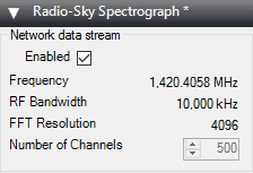
The Radio-Sky Spectrograph SDR# Plugin

Radio-Sky Spectrograph now supports the SDRPlay

Radio-Sky Spectrograph is a radio astronomy software program that integrates data over long periods of time and displays it as a waterfall. It is described by the author:

Radio-Sky Spectrograph displays a waterfall spectrum. It is not so different from other programs that produce these displays except that it saves the spectra at a manageable data rate and provides channel widths that are consistent with many natural radio signal bandwidths. For terrestrial , solar flare, Jupiter decametric, or emission/absorption observations you might want to use RSS.

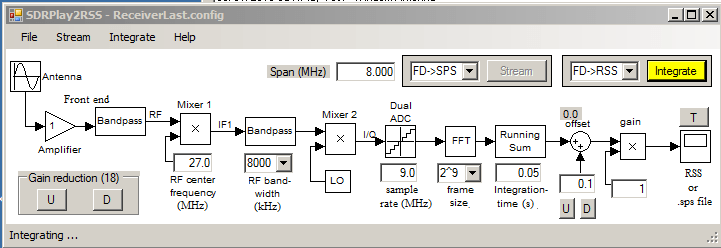
Radio Sky Spectograph is compatible with the RTL-SDR via an intermediary program called RTL Bridge, and now it is also compatible with the SDRplay via another intermediary program written by Nathan Towne called SDRplay2RSS

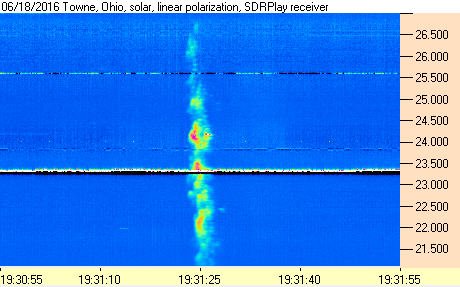
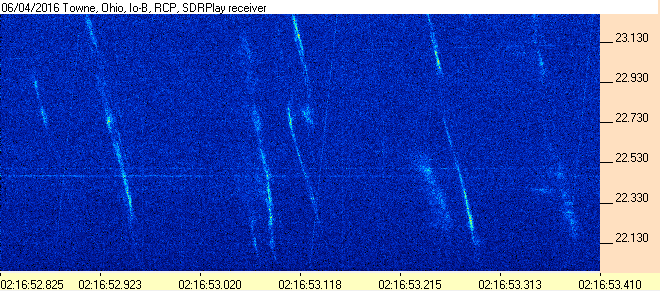
In previous posts we showed how some amateur radio astronomers were able to capture noise bursts from the sun and from Jupiter with an RTL-SDR. In the SDRplay software release post and documentation that comes with the software Nathan shows how he was able to capture solar emissions and Jupiter bursts with the SDRplay.

SDRPlay2RSS
SDRPlay2RSS
Solar emissions received with the SDRplay and Radio-Sky Spectograph.
Jupiter Noise Bursts with the SDRPlay and Radio-Sky Spectrograph.

Building a Quad RTL-SDR Receiver for Radio Astronomy

Amateur radio astronomer Peter W East has recently uploaded a new document to his website. The document details how he built a quad RTL-SDR based receiver for his radio astronomy experiments in interferometry and wide-band pulsar detection (pdf – NOTE: Link Removed. Please see his website for a direct link to the pdf “Quad RTL Receiver for Pulsar Detection”. High traffic from this post and elsewhere has made the document go offline several times). Interferometry is a technique which uses multiple smaller radio dishes spaced some distance apart to essentially get the same resolution a much larger dish. Pulsars are rapidly rotating neutron stars which emit radio waves, and the strongest ones can be observed by amateur radio telescopes and a receiver like the RTL-SDR.

The Quad receiver has four RTL-SDR’s all driven by a single TCXO, mounted inside an aluminum case with fans for air cooling. He also uses a 74HC04 hex inverter to act as a buffer for the 0.5 PPM TCXO that he uses. This ensures that the TCXO signal is strong enough to drive all four RTL-SDRs.

The Quad RTL-SDR with air cooling.

Whilst all the clocks are all synced to a single master clock, synchronisation between the RTL-SDR’s is still difficult to achieve because of jitter introduced by the operating system. To solve this he introduces a noise source and a switch. By switching the noise source on and off, correlation of the signal data can be achieved in post processing.

Noise Source and Switch Calibration Unit.
How correlation with the pulsed noise source works.

In the document Peter shows in detail how the system is constructed, and how it all works, as well as showing some interferometry results. The system uses custom software that he developed and this is all explained in the document as well.

Hydrogen Line Observation with an RTL-SDR

The RTL-SDR can be used for many interesting radio astronomy applications such as observing the Hydrogen line. Hydrogen atoms randomly emit photons at a wavelength of 21cm (1420.4058 MHz). Normally a single hydrogen atom will rarely emit a photon, but since space and the galaxy is filled with many hydrogen atoms the average effect is an observable RF power spike at 1420.4058 MHz. By pointing a radio telescope at the night sky and integrating the RF power over time, a power spike indicating the hydrogen line can be observed in a frequency spectrum plot.

On his website Steve Olney has been writing about his experiments and results with using an RTL-SDR to observe the hydrogen line. On his website he writes that he uses a 3M dish, with an LNA at the antenna to reduce the system NF, a hydrogen line tuned bandpass filter to remove out of band noise, 2 line amps to overcome coax loss, and finally a second LNA just before the RTL-SDR dongle to optimize the signal strength for the ADC. The dongle he uses has been modified to use a TCXO, and is aircooled via a PC fan. He also uses a modified version of the rtlsdr.exe IQ file recorder and his own custom GUI for controlling the RTL-SDR and antenna tracking mechanism.

His results show that he was able to detect the Hydrogen in the Large and Small Magellanic clouds. He also shows a method for converting the 8-bit IQ data down to 1-bit to save disk space, and shows that while some noise is added, the overall result is preserved.

See the related posts for other hydrogen line experiments with the RTL-SDR.

The 3M dish used for hydrogen line detection.
The fan cooled RTL-SDR used to detect the Hydrogen line.

Software De-Dispersion of RTL-SDR Pulsar Data

Back in September 2015 we posted about how radio astronomers Peter W East and GM Gancio were able to use an RTL-SDR dongle for the radio astronomy task of detecting pulsars. A pulsar is a rotating neutron star that emits a beam of electromagnetic radiation. If this beam points towards the earth, it can then be observed with a large dish antenna and a radio, like the RTL-SDR. 

More recently they published a new paper titled “Software De-Dispersion of RTL-SDR Pulsar Data” (pdf).  De-dispersion is a technique that allows very weak signals to be extracted from the background noise. The introduction to the paper reads:

Data files produced by RTL SDR dongles can be folded directly for pulsar detection using software such as rapulsar.exe. Using simple I/Q vector averaging software, the data can be down-sampled by factors of more than 100 prior to folding and/or period search processing to speed up useful data extraction. Ideally, wide band RF data should be de-dispersed to optimise later search and folding processing. De-dispersion is normally carried out by time adjusting data sampled from RF filter banks before combination. This note describes how data already digitised from the RTL SDR can be spectrum analysed or filtered using the FFT algorithm. Two methods are discussed, one summing power with some down-sampling; the second, a ‘coherent’ method that de-disperses the rtlsdr.exe .bin data file and outputs a .bin-compatible file. Both accurately de-disperses the data offering an improved folded data SNR.

More information about radio astronomy with the RTL-SDR, pulsars and the associated software links can be found at Peter W East’s webpage http://y1pwe.co.uk/RAProgs/index.html.

The de-dispersion principle

Radio Astronomy Tool rtl_power_fftw Updated

The rtl_power program allows you to use the RTL-SDR to perform a power scan over an arbitrarily large portion of the frequency spectrum (within the RTL-SDR’s supported frequency range) by hopping over ~2 MHz swaths of bandwidth. The updated rtl_power_fftw software was originally written by Klemen Blokar and Andrej Lajovic and is an update over the regular rtl_power program. It uses a faster FFT processing algorithm and has several other enhancements that make it more useful for radio astronomy purposes.

Recently Mario Cannistrà has released a new version of rtl_power_fftw which has several additional improvements applied. He intends to use it in his RTL-SDR based radio astronomy IoT project which is presented on his Hackster.io blog. He writes:

I added the following command line parameters:

  • -e param for session duration
    this allows to specify the recording duration in sec, mins… etc just like it was possible with rtl-power
  • -q flag to limit verbosity
    this will allow the various printouts to happen only the first time and not on every scan
  • -m param to produce binary matrix output and separate metadata file
    this will get a file name (no extension) and use it to store the power values in binary format within a .bin file + a metadata text file with .met extension

Summary of my requirements:

  • I wanted to leverage the ability of rtl-power-fftw to specify N average values to integrate for less than 1 second when needed. Plus running multi-MHz scans and storing for several minutes.
  • I wanted to use a binary format instead of the .csv one in order to obtain the smallest possible size since I’m logging all the night long (CSV’s blank delimiters and decimal dots were wasting my precious microSD space)
  • keep high the precision on decimal digits saving float values (could be important for other usages)
  • obtain a complete stream of binary values representing all the bins for each scan, one scan after the other, in a matrix like organization
  • …that would allow me to plot the waterfall extremely fast with gnuplot
  • …and then add specific annotations and file properties/metadata in a more convenient way using python
Example rtl_power_fftw output: A scan of Jupiter's radio emissions.
Example rtl_power_fftw output: A scan of Jupiter’s radio emissions.

Radio Astronomy with an RTL-SDR, Raspberry PI and Amazon AWS IoT

Recently amateur radio astronomer Mario Cannistrà wrote in and showed us a link to his project. Mario has been doing some interesting experiments with an RTL-SDR that involve receiving emissions originating from the Sun, the planet Jupiter, and one of its moons Io.

Jupiter and its satellites like Io sometimes interact to create “radio storms” which can be heard from earth at frequencies between 3 to 30 MHz. The radio storms can be predicted and Mario uses the Windows software Radio Jupiter Pro to do this. This helps to predict when are the best times to listen for emissions. On his Raspberry Pi Mario has also written a python script that can do the predictions too. 

To make the radio emissions measurements, Mario uses an RTL-SDR dongle and upconverter together with rtl_power to gather FFT frequency power results and waterfall plots. To measure the emissions Mario writes that he keeps the frequency scan running for at least several hours a night with a Raspberry Pi as the receiving computer. For his antenna the low Jupiter frequencies necessitate a large 7 meter dipole tuned for receiving at 20.1 MHz.

For the Internet of Things side of the project, Mario envisions that several amateur radio astronomers around the world could run a similar setup, with all sharing the data to an Amazon AWS data storage server. Mario has already written software that will do the scan and automatically upload the results to the server. To participate you just need to write to him to receive the AWS IoT authentication certificate files.

Some example Jupiter spectographs stored on the AWS server can be found at http://jupiter-spectrograms.s3-website.eu-central-1.amazonaws.com/?prefix=Jupiter/20160130/.

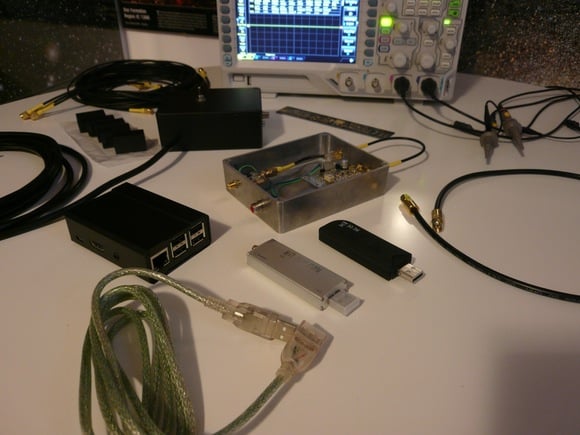
Mario's setup including RTL-SDR dongle, upconverter and Raspberry Pi.
Mario’s setup including RTL-SDR dongle, upconverter and Raspberry Pi.
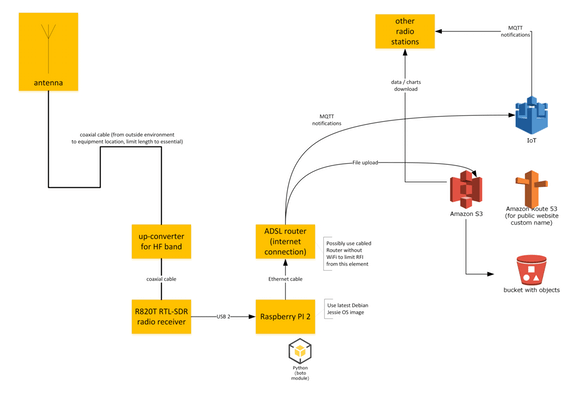
Overall design of the receiver and IoT side.

Detecting Pulsars (Rotating Neutron Stars) with an RTL-SDR

The RTL-SDR has been used for some time now as an amateur radio astronomy tool. Radio astronomers Peter W East and GM Gancio have recently uploaded a paper that details their experiments with detecting Pulsars with an RTL-SDR (doc file).

A pulsar is a rotating neutron star that emits a beam of electromagnetic radiation. If this beam points towards the earth, it can then be observed with a large dish antenna and a radio, like the RTL-SDR. The abstract of the paper reads: 

This project sought to determine the minimum useful antenna aperture for amateur radio astronomers to successfully detect pulsars around the Hydrogen line frequency of 1420MHz. The technique relied on the collaboration with GM Gancio, who provided RTL SDR data of the Vela pulsar (B0833-45, J0835-4510) and others, collected with a 30m radio telescope. This data was processed to determine the achievable signal-to-noise ratio from which, the minimum useful dish size necessary for some effective amateur work, could be calculated. Two software packages were developed to do synchronous integration, a third to provide a power detection function and a fourth for spectrum analysis to recover pulsar rotation rate.

With their system the authors were able to detect and measure the rotation period of the Vela pulsar. Also, from their data they were able to estimate that the minimum dish aperture required to observe the Vela pulsar would be 6m, noting that the Vela pulsar is probably the strongest pulsar ever detected. They also write that by utilizing 5 RTL-SDRs to gather 10 MHz of bandwidth together with some processing that the minimum required dish aperture could be reduced to 3.5m.

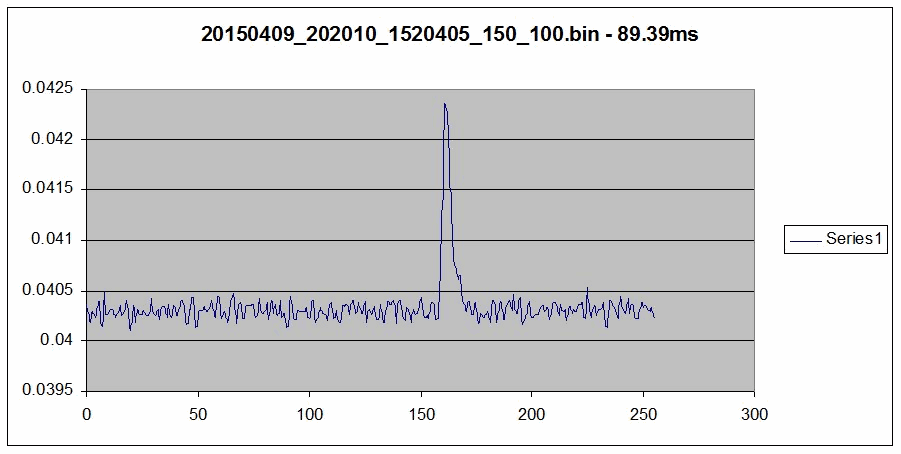
The Vela pulsar pulse power integrated over a 50 second 100MB file, combining some 560 pulsar pulses
The Vela pulsar pulse power integrated over a 50 second 100MB file, combining some 560 pulsar pulses.

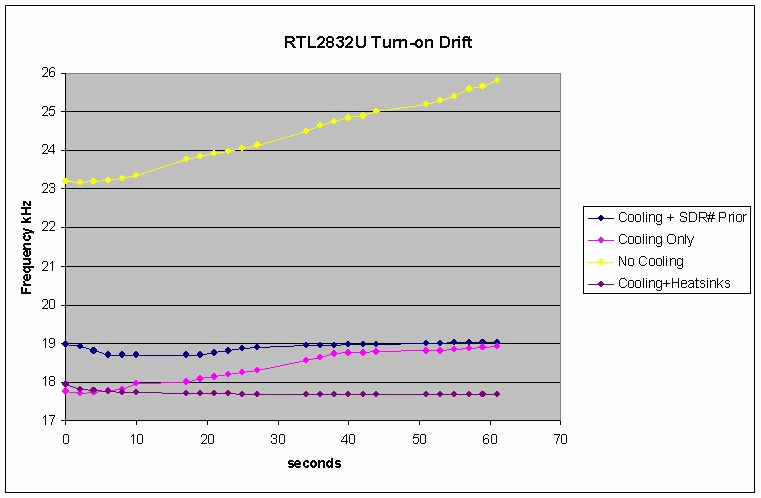
In addition to these Pulsar experiments, Peter has also uploaded new papers about improving his Hydrogen Line RTL-SDR Telescope (pdf), and has updated his paper on improving the frequency stability of RTL-SDR’s with air cooling (doc file). Peter found that the frequency stability of the RTL-SDR (with standard oscillator) could be significantly improved by adding heat sinks and aircooling them. The graph from his paper below summarizes his results.

Results from air cooling the RTL-SDR.
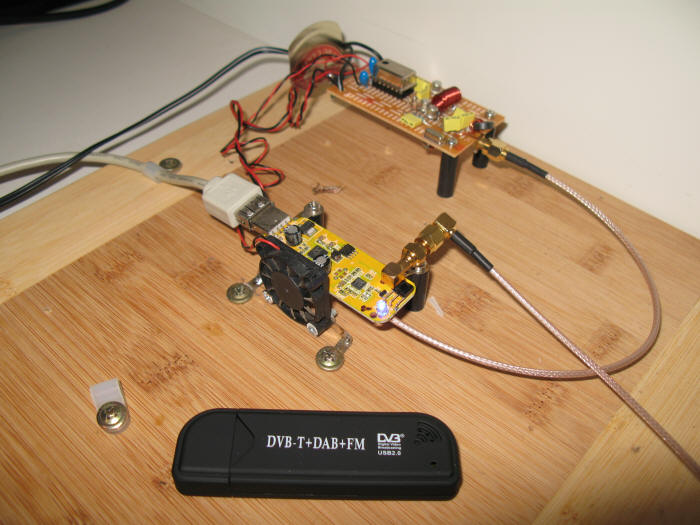
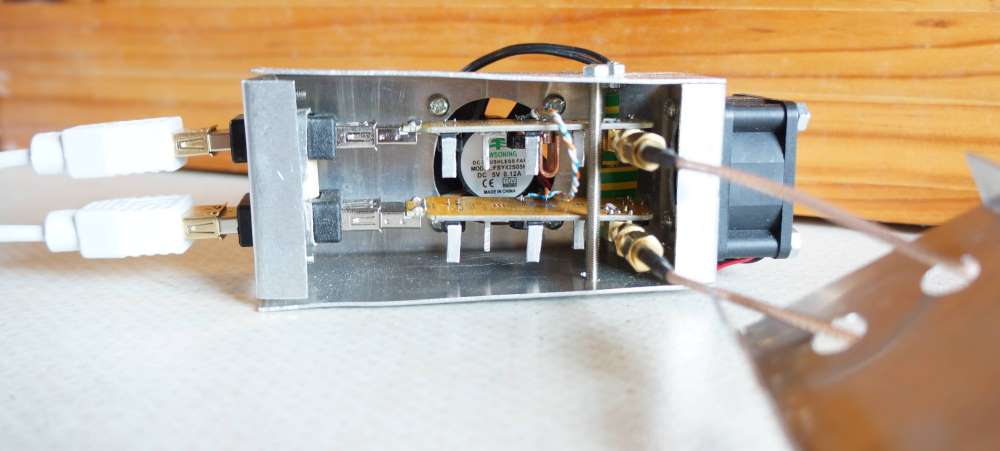
The air cooled and heatsinked RTL-SDRs
The air cooled and heat sinked RTL-SDRs

All of Peters papers can be found on his website at y1pwe.co.uk/RAProgs/index.html. He has many RTL-SDR radio astronomy related resources there, so check it out if you are interested.