Over at the MIT Haystack Observatory in Westford Massachusetts, researchers O.B Alam and A.E.E Rogers have been working on creating a low cost ground based Ozone spectrometer out of RTL-SDR dongles (pdf warning). An Ozone spectrometer is used by scientists to measure the concentration, velocity and temperature of the ozone gasses in the mesosphere (50 – 85 km above the ground) and lower thermosphere (85 km+) at the Ozone line frequency of 11072.4545 MHz.
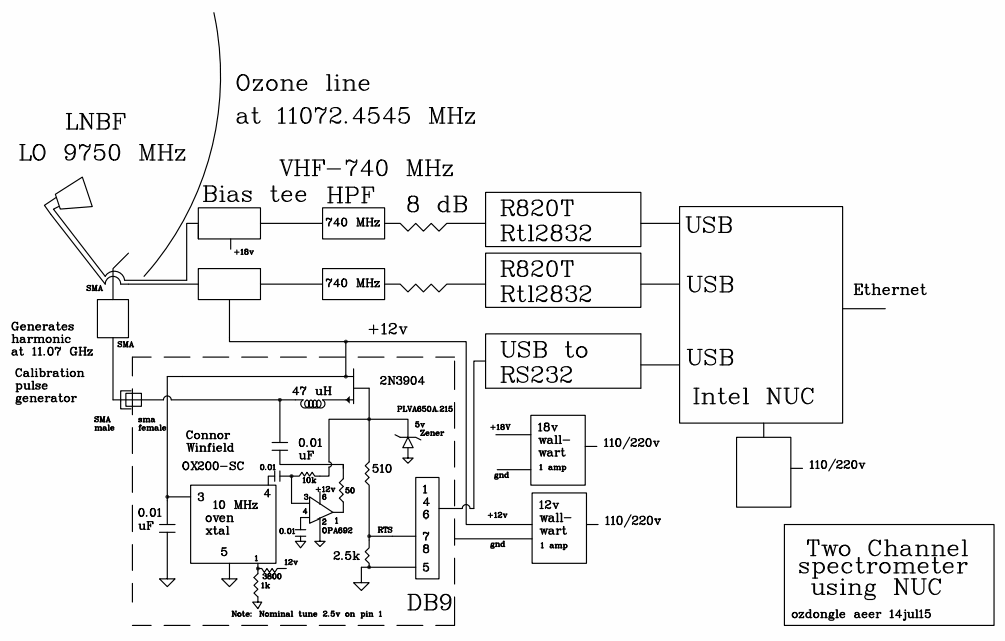
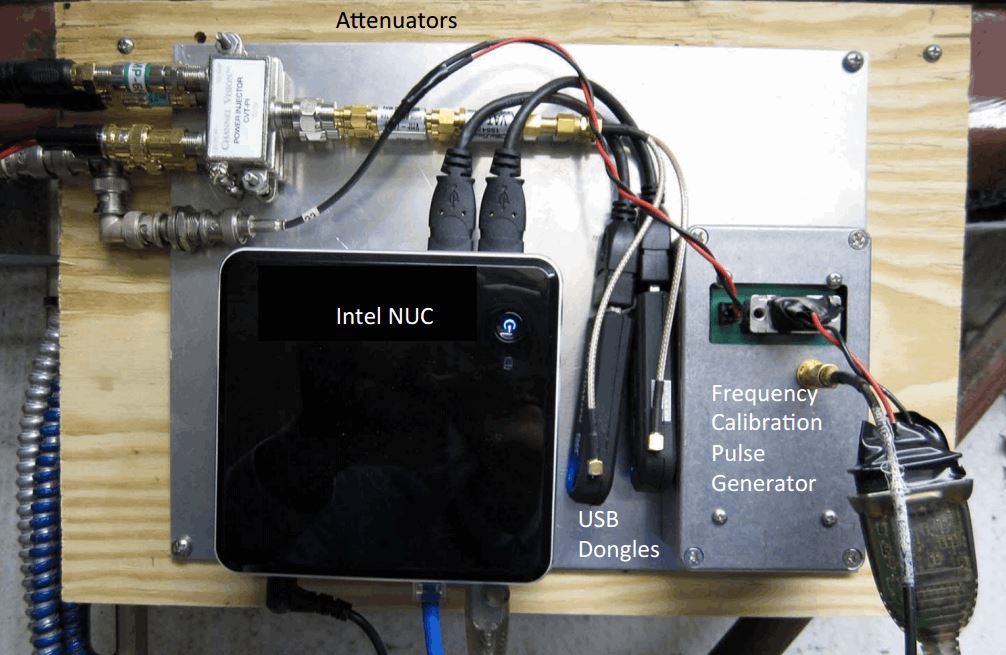
The spectrometer the researchers built consists of a satellite TV parabolic reflector dish with 46.72cm diameter, 9750 MHz LNBF, two Bias Tees, two 740 MHz high pass filters, two 8dB attenuators, a calibration pulse generator, an Intel NUC mini PC and three R820T RTL-SDR dongles.
RTL-SDR based Ozone Spectrometer block diagram from the MIT Haystack Observatory.Photo of some of the components of the ozone spectrometer.
The annual Perseids meteor shower is peaking right now (this Wednesday and Thursday), and with the right equipment (and location) you can detect these meteors with an RTL-SDR dongle and appropriate antenna. When a meteor enters the atmosphere it leaves behind a brief trail of ionized air which is highly reflective to RF signals. These trails can reflect carrier waves from distant transmitters towards your antenna, allowing you to detect a meteor entering the atmosphere. This is called meteor scatter.
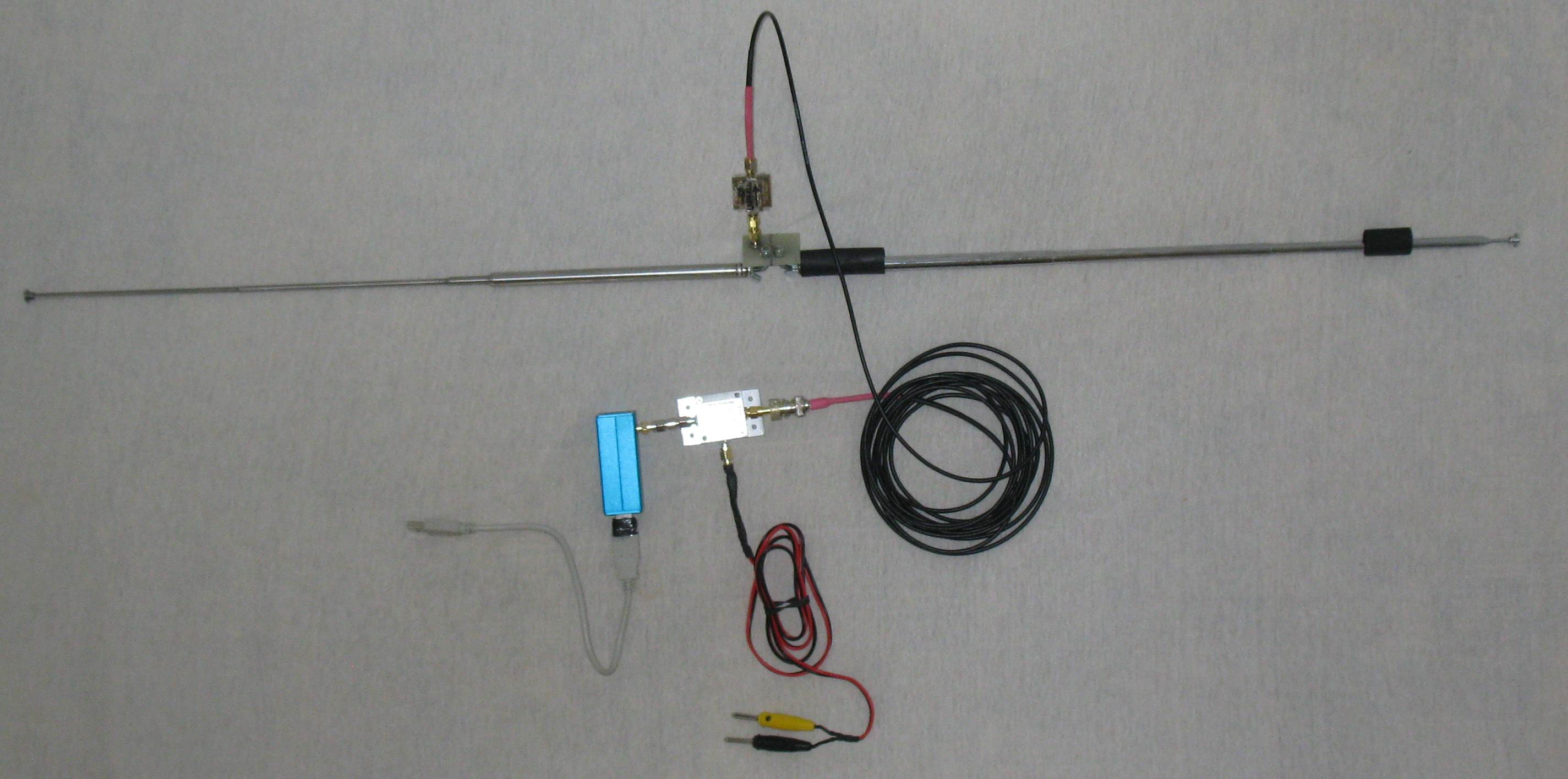
If you live in Europe, you can use the powerful Graves radar at 143.050 MHz as the transmitter. In other locations and the USA you can also use analogue TV broadcasts like in this post where the observer uses a TV tower in Canada. For Graves all you’ll need is a dipole antenna and perhaps LNA, but for TV transmissions you may need a directional Yagi antenna. More information can be found in our previous posts about meteor scatter and is this document.
At the recent 2015 Society of Amateur Radio Astronomers (SARA) Conference Ciprian Sufitchi (N2YO) presented a paper titled “Detecting meteor radio echoes using the RTL/SDR USB dongle” (pdf). His paper introduces the RTL-SDR, the theory behind forward scatter meteor detection as well as the practical application of the RTL-SDR to meteor detection. Ciprian summarizes meteor scatter as the following:
When a meteor enters the Earth’s upper atmosphere it excites the air molecules, producing a streak of light and leaving a trail of ionization (an elongated paraboloid) behind it tens of kilometers long. This ionized trail may persist for less than 1 second up to several minutes, occasionally. Occurring at heights of about 85 to 105 km (50-65 miles), this trail is capable of reflecting radio waves from transmitters located on the ground, similar to light reflecting from a mirrored surface. Meteor radio wave reflections are also called meteor echoes, or pings.
In the paper he explains how analog TV transmissions are the best for meteor scatter, but unfortunately these been discontinued within the USA. Instead he has been able to use analog TV transmitters from Canada, who still transmit this type of signal. He shows that about half of the USA could use the transmitter he is using for meteor scatter, which is based in Ontario, Canada.
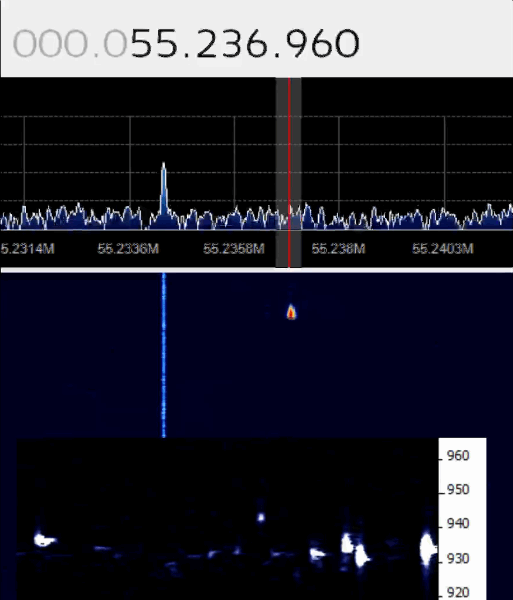
Ciprian is also running a very cool live meteor detection stream on his website at livemeteors.com. His setup is located in the DC Metropolitan area and uses a directional Yagi antenna pointed at the Canadian analog TV tower which is broadcasting at 55.237 MHz. The receiver is an RTL-SDR dongle coupled with SDR# and the ARGO software.
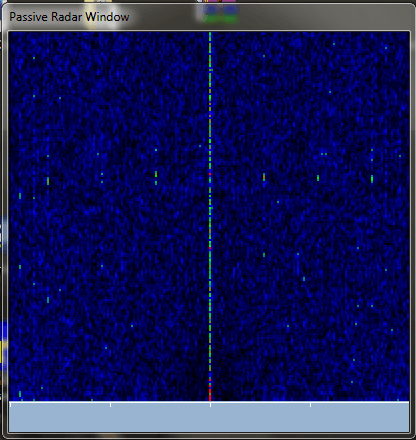
The first one is Passive Radar which bases on the signal from only one dongle. The ambiguity function is the same as in advanced projects with the difference that I implemented self-correlate function instead of cross-correlate one which is used in 2 dongles projects. Such solution theoretically should works as can be found in internet. It should be noticed that for proper work of such passive radar the direct signal should be comparable in strength to the reflected one. This plugin is still under development.
In the future he hopes to be able to support two dongle passive radar as well.
The Passive Radar plugin by Dr. Kaminski in SDR#.The Passive Radar window.
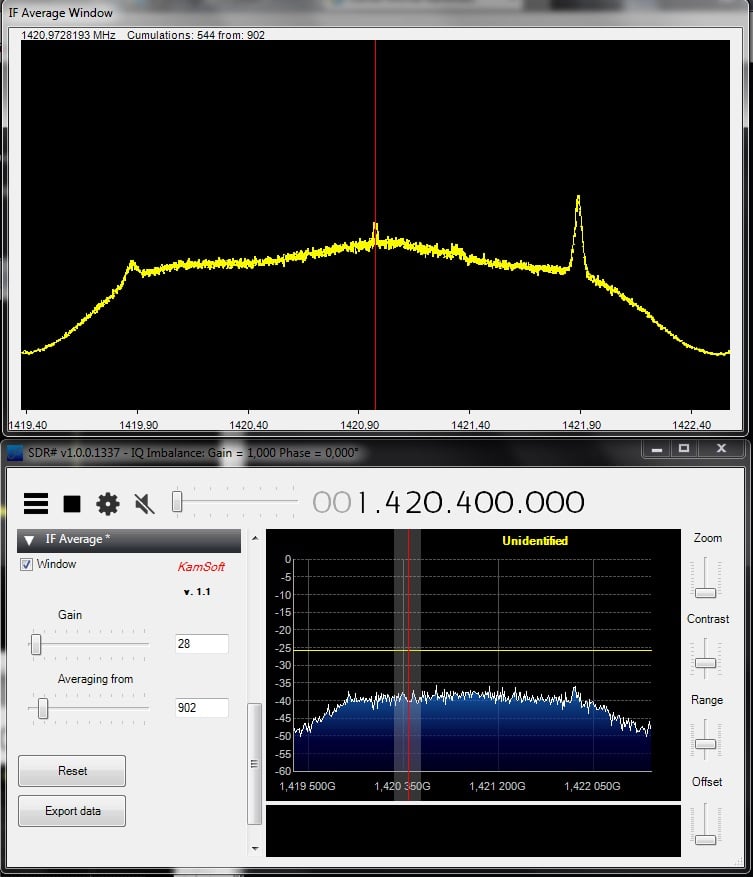
The second plugin is called "IF Average". This plugin allows the IF signal (the entire active bandwidth is what he seems to be referring to) to be averaged which is useful for many applications including radio astronomy projects such as detecting the Hydrogen line. He writes:
The second plugin which is finished is for IF signal averaging. It is important in case of radio-astronomical observations. It allows to cumulate signals (up to 10000 samples in real time), present them in friendly way and save for further work.
Adam 9A4QAV is mostly known as the manufacturer of the popular LNA4ALL, a low cost low noise amplifier which is often used together with the RTL-SDR to improve reception of weak signals. He also sells an ADS-B bandpass filter and an ADS-B antenna, the latter of which we reviewed in a previous post.
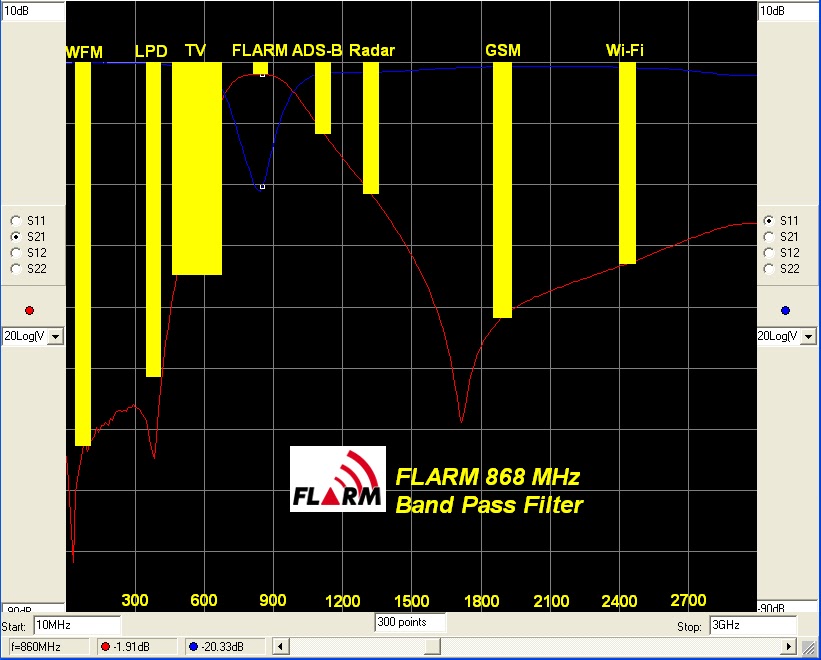
The first new filter that he has developed is for FLARM (FLight Alarm System). FLARM broadcasts at 868 MHz and is a protocol similar to ADS-B. It is used by Gliders and some Helicopters for collision avoidance. It is possible to decode FLARM with an RTL-SDR which allows you to track gliders on a map, as discussed in one of our previous posts.
Characteristics of Adam’s FLARM Filter.
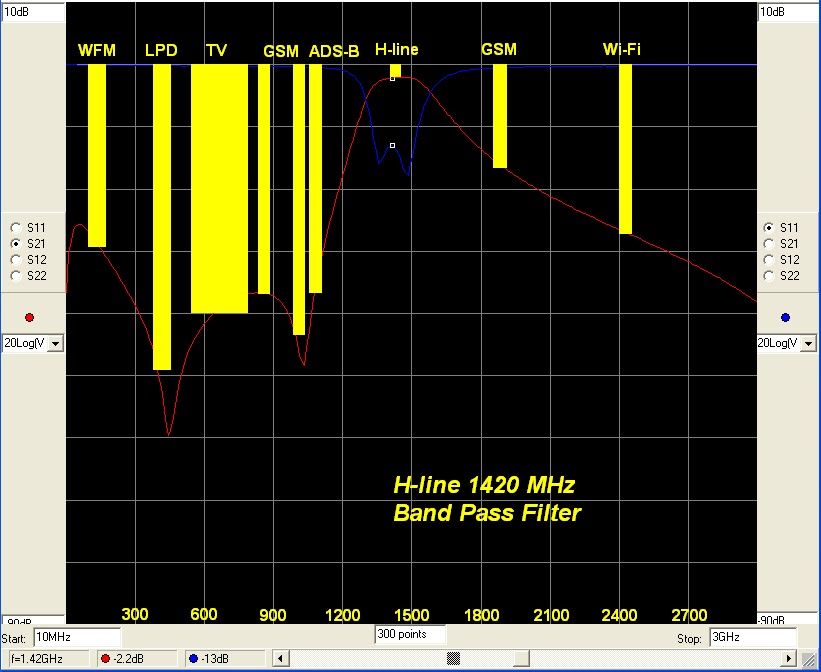
The second filter is for amateur radio astronomers who wish to detect the Hydrogen Line at 1420 MHz. Hydrogen molecules in space occasionally emit a photon at 1420 MHz. A single emission can’t be easily detected, but space and the galaxy is full of Hydrogen and the net result is an observable RF power spike at 1420 MHz. This can be detected with a high gain antenna, LNA, RF filter and radio like the RTL-SDR. The Hydrogen line can be used to measure things like the rotation and number of arms in our galaxy. Filters are very important for radio astronomy work as man made interference can easily drown out the relatively weak cosmic signals.
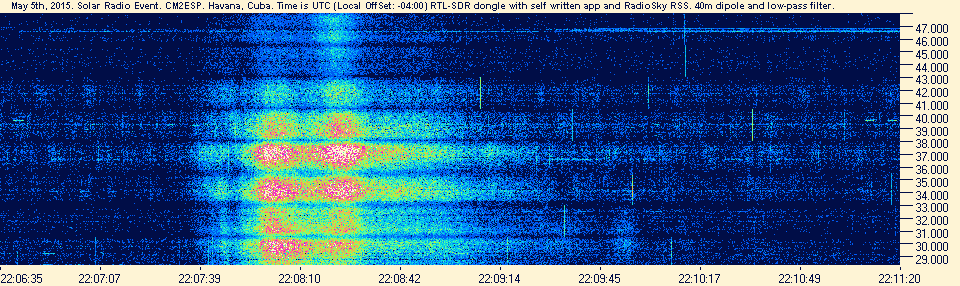
Radio-Sky Spectrograph is a software application that is designed to produce waterfall displays similar to other software, but with a focus on observing radio astronomy phenomena.
Radio-Sky Spectrograph displays a waterfall spectrum. It is not so different from other programs that produce these displays except that it saves the spectra at a manageable data rate and provides channel widths that are consistent with many natural radio signal bandwidths. For terrestrial, solar flare, Jupiter decametric, or emission/absorption observations you might want to use RSS [Radio-Sky Spectrograph].
Recently amateur radio astronomer Jim Brown used an RTL-SDR dongle together with a Ham-it-up upconverter and preamp to capture noise bursts from the planet Jupiter. Not much information about his observations are available yet as he has not yet made a write up, but he has given the image of the noise burst shown below to Jim Sky, programmer of RTL Bridge and Radio-Sky Spectograph which is some of the software used to capture the noise bursts. We will make another post in the future if Jim Brown does a write up.
Jim Sky has also updated his RTL Bridge software to use Oliver Jowetts patched drivers, which allow the RTL-SDR to receive below its usual 24 MHz limit.
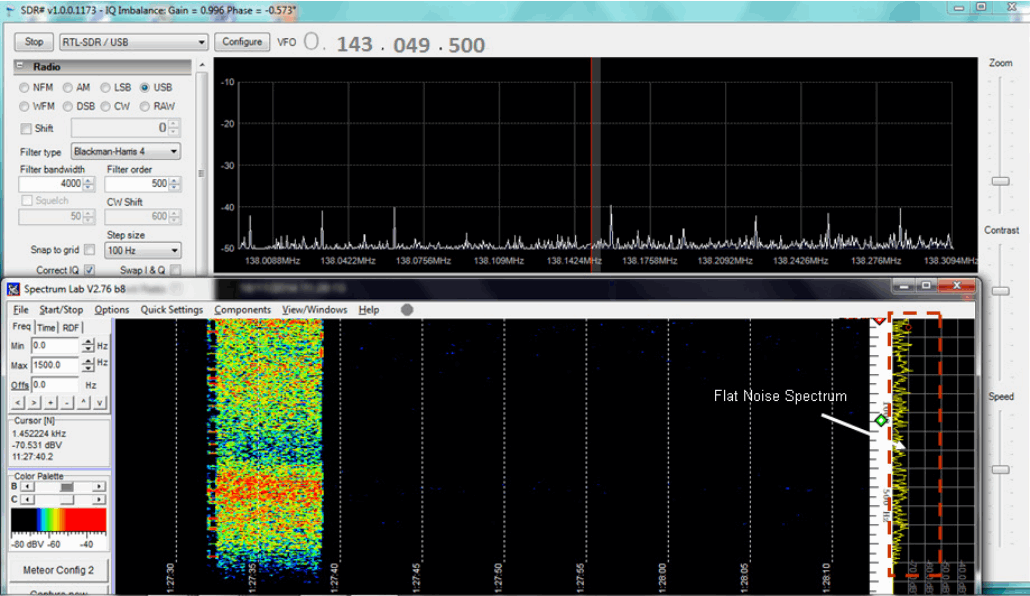
A software defined radio can be used to detect and count meteors entering the earth’s atmosphere by detecting strong radio waves reflected by ionized trails left by the meteor. If you are unfamiliar with how to detect meteors using radio waves, you should consult Dr Morgans older papers called Detection of Meteors by RADAR, Meteor Radar SDR Receiver (Funcube Dongle), and Antennas for Meteor Scatter. The tutorial shows how to set up SDR# and Spectrum Lab to work together to detect meteors using the Graves Radar in France at 143.050 MHz.