Tagged: rtl2832

Analyzing Radar Pulses with Baudline and an RTL-SDR

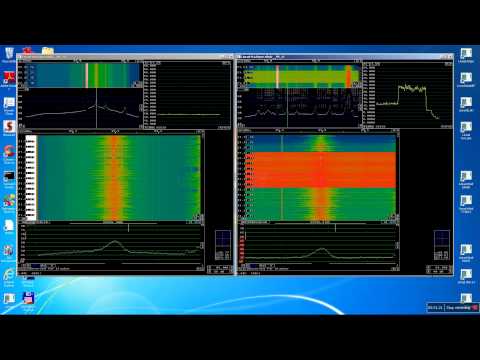
Over on YouTube user Albert Schäferle has uploaded a short video showing his reception of some radar pulses and their corresponding echoes. He uses rtl_fm and pipes the output into Baudline which is used to display the radar waveform. On the video description he writes:

Receiving direct and (supposedly) reflected pulses from an L-band radar in Učka, HR (Lockheed Martin AN/FPS-117). The receiving station was 83 km away, with clear LOS.
Center frequency is 1258 MHz (one out of four that this frequency-agile radar head is using).
The receiver is a RTL-SDR dongle (R820T tuner IC) with a 2-dipole collinear array (tuned for 403 MHz) and approx 7 m of Belden 1694A RG-6 coax.

rtl_fm output was piped to baudline, which is the software shown in the video. The IQ sampling rate is 2 MHz; the transform is a complex STFT (size=2048 samples, Blackman window).
This is a 0.008x speed playback of 15 ms of recording.
The (again, supposedly) reflected pulses are obviously more time-local with a shorter transform window size, e.g. 512 samples http://i.imgur.com/sAHWhwD.png

The effect of pulse compression is quite evident http://www.radartutorial.eu/08.transm…
The direct-reflected delay is approx 278 µs (~42 km from receiver, in a simple 2D, along beam, normal incidence model). I should add that this “reflection delay” effect does not usually show up.
There’s another fainter echo closer to the pulse, but I suspect that it could be a time-sidelobe of the main pulse: a side effect of pulse compression. Anyway, I must state that I have no formal knowledge on radar topics. So you’d better take all this with a grain of salt 😉

Link to recording: https://db.tt/Lxe67Ig3 (save destination as…)

Video recorded with VLC, audio piped to stdout and saved, then synced in Blender.

Radar WGS84 coordinates: 45.286757,14.202732 http://www.panoramio.com/photo/26952908

Analyzing radar pulses with Baudline and RTL-SDR.

Beaglebone Black FM/Internet Radio Combo Receiver using an RTL-SDR

Last year we missed this interesting project by Frederick Vandenbosch where he created a FM/internet radio combination receiver using a BeagleBone Black mini embedded PC and an RTL-SDR dongle.

The idea is that the system will receive FM radio through the RTL-SDR normally, but when reception is poor or unavailable you can switch to internet radio which is received through WiFi. The radio is controlled through an LCD screen attached to the BeagleBone Black.

Frederick used Linux on the BeagleBone and created a custom GUI that allows for easy tuning using rtl_fm as the RTL-SDR back end, setting channel presets and for switching between internet and live FM radio.

BeagleBone Blade FM/Internet Radio Combo Receiver
Beaglebone Black Digital Radio with RTL-SDR and Wifi

Monitoring a Trunked P25 LSM Simulcast System with OP25 and an RTL SDR

Over on YouTube user jdlucas78 has uploaded a video showing a P25 LSM modulated digital voice signal being decoded by the Osmocom OP25 software for Linux. Although DSD and DSD+ can decode P25 voice, it seems that the Osmocom OP25 software is better at decoding P25 signals as it implements better error correction algorithms.

Over on the RadioReference forums there is a thread discussing the use of the OP25 decoding software which can be found here. There is a post in the thread that shows an easy Linux install procedure for the OP25 software.

Monitoring a Trunked P25 LSM Simulcast System w/ OP25 and RTL SDR Dongle

Take 2: Monitoring a Trunked P25 LSM Simulcast System w/ OP25 and RTL SDR Dongle

Decoding Oregon Scientific Weatherstation Messages using Gnuradio

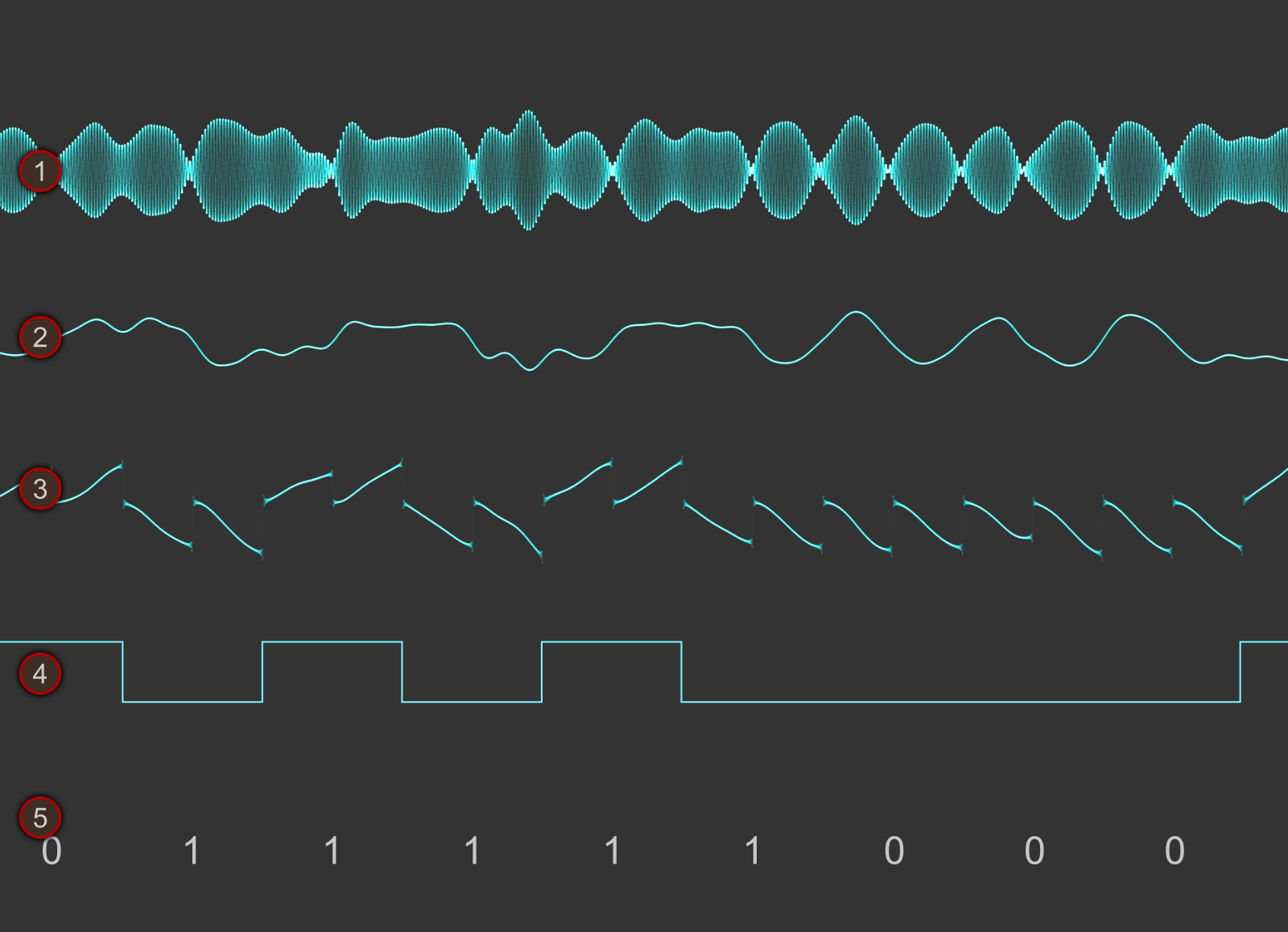
Recently a reader of rtl-sdr.com, DO2BJK wrote in to let us know about his project where he used GNU Radio to decode Oregon Scientific V1 and V2 weather station messages. To receive the weather station messages which are sent in the ISM band at 433 MHz, DO2BJK used a USRP B210, but he writes that other SDRs such as an RTL-SDR or HackRF will also work. To decode the signal, DO2BJK took the usual steps of recording the signal and looking at the audio waveform in Audacity. From the waveform he was able to determine the bit string and discover the preamble, sync and data parts of a packet. He then used GNU Radio and wrote a Python program to receive the signal and automatically detect the preamble and extract the temperate data. His code is available on GitHub at https://github.com/bkerler/OregonDecoder/.

Bit string signal interpretation

Listening to EPIRB Distress Beacons with the RTL-SDR

Over on YouTube user Tom Mladenov has recently been using his RTL-SDR to listen to EPIRB distress beacons transmitted by the SARSAT payload carried by the NOAA 18 satellite. To do this he uses a 6.5 turn helix antenna that is resonant on 1.5 GHz.

An EPIRB is a maritime device that is used to send out a distress beacon for vessels in serious trouble. The EPIRB beacon transmits data that contains GPS coordinates of the vessel at 403 MHz to the satellite. The data is then retransmitted to a mission control centre at 1.5 GHz.

Note that the professional version of MultiPSK can be used to decode EPIRB signals.

(YouTube Videos Removed)


New SDR# Plugin: PAL / SECAM TV

The SDR# plugins programmer over at rtl-sdr.ru has recently released a new plugin which allows the decoding of PAL / SECAM TV images from within SDR# (note link in Russian, use Google translate or see the download link at the bottom of the page). The author also writes that if you are using a newer software defined radio like an Airspy, you can also receive the audio channel using the SDR# multiple VFO plugin.

We note that there is also the TVSharp software by the same author which is a standalone program that can decode PAL and NTSC.

PAL / SECAM TV SDR# Plugin

RTL-SDR with GQRX Running on an Odroid C1 at 1 MSPS and Max FFT

Over on YouTube user neutron2025 has uploaded some videos showing GQRX running on an Odroid C1. The Odroid C1 is a low cost ($35 USD) mini computer with an Arm Cortex A5 quad core CPU and 1 GB RAM which runs Ubuntu 14.04 or Android KitKat. It is a much more powerful competitor to the Raspberry Pi which also goes for around the same price.

Despite its low cost, the video by neutron2025 shows that the Odroid C1 has enough processing power to run the relatively CPU intensive GQRX SDR software with the RTL-SDR at a 1 MSPS sampling rate and maximum FFT resolution.

To install GQRX, GNU Radio also needs to be installed. Installation of GNU Radio is a lengthy process containing many writes to the file system. The amount of writes that occur could destroy a SDCard. To get around this neutron2025 connected an external hard drive and used that as a swap file while installing GNU Radio. His installation notes can be found on pastebin. He writes that installation took around 8 hours.


RTL-SDR / Odroid C1 / GQRX / 2msps / Max FFT

Techniques for using the RTL Dongle for Detecting Meteors

Back in 2013 we posted about a Dr. David Morgan who had written a tutorial paper discussing how he used the Funcube Dongle Pro+ for radio astronomy. Recently Dr Morgan has also written another paper showing how to use the RTL-SDR together with the Spectrum Lab software to detect meteors.

A software defined radio can be used to detect and count meteors entering the earth’s atmosphere by detecting strong radio waves reflected by ionized trails left by the meteor. If you are unfamiliar with how to detect meteors using radio waves, you should consult Dr Morgans older papers called Detection of Meteors by RADARMeteor Radar SDR Receiver (Funcube Dongle), and Antennas for Meteor Scatter. The tutorial shows how to set up SDR# and Spectrum Lab to work together to detect meteors using the Graves Radar in France at 143.050 MHz.

Meteor Scatter Detection in Spectrum Lab