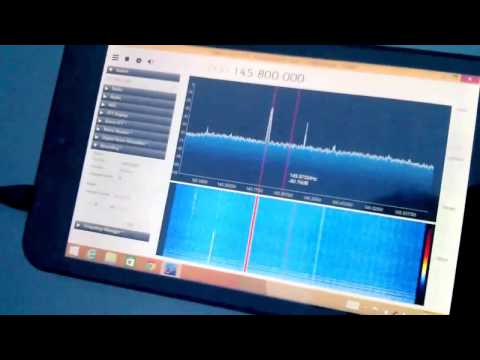
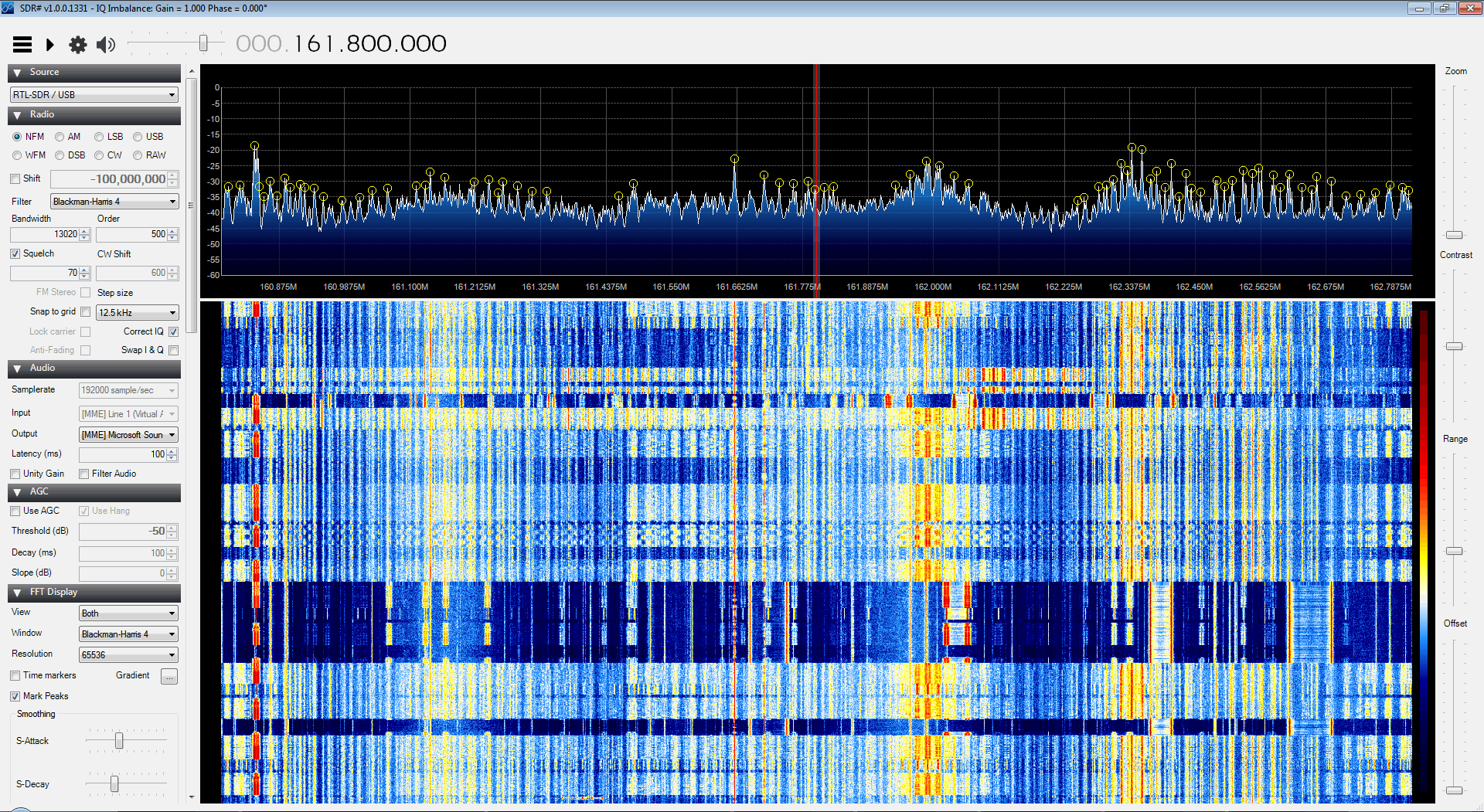
Over on YouTube user BSoD Badgers has uploaded a video showing reception of Hellschreiber on HF at 20m. To receive the HF frequencies he used a ham-it-up upconverter. He used SDR# to receive the signal and the Fldigi decoding software to decode the signal.
Hellschreiber is a fax-like communications mode used by amateur radio hobbyists.
The reception process is to essentially record an IQ file of an LRPT transmission using SDR#, reduce the sample rate of the IQ file using audacity and then decode the file using LRPTrx.exe. Then finally the decoded data can be imported into LRPTofflineDecoder to produce an image.
The lab sheet starts off by showing how the RTL-SDR works at a high level, then goes on to explain the function of the R820T tuner chip and RTL2832U chip. The lab then shows a behavioural level model of the RTL-SDR which becomes useful for mathematical analysis. Finally, the lab also explains demodulation theory for FM and FSK signals and sets several lab exercises that involve writing FM and FSK demodulators in MATLAB or Python.
A TCXO is a temperature controlled oscillator. Its advantage over a standard oscillator like the one used in a normal RTL-SDR is that its frequency will not drift as the temperature of the dongle changes.
On this episode of Hak5, a popular YouTube technology channel, Shannon shows two Android based ADS-B RTL-SDR apps that we have mentioned on this blog previously. One is “ADS-B on USB SDR RTL” and the other is Avare ADS-B. Both are ADS-B apps that will display real time airplane positions on a map.
To run these apps you need a RTL-SDR dongle, a USB OTG cable and an Android phone.
Cellular Testing Tools and Mobile SDR Apps, Hak5 1708
Japanese blogger and RTL-SDR experimenter ttreftech has had an ADS-B front end kit (In Japanese, use Google Translate) consisting of a low noise amplifier (LNA) and SAW filter available for sale in Japan for a few months now. The LNA helps to push weak signals through the coax feed line and the SAW filter is a bandpass filter that helps to remove interference outside of the 1090 MHz ADS-B region. If you are interested in building your own version, ttrftech has also posted a schematic. Another recent post about the front-end can be found here.
Another Japanese blogger, “pup” has posted about his results with the ADS-B front end kit (Also in Japanese, use Google Translate). His results show that the front end does significantly improve ADS-B reception. The image below shows an ADS-B signal with the front end turned off (top) and with it turned on (bottom). Pup has also posted a video showing the kit and its performance on HDSDR.
Adafruit has released a tutorial showing how to build a portable TFT screen based Raspberry Pi RTL-SDR spectrum analyzer that was inspired by the HackRF portapack. Construction of the project is very simple and the “FreqShow” python software is provided as a simple download that is ready to run once the RTL-SDR is installed on the Raspberry Pi.
The FreqShow software appears to be fully featured with the ability to change the center frequency, sample rate, and gain. It can show on the TFT screen the real time RF spectrum of the currently tuned area or it can be switched to show a waterfall of the spectrum as well. Below is a video of the finished project that shows the software in action.
“Freq Show” Software in action on a Raspberry Pi with TFT Screen