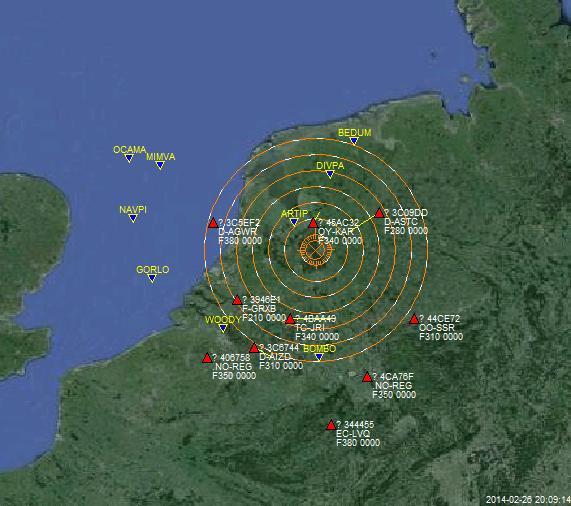
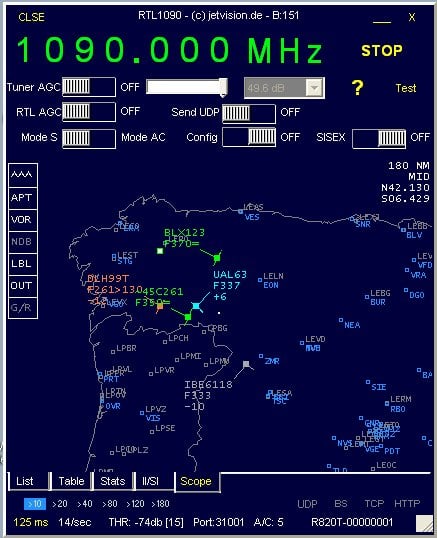
The beta version of the popular ADS-B decoding software RTL1090 has been updated to version 3. Version 3 comes with a simple radar visualization scope built into the software, which allows you to see aircraft directly in the RTL1090 software.
The popular RTL-SDR ADS-B decoder RTL1090 requires the rtlsdr.dll and libusb.dll files to be manually downloaded and then placed into the RTL1090 folder. However, now the author of RTL1090 has created an automatic installer which will download and install all the required files automatically.
This internet based utility helps you with setting up a complete RTL1090 installation with almost no manual intervention. It automatically downloads the relevant files as rtlsdr.dll, zadig.exe and helps to configure zadig with a built in tutorial.
The installer is called the IMU (Installer and Maintenance Utility) and can be download from the RTL1090 website at rtl1090.web99.de.
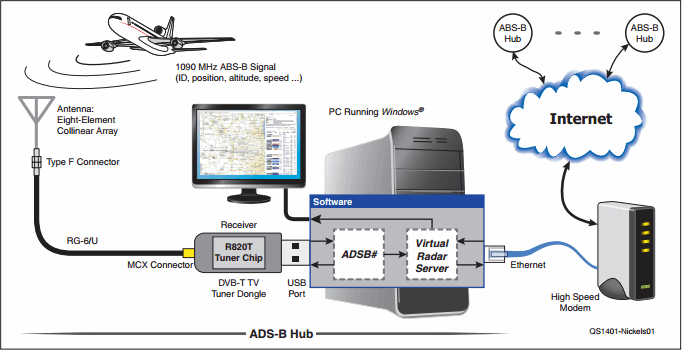
The American Radio Relay League (ARRL) a.k.a The American National Association for Amateur Radio has put online a freely available ADS-B tutorial featured in their monthly QST magazine, written by Robert Nichols, W9RAN. The tutorial focuses on using an R820T RTL-SDR dongle to receive ADS-B signals, and then using computer software to decode the signals and create a virtual aircraft radar.
ADS-B is a protocol used by most modern aircraft to broadcast their position and altitude which is determined via GPS. ADS-B is intended to supplement and eventually replace traditional radar.
In this ADS-B tutorial, they show how to create a weatherproofed 1090 MHz collinear antenna from RG-6/U coax and PVC pipe and how to use the ADSB# and virtual radar server software to decode and visualize aircraft positions, like a radar.
To use the app, you will need an Android device that supports USB OTG, which most Android devices on Android 4.0+ should support. You will also need a USB OTG cable, and an RTL-SDR dongle. You may want to consider a USB OTG cable that has a second port for external charging capabilities, as the RTL-SDR can drain the battery quickly.
The app is cheaply priced at under $2, so give it a try!
This ADS-B antenna by amateur radio hobbyist F5ANN combines a 30dB LNA preamplifier, bandpass filter and antenna tuned for 1090MHz together on a single PCB board. The LNA preamplifier helps boost weak signals, whilst the bandpass filter helps to remove interference from others signals such as GSM. The novel thing about this antenna is that everything is neatly packaged into a single PCB board, which makes this antenna very compact, and yet have high performance.
F5ANN uses his combined antenna together with an RTL-SDR dongle and the RTL 1090 ADS-B decoding software with PlanePlotter, and was able to receive 194 simultaneous aircraft signals with a message rate of 556 messages a second at distances of up to 250 nm.
Over on YouTube user adsbrus shows us his project which is an in car ADS-B aircraft tracker using a Raspberry Pi mini computer and an RTL-SDR. The system uses an LCD screen mounted where the car radio usually is to show aircraft identifier, altitude, and speed information in text.
ADS-B in CAR (Raspberry PI & USB TV RTL2832U+R820T)
In order to do this he used the Linux based dump1090 ADSB-B decoder and hub software on his main PC. Lui was even able to compile and run the ADS-B hub portion of dump1090 on his Windows PC using Cygwin, but was unable to get the decoder part to work. It doesn’t matter though because the dump1090 hub can receive data from any ADSB decoder, such as ADSB#. His results look very promising as can be seen by the timelapse of plane traces in the image below.
Yesterday we posted about the command line rtl_acars ACARS decoder. Today on YouTube, Pawel Janowski has posted a video showing how to download, compile and run the rtl_acars.c code on Linux.