Category: Amateur Radio

SoftRock Lite II Build and Test Tutorial Video

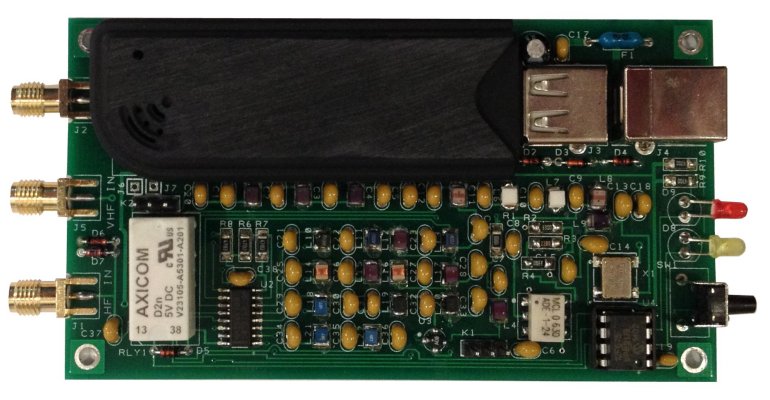
The SoftRock Lite II is a (now fairly old) soundcard based software defined radio kitset that is capable of receiving on the HF bands. Over on YouTube user w2aew has uploaded a video showing the entire kitset build process for the SoftRock Lite II SDR radio. He also goes over the circuit blocks explaining their function and how they work.

This is an excellent video if you are interested in learning more about the components and circuits used in some SDRs.

#148: Software Defined Radio kit | Tutorial | Build | Test | Softrock Lite II

RTL-SDR HF Preselector Project

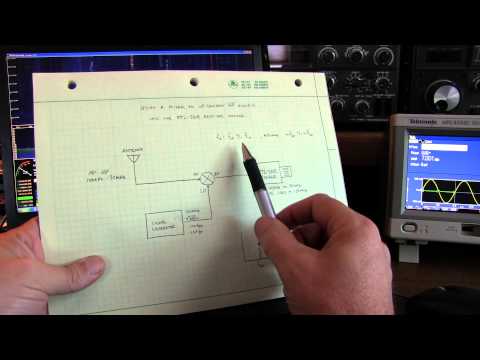
Over on YouTube user Theo Faber has uploaded a video showing his adjustable multiband HF preselector project for his RTL-SDR dongle. The preselector covers the entire HF band. Theo designed and built his own homemade upconverter for this project as well.

Preselectors on the RTL-SDR can vastly improve reception quality. Without preselection, noise and strong images of other nearby stations can cause strong interference.

My project ‘pre selector’ for wideband radios and in particular the popular tv-sticks than can be used for SDR reception. The sticks are very cheap and the software free available on the internet. SDR Sharp in this case, is operating stable under XP and W7. Sticks are sensitive, however the input level can only vary +- 20dB. The sticks are easely overloaded and will produce cross and intermediation. So you need in front of the stick / converter band pass or tunable filters. Hopefully this inspired you to build your own set of filters, to fully benefit from the perfect performing of this affordable SDR.
for more info contact me on: t.faber87__AT__upcmail.nl
kind regards and 73’s

SDR RTL dongle and pre selector with HF converter

Receiving Kicksat Telemetry with the RTL-SDR

Recently a bunch of amateur radio nano-satellites known as ‘Kicksats‘ were launched on the latest SpaceX rocket. So far the Kicksat carrier has been successfully deployed, which is essentially the box containing the nano-satellites. On May 4, the nano-satellites known as ‘sprites’ are due to be deployed from the carrier.

Both the carrier and Kicksat sprites have telemetry signals which are receivable with the RTL-SDR. As the sprites transmit using only 10mW of power, a high gain Yagi antenna and an LNA are required to receive their signals.

Over on his blog, Dolske has been trying to receive and record the Kicksat carrier using his RTL-SDR. He was able to capture a telemetry packet at 437.505 MHz using SDR#. He then tried to use QTMM AFSK1200 to decode the packet, but has been unsuccessful so far probably due to the weak signal he received.

Kicksat 'nano' satellite sprite.
Kicksat ‘nano’ satellite sprite.

Softrock Ensemble II vs the RTL-SDR + Upconverter on Shortwave

Over on YouTube user mutezone has posted a video comparing the RTL-SDR with upconverter against a Softrock Ensemble II software defined radio. The Softrock Ensemble II is an SDR dedicated to the HF frequencies and is thus expected to have better performance for that purpose. Mutezone writes

A performance between the Softrock Ensemble II vs the RTL-SDR (R820T) on shortwave. Here we are trying to see which one is best at receiving AM broadcasters. Both SDRs were using the same longwire antenna connected to an ATU (Antenna Tuning Unit).

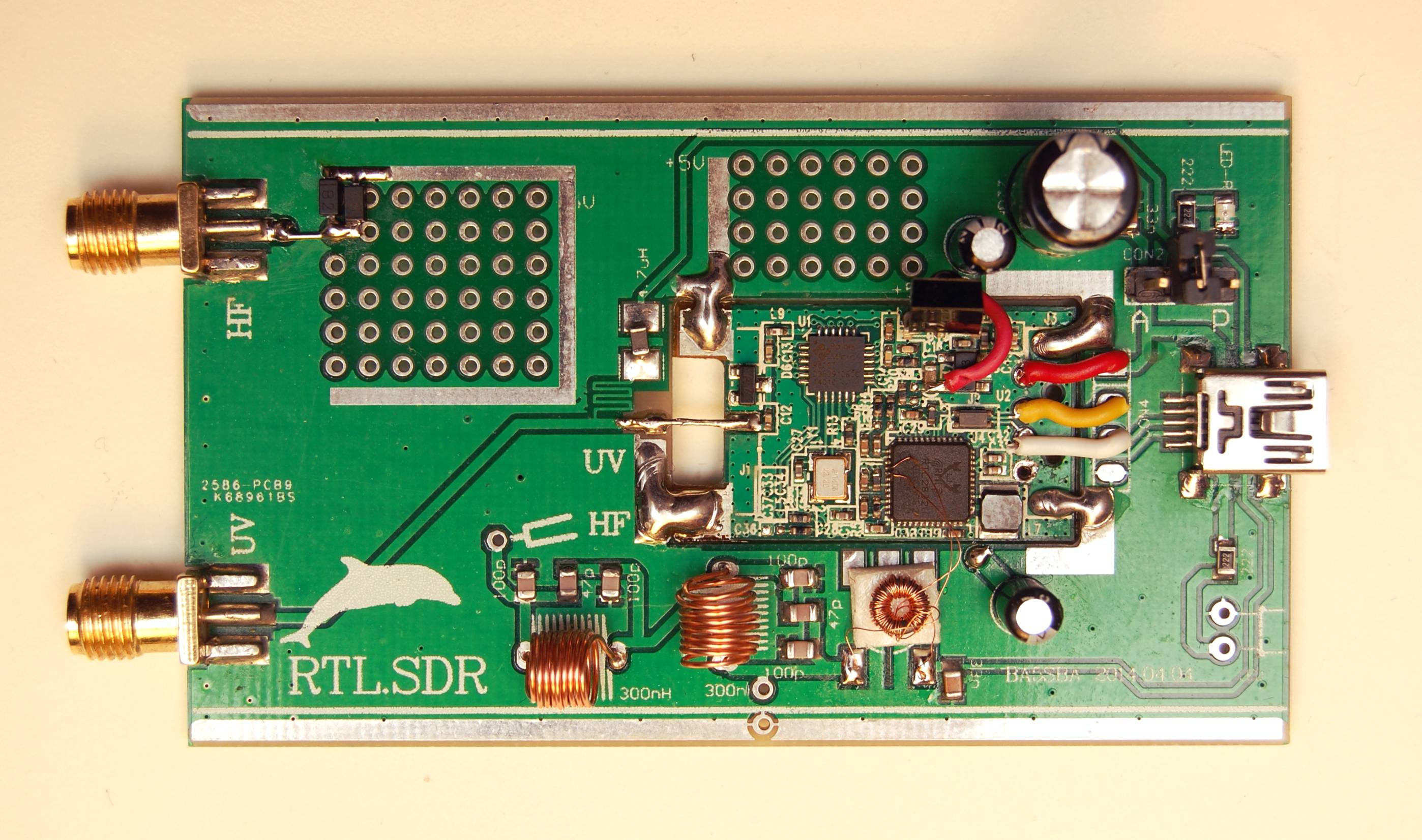
Although I know this comparison is somewhat unfair, since the RTL-SDR is not meant for shortwave & the Softrock is, it is to show that there is a difference in performance, even though the RTL-SDR has a much wider frequency range & cannot be beaten when it comes to value for money. My opinion is that if you want an SDR that should deliver on HF / Shortwave performance, then go for a dedicated one like the Softrock, Afedri, SDR-IQ or any others that do the same job on the market. Even when using a decent HF Upconverter, the RTL-SDR will still not match the performance of more upmarket HF SDRs.

Receiving SO-50 Saudisat 1C with the RTL-SDR

Over on YouTube user Orlando Lima shows reception of the SO-50 Saudisat 1C satellite. Saudisat is an amateur radio satellite with an FM radio repeater. Orlando listened to the downlink frequency at 436.795 MHz using an RTL-SDR, Yagi antenna and Orbitron software to track the downlink frequency in SDR#.

Receiving Weather RTTY and FAX with the RTL-SDR

YouTube user Tiago Sousa shows how he was able to receive weather Radioteletype (RTTY) data using the RTL-SDR, an upconverter and MultiPSK. Weather RTTY is broadcast by weather services such as the Deutscher Wetterdienst (DWD) which is broadcast from Hamburg, Germany. It is intended for people at sea.

Tiago used an RTL-SDR with upconverter and an 11 meter long wire antenna. For the software he used SDR# and piped the audio to MultiPSK.

Weather RTTY - DWD Hamburg heard in Portugal

Tiago has also uploaded a second video showing him receiving Weatherfax with the same setup. Weatherfax is a signal that transmits a fax image showing weather patterns.

Weather Fax - DWD Hamburg heard in Portugal

Decoding APRS with SDR#, APRSISCE32 and an RTL-SDR

Over on YouTube user k2nccvids has posted a video showing how he was able to decode APRS signals and plot them on a map using APRSISCE32. APRSISCE32 is an advanced Automatic Packet Reporting System (APRS) decoder which has mapping capabilities and can also connect to the internet as an iGate. APRS is used by amateur radio hobbyists to send data like messages, announcements and also GPS coordinates.

Building an Upconverter from the LNA4HF

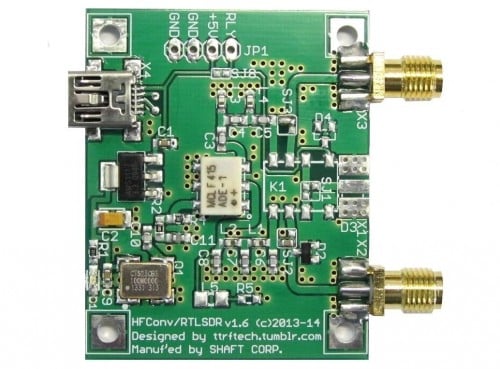
Adam the manufacturer of the LNA4HF has recently uploaded a video showing how to easily build an upconverter from the LNA4HF. The LNA4HF is a low noise amplifier intended for use with SDRs like the RTL-SDR. The video shows how to connect up two components, the Mixer and Oscillator which are required to create the upconverter.

HF upconverter built from the LNA4HF