Category: Applications

Controlling a Remote Controlled Car with an RTL-SDR Attached to a Raspberry Pi

Over on YouTube user SilverXiaify has uploaded a video of a project he completed for a class in his electrical engineering school. His project involves controlling a remote controlled car using a ham radio. The remote control car carries on board an RTL-SDR for signal reception and an Raspberry Pi for data processing and control. The communications protocol they used is a naive version of AFSK700.

EE123 Final Project Demo

RTLSDR Scanner Now Supports GPS for Signal Strength Mapping

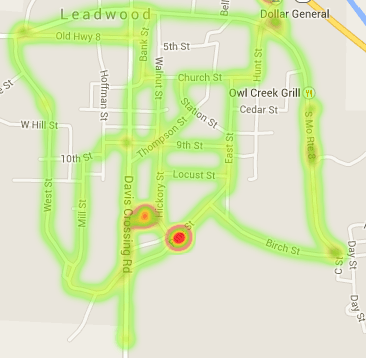
The RTLSDR scanner software has been updated and now supports connection to an external GPS receiver. With a GPS receiver attached to a laptop, the RTL-SDR can be used to make signal strength maps by driving around in a car and monitoring the radio spectrum with RTLSDR Scanner running. The signal strength map can then be viewed in Google Earth, a GIS program or any image viewer.

RTLSDR Scanner GPS Signal Strength Heatmap

GNSS-SDRLIB: Real Time GPS Positioning with RTL-SDR

Over on YouTube user taroz1461 has posted a video showing an RTL-SDR getting a real time GPS location fix using his GNSS-SDRLIB software package. Taroz1461 used an RTL-SDR modified with a temperature controlled oscillator (TCXO) to improve the frequency stability of the dongle.

In the video description he writes that GNSS-SDRLIB will soon have RTL-SDR support in the next update.

GNSS-SDRLIB: Real-time positioning with RTL-SDR (DVB-T Dongle)

Receiving Mexican Pirate SSTV on Military Satellite Frequencies with the RTL-SDR

Happysat, a reader of RTL-SDR.com wrote in to let us know his experience with receiving Milsat pirate SSTV images using his R820T RTL-SDR and his homebrew QFH antenna. During his research he found that Brazillian Mexican Pirates hijack military satellite transponders to send SSTV pictures of their families on 255.560 MHz 22.4° West UFO F7 (USA 127).

Happysat writes that he found an active signal on that frequency most of the time. To receive the SSTV signal happysat used the free RX-SSTV software.

SSTV is an acronym for slow scan television and is a mode usually used on HF (0-30 MHz) frequencies by ham radio enthusiasts for sending out digital calling cards.

More information about pirate SSTV can be found here.

Edit: From our Facebook page comments, it seems these signals are actually from Mexican pirates. More info here http://www.qsl.net/py4zbz/ec/ec.htm.

Milsat Pirate SSTV
Milsat Pirate SSTV in SDR#
SSTV Image
Received SSTV Image 1
SSTV Image
Received SSTV Image 2

K2NCC’s Guide to AIS Reporting for the RTL-SDR

AIS enthusiast K2NCC has posted in our forum a link to a PDF document he has created showing how to use SDR#, AISMon and AIS Dispatcher to report AIS data to marinetraffic.com and aishub.net. Marinetraffic.com and Aishub.net are websites which aggregate AIS data from various contributors around the world.

AIS is an acronym for Automatic Identification System and is a type of modern GPS based radar system similar to ADS-B used by mariners to help avoid collisions at sea.

Map from Aishub.net
Map from Aishub.net

Receiving Kicksat Telemetry with the RTL-SDR

Recently a bunch of amateur radio nano-satellites known as ‘Kicksats‘ were launched on the latest SpaceX rocket. So far the Kicksat carrier has been successfully deployed, which is essentially the box containing the nano-satellites. On May 4, the nano-satellites known as ‘sprites’ are due to be deployed from the carrier.

Both the carrier and Kicksat sprites have telemetry signals which are receivable with the RTL-SDR. As the sprites transmit using only 10mW of power, a high gain Yagi antenna and an LNA are required to receive their signals.

Over on his blog, Dolske has been trying to receive and record the Kicksat carrier using his RTL-SDR. He was able to capture a telemetry packet at 437.505 MHz using SDR#. He then tried to use QTMM AFSK1200 to decode the packet, but has been unsuccessful so far probably due to the weak signal he received.

Kicksat 'nano' satellite sprite.
Kicksat ‘nano’ satellite sprite.

Hak5: ADS-B on a Quadcopter carrying a Wifi Enabled Linux Computer, RTL-SDR and Coaxial Collinear Antenna

Over on YouTube, Hak5 a electronics enthusiast channel has posted a video showing an interesting ADS-B project they undertook.

The Hak5 team took a quadcopter up on top of a high mountain, attached to it a WiFi Pineapple (a small WiFi equipped Linux computer), an RTL-SDR dongle and a coax collinear antenna and then flew it up high. They ran dump1090, a Linux based ADS-B decoder on the WiFi pineapple and then broadcast the decoded information back to a laptop on the ground.

Although the results were less than favourable, it is still an interesting project to explore. Their poor results may be due to a nearby RF broadcast tower which could have been overloading the dongle, or EMF from the quadcopter motors.

Tracking Aircraft over 300 miles away! Mountain + Drone + SDR, Hak5 1609

RTL-SDR on PureData and Max/MSP

At the beginning of March we posted about Tom Zicarelli who had created a Max/MSP wrapper for the RTL-SDR. Back then he said he was also working on a wrapper for PureData (PD). Now Tom has written the wrapper and uploaded a video showing a demonstration of the RTL-SDR working in PD. He has also uploaded a new Max/MSP wrapper video. Tom plans to make the wrapper available in the next few months.

Max/MSP and Pure Data are graphical programming tools for creating music, sound, video and interactive graphics applications.

rtlsdr FM radio in Pd

rtlsdr FM radio in Max