If you've been following our blog, or have your own RTL-SDR based weather satellite station, then you'll know that the NOAA-15 APT satellite has been experiencing issues lately. There appear to be problems with it's camera scan motor resulting from it running low on lubrication. This is fully understandable as the satellite is 21 years old and well past it's expected life span. The satellite appears to be working some days, and producing garbage image other days.
When NOAA-15 fails for good, don't feel too bad as we still have NOAA-18 and NOAA-19, the Russian Meteor M2, and Meteor M2-2 satellites, and the GOES satellites, all of which can be received by an RTL-SDR. Several new weather satellites are also planned for 2020 and onwards.
UPDATE: John wanted to add the following clarification:
In the article you wrote, you suggest that the two noise generators are equivalent. This is not the case. The noise generator you mentioned generates "Thermal Noise". Mine generates "Shot Noise".
The Zener in the generator you mentioned, contributes zero noise in the Gigahertz spectrum. Whereas mine generates Shot Noise roughly 20 db higher than the thermal noise floor all across the range.
The physics and the mathematics are as different as night and day.
Thank you to John Jackson from Jackson Research for writing in and sharing his Kickstarter for a laboratory grade RF broadband noise generator. John notes that he's discovered a semiconductor that is much cheaper than the expensive avalanche diodes used in other high end noise sources. This semiconductor has allowed him to create a noise source that works from 40 MHz up to 6 GHz. The target output power is 0 dB, with a flatness of less than 2 dBm over the entire bandwidth.
A noise source is useful for SDR/radio experiments as it is used in many applications such as scalar network analyzers, filter response measurements, satellite tuning, cellphone network tuning, antenna VSWR measurements, amplifier noise measurements and in jammers. If you're interested we have a previously posted tutorial about using an RTL-SDR and noise source for filter characterization and antenna VSWR measurements.
John is fundraising via Kickstarter in order to help fund development of the final product. The pricing is currently US$500. This might seem high, but John notes that comparable professional noise sources start at US$3,500 and go up to US$30,000. John writes:
There are a number of laboratory grade RF Noise generators on the market. They are all extremely expensive ranging in the thousands of dollars. This is beyond the reach of most individuals. In contrast, there are some low cost RF noise generator schematics floating around the Internet which are all based upon Zener diodes.
The problem with Zener diodes is the noise bandwidth. All the circuits I have seen have cutoff frequencies in the Megahertz range. The one noise circuit I saw used in the Gigahertz range was actually amplifier noise and had problems due to the several stages of amplification.
The alternative to Zener diodes is the avalanche diode specifically designed as a RF noise generator. These devices are difficult to acquire and have very high prices which often exceed the entire cost of all the parts and components needed to build the instrument.
Professor Jackson at Jackson Research has discovered a semiconductor that generates RF noise like an avalanche noise diode into the Gigahertz range, but at Zener diode prices. He has raw laboratory data and now needs to build up a professional grade instrument. To achieve this goal, he has launched a new KickStarter fund raiser to build up a number of units.
Jackson Research Laboratory Grade Broadband RF Noise Source
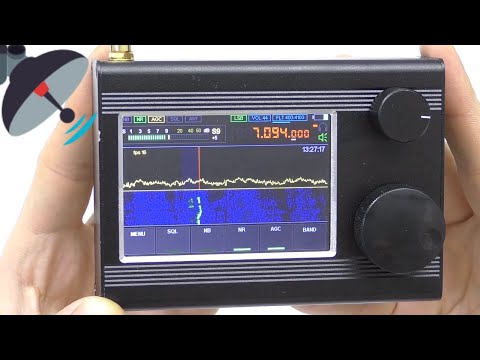
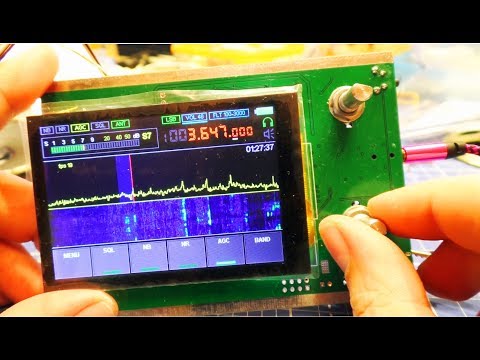
Over on YouTube Kevin Loughin has uploaded a video reviewing the "Recent RS-918" which is a Chinese clone of the popular mcHF open source SDR transceiver made by Chris (M0NKA). The mcHF is a well known small and inexpensive home brewed open source HF QRP SDR that was started back in 2013. It's sold either as a kit for 236.82 GBP (US$287), or with metal enclosure at 292.78 GBP (US$354). The kit comes with SMD components already soldered, but you still need to solder the through hole components and assemble it into the enclosure. The RS-918 clone can be found fully assembled as a ready to use product on eBay for approximately US$400.
As the "Recent RS-918" is a commercial Chinese clone of an open source project that has restrictions against commercial use, it goes against the spirit and legality of the licence imposed by the original creator. So based on that Kevin cannot recommend the RS-918 SDR. However, from his review Kevin notes that apart from some burning hot areas on the metal after transmitting, the SDR itself works and has a nice minimal design. The design appears to be based on an older version of the mcHF, so the latest upgrades are not available.
Kevin's review just overviews the RS-918 and doesn't go into depth reviewing the radio. For the rest of his video Kevin discusses the lineage of the RS-918, noting that it is actually a clone of the Ailunce HS1, which in turn is a clone of the mcHF. He then goes on to discuss the mcHF itself, noting that we should support all the hard work that Chris has put in (and continues to put in) to the original mcHF rather than these immoral clones.
Ham Radio - The RS-918 clone of a clone of an outstanding open source SDR transceiver, the mcHF.
A modern digital oscilloscope uses an analogue to digital converter (ADC) and digital signal processing (DSP), just like a software defined radio does, so it stands to reason that with some software hacks an oscilloscope could be turned into an SDR.
To facilitate this, jmfriedt has just released his new software called "gr-oscillioscope" over on GitHub. GR-Oscilloscope allows you to use a digital oscilloscope as a software defined radio source in the latest GNU Radio 3.8. It has been tested with a Rohde & Schwarz RTO2034 and RTE1054, and should work on any RT series oscilloscope. The software works by using the VXI11 RPC protocol which is a protocol designed for connecting instruments like oscilloscopes to computers.
We've decided to ask the community what sort of radio would be more popular for a ~$30 RX-only SDR. Note that thus far this is only a hypothetical SDR that does not yet have any designs. We are just feeling for what's most interesting to people and exploring for future ideas which may not even be feasible at this time.
As always with engineering, there is always a trade off. It is likely that any low cost SDR can only be wide band, with basic RF performance, narrowband with good RF performance, or expensive.
Loading ...
Wider bandwidth: Currently the RTL-SDR allows you to see up to 3.2 MHz of spectrum live. Higher bandwidth (10 MHz or more) would mean seeing more of the spectrum at once without needing to retune, faster whole spectrum scans and the ability to receive wideband signals.
RF Performance: The RTL-SDR has an 8-bit ADC. While sufficient for many applications, in the presence of strong signals the ADC will saturate resulting in poor reception and signal overload. Higher end SDRs like the SDRplay, Airspy, LimeSDR etc use 12-bit or higher ADCs.
Frequency Range: The RTL-SDR V3 can tune from 500 kHz to 1.75 GHz. An expanded SDR could potentially tune up to 4 GHz or even higher.
If you're interested in other things, please comment on this post!
Software defined radio (SDR) is a relatively new technology that has impacted the world of radio technology in many ways. But beyond SDR, there are still some other very interesting radio technologies being worked on, such as "Atomic Radio" a.k.a "Quantum Radio".
Atomic radio is essentially an idea that makes use of how special "Rydberg" atoms can modulate a laser beam when radio waves pass through them. A photo diode is then used to optically detect the radio wave from the modulated laser. This way of receiving requires no traditional radio circuits like amplifiers, mixers, and of course no antenna, so in theory the radio signal could be received with significantly less noise and with the highest possible SNR.
If you're interested in learning more about Atomic Radio, Hackaday recently ran an excellent article where they describe the concept and science behind it in more depth. They also go into some recent studies where scientists showed that they were able to receive two signals at once, and mention how one paper describes an extremely wideband Atomic Radio that can receive from the C-Band to the Q-band (4 GHz to 50 GHz).
Hackaday's Article is a Great Introduction to Atomic Radio
The Signal ID Wiki (sigidwiki) is our sister site that we started a few years ago as a way to collect and catalog various types of signals that an SDR user might see and hear on the airwaves. The idea is that a user could search the database to learn about and identify unknown signals. Over time it has grown significantly, with now almost 400 known signals with both waterfall images and sound samples available in the database. Special thanks to lead admin Carl Colena for maintaining and playing a huge role in the databases' growth.
Artemis is an open source Windows/Linux/MacOS compatible application initially programmed by Marco Dalla Tiezza. It brings the sigidwiki website into an offline searchable database with an easy to use UI. Today version 3.0 was released to the public. The new version has been completely rewritten from scratch in Python, as the previous versions were written in BASIC (a now abandoned programming language). The new version has an improved UI, and paves the path for future improvements.
Marco notes that in the future they hope to add an Autocorrelation function, which might help users automatically identify certain types of repetitive signals simply by playing the raw audio into Artemis.
Note that in order to download the software you will need to sign up to their forum, which is free.
In this episode Corrosive from the SignalsEverywhere YouTube channel begins a series on reverse engineering an old 90's Barbie branded 2.4 GHz wireless camcorder toy, and using it for Amateur Radio TV. The camcorder toy consists of the wireless camera, and a base station that plugs into a TV.
After taking the camcorder apart Corrosive discovered a potentiometer on the PCB which allows the transmit frequency to be adjusted, and that the camera's CCD sensor can actually output composite video, possibly allowing for improved video quality. In addition he found the datasheet for the main FM demodulator chip on board the base station, and saw that it is designed to operate from 350 to 550 MHz. So he speculates that elsewhere in the circuit is a 2.4 GHz downconverter which may be useful for other projects too.