The Othernet project aims to bring live data such as news, weather, video, books, Wikipedia articles and audio broadcasts to the world via cheap receivers and a free satellite service. Although an internet connection provides the same data, Othernet's satellite broadcast is receivable in remote areas, will continue working in disasters, and costs nothing to continually receive roughly 100-200 MB of data a day. The trade off is that the service is downlink only, so the data that you get is only what is curated by the Othernet team. Currently the service is only available in North America and Europe, but service to other areas in the world may eventuate in the future.
We've posted about this project a few times in the past, as previously they used an L-band satellite service that was received by RTL-SDR dongles. However, these days they operate using LoRa hardware chips on the Ku-band.
Over on YouTube the TechMinds YouTube channel has just uploaded a video that demonstrates the Othernet service being received from the UK via their Dreamcatcher hardware. In particular he shows off the APRS feature which sends any APRS message containing the string "OUTNET" to the Othernet satellite stream. Later in the video he also shows the news articles, weather data, Wikipedia and audio data that was received.
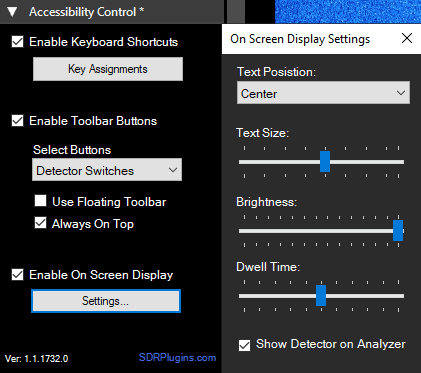
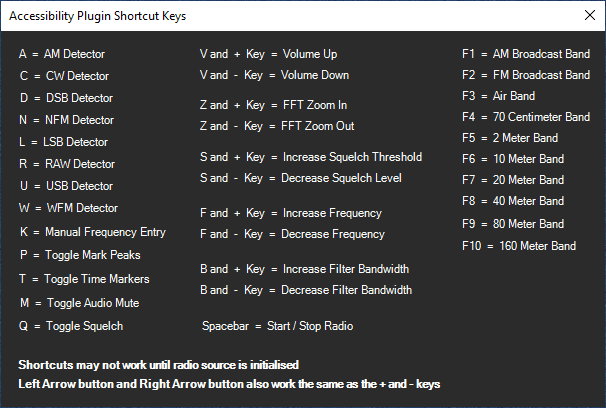
In the past we've seen several SDR# plugins released by Eddie MacDonald, and now thanks to recent updates to the core of SDR#, he's been able to work on and release a new accessibility plugin for SDR#. Eddie writes -
I have created a new plugin which provides keyboard shortcuts, an on screen display and a new improved toolbar for the new native toolbar area that Prog has provided to plugin developers.
There are many new and improved toolbar buttons available.
Many, many keyboard shortcuts including the ability to directly enter the frequency easily from the keyboard.
I am currently working on incorporating a screen reader into the plugin to aid the blind in using SDR#.
GNU Radio Conference 2019 (GRCon19) was a conference about GNU Radio and projects based on GNU Radio that was held back in September 2019. GNU Radio is an open source digital signal processing (DSP) toolkit which is often used in cutting edge radio applications and research, and to implement decoders, demodulators and various other SDR algorithms.
Yesterday videos from all the GRCon19 talks were uploaded to YouTube. The talks consists of many high level and cutting edge SDR topics. All talks can be found on their GRCon19 YouTube playlist, and matching slides on the GRCon19 website presentations page.
A list of the talk titles is pasted below.
Huntsville's Connection to Space
GNU Radio Project Update
Mega Hertz, Mega Samples, Mega bits, Mega Confusing
Man or Machine?: Developing a Turing Test for Radio Intelligence
UHD Four-O
Striving for SDR Performance Portability in the Era of Heterogeneous SoCs
Fixing the E310 Bottleneck: Implementing a High-Rate Heterogeneous FPGA DMA
Determining Optimized Radio settings for specific waveforms
Software Defined Everything
GNU Radio Beyond 3.8 - A Technical Outlook
GNU Radio Enhancements for Space-Based Research
A decade of gr-specest -- Free Spectral Estimation!
Open Source Licensing
Spectrum Monitoring Network: Tradeoffs, Results, and Future Directions
The Future of Digital RFICs
Phase Synchronization Techniques
Synchronization: Core Concepts and Applications
AI and SDR: Software Meets Hardware Again...
Building a radio with M2K and spare parts
How we talked from the Moon: the Apollo communication system
gr-satellites: a collection of decoders for Amateur satellites
gr-iio: Nuances, Hidden Features, and New Stuff
Open Sourcing the Search for Extraterrestrial Intelligence
Multi-Vehicle Map Fusion Using GNU Radio
SigMF.
GPUDirect + SDR: How to Move One Billion Samples per Second over PCIe
Multichannel phase coherent transceiver system with GNU Radio interface
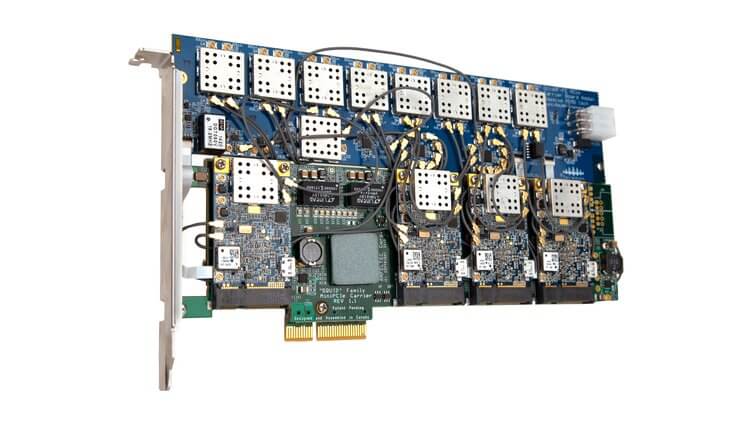
Back in 2017 we posted about the crowd funding of the Fairwaves XTRX, a small PCIe based TX/RX capable software defined radio that back then cost US$199 (now only the XTRX Pro is available for US$599). The XTRX is based on the same RF chips that are used in the LimeSDR and each unit has 2 x 2 MIMO (multi-input, multi-output), 120 MSPS SISO / 90 MSPS MIMO, 30 MHz to 3.7 GHz tuning range and comes with an on board GPSDO.
If you’re working on a massive MIMO system or have a large swath of spectrum you need to monitor, XYNC (pronounced iks-sync) is right for you. XYNC builds on the success of the Octopack SDR we offered during the XTRX campaign and takes into account feedback from the original Octopack users.
You can connect two XYNC boards, either to increase the number of RX/TX channels (e.g., two XYNC Octos give you 32 TX and 32 RX channels) or to increase throughput per channel (e.g., two XYNC Quadros give you twice the throughput of a single XYNC Octo). Connecting more than two XYNC boards is also possible, but requires an external clock and 1 pps signal distribution circuitry, neither of which is provided as part of this campaign.
While advertised as low cost, the pricing is probably out of reach for most hobbyists, with the quad 8x8 unit coming in at US$4500 and the top 16 board 32x32 unit priced at US$13,000. Still, these prices are very good for a massively MIMO SDR and pricing is set to rise once the crowdfunding campaign ends in 39 days.
The XSYNC Massively MIMO SDR with up to 32x32 TX/RX Channels
If you’re unfamiliar with Hackaday’s Hack Chat, these are chat sessions with individuals experienced in various fields in which anyone can join in and ask questions during the session. The Hackaday team has run these events with many guest hosts covering a plethora of interesting topics. This however, will be the first Hack Chat revolving around Software Defined Radio.
The hack chat will discuss many sub-hobbies of the SDR world from Amateur Radio and satellite operation to things like weather sonde tracking, monitoring and more.
If you have some SDR questions that have been burning you may want to hop on this session as it’s a one-day event, of course there is always our [Forums] where our community is happy to answer your questions as well.
Ben Hilburn is the project lead for GNU Radio, the free and open software radio ecosystem.
GNU Radio works best in an Linux environment and can also run on the ever popular Raspberry PI.
Ben and I discuss what GNU Radio is, how people are using GNU Radio, and how easy it is to get started with this amazing piece of free software.
If you are looking to learn how the hardware inside of a radio makes it work, or maybe you already do…. GNU radio is a great resource for you
Ben himself has a new podcast of his own titled "Signals & Bits" and there are a number of episodes already out, including an interview with SignalsEverywhere YouTube channel host Harold Giddings, Manuel Uhm Director of Marketing at Xilinx who talks about SDR designs on FPGA chips, and most recently Daina Bouquin who talks about her project called "The Space Library" that is in collaboration with the LibreSpace Foundation.
If you've been following our blog, or have your own RTL-SDR based weather satellite station, then you'll know that the NOAA-15 APT satellite has been experiencing issues lately. There appear to be problems with it's camera scan motor resulting from it running low on lubrication. This is fully understandable as the satellite is 21 years old and well past it's expected life span. The satellite appears to be working some days, and producing garbage image other days.
When NOAA-15 fails for good, don't feel too bad as we still have NOAA-18 and NOAA-19, the Russian Meteor M2, and Meteor M2-2 satellites, and the GOES satellites, all of which can be received by an RTL-SDR. Several new weather satellites are also planned for 2020 and onwards.
UPDATE: John wanted to add the following clarification:
In the article you wrote, you suggest that the two noise generators are equivalent. This is not the case. The noise generator you mentioned generates "Thermal Noise". Mine generates "Shot Noise".
The Zener in the generator you mentioned, contributes zero noise in the Gigahertz spectrum. Whereas mine generates Shot Noise roughly 20 db higher than the thermal noise floor all across the range.
The physics and the mathematics are as different as night and day.
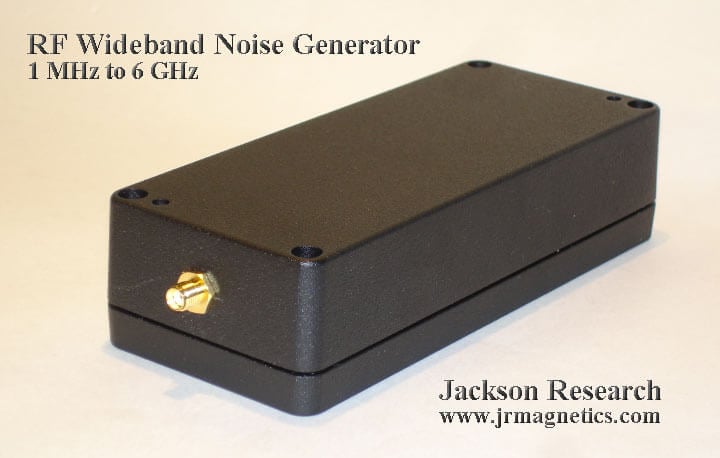
Thank you to John Jackson from Jackson Research for writing in and sharing his Kickstarter for a laboratory grade RF broadband noise generator. John notes that he's discovered a semiconductor that is much cheaper than the expensive avalanche diodes used in other high end noise sources. This semiconductor has allowed him to create a noise source that works from 40 MHz up to 6 GHz. The target output power is 0 dB, with a flatness of less than 2 dBm over the entire bandwidth.
A noise source is useful for SDR/radio experiments as it is used in many applications such as scalar network analyzers, filter response measurements, satellite tuning, cellphone network tuning, antenna VSWR measurements, amplifier noise measurements and in jammers. If you're interested we have a previously posted tutorial about using an RTL-SDR and noise source for filter characterization and antenna VSWR measurements.
John is fundraising via Kickstarter in order to help fund development of the final product. The pricing is currently US$500. This might seem high, but John notes that comparable professional noise sources start at US$3,500 and go up to US$30,000. John writes:
There are a number of laboratory grade RF Noise generators on the market. They are all extremely expensive ranging in the thousands of dollars. This is beyond the reach of most individuals. In contrast, there are some low cost RF noise generator schematics floating around the Internet which are all based upon Zener diodes.
The problem with Zener diodes is the noise bandwidth. All the circuits I have seen have cutoff frequencies in the Megahertz range. The one noise circuit I saw used in the Gigahertz range was actually amplifier noise and had problems due to the several stages of amplification.
The alternative to Zener diodes is the avalanche diode specifically designed as a RF noise generator. These devices are difficult to acquire and have very high prices which often exceed the entire cost of all the parts and components needed to build the instrument.
Professor Jackson at Jackson Research has discovered a semiconductor that generates RF noise like an avalanche noise diode into the Gigahertz range, but at Zener diode prices. He has raw laboratory data and now needs to build up a professional grade instrument. To achieve this goal, he has launched a new KickStarter fund raiser to build up a number of units.
Jackson Research Laboratory Grade Broadband RF Noise Source