Category: RTL-SDR

New product from FlightAware: A 1090 MHz Bandpass Filter for the RTL-SDR

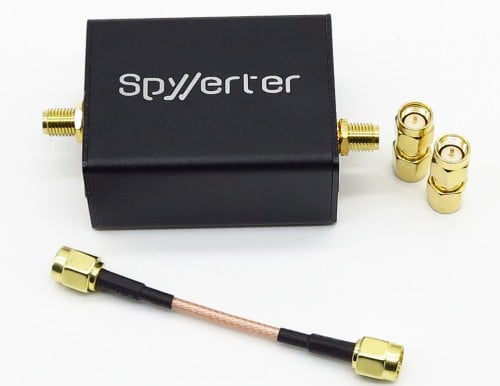
FlightAware.com have released a new 1090 MHz bandpass filter that is intended for use with the RTL-SDR. FlightAware.com is a website that aggregates ADS-B aircraft location data from various contributors. The contributors are often users with RTL-SDR dongles running their PiAware software. By contributing to their service you gain access to their premium services for free.

The bandpass filter is available on Amazon for US customers for $19.95 USD and on eBay worldwide for $24.95 USD. This is the cheapest ADS-B filter we've seen yet. It comes in a metal case with SMA connectors, passes 980 MHz - 1150 MHz, has an insertion loss of about 1.65 dB at 1090 MHz and has about a 40dB drop outside the pass band. Over on their forums many users are reporting good results.

A bandpass filter blocks all frequencies apart from the range you are interested in, significantly reducing the effects of out of band interference. It is especially useful if you live near cell phone towers as these can easily interfere with the 1090 MHz frequency. 

FlightAware also sell an ADS-B antenna on Amazon for $44.95 USD and worldwide on eBay for $54.99 which may be of interest to some people.

An alternative ADS-B filter for the RTL-SDR is the one made by Adam 9A4QV. Adams filter uses LTCC filter technology which gives lower insertion loss, but a less sharp cutoff.

The FlightAware 1090 MHz ADS-B Filter
Filter Reponse Test Data

Frequency Manager Suite Plugin for SDR#

Recently the popular Frequency Manager + Scanner plugin set for SDR# has been upgraded and renamed to the “Frequency Manager Suite”. The plugin can be downloaded from their new website at www.freqmgrsuite.com. The plugin suite includes a frequency scanner and manager, a scanner metrics recorder, a scheduler, an activity logger and a frequency entry plugin.

Apart from plugins the suite also now includes a plugin manager program called “Pluginator” which can help you to install and delete plugins without needing to edit the Plugins.xml file directly. There is also a new database manager tool which can help you to import frequency databases from online or other sources.

We have posted the full feature release below:

The Frequency Manager Suite (FMS) adds 4 more plugins to the previous set of 3:

  • Scheduler – allows you to schedule listening activities by date and time.

  • Activity Logger – records scanner activity to a file for later use.

  • Scanner Decisions – now a first-class plugin and also available as the classic stand-alone window. And you can change the position of the plugin without restarting SDR#.

  • Frequency Details – displays details about a frequency from your database. And you can change the position of the plugin without restarting SDR#.

New standalone applications also come with FMS:

  • Data Tools – this significantly upgraded import/export application lets you import data from 6 popular internet databases as well as generically-formatted files, and permits you to export your FMS databases to standard file format.
  • The Pluginator – an application that lets you add, delete, and change the order of plugins without ever having to hand-edit the SDR# file Plugins.xml. Just fill in the blanks.

New features in Frequency Manager + Scanner:

  • The new Preferences dialog allows customization without hand-editing a configuration file.
  • FMS configurations are now kept in a file separate from those of SDR#, permitting easier upgrades to SDR#.
  • You can have multiple frequency databases, and can change to a different database without restarting SDR#.
  • When tuning manually you can optionally change the radio settings (mode, BW, etc.) according to what’s in the database for the tuned frequency.
  • Scan resolution – high-res or low-res to favor speed over accuracy or vice versa.
  • Adjacent Frequency Rejection now displays its bandwidth on the spectrum analyzer.
  • Plus many other improvements and bug fixes.

fms_1v2   fms_3   fms_2   

pluginator

Detecting Pulsars (Rotating Neutron Stars) with an RTL-SDR

The RTL-SDR has been used for some time now as an amateur radio astronomy tool. Radio astronomers Peter W East and GM Gancio have recently uploaded a paper that details their experiments with detecting Pulsars with an RTL-SDR (doc file).

A pulsar is a rotating neutron star that emits a beam of electromagnetic radiation. If this beam points towards the earth, it can then be observed with a large dish antenna and a radio, like the RTL-SDR. The abstract of the paper reads: 

This project sought to determine the minimum useful antenna aperture for amateur radio astronomers to successfully detect pulsars around the Hydrogen line frequency of 1420MHz. The technique relied on the collaboration with GM Gancio, who provided RTL SDR data of the Vela pulsar (B0833-45, J0835-4510) and others, collected with a 30m radio telescope. This data was processed to determine the achievable signal-to-noise ratio from which, the minimum useful dish size necessary for some effective amateur work, could be calculated. Two software packages were developed to do synchronous integration, a third to provide a power detection function and a fourth for spectrum analysis to recover pulsar rotation rate.

With their system the authors were able to detect and measure the rotation period of the Vela pulsar. Also, from their data they were able to estimate that the minimum dish aperture required to observe the Vela pulsar would be 6m, noting that the Vela pulsar is probably the strongest pulsar ever detected. They also write that by utilizing 5 RTL-SDRs to gather 10 MHz of bandwidth together with some processing that the minimum required dish aperture could be reduced to 3.5m.

The Vela pulsar pulse power integrated over a 50 second 100MB file, combining some 560 pulsar pulses
The Vela pulsar pulse power integrated over a 50 second 100MB file, combining some 560 pulsar pulses.

In addition to these Pulsar experiments, Peter has also uploaded new papers about improving his Hydrogen Line RTL-SDR Telescope (pdf), and has updated his paper on improving the frequency stability of RTL-SDR’s with air cooling (doc file). Peter found that the frequency stability of the RTL-SDR (with standard oscillator) could be significantly improved by adding heat sinks and aircooling them. The graph from his paper below summarizes his results.

Results from air cooling the RTL-SDR.
The air cooled and heatsinked RTL-SDRs
The air cooled and heat sinked RTL-SDRs

All of Peters papers can be found on his website at y1pwe.co.uk/RAProgs/index.html. He has many RTL-SDR radio astronomy related resources there, so check it out if you are interested.

CubicSDR v0.1.4 Beta Released

CubicSDR is a new and upcoming multi platform open source SDR software package that is compatible with the RTL-SDR. It is similar to programs like SDR#, HDSDR and SDR-Radio. Recently the programmers have released version 0.0.4-beta which adds several new features which we have listed below:

  • Audio Spectrum visuals, drag the A/V visuals area to toggle between audio Scope and Spectrum
  • Waterfall speed can now be controlled between 1 and 1024 lines per second
  • Waterfall now continues to render while minimized or in background
  • Waterfall/Spectrum can now be zoomed to 30khz window with improved resolution
  • Spectrum averaging speed can now be controlled between 1% and 99%
  • I/Q mode for piping decimated I/Q to other applications at audio sample rate
  • Spectrum peak and floor decibels now displayed (can toggle off/on with ‘B’)
  • Can now mute demodulator with ‘M’ button or pressing ‘M” while hovering
  • Save and recall device Offset, I/Q swap, Direct sampling, Waterfall/Spectrum speed, Window state
  • Performance and UI responsiveness improvements
  • Can now use direct input for demod bandwidth
  • Direct input < 3000 now assumes Mhz
  • Additional device input sample rates
  • Improved waterfall keyboard controls via arrow keys
  • Can now specify alternate configuration name via -c (name) or -config (name) at command line
  • Automatically reduce unused buffer memory over time
  • Several crash fixes

CubicSDR is compatible with Windows, Linux and MacOS. It can be downloaded from www.cubicsdr.com.

CubicSDR v0.1.4 Demonstration

Showing how the R820T stops receiving at 1.4 GHz+ with increasing temperature

Over on YouTube RTL-SDR experimenter Adam 9A4QV has uploaded a video showing how the R820T dongle can fail to receive properly at frequencies above about 1.4 GHz as the temperature in the dongle rises. This is a known problem that may cause issues when trying to receive satellite signals like Inmarsat at 1.541450 GHz. In our own tests, the R820T2 chip appears to be much less prone to this behaviour when compared with the R820T, but still fails if the ambient temperature gets too hot, for example if left in direct sunlight. We’ve had several R820T2 RTL-SDR’s running at 1.5 GHz+ for over 48 hours when left in the shade, but not one R820T ran for more than a few minutes at those frequencies. Of course the E4000 tuner is the best RTL-SDR tuner for these GHz level frequencies, but that tuner is now rare and expensive.

Over on Reddit, some people have been discussing this issue, and have proposed that the likely cause is related to the PLL failing to lock properly at higher temperatures. A fix may be to apply a blob of solder to the vias underneath the R820T chip, and then attach a heatsink. The problem also does not occur on the Airspy, a higher performance SDR that also uses the R820T2 chip in its design. This may be due to better drivers for the Airspy, or better heat dissipation in the Airspy’s hardware design.

R820T stop receiving @ higher frequencies

Reverse Engineering Bus Telemetry Data with an RTL-SDR

Bastian recently wrote into us at RTL-SDR.com to let us know that he’s been working on reverse engineering the bus telemetry system used in his hometown of Paderborn, Germany. Bus telemetry is often used to update live signs at bus stops that indicate based on GPS data how long a bus user needs to wait for the next bus.

Bus sign: Wireless bus telemetry updates this sign.

A similar reverse engineering of bus telemetry was performed before by Oona Raissan in Helsinki, Finland. Oona found that in Helsinki bus telemetry was transmitted as a DARC subcarrier embedded in regular broadcast FM radio. In many countries bus telemetry runs through GSM or TETRA communications as well, which are encrypted and would be very difficult to decode.

However in Paderborn, Germany Bastian discovered that the bus telemetry system used a different protocol which he discovered by noticing that some very strong signals appeared on his spectrum at 150.9 MHz whenever a bus drove by his flat.

After making a recording of this signal in GQRX, bastian analysed it in Audacity and discovered that the binary data bits were encoded by the presence or absence of a half sine wave. After discovering the encoding he was then able to determine the bit rate and build a decoder in GNU Radio. His post goes into further detail about concepts he used in his GNU Radio program such as frame detection, bit stuffing and error detection.

Finally, with all his decoder program written he was able to gather lots of data from each packet such as the bus ID, line, bus stop, distance from last bus stop, delay, position and even the orientation of the bus. Bastian has also uploaded a video showing everything in action, which we have embedded below.

Bus position heatmap from data obtained via the RTL-SDR

A new AIS Decoder for the RTL-SDR on Android

A reader of our blog, EBC81, has written in to let us know about a new RTL-SDR based AIS decoder that he has written for the Android OS. AIS stands for Automatic Identification System and is used by ships to broadcast their GPS locations, to help avoid collisions and aid with rescues. An RTL-SDR with the right software can be used to receive and decode these signals, and plot ship positions on a map.

EBC81’s program is called rtl_ais_android and can be downloaded from this GitHub link. It decodes the AIS data into NMEA messages, which can then be sent via UDP to mapping programs in Android or a program like OpenCPN on your PC. To use the app you will need a USB OTG cable to connect your Android device to the RTL-SDR.

In the future EBC81 hopes to create a second app which will display the ship positions on a map.

RTL-SDR Tutorial: Decoding Inmarsat STD-C EGC Messages

Inmarsat is a communications service provider with several geostationary satellites in orbit. They provide services such as satellite phone communications, broadband internet, and short text and data messaging services. Geostationary means that the satellites are in a fixed position in the sky and do not move. From almost any point on earth at least one Inmarsat satellite should be receivable. 

Inmarsat transmits in the L-band at around 1.5 GHz. With an RTL-SDR dongle, a cheap $10 modified GPS antenna or 1-2 LNA's and a patch, dish or helix antenna you can listen to these Inmarsat signals, and in particular decode one channel known as STD-C NCS. This channel is mainly used by vessels at sea and contains Enhanced Group Call (EGC) messages which contain information such as search and rescue (SAR) and coast guard messages as well as news, weather and incident reports. More information about L band reception is available at UHF-Satcoms page. See the end of this post for a tutorial on modifying a GPS antenna for Inmarsat reception.

Some examples of the EGC messages you can receive on the STD-C NCS channel are shown below:

Military Operations: Live Firing Warning
STRATOS CSAT 4-AUG-2015 03:21:25 436322
SECURITE
FM: RCC NEW ZEALAND 040300 UTC AUG 15

COASTAL NAVIGATION WARNING 151/15

AREA COLVILLE, PLENTY
CUVIER ISLAND (REPUNGA ISLAND), BAY OF PLENTY
1. LIVE FIRING 060300 UTC TO 060500 UTC AUG 15 IN DANGER AREA NZM204. 
ANNUAL NEW ZEALAND NOTICES TO MARINERS NUMBER 5 REFERS.
2. CANCEL THIS MESSAGE 060600 UTC AUG 15
NNNN
Armed Robbery / Pirate Warning
NAVAREA XI WARNING
NAVAREA XI 0571/15
SINGAPORE STRAIT.
ARMED ROBBERY INFORMATION. 301845Z JUL.
01-04.5N 103-41.8E.
FIVE ROBBERS ARMED WITH LONG KNIVES IN A SMALL UNLIT HIGH SPEED BOAT APPROACHED A BULK CARRIER UNDERWAY.  ONE OF THE ROBBERS ATTEMPTED TO BOARD THE SHIP USING A HOOK ATTACHED TO A ROPE. ALERT CREW NOTICED THE ROBBER AND RAISED THE ALARM AND CREW RUSHED TO THE LOCATION. HEARING THE ALARM AND SEEING THE CREW ALERTNESS, THE ROBBERS ABORTED  THE ATTEMPTED ATTACK AND MOVED AWAY. INCIDENT REPORTED TO VTIS SINGAPORE. ON ARRIVAL AT SINGAPORE WATERS, THE COAST GUARD BOARDED THE SHIP FOR INVESTIGATION.

VESSELS REQUESTED TO BE CAUTION ADVISED.
Armed Robbery / Pirate Warning
NAVAREA XI WARNING
NAVAREA XI 0553/15
SINGAPORE STRAIT.
ROBBERY INFORMATION. 261810Z JUL. 
01-03.6N 103-36.7E. 
DUTY ENGINEER ONBOARD AN UNDERWAY PRODUCT TANKER DISCOVERED THREE ROBBERS IN THE ENGINE ROOM NEAR THE INCINERATOR SPACE. THE ROBBER THEIR BOAT. A SEARCH WAS CARRIED OUT. NO ROBBERS FOUND ON BOARD AND NOTHING REPORTED STOLEN. VTIS SINGAPORE INFORMED. COAST GUARD BOARDED THE TANKER FOR INVESTIGATION UPON ARRIVAL AT SINGAPORE PILOT EASTERN BOARDING AREA.VESSELS REQUESTED TO BE CAUTION ADVISED.
CANCEL 0552/15.
Submarine Cable Repair Warning
NAVAREA XI WARNING
NAVAREA XI 0569/15
NORTH PACIFIC. 
SUBMARINE CABLE REPAIRING WORKS BY 
C/V ILE DE SEIN. 05 TO 20 AUG. 
IN VICINITY OF LINE BETWEEN 
A. 21-37.3N 156-11.5W AND 25-03.6N 148-43.2E.
CANCEL THIS MSG 21 AUG.
Search and Rescue - Missing Vessel
ON PASSAGE FROM LAE (06-44S 147- 00E) TO FINSCHHAFEN (06-36S 147-51E), MOROBE PROVINCE. VESSEL DEPARTED LAE AT 310500Z JUL 15 FOR FINSCHAFFEN WITH ETA OF 310800Z JUL 15 BUT FAILED TO ARRIVE. 
ALL VESSELS REQUESTED TO KEEP A SHARP LOOKOUT AND BE PREPARED TO RENDER ASSISTANCE. REPORTS TO THIS STATION OR MRCC PORT MORESBY VIAEMAIL: ******@****.***.**, TELEPHONE +*** *** ****; RCC AUSTRALIA VIA TELEPHONE +*********** INMARSAT THROUGH LES BURUM (POR ***,IOR***), SPECIAL ACCESS CODE (SAC) **, HF DSC *******
NL BURUM LES 204 4-AUG-2015 03:23:14 773980
AMSA_ER 23150928
PAN PAN
FM JRCC AUSTRALIA 030858Z AUG 15 INCIDENT 2015/5086
AUS4602 CORAL AND SOLOMON SEAS
23FT WHITE BANANA BOAT WITH BROWN STRIPES, AND A 40HP OUTBOARD AND 5 ADULT MALES IS OVERDUE ON PASSAGE FROM LAE (06-44S 147- 00E) TO FINSCHHAFEN (06-36S 147-51E), MOROBE PROVINCE. VESSEL DEPARTED LAE AT 310500Z JUL 15 FOR FINSCHAFFEN WITH ETA OF 310800Z JUL 15 BUT FAILED TO ARRIVE. 
ALL VESSELS REQUESTED TO KEEP A SHARP LOOKOUT AND BE PREPARED TO RENDER ASSISTANCE. REPORTS TO THIS STATION OR MRCC PORT MORESBY VIA EMAIL: *******@****.***.**, TELEPHONE +*** *** ****; RCC AUSTRALIA VIA TELEPHONE +************ INMARSAT THROUGH LES BURUM (POR ***,IOR ***), SPECIAL ACCESS CODE (SAC) **, HF DSC *********, EMAIL: ******@****.***.** OR BY FAX +************.
NNNN
Scientific Research Vessel Drilling - Request for wide clearance
NL BURUM LES 204 4-AUG-2015 02:29:41 709950
AMSA_ER 23153978
SECURITE
FM JRCC AUSTRALIA 040224Z AUG 15 
AUSCOAST WARNING 202/15
SPECIAL PURPOSE VESSEL JOIDES RESOLUTION CONDUCTING DRILLING OPERATIONS IN POSITION 28 39.80` S 113 34.60` E
2.5NM CLEARANCE REQUESTED.
NNNN
Weather Warning
PAN PAN
TROPICAL CYCLONE WARNING / ISSUED FOR THE NORTH OF EQUATOR OF METAREA
XI(POR).
WARNING 050900.
WARNING VALID 060900.
TYPHOON WARNING.
TYPHOON 1513 SOUDELOR (1513) 930 HPA
AT 19.9N 133.2E WEST OF PARECE VERA MOVING WEST 12 KNOTS.
POSITION GOOD.
MAX WINDS 95 KNOTS NEAR CENTER.
RADIUS OF OVER 50 KNOT WINDS 80 MILES.
RADIUS OF OVER 30 KNOT WINDS 240 MILES NORTH SEMICIRCLE AND 210 MILES
ELSEWHERE.
FORECAST POSITION FOR 052100UTC AT 20.1N 130.6E WITH 50 MILES RADIUS
OF 70 PERCENT PROBABILITY CIRCLE.
935 HPA, MAX WINDS 90 KNOTS NEAR CENTER.
FORECAST POSITION FOR 060900UTC AT 20.8N 128.1E WITH 75 MILES RADIUS
OF 70 PERCENT PROBABILITY CIRCLE.
935 HPA, MAX WINDS 90 KNOTS NEAR CENTER.

JAPAN METEOROLOGICAL AGENCY.=

Continue reading