At the beginning of November, SDRplay Released version 5 of their SDRconnect software. SDRconnect is a relatively new official software platform for the SDRplay line of devices. Unlike their other software, SDRUno, SDRconnect is multiplatform and comes with a cleaner interface.
In their latest 'Preview 5' build the team has added various features listed below. In addition, a week after Preview 5 was released, they also released 'Update 1' which fixed several bugs. You can read about the changes in their Release notes, or via the screenshot below.
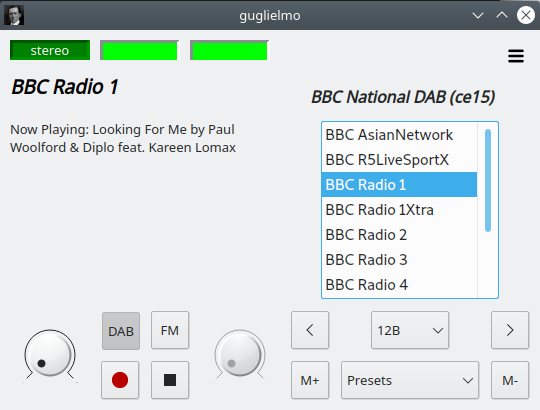
Guglielmo is Linux, Windows (and, in this recent update, x86 MacOS) based RTL-SDR FM and DAB tuner software that supports SDRs, including the RTL-SDR, Airspy, SDRplay, HackRF, and LimeSDR. It is designed to be easy to use for media users rather than hobbyist technical users.
Version 0.6 fixes bugs and adds the following features:
Software automatic gain control
Support for multiple devices for RTL-SDR and SDRplay
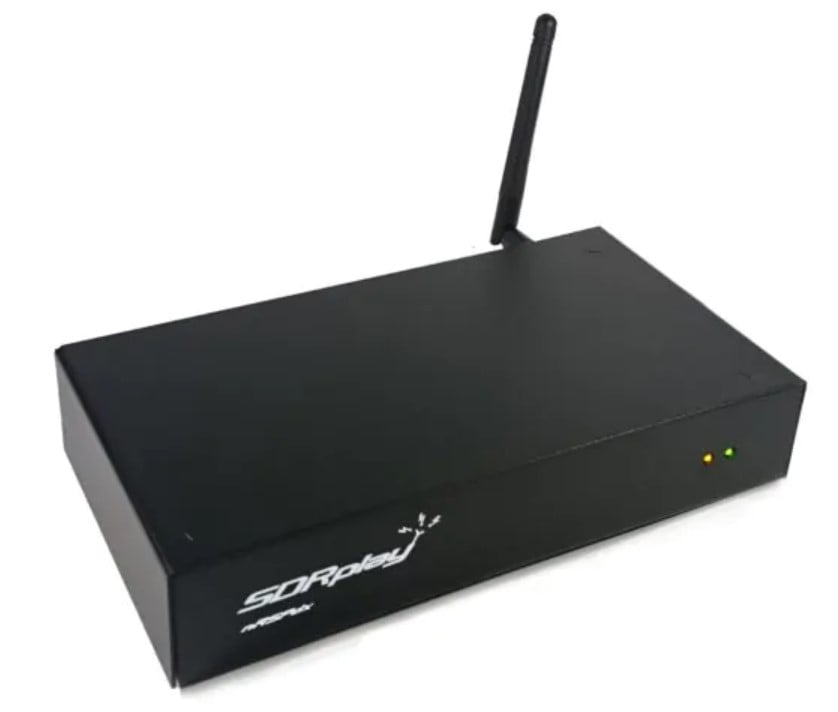
SDRplay has recently announced the upcoming release of their "nRSP-ST" networked receiver. The product appears to essentially be an RSP2 with built-in computing and networking. The idea is that this networked receiver will be used remotely, and connected to over a local network connection or the internet.
The device will work with SDRplays SDRConnect software and will be able to transfer RF data in three modes, Full IQ, IQ Lite, and Compact. In IQ lite mode, only the active channels' IQ data are transferred, saving on significant network bandwidth when compared to full IQ mode. In compact mode demodulation is carried out on the nRSP-ST itself, and compressed demodulated audio is sent over the network, saving on network bandwidth even more.
There are no details yet about the build, but we assume the internal computer is something like a Raspberry Pi 4 compute module or similar.
The new SDRplay nRSP-ST
SDRplay write:
SDRplay is demonstrating a new product at the UK Hamfest today in newark, UK. It’s an all-in-one, plug-and-play networked receiver which will launch later in the year.
SDRplay Limited is announcing the imminent launch of the “nRSP-ST”, an All-in-one, Plug-and-play Networked SDR Receiver. The “nRSP-ST” is being demonstrated publicly for the first time at the UK National Hamfest in Newark today.
This exciting new product addresses the needs of radio enthusiasts who want a ‘plug-and-play’ solution for remote reception. As well as achieving this, we have addressed typical internet bandwidth limitations with the creation of a novel “IQ Lite” mode, which efficiently delivers channels of IQ data. We have also introduced the ability to control and store IQ recordings at the remote location. We think the nRSP-ST will be ideal for anyone wanting a wideband remote receiver without needing computer skills and hours of set-up time and ongoing maintenance at the remote location. We are very much looking forward to making the product available as soon as possible. We are aiming to launch the nRSP-ST in time for the holiday shopping season and aiming at a price of just under $500 USD before tax.
The nRSP-ST key features:
A truly “plug and play” integrated, networked general coverage receiver:
Combines a receiver, a host computer and a whole lot more – all in one box!
Apply power and connect to the internet (Ethernet or Wi-Fi) and the nRSP-ST is automatically accessible from anywhere
The 14-bit ADC full featured wideband SDR receiver covers all frequencies from 1kHz through VLF, LF, MW, HF, VHF, UHF and L-band to 2GHz, with no gaps
Remotely monitor up to 10MHz of spectrum at a time from a choice of 3 antennas
Multi-platform SDRconnectTM software supports local operation or remote access on Windows, MacOS or Linux platforms
The nRSP-ST & SDRconnectTM are configurable for available network bandwidth:
In “Full IQ” mode, the nRSP-ST provides IQ data transfer of the visible spectrum bandwidth (e.g.for high-speed LAN or superfast internet connectivity)
In “IQ Lite” mode, the nRSP-ST provides IQ data of channels up to 192kHz wide (e.g. for digital decoding by the client)
In “Compact” mode the nRSP-ST provides compressed audio (ideal for slower internet connections)
Supports multiple client connections with a simultaneous mixture of connection modes
All modes support visualization of up to 10MHz spectrum bandwidth
Two remote connection options:
Use a remote SDRconnect client or
Use the built-in web-server for remote access from any web browsing capable device, including Android/iOS tablets and phones
The nRSP-ST offers the ability to record IQ and audio files to a NAS (network attached storage) device if available on the LAN.
Over on YouTube "Sam's eXperiments logs" have uploaded a video showing how he was able to succeed when using TEMPESTSDR to eavesdrop on HDMI cables with his SDRplay. TEMPESTSDR software combined with a software defined radio allows a user to eavesdrop on TVs, monitors, and more by wirelessly receiving their unintentional RF emissions and recovering information from those emissions. In many cases it is possible to recover live images of the display, clear enough to read text.
Sam's video explains the challenges he faced with signal strength due to the highly effective shielding of his HDMI cables. To get around this Sam shows how he unshielded his HDMI cables for the test. This is good news for privacy, as it shows how effective shielding can be at stopping these kinds of attacks. He then goes on to show the results he obtained which show text being read from his screen.
I Finally Succeeded: HDMI Signal Eavesdropping with TEMPESTSDR
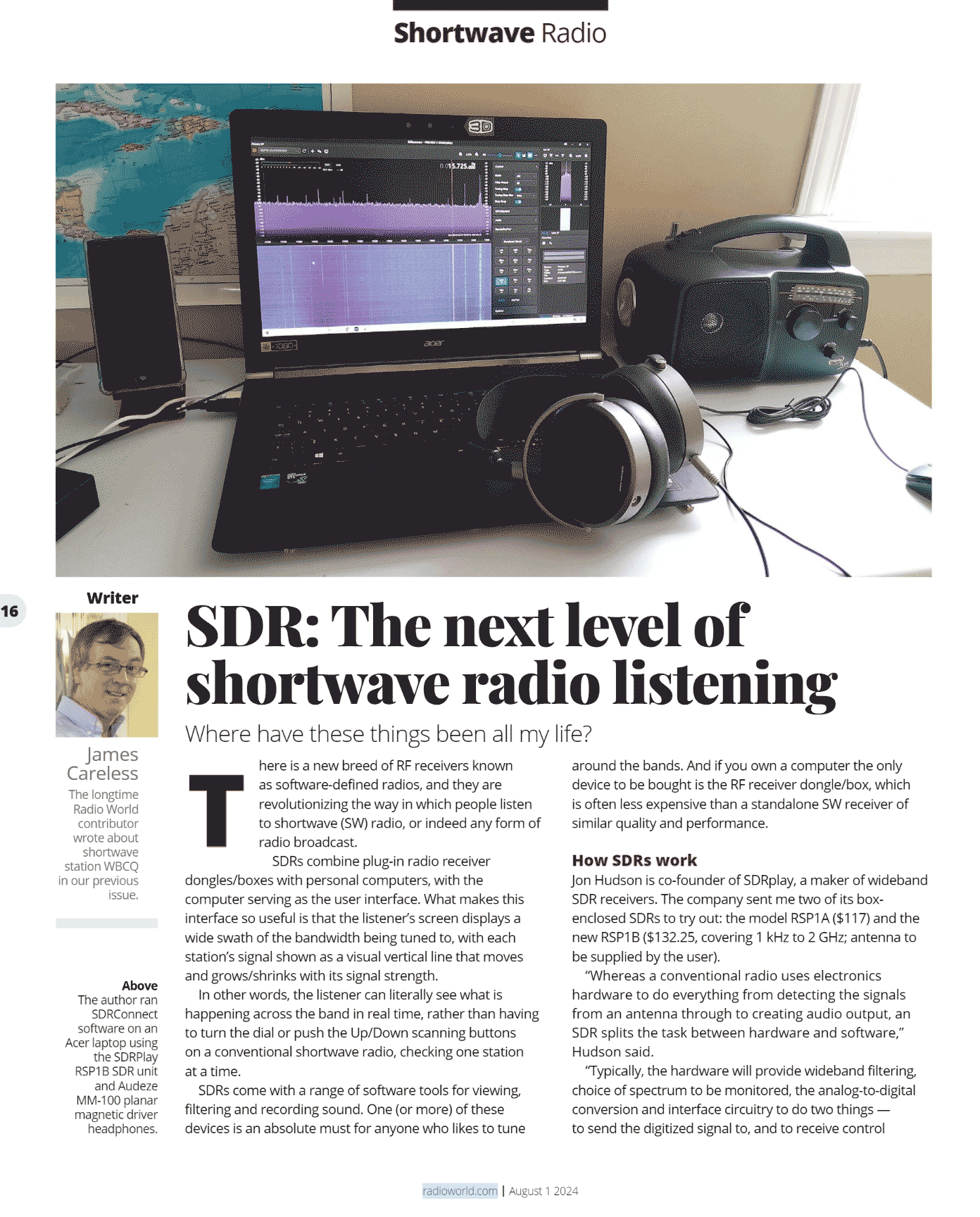
The latest August edition of the RadioWorld Magazine has included an article by James Careless about the use of software defined radios for shortwave radio listening. RadioWorld is a magazine targeted towards radio broadcast owners, managers and engineers all over the world. The article explores SDRplay and RTL-SDR Blog V4 units from the perspective of a shortwave listener new to software defined radios, comparing them to his high-end Sangean ATS-909X2 shortwave digital receiver.
At the end of last week, we posted how SDRplay released the RSPdx-R2, an updated version of their RSPdx product. Recently Matt from the Tech Minds YouTube channel received his RSPdx-R2 and has uploaded a video comparing the RSPdx-R2 to the previous model. His results show that the new model has an improved lower noise floor, resulting in signals with higher SNR.
In his tests, Matt uses the SDR Connect Preview 3 software. This is the latest version of SDRplay's new custom multiplatform software that they are developing. While testing the RSPdx-R2, Matt allows shows some of the new features in SDR Connect Preview 3, including a new Audio peak hold graph, FM MPX view, and a new frequency manager.
Introducing The New SDRPlay RSPdx R2 & SDR Connect Preview 3
Jon Hudson, SDRplay Sales and Marketing Director said “Global supply chain support issues have prompted some redesign of existing products to ensure continued supply for our UK manufacturing partners. With each new member of the RSP family, SDRplay tries to include improvements. This has given us the opportunity to offer performance enhancements at the same time as assuring supply”.
The RSPdx-R2 provides up to 10MHz spectrum visibility anywhere from 1kHZ to 2GHz with no gaps. It features:
Improvements to the RSPdx for MF frequencies and below:
Improved noise performance below 1MHz
Improved dynamic range below 2MHz both in tuner mode and HDR mode
3 Software selectable inputs, including a BNC input for up to 200MHz
The suggested retail price is £188.00 GBP (excluding VAT), $235.00 USD (excluding tax) or €225.60 EUR (excluding tax).
SDRplay recently launched their free multiplatform SDRconnect software which as well as running on Windows, will also run on MacOS and Linux/Raspberry Pi. As with their SDRuno windows software, the emphasis is on “plug and play” making the SDRplay receivers an easy-to-use and low-cost way to discover (or rediscover) the radio hobby for anyone who already uses a computer.
SDRplay has also provided the datasheet of the RSPdx-R2 which can be downloaded here.
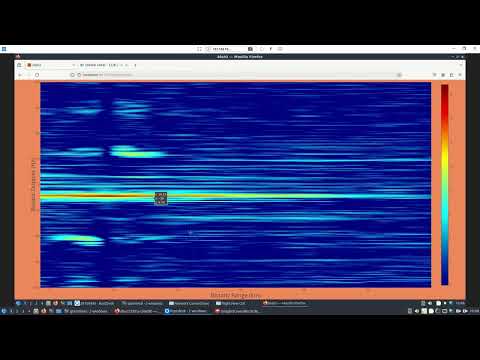
Over on his YouTube channel, Aaron, creator of DragonOS and the WarDragon kit has uploaded a video showing the Blah2 passive radar software working with an SDRplay RSPDuo. In the video Aaron shows some setup steps before showing the passive radar range-doppler graph.
Blah2 is passive radar software that appears to be inspired by the KrakenSDR passive software that was removed for regulatory reasons. We note that it is legal for others to publish open source passive radar software, but KrakenSDR cannot legally publish their own open source passive radar software because it would be tied to their own physical product. Providing code would mean they essentially sell an off the shelf passive radar product which is restricted.
The notes in Blah2 specifiy that it currently only supports the SDRplay RSPduo and USRP devices, but in the future they are looking to add support for the KrakenSDR and modified RTL-SDR and HackRF hardware.
Aaron also briefly demonstrated the related adsbdd software, from the same author as Blah2. This software allows a user to convert ADS-B data to delay-doppler truth. Essentially allowing you to confirm is an aircraft position determined via ADS-B is on the range-doppler ellipse determined via passive radar. In the future the author hopes to be able to plot all aircraft in a 2D delay-doppler space graph.
DragonOS FocalX Passive Radar Setup + Test w/ Open Source Code (RSPDUO, RTLSDR, Blah2)