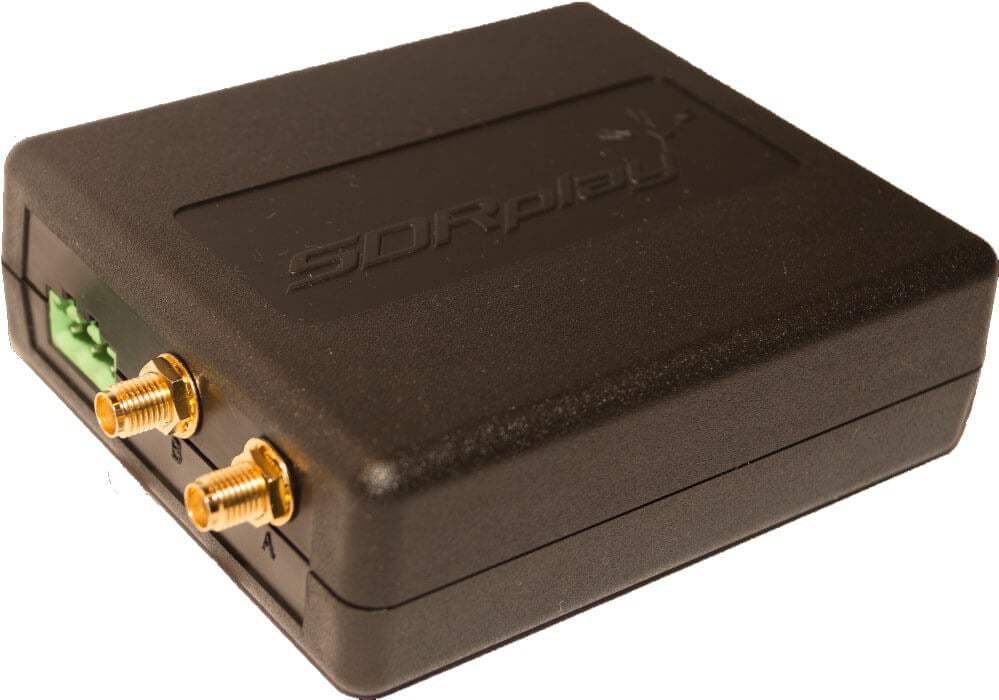
SDRPlay RSP2 Release Announcement and Review
Today SDRplay have just released their newest software defined radio – the Radio Spectrum Processor 2 (RSP2) which is the successor of the RSP1. The RSP2 costs $169.95 USD, and the older RSP1 is still for sale at $129.95 USD. There is also the “RSP2pro” model which is an RSP2 in a metal enclosure, and this sells for $192.95 USD.
The RSP2 has nearly the same base specifications as the RSP1 (12 bit ADC, 10 MHz bandwidth, 10 kHz – 2 GHz range), but now comes with additional features and enhancements such as a software switchable BCFM and BCAM notch filter, TCXO, multiple antenna ports, HF optimized Hi-Z antenna port, clock in and out ports, better shielding and can also now tune down to 1 kHz.
It is available for purchase at sdrplay.com/rsp2 (Worldwide), HamRadioOutlet.com (USA) and ML&S (UK).
The announcement reads:
SDRplay Limited has today announced the launch of a second Software Defined Radio product – the RSP2.
Building on the popularity of our first product, the RSP1, we have now launched the RSP2. The RSP2 delivers a significant number of additional features which result in a higher spec for specialist amateur radio users as well as benefits for additional scientific, educational and industrial SDR applications.
Here are the main additional features of the RSP2:
- 10 built in front-end pre-selection filters, with substantially enhanced selectivity
- Frequency coverage extended down to 1 KHz
- Software selectable variable gain Low Noise Preamplifier
- 2 x SMA Software Selectable 50Ω RF ports (1.5 MHz – 2 GHz)
- 1 x High Impedance RF port (1 kHz – 30 MHz)
- Built in software selectable MW /FM notch filters
- Highly stable 0.5PPM TCXO trimmable to 0.01PPM
- 24MHz Reference clock input / output connections
- 4.7V Bias-T option (on one of the software selectable antenna inputs)
- RF screening within a strong plastic case for the standard RSP2
- A Rugged metal box version – the ‘RSP2pro’
When used together SDRplay’s own SDRuno software, the RSP2 becomes a high performance SDR platform. The benefits of using the RSP2 with SDRuno include:
- Highly integrated native support for the RSP2 professional grade software based upon class leading ‘Studio 1’, free of charge
- Calibrated S-Meter including support for IARU S-Meter Standard
- Calibrated RF Power Meter with in excess of 100 dB of usable range
- Best in class audio quality
Currently the RSP2 requires the use of SDRuno software, but in the coming weeks we plan to provide support for HDSDR, Gnu Radio, CubicSDR and we are working with Simon Brown to get support within SDR Console.
We believe that the RSP1 will continue to prove very popular as the lowest cost 12-bit SDR for general applications such as Short Wave Listening or for use as a panadapter and we pleased that we can now offer more choice to the growing community of RSP users.
The RSP2 is expected to retail at approximately £130 (excluding taxes) or $169 (excluding taxes)
For more information visit our website on www.sdrplay.com
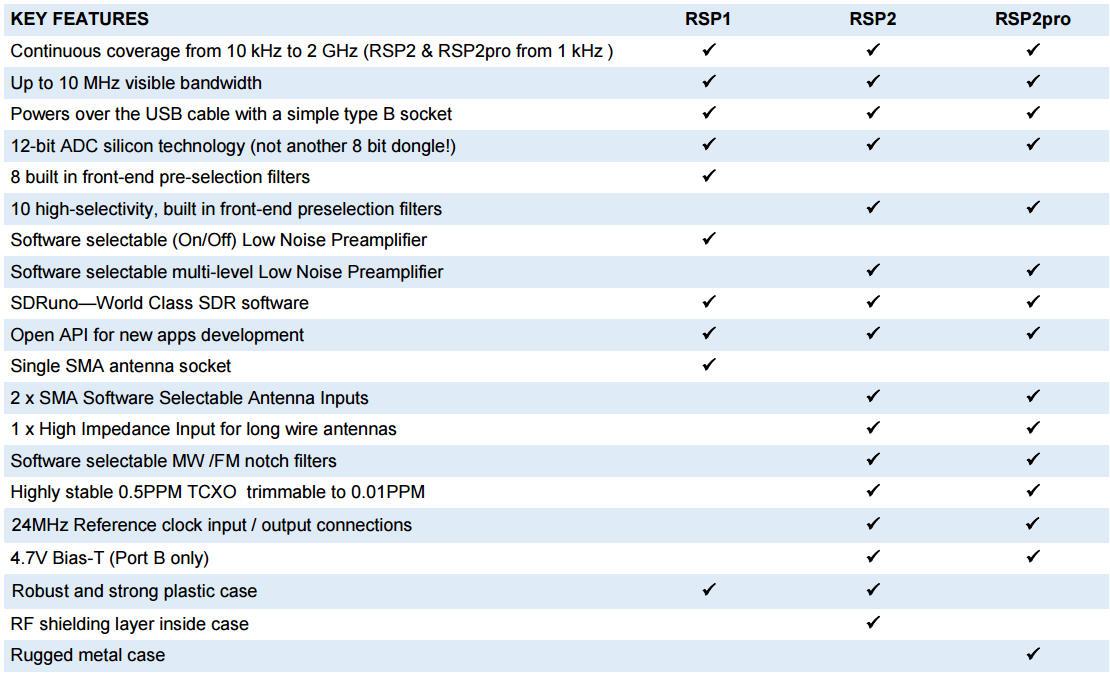
The table below shows a comparison of the RSP1, RSP2 and RSP2pro. A datasheet can be found on SDRplay’s new RSP2 webpage.
SDRplay RSP2 Review
Two other reviews have already come out, one from swling.com and one from NN4F.com.
Thanks to the generosity of the SDRplay team we were fortunate enough to receive an early pre-production review model of the standard (not pro) RSP2 unit. The unit arrived a few days ago, and here we give it an initial review. In a previous review we did a comparison of the Airspy SDR, SDRplay RSP1 and HackRF. We found that the RSP1 and Airspy had similar overall performance, but that the Airspy would be better for those people who needed high dynamic range performance in strong signal environments, and that the SDRplay RSP1 would be best for people who wanted a low cost all-in-one unit with performance better than an RTL-SDR.
The Inside
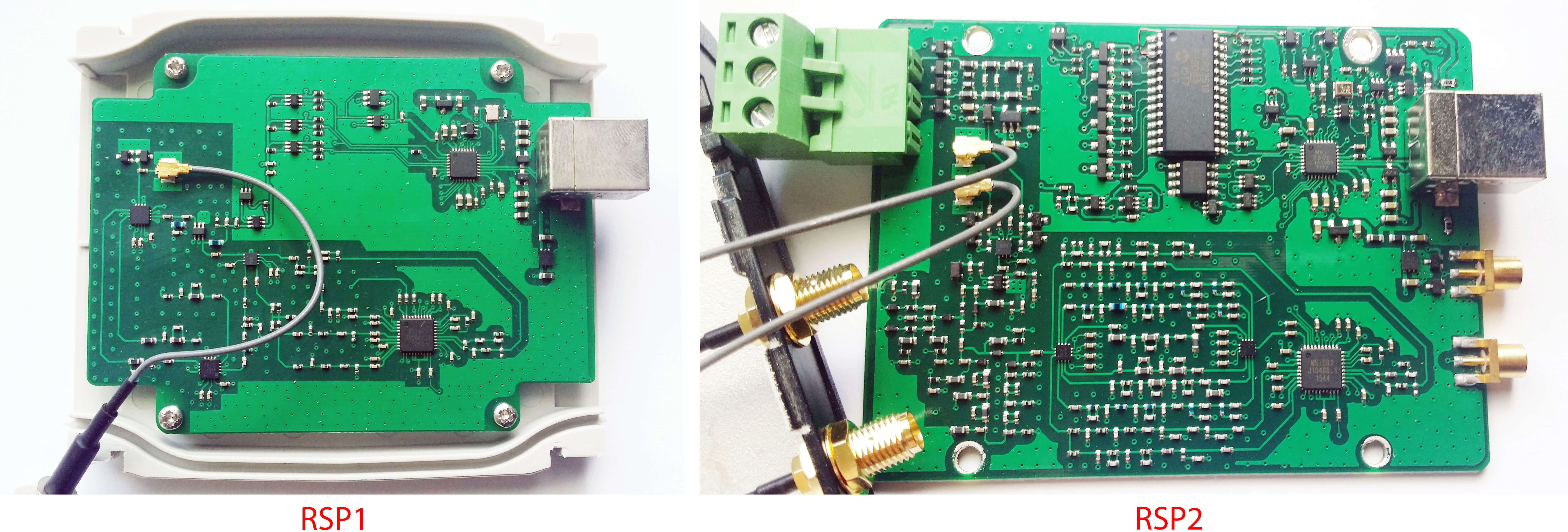
We decided to take a look inside and see how much the PCB has changed from the RSP1 to the RSP2. Judging from the two photos we can see that there is quite a significant increase in the number of components used. What was once a sparse PCB is now populated much more heavily with additional filter banks and several new switches. However, the core design of the RSP2 remains similar to the RSP1. The RSP2 uses the same Mirics MSi001 tuner chip and MSi2500 ADC chips.
The standard plastic enclosure is also now spray painted on the inside with conductive metal paint which helps by acting as a Faraday cage. This prevents interference from getting through and should be almost as good as a metal enclosure.
The conductive paint seems to be working well, as in our tests the RSP2 does not receive any signals with the antenna disconnected, whereas the RSP1 does weakly receive some very strong pager signals.

Continue reading for the rest of our review