Tagged: ads-b

New Low Power RTL-SDR’s for Stratux ADS-B Receivers

Stratux is an RTL-SDR based project that gives small plane pilots access to ADS-B data, without having to purchase an expensive commercial ADS-B installation. It consists of software that runs on a Raspberry Pi, and two RTL-SDR dongles to receive both 1090 MHZ ADS-B, and 978 MHz UAT. The decoded data is then streamed via WiFi to a tablet running navigation aide software with charts for pilots.

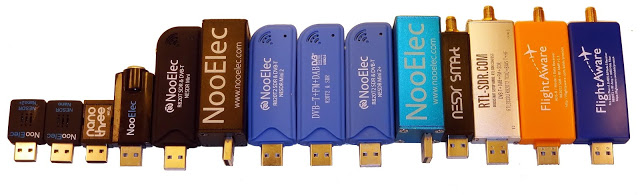
Typically Stratux kits come with two standard ‘Nano’ styled RTL-SDR dongles. However, users of the Stratux system have been reporting problems with overheating, and with the Pi struggling with the high current demands of a typical setup which includes two RTL-SDR dongles, active WiFi broadcasting, a GPS unit and an optional cooling fan. A typical RTL-SDR dongle draws 280 mA, so two dongles are already pulling 560 mA.

Chris, creator of the Stratux software and seller of Stratux kits has just released a new low power RTL-SDR dongle (kit with antennas). The cost is $35 USD for two dongles (one for 1090 MHz and one for 978 MHz). The dongle obtains its low power feature by using a switching regulator instead of a linear regulator as the main 3.3V power regulator on the PCB. Normally you would not want to use switching regulator for the main regulator in an RF device because they are very noisy in terms of RF interference generated. However switching regulators are much more efficient compared to linear regulators, and thus save a lot of current wastage. Other dongle manufacturers like ThumbNet have actually gone the other way, removing the secondary 1.2V switching regulator from the standard dongle design, and using a linear regulator instead. The ThumbNets end up with lower noise, but draw 400 mA of current. 

With the switching regulator the new Stratux dongles only draw about 185 mA, a saving of almost 100 mA. They also generate 0.5W less heat. Users of the Stratux system have so far been impressed with them and have not noticed any appreciable difference in ADS-B performance. We think that these low power dongles might also be of interest to people using them on mobile phones or battery/solar powered remote installations.

The new Stratux low power RTL-SDR dongles.

During testing, Chris found that there was no significant noise floor increase visible on the 978 MHz  & 1090 MHz frequencies. Most of the switching noise increase appears to be on the lower frequencies, but those frequencies are not relevant for the Stratux use case anyway.

Chris was kind enough to send us some samples of the new low power dongles. First we ran a noise floor scan with rtl_power to determine the effect of the switching regulator. The results show that the spurs and noise floor readings have definitely increased by a significant amount, with an especially large noise floor rise below 400 MHz. In SDR# wandering switching noise spurs are also visible throughout the spectrum, but they tend to weaken in strength once an antenna is connected.

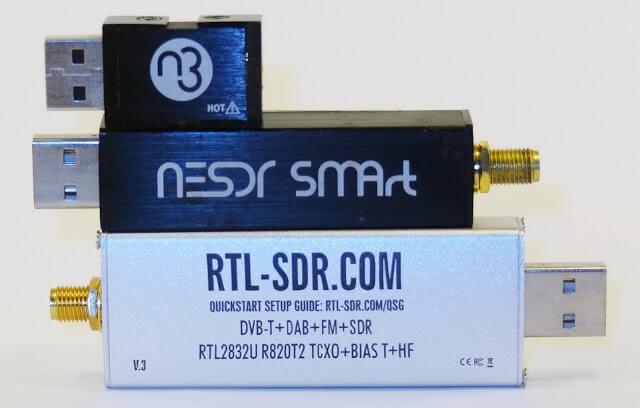
Stratux vs Standard Dongle vs V3 Dongle Noise Floor Scan

Fortunately, ADS-B is very tolerant to spurs and is generally not affected by this type of noise. We’ve only given the Stratux a quick test on ADS-B so far, but when compared against another ‘nano’ styled dongle the Stratux performed nearly identically (in fact even a little better) in terms of messages received. The two dongles were connected to the same antenna via a splitter and we logged the number of messages received in 10 minutes.

Quick ADS-B Reception Test

In conclusion the Stratux RTL-SDR set out to solve the mobile power issues suffered by people using the Stratux system. It has achieved that with an over 100mA saving in current use. The new Stratux dongle is much noisier, but the noise does not appear to significantly affect ADS-B reception as seen by our results and from the reports from Stratux users who beta tested this dongle.

Chris has also created a post on Reddit /r/stratux which talks a bit more about the new dongle.

FlightAware Release their Pro Stick Plus: An ADS-B Optimized RTL-SDR with LNA and 1090 MHz Filter Built in

Back in March of this year we posted about the release of the FlightAware "Pro Stick". The Pro Stick is FlightAware's ADS-B optimized RTL-SDR dongle. It uses a low noise figure LNA on the RF front end to reduce the system noise figure, thus improving the SNR at 1090 MHz. Because the added gain of the LNA can easily cause overload problems if there are other strong signals around, FlightAware recommend using one of their 1090 MHz ADS-B filters in front of the dongle to prevent overload.

FlightAware have just come out with the "Pro Stick Plus" which is the same as their Pro Stick, but now with the 1090 MHz filter built into the dongle itself. The Pro Stick Plus costs $20.95 USD on Amazon, which is a good deal cheaper than buying the standard Pro Stick ($16.95 USD) plus their ADS-B filter ($19.95 USD), which totals $36.90. Customers outside of the USA can purchase the Pro Stick Plus from seller "WiFi Expert" on eBay for $29.95 USD.

FlightAware.com is a company that specializes in live air travel tracking. Most of their data comes from volunteers running RTL-SDR ADS-B receivers.

The new Pro Stick Plus RTL-SDR based ADS-B Receiver from FlightAware.

Over on their forums and on Amazon, they announced the device and specs. They wrote:

FlightAware is excited to announce the next evolution of USB SDR sticks for ADS-B reception! The new Pro Stick Plus USB SDR builds on the popular Pro Stick by adding a built-in 1090 MHz bandpass filter. The built-in filter allows for increased performance and range of reception by 10-20% for installations where filtering is beneficial. Areas with moderate RF noise, as is typically experienced in most urban areas, generally benefit from filtering. By integrating the filter into the SDR stick, we are able to reduce the total cost by more than 40% when compared to buying a Pro Stick and an external filter.

Specifications:

  • Filter: 1,075 MHz to 1,105 MHz pass band with insertion loss of 2.3 dB; 30 dB attenuation on other frequencies
  • Amp: 19 dB Integrated Amplifier which can increase your ADS-B range 20-100% more compared to dongles from other vendors which can increase range 10-20% over a Pro Stick in environments where filtering is beneficial
  • Native SMA connector
  • Supported by PiAware
  • R820T2 RTL2832U chips
  • USB powered, 5V @ 300mA

Note that this dongle is only for ADS-B at 1090 MHz, and not for 978 MHz UAT signals, as the filter will cut that frequency out.

Back in April, we did a review of the original Pro Stick. We found its performance on ADS-B reception to be excellent, but only when a filter was used. The low NF LNA theoretically improves the SNR of ADS-B signals by about 7-8 dB, but in reality there is too much gain causing signal overload everywhere, thus making reception impossible without the filter. Rural environments may not need a filter, but in a typical urban or city environment strong FM/TV/GSM/etc signals are abundant and these signals easily overloaded the Pro Stick when no filtering was used. This new Pro Stick Plus dongle completely solves that problem at a low cost with its built in filter.

Remember that if you are using a run of coax cable between the LNA and RTL-SDR, then it is more optimal to use an external LNA, like the LNA4ALL. Only an external LNA mounted near the antenna can help overcome coax, connector, filter and other losses as well as reducing the system noise figure. The FlightAware dongles are the optimal solution when they are mounted as close to the antenna as possible. This is usually the case when running the FlightAware feeder software on a Raspberry Pi.

We hope to soon review the Pro Stick Plus, however we assume it will operate nearly identically to the Pro Stick + FlightAware ADS-B filter combination.

New Posts From RTLSDR4Everyone: Avoiding RTL-SDR Ripoffs, ADS-B Antenna Reviews, Travel Kits and Direct Sampling vs Upconverter vs SDRPlay

Akos from the rtlsdr4everyone blog has been busy uploading new posts over the past few days. His first post is part three in a series that discusses how to avoid ripoffs when buying RTL-SDR dongles. The RTL-SDR market has recently become quite saturated, and it is now easy to purchase something that most experienced users would consider a ripoff. His post shows some examples of what he considers to be poor value choices available on eBay.

An example of a ripoff price.

His second post discusses his methodology for testing dongles on their ADS-B performance. The second post then leads into the third post in which he compares four antennas on ADS-B reception. He compares two telescopic whip antennas, one set to 1/2 wave length, and the other set to 1/4 wave, a NooElec 5dBi whip antenna, and the FlightAware ADS-B antenna. His results show that the FlightAware antenna was the best performer, followed by the 1/2 wave telescopic whip, then the NooElec 5dBi whip and finally the 1/4 wave telescopic whip. The fourth post continues the ADS-B topic, and he reviews the NooElec 5dBi ADS-B antenna. Although the performance is not as good as the FlightAware antenna he mentions that it is much smaller and great for portable use. If  you are interested, we have also a review of the FlightAware antenna, and we also found its performance to be excellent.

The four ADS-B antennas tested in Akos' review.
The four ADS-B antennas tested in Akos’ review.

In his fifth post Akos shows what his RTL-SDR travel kit consists of. In this post he recommends both our RTL-SDR V3 dongle as well as the NooElec SMArt. For a portable computer, he takes along a Raspberry Pi 3 and a 20,000 mAh battery bank with solar charger. (Though we’d be interested to hear from Akos how long it takes for that small solar panel to charge the battery bank, probably takes days to charge?) For antennas he prefers to take along our large 1.5m telescopic antenna, the NooElec 5dBi ADS-B antenna, a medium telescopic antenna and a Nagoya knock-off telescopic antenna.

Akos' Mobile ADS-B Station.
Akos’ Mobile ADS-B Station.

Finally in the sixth post he shows a video that compares the differences between a generic dongle modded with direct sampling (without any impedance matching circuitry), an RTL-SDR dongle with ham-it-up upconverter and an SDRplay. Unsurprisingly the upconverter and SDRplay performs best.

Direct sampling vs upconverter vs SDRPlay on shortwave broadcast stations - 16 mins

As a bonus, Akos also has done an interesting stress test on the metal case of our RTL-SDR dongles, where he runs it over with a bus to see if it will survive. The case is mangled afterwards, but the dongle and functionality survives!

Dotcom dongle meets a bus

RTLSDR4Everyone: Review of the FlightAware ADS-B RTL-SDR

Akos from the RTLSDR4Everyone blog has recently uploaded a review of the FlightAware ADS-B ProStick RTL-SDR dongle. The FlightAware (FA) dongle is a standard RTL-SDR with SMA connector, but with a very low noise figure LNA built into the front end. This low noise figure helps improve the SNR of ADS-B signals, resulting in more decodes and further range. We previously reviewed the FlightAware dongle in our own review available here.

In his post Akos reviews the FA dongle on its use as a general RTL-SDR as well as an ADS-B receiver. His review is initially critical to some of the misinformed advertising claims made by FA. He then goes on to show some noise floor scans and some ADS-B reception comparisons. Finally he shows some modifications that can be made to improve the cooling of the PCB.

He concludes that the FA ProStick works very well on improving ADS-B performance, but that overloading due to the increased gain is common.

prostickreview_akos2

RTLSDR4Everyone Four New Posts: Janilab Preamp Review, Why Use a Preamp?, Small ADS-B Antennas Review, SDRUno User Guide

Akos from the RTLSDR4Everyone blog has recently posted three new articles. The first article reviews the Janilab LNA Preamp which has a frequency range of 1 MHz to 3 GHz and an adjustable gain. In the review he compares reception with and without the preamp at shortwave frequencies and at ADS-B frequencies. Finally he also compares it against the LNA4ALL and LNA4HF, and notes that they generally have better specs than the Janilab preamp, but the disadvantage is needing two to cover HF + VHF/UHF, meaning an increase in costs.

In his second post Akos explains when and why you should use a preamp. Basically he explains how the lower noise figure of the preamp can help improve SNR.

In his third post Akos does a review on small ADS-B antennas. These are small whip type antennas that are tuned for 1090 MHz. In his testing he found that a telescopic antenna gave significantly better results that the ADS-B whip, but recognizes that these are designed for pilots and light aircraft owners who need a small sturdy antenna.

Finally his fourth post he shows an updated beginners guide for SDRuno. SDRuno is the official software for the SDRplay RSP, but is compatible with the RTL-SDR.

The LNA4ALL and LNA4HF vs the Janilab Preamp

ADS-B Traffic Analytics with Valo and an RTL-SDR

Valo is a software service for real time big data streaming analytics of data from many sensors.  On their website they explain their service as follows.

Valo is a single platform for streaming (real time) and batch (historical) data analysis. Valo provides multi-paradigm big data storage for both semi-structured and numerical data. Valo contains a powerful analytics engine for processing all of this data. Finally Valo is super simple – a single tool that can be up and running in minutes.

Recently Rémi Selva wrote in to let us know about an interesting use-case for Valo which involves the RTL-SDR. In his post Rémi shows us how he uses an RTL-SDR, Raspberry Pi running dump1090, and Valo to create interesting data visualizations of the ADS-B aircraft data. He not only shows how to visualize the data in Valo, but also how to use queries to dig deeper into the data, looking for patterns.

Valo ADS-B Data Flow

Rémi writes that what he’s done is simply a proof of concept that shows the power of Valo. He writes that one such interesting future development could be using Valo to detect FBI/CIA surveillance aircraft. Previously we posted about how an RTL-SDR user discovered these surveillance aircraft by their odd circular flight paths. The analytics engine of Valo could be used to automatically detect odd flight patterns such as from these surveillance aircraft. 

Plotting the history of aircraft coming into land at HK airport

An ADS-B Decoder for the GOMX-3 Satellite ADS-B Repeater

The GOMX-3 is a CubeSat which carries an experimental ADS-B repeater. Since it is a satellite the experimental receiver hopes to be able to receive ADS-B from orbit, then beam it back down to earth at a frequency of about 437 MHz using a GFSK at 19200 baud high data rate transmission protocol. From space the GOM3-X satellite can see many aircraft at one time and space based tracking allows for aircraft tracking over oceans.

Recently the creators of the satellite, GomSpace released a complete decoder for the ADS-B downlink, and now it has also been turned into a GNU Radio flowgraph by Daniel Estevez which can output decoded aircraft position data directly to a KML file which can then be opened in Google Earth or similar. This blog by DK3WN shows several logged decodes of the satellite and shows what the signal looks like in SDR#. Some of his posts also curiously shows what looks to be a Windows decoder, or logger, though we were unable to find a download for it.

Decoding the downlink should give you real time ADS-B data in your area, but the full log of stored stored data is apparently only downloaded when the satellite passes over the GomSpace groundstations which are mostly located in the EU.

[Also mentioned on Hackaday]

The GOMX-3 ADS-B Downlink Signal.
Aircraft detected by the GOM3-X Satellite ADS-B Receiver.
Logged aircraft detected by the GOM3-X Satellite ADS-B Receiver. Major flight corridors are visible.

SDRplay Updates: Android Support, ADS-B Decoder Upgrades and Acquisition of Studio1 Software

The SDRplay team have been hard at work during the last few weeks. First they announced beta support for Android via SDRtouch, then they announced an improved ADS-B decoder, and finally they have just announced their acquisition of Studio1. 

The SDRplay is a 12-bit software defined radio with tuning range between 100kHz – 2 GHz. Many consider it along with the Airspy to be the next stage up from an RTL-SDR dongle. 

Android Support

The author of SDRTouch on Android recently announced support for the SDRplay. SDRTouch is a Android program similar in operation to PC based software like SDR#. To access the beta you can sign up at this link. Currently there is support for up to 2 MHz of bandwidth.

SDR Touch demo on Android device using SDRplay RSP

Improved ADS-B Decoder

Back in March the SDRplay team released ADS-B decoder software for their SDR with the promise of improving its performance in the near future. 

Recently the SDRplay team released an updated version of their ADS-B decoder for the Raspberry Pi which now fully utilizes the full 12-bits of the ADC and takes advantage of the full 8 MHz bandwidth. Jon, the head of marketing at SDRplay writes the following:

We now have an updated beta version of ADS-B for both the Raspberry Pi 2 and 3. This is based upon the 16bit Mutability version of dump1090 developed by Oliver Jowett and unlocks the full 12 bit performance of the RSP1. People should see a significant performance improvement over the dump1090_sdrplus version, which was based upon 8 bit code. The latest beta version can be downloaded in binary form from http://www.sdrplay.com/rpi_adsb.html . Should anyone have questions or feedback, please contact [email protected]

We plan to eventually compare the SDRplay with the Airspy and RTL-SDR on ADS-B performance. If you are interested we previously did a review of the SDRplay, Airspy and HackRF here, but as the SDRplay did not have ADS-B back then, that particular test was not done.

Acquisition of Studio1 SDR Software

The last major piece of news is that SDRplay have now acquired the Studio1 SDR software. Studio1 is a paid SDR program, similar in nature to SDR#/HDSDR/SDR-Console. Like HDSDR, Studio1 is a spinoff from the old WinRad software. Their press release reads:

SDRplay Limited has today announced that it has reached an agreement with Sandro Sfregola, (formerly CEO of SDR Applications S.a.s.) to acquire all Rights, Title and Interest in Studio 1 a leading software package for Software Defined Radio applications.

Jon Hudson, SDRplay Marketing Director said: “We are delighted to have reached this agreement with Sandro to acquire Studio 1. Studio 1 is the perfect complement to our SDR hardware products and gives us the ideal platform to deliver a complete class leading SDR solution for our customers. We look forward to working with Sandro and further developing Studio 1 to unlock the full capability of our current and future products”.

Hudson added: “Studio1 has established a strong customer base with users of many other SDR hardware products. Studio 1 will continue to be available as a stand-alone product from WoodBoxRadio http://www.woodboxradio.com/studio1.html for the foreseeable future , but we also look forward to further developing Studio 1 to specifically benefit present and future owners of our products”

Sandro Sfregola added: “I am very pleased to have reached this agreement with SDRplay. The long term future for SDR lies in complete end to end solutions and I feel the SDRplay RSP combined with Studio 1 software gives users an outstanding combination of performance and affordability”.

About Studio 1:

Studio1 was developed in Italy by SDR Applications S.a.s. and has hundreds of happy customers around the world.Studio 1 is known for its user friendly stylish GUI, CPU efficiency and advanced DSP capabilities, including features notavailable on other SDR software packages.

www.sdrapplications.it

About SDRplay:

SDRplay limited is a UK company and consists of a small group of engineers with strong connections to the UK Wireless semiconductor industry. SDRplay announced its first product, the RSP1 in August 2014

www.sdrplay.com

We believe that this is a good move for SDRplay, as one of the major issues with the RSP SDR was the lack of decently supported software.

Studio1_banner2