Tagged: end of train

isTRAIN: Detecting if a Train is Blocking a Local Crossing By Listening to Railroad Frequencies

Jhestyr takes pride in being punctual, but a local railroad crossing keeps getting in the way. Trains sometimes park across it for hours at a time, and there is no way to know one is sitting there until you have already driven out to it. Every wasted trip to the crossing and back out to an alternative route costs him a significant chunk of time and fuel.

This is why Jhestyr used two RTL-SDR dongles to build isTrain, an open source program that decodes End-of-Train brake pressure and motion telemetry on 457.9375 and 452.9375 MHz, transcribes railroad voice traffic in the 160 to 162 MHz band via Whisper, and fuses both sources into a single live verdict on whether the crossing is blocked.

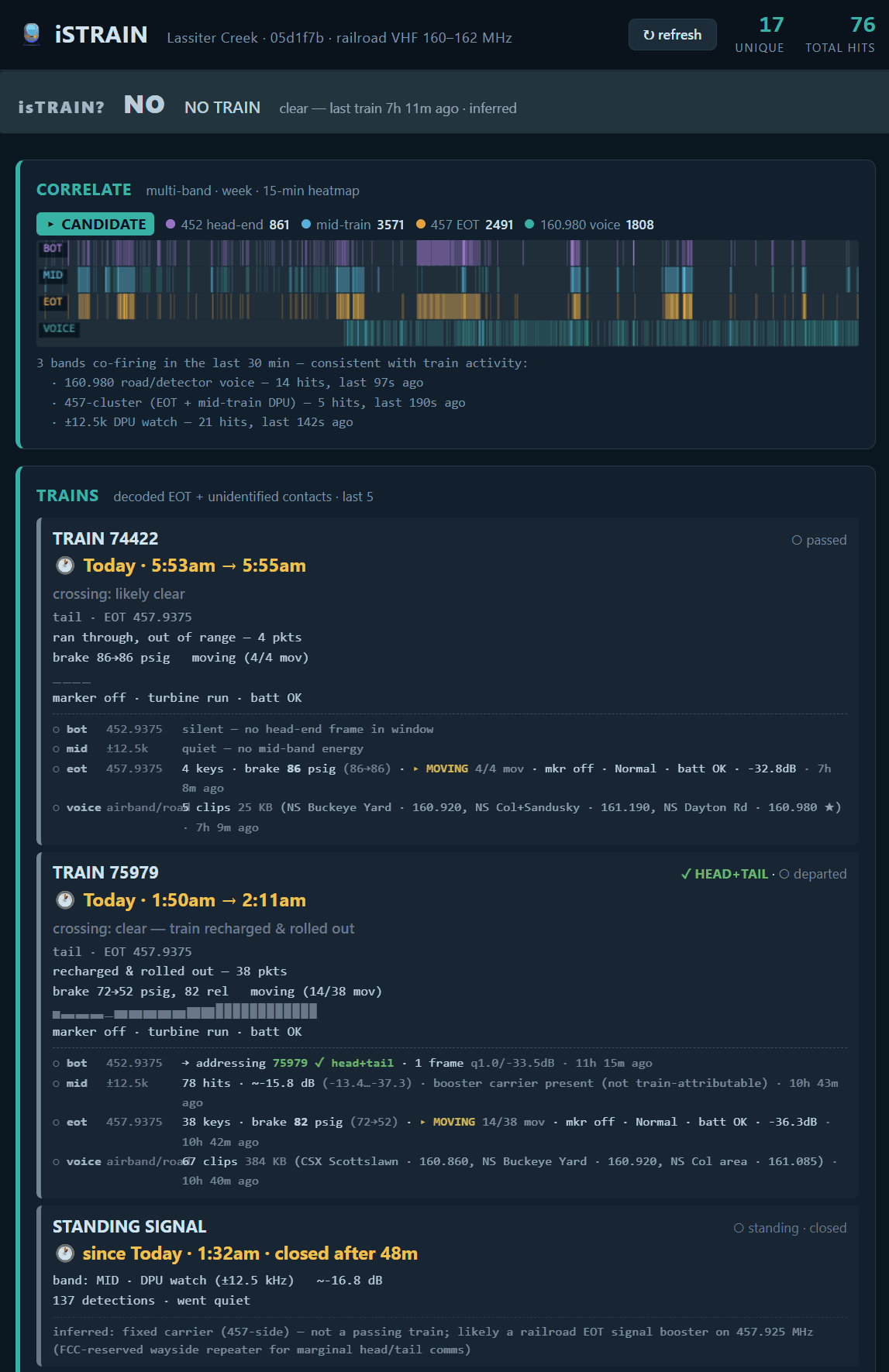
The program generates a webpage that can be accessed, providing a YES/NO verdict on whether there is a train blocking the crossing. A live public instance of Jhestyr's isTrain webpage is available here https://istrain.jhestyr.net.

AI-Disclaimer: Jhestyr notes that the code was developed with a 60/40 agentic/human split.
The isTrain Web Interface

Decoding End Of Train and Head Of Train Packets with an RTL-SDR

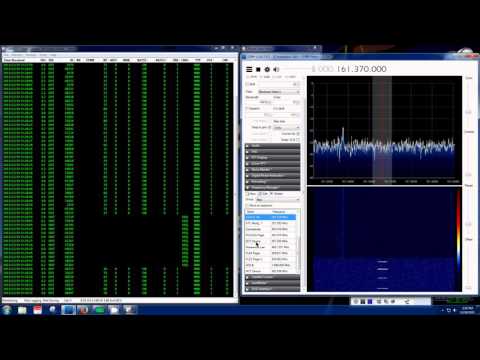
Back in March 2014 we showed a video of a RTL-SDR user decoding End Of Train (EOT) and Head of Train (HOT) signals. Head of Train (HOT) and End of Train (EOT) signals are used on trains to transmit telemetry data such as brake line pressure and monitor accidental separation of the train. If you live near a trainyard of railway line you may be able to pick up these signals.

Now over on YouTube user berwin018 shows us another video of EOT and HOT signals being decoded. There doesn’t seem to be much information in these packets, but they could potentially be used to track which trains are passing by.

To decode EOT and HOT packets you can use the softEOT software which can be downloaded from the softEOT Yahoo! Group after requesting and being accepted into membership.

Decoding End Of Train & Head Of Train Packets

Decoding HOT, EOT & DPU Train Data

On YouTube user Curt Rowlett has uploaded a video showing how he was able to decode HOT, EOT & DPU signals from trains using an RTL-SDR. Head of Train (HOT) and End of Train (EOT) signals are used on trains to transmit telemetry data such as brake line pressure and monitor accidental separation of the train. Distributed Power Unit (DPU) signals are control signals that are used to control remote DPU’s on long trains. DPU’s are locomotives which are placed in the middle or rear of a train to help more evenly distribute pushing and pulling power over the entire train.

Curt used the SoftEOT and SoftDPU software programs to monitor and decode these signals. This software can be downloaded from the softEOT Yahoo! Group after requesting and being accepted into membership.

HOT signals can be found on 452.9375 MHz, EOT signals on 457.9375 MHz and DPU signals on 457.9250 MHz.

Decoding HOT, EOT & DPU Train Data