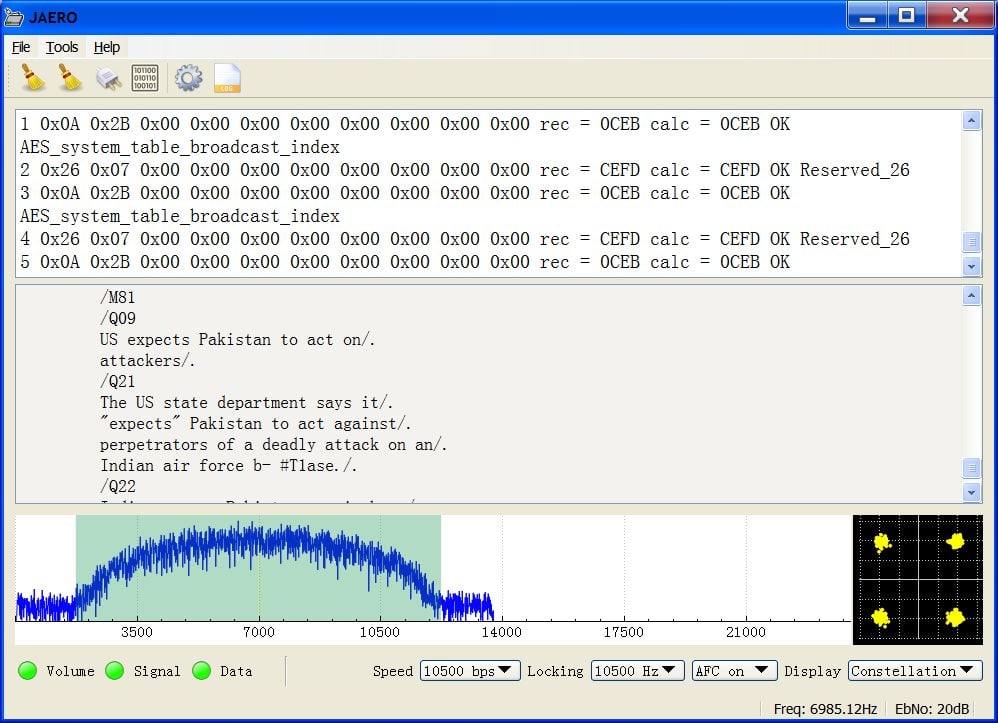
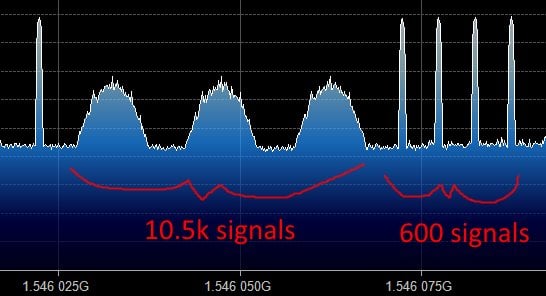
The JAERO decoder for AERO signals on Inmarsat satellites has recently been updated to version 1.03. This new version supports the decoding of 10.5k Aero-H and Aero-H+ signals. The author of JAERO Jonti writes that on these channels he’s seeing significantly more traffic than on the narrowband signals and that he was suprised to see that other non-aircraft messages such news was broadcast on this 10.5k signal. Jonti writes about his experience in developing the 10.5k decoder and his experience with receiving the messages in this post.
Jonti discovered that news updates are also broadcast on 10.5k AERO.What the 10.5k signals look like compared to the 600 signals.
If you like Jonti’s apps, then please remember to donate a small amount to him so that he can continue to work on them more. His PayPal donate button can be at the bottom of his main page.
Bob W9RAN recently wrote in to let us know about some developments he and Youssef have had with getting the Airspy to function at full speed on a Raspberry Pi 2 with ADS-B decoding. Bob and Youssef created the SpyVerter upconverter, and Youssef is the programmer of SDR#. Bob writes the following:
Airspy is a high-performance SDR that streams 12 bit samples at 20 MSPS (real, not IQ) to a PC where the real processing is done. But 20 million samples per second uses a significant fraction of the bandwidth available with USB 2.0, and has made apparent the weaknesses in USB subsytems on a number of PCs. So of course the natural assumption by "experts" has been that the Raspberry Pi 2 isn't up to the task.
As we Pi fans know, the Pi 2 has a 900 Mhz 4-core ARM Cortex A7 CPU, and the key to performance is properly implemented code that can take full advantage of the processor architecture.
Youssef Touil, author of SDR# and creator of Airspy has done that, proving first that an optimized multithreaded version of his ADSB decoder would run on a 4-core Odroid that has more CPU power than the Pi 2. But today we have proven that not only can the Raspberry Pi 2 run the optimized ADSB decoder at full speed (20 million samples per second via USB), but that it even has enough horsepower left to run the Virtual Radar Server Google map display in the Pi's Epiphany web browser!
For those not familiar, the map display is created by a program called Virtual Radar Server that runs on a PC and receives samples from the Pi over ethernet, and includes a web server that allows other computers (in my case, the Pi 2) to view the composite map display. (For more information about ADSB, see my article in QST for January 2014).
I'm really thrilled to be able to demonstrate that the Pi 2 has this impressive capability! This makes it feasible to create inexpensive high performance ADSB receiving systems, and who knows what else?
Back in June of 2014 we posted about the released of a new program called RTLSDR-Airband. RTLSDR-Airband is a Windows and Linux compatible command line tool that allows you to simultaneously monitor multiple AM channels per dongle within the same chunk of bandwidth. It is great for monitoring aircraft voice communications and can be used to feed websites like liveatc.net.
Since our post the development of the software has been taken over by a new developer szpajder, who wrote in to us to let us know that he has now updated RTLSDR-Airband to version 2.0.0. The new versions improves performance and support for small embedded platforms such as the Raspberry Pi 2, but the Windows port is now not actively maintained and probably does not work. The full list of changes is shown below:
New libconfig-style config file format
util/convert_cfg: can be used to convert old-style config.txt to the new format
Syslog logging (enabled by default)
Daemon mode
Reworked makefiles, added install rule
/dev/vcio is now used to access GPU on Raspberry Pi; creating char_dev no longer necessary
Startup scripts for Debian and Gentoo
Support for auto gain setting
Support for multiple outputs per channel
Support for recording streams to local MP3 files
Support for ARMv7-based platforms other than RPi (eg. Cubieboard)
Back in August of this year we showed how it was possible to use an RTL-SDR dongle, satellite antenna, LNA and decoding software to receive and decode STD-C EGC signals from Inmarsat satellites. We also showed how it was possible to modify a low cost GPS antenna to use as a satellite antenna.
Now a radio hobbyist called Jonti has released a Windows decoder for the Inmarsat AERO set of signals. AERO is a system that provides a satellite based version of VHF ACARS (Aircraft Communications Addressing and Reporting System). ACARS is typically used by ground control and pilots to send short messages and is also sometimes used for telemetry.
Jonti writes:
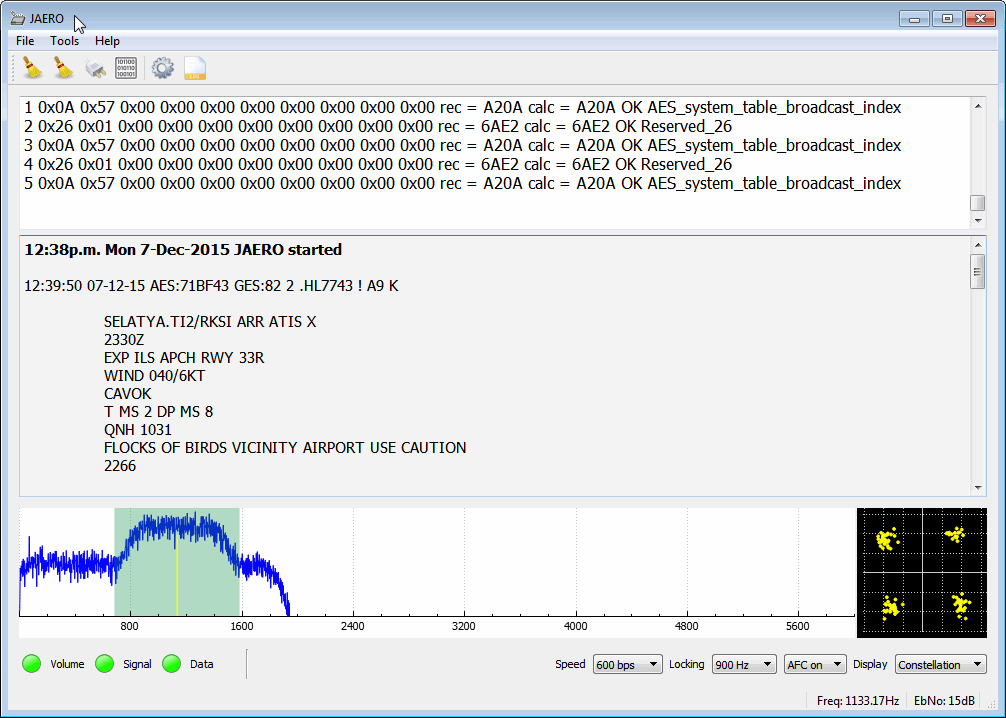
JAERO is a program that demodulates and decodes Classic Aero ACARS (Aircraft Communications Addressing and Reporting System) messages sent from satellites to Aeroplanes (SatCom ACARS) commonly used when Aeroplanes are beyond VHF range. Demodulation is performed using the soundcard. Such signals are typically around 1.5Ghz and can be received with a simple low gain antenna that can be home brewed in a few hours in conjunction with a cheap RTL-SDR dongle.
In the advent of MH370, Classic Aero has become a well-known name. A quick search on the net using “Classic Aero MH370” will produce thousands of results. The Classic Aero signals sent from satellites to the Aeroplanes are what JAERO demodulates and decodes.
Unlike the usual VHF ACARS, with SatCom ACARS you can not receive signals from the Aeroplane only the people on the ground talking to the people in the Aeroplane. This means you do not get the airplanes reporting their position. Instead you tend to get weather reports, flight plans, and that sort of stuff. Just like VHF ACARS they usually use cryptic shorthand notation. For example “METAR YSSY 040400Z 08012KT 9999 FEW040 SCT048 23/09 Q1024 FM0500 05012KT CAVOK=” is the weather report for Sydney Airport in Australia in a format called METAR. It tells you the time, when the report was issued, the wind direction and speed, visibility, clouds, temperature, due point and air pressure. Then it says from 5 AM UTC the wind direction and speed and that the weather will be nice. There are sites such as Flight Utilities that can decode such information and display it in a more understandable format.
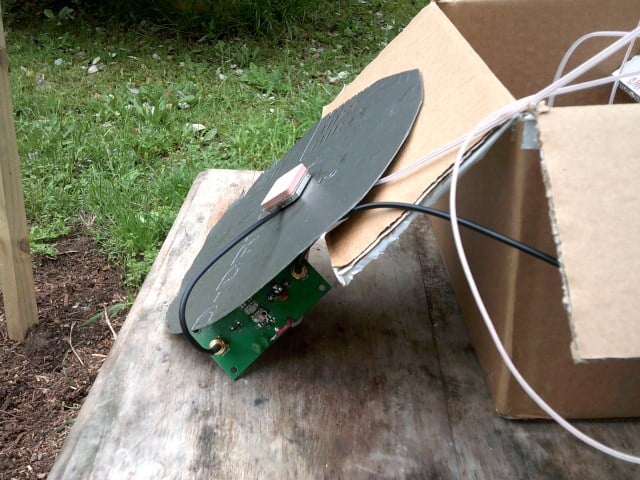
In his post Jonti also shows how he uses a modified GPS antenna to receive the AERO signals.
Jonti’s modified GPS antenna for receiving Inmarsat AERO
We gave JAERO a test and found that it decoded AERO signals easily, even with low signal strength. To use JAERO tune to an Inmarsat AERO signal in SDR# or a similar program using USB mode. JAERO will listen to the audio from the sound card or from a virtual audio pipe. We recommend setting the AFC (Automatic Frequency Control) setting on on if you find that your RTL-SDR drifts too much.
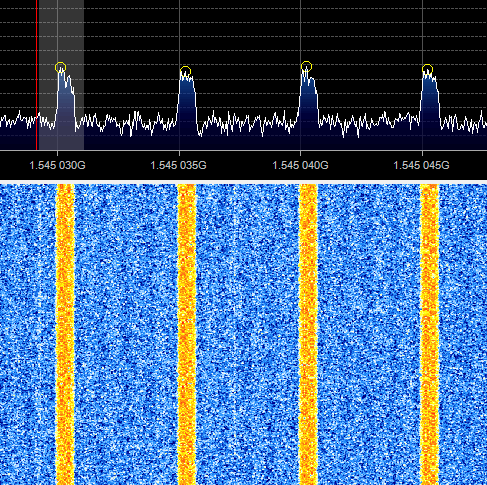
AERO signals can be found at around 1545 MHz. They only use about 800 Hz in bandwidth. See UHF satcoms page for a list of AERO frequencies.
The JAERO decoder.Some AERO signals.
Remember that some R820T/2 RTL-SDR dongles can have problems when receiving this high, especially when they heat up. If you find that your dongle gets deaf at these L-band frequencies try cooling the R820T/2 chip with a heatsink or fan. The Airspy or SDRplay RSP software defined radios are better choices for decoding signals this high, but the RTL-SDR will work fine if your signal strength is decent and the R820T/2 chip is kept cool.
If you are interested in VHF ACARS as well, then we have a tutorial about decoding that here.
Dump1090 is one of the most popular ADS-B decoders that is used together with the RTL-SDR dongle. ADS-B stands for Automatic Dependant Surveillance Broadcast and is a system used by aircraft that broadcasts their GPS positions. It is a replacement for traditional reflection based radar systems. We have a tutorial on using the RTL-SDR to decode ADS-B here.
There is now a forked version of dump1090 by tedsluis that incorporates heatmap generation and range/altitude view. A heatmap will allow you to visualize where the most active aircraft paths in your area are and the range/altitude view allows you to see at what altitudes aircraft typically fly at in different locations. The software logs aircraft data in a CSV file, and then after collecting enough data a second program can be used to generate the heatmap. The full explanation of the software and instructions for installing and using it on a Raspberry Pi Linux system together with PiAware are posted on the flightaware.com forums.
A heatmap of aircraft flight paths.
dump1090-mutability with Heatmap ADS-B and range altitude view
Recently Dan, a reader of RTL-SDR.com wrote in to let us know about a new web project he’s started called adsbexchange.com. ADSBexchange is similar to services like FlightRadar24.com and FlightAware.com, but with one key difference. ADSBExchange explicitly states that they do not and will not filter ADS-B traffic for security reasons. Other similar services all filter FAA BARR (Block Aircraft Registration Request), military and other potentially sensitive ADS-B data. However, Dan argues that filtering the data is simply unneeded security theatre as anyone can build their own unfiltered receiver for very cheap. He writes:
I recently started a website that collects SDR ADS-B and MLAT data (typically from dump1090) worldwide, and displays it unfiltered – http://www.adsbexchange.com . This means that military, “blocked” and other “restricted” traffic is available to see, which is unique as far as I can tell. We’ve recently tracked a U2 over the UK above 60,000 ft., Air Force One, and various diplomatic aircraft. Additionally, there is a database of all previous aircraft “sightings” searchable on various parameters.
All of my research indicates this is legal, but perhaps “frowned upon” by local authorities. The major flight tracking sites seem to not want to make any waves and voluntarily strip this data from their public feeds, even though they are typically fed “unfiltered” data from their volunteer participants.
The service is currently looking for RTL-SDR users who feed ADS-B data to join their feeding program so that they can expand their service coverage.
The “ADS-B on Android” app has been updated and now supports the reception and display of 978 MHz UAT FIS-B Weather and Traffic data. The app also receives ADS-B data as per normal. To use the app you will need an RTL-SDR dongle and a USB OTG cable.
UAT stands for Universal Access Transceiver and is a protocol similar to ADS-B that is used mainly by smaller aircraft in the USA. UAT has some extra features for pilots compared to ADS-B. In addition to location information UAT provides a Traffic Information Service (TIS-B) which allows pilots in the air to see what ground control sees on their traditional RADAR system. It also provides a Flight Information Service-Broadcast (FIS-B) which includes NEXRAD weather data and other information. NEXRAD is an array of ground station weather radars that are used to provide pilots with accurate maps of precipitation and wind.
The free version of the app has ads and does not display NEXRAD weather radar on the default map. The pro version removes the ads and allows you to display a NEXRAD overlay on the map. It costs $2.50 USD.
Now it is possible to use an RTL-SDR to receive the FIS-B weather information that is transmitted on the 978 MHz UAT frequency which is available only in the USA. UAT stands for Universal Access Transmitter and is similar to ADS-B transmitted at 1090 MHz, however UAT has some extra features for pilots compared to ADS-B. In addition to location information UAT provides a Traffic Information Service (TIS-B) which allows pilots to see what ground control sees on their traditional RADAR system. It also provides a Flight Information Service-Broadcast (FIS-B) which includes weather and other information. UAT is commonly used on small aircraft due to it’s lower cost and additional features.
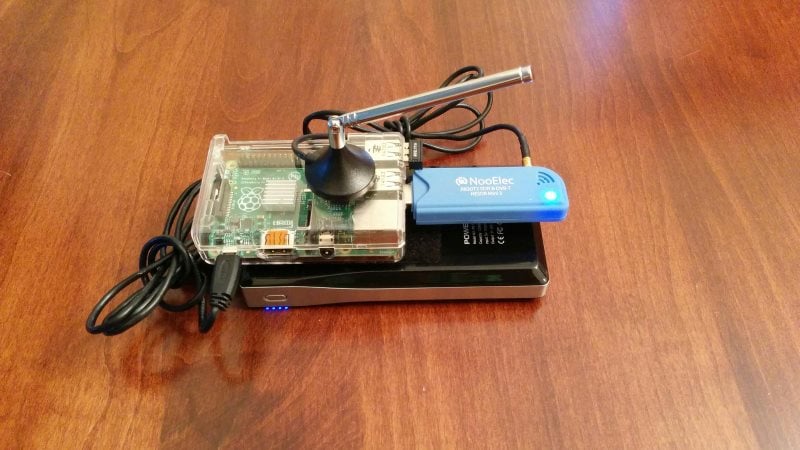
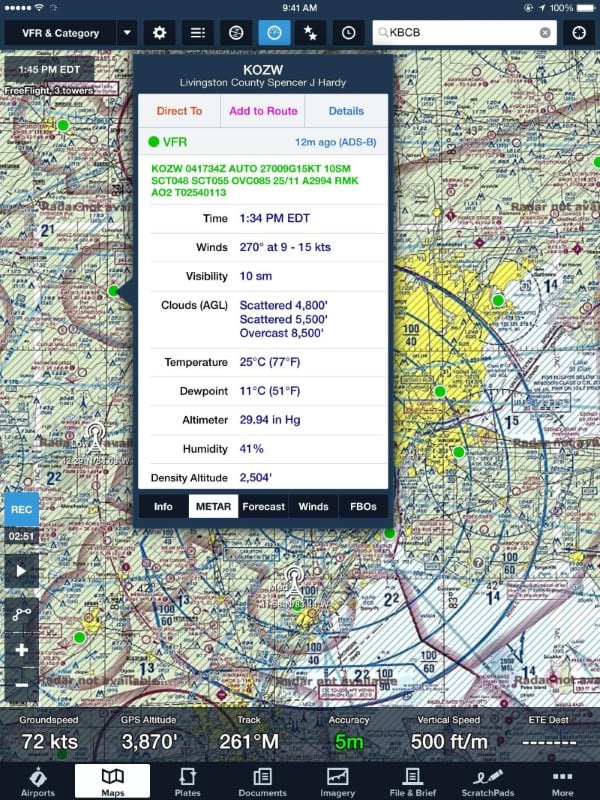
To receive UAT FIS-B weather information the pilot used dump978 on a Raspberry Pi 2. Dump978 is a UAT decoder, similar in operation to dump1090. He has also created a program called “Stratux“, which together with a WiFi adapter allows the decoded FIS-B data to be transmitted from the Raspberry Pi by WiFi to an iPad running ForeFlight. Running the software is as simple as piping the 978 MHz signal from rtl_fm into dump978, and then piping the decoded output of dump978 into stratux. Foreflight can then connect to the WiFi signal and work like it is connected to an expensive Stratus receiver.
In the video example below you can see some weather radar animations from FIS-B data received from the RTL-SDR shown on the ForeFlight screen at around 4:29 and onwards.
RTL-SDR, Rasperry Pi, WiFi dongle and portable battery pack for receiving UAT.FIS-B UAT Weather Report received on Foreflight from a Raspberry Pi and RTL-SDR running dump978.