Category: Applications

RTL-SDR Wrapper for Max/MSP

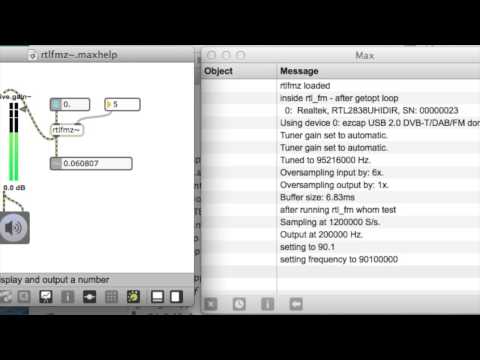
Max/MSP is a graphical programming tool for creating music, sound, video and interactive graphics applications. YouTube user Tom Zicarelli has recently posted a video showing his test of a Max wrapper for rtl_fm, allowing an FM audio stream to be received and controlled in Max. Tom is also working on an RTL-SDR wrapper for PureData, another visual programming language aimed at artists. These wrappers will be useful for artists who wish to utilize RF in their projects.
Video Tutorial: Hak5 on Decoding RDS with GNU Radio and GR-RDS

Hak5 has recently posted another video continuing their easy to follow series on GNU Radio and the RTL-SDR. In this video they talk about Radio Data System (RDS) and explain how it is a digital signal that is embedded in broadcast FM signals. They then download GR-RDS, a GNU Radio based RDS decoder program and use it to decode a local RDS signal.

Decoding Digital Subcarriers with a $20 SDR, Hak5 1602

Analyzing TD-LTE with the RTL-SDR

TD-LTE is a mobile phone standard acronym for Time Division Long Term Evolution. It is one of two variants of LTE technology, with the other being FD-LTE (Frequency Division LTE).

Over in China where TD-LTE is commonly used, Jiao Xianjun discovered that the current LTE-Cell-Scanner Linux program did not support TD-LTE, so he made a fork which does support TD-LTE. LTE-Cell-Scanner is a program which can decode LTE cell tower data which contains information like the cell ID, transmit frequency and transmit strength. With his modified LTE-Cell-Scanner, some MATLAB scripts he wrote and an RTL-SDR, Jiao was able to decode the cell information from 10 TD-LTE signals and 2 FD-LTE signals. He has uploaded a video showing this too.

TD-LTE, LTE FDD, scanning/demodulation results in Beijing, China

RTLAMR: An RTL-SDR Receiver for 900MHz ISM Smart Meters

Smart meters are meters that monitor electricity usage and wirelessly transmit consumption data to the electricity company. They are a part of the “smart grid”, and allow for better electricity control and usage reporting.

Douglas recently wrote in to us to let us know about his work on RTLAMR, an RTL-SDR based Automatic Meter Reader (AMR) decoder. Currently Douglas has tested the decoder on his local Itron C1SR smart meters, but notes that it should work on any meter using the common AMR protocol known as Electronic Receiver Transmitter (ERT).

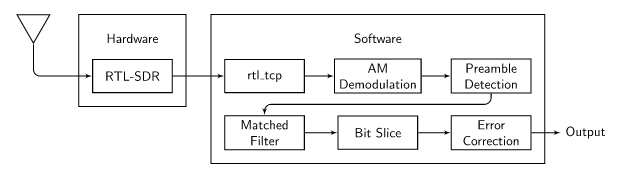
Over on his website Douglas has also done a neat writeup discussing the ERT protocol and showing how he decoded it, including the steps of preamble detection, matched filtering, bit slicing and error correction.

We would like to note that we also recently posted about a similar project about decoding Elster R2S smart meters.

RTLAMR Smart Meter Decoder Flow Diagram

Monitoring APRS with the RTL-SDR

YouTube user Troy McQuinn has uploaded a video showing how he is able to decode amateur radio APRS signals. APRS is an acronym for Automatic Packet Reporting System and is used by ham radio users to send data like messages, announcements and also GPS coordinates. To decode APRS he uses SDR# and pipes the audio to QTMM AFSK 1200 Decoder.

RTL-SDR + Upconverter vs. Portable Shortwave Receiver

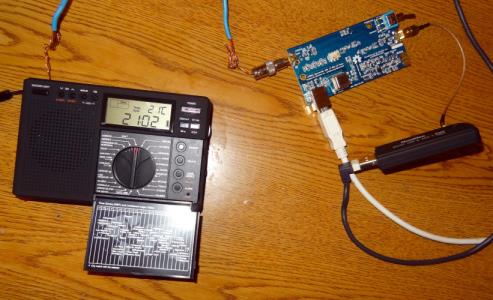
Akos from the SDR for Mariners blog has put together an article doing a comparison between the RTL-SDR + ham-it-up upconverter and a Grunding G8 Traveler II Digital conventional portable hardware shortwave radio.

His results show that the RTL-SDR and portable receiver are comparable in terms of performance, with a slight edge to the RTL-SDR. He adds that software tweaks available in SDR# can improve the voice quality for the RTL-SDR. However his final recommendation for general shortwave listening is that the portable is still the better option due to it’s ease of use.

RTL-SDR + Upconverter vs. Portable Shortwave Radio

NRF905 RTL-SDR Decoder

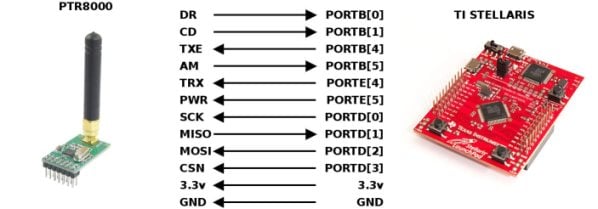
The NRF905 is a multiband RF tranceiver IC that uses frequencies in the ISM bands. Fabien le mentec posted about a project where he wanted to remotely monitor his garage door status using a microcontroller and the PTR8000 wireless module which contains the NRF905 chip.

In order to validate that his hardware settings were set correctly and that the NRF905 was transmitting correctly, he used an RTL-SDR and his recently written NRF905 decoder program to check the output frames.

Recently, we posted a similar project involving the NRF24L01+ wireless tranceiver where a decoder for that had been written as well.

PTR8000 Wireless Transceiver with the NRF905 Chip