Over on YouTube user Adam Alicajic has uploaded a video showing how coax cable loss affects the frame rate when receiving ADS-B. To do this test Adam uses a precision attenuator in between his ADS-B antenna and RTL-SDR dongle to simulate attenuation from coax cable loss. His results show that for every 1 dB of attenuation the frame rate drops by about 10%.
Coax cable loss for common type of cable can be estimated with calculators available at http://www.net-comber.com/cable-loss.html and http://www.arrg.us/pages/Loss-Calc.htm. RG-6 cable has a low loss at 1090 MHz of about 0.23 – 0.32 dB per meter, whereas RG58 has a loss of about 0.5 – 0.6 dB per meter and RG174 (stock antenna cable on most RTL-SDR units) has a greater loss of about 1.2 dB per meter.
Coax length loss contribution to the bad ADS-B reception
Over on Reddit and GitHub user cuppa-joe has released a Python based EAS SAME Alert message decoder called dsame which is compatible with the RTL-SDR. EAS is an acronym for Emergency Alert System and is a system that is most commonly used to alert the public to local weather emergencies such as tornadoes, flash floods and severe thunderstorms.
Local EAS weather alerts are encoded with the SAME (Specific Area Message Encoding) protocol. They are transmitted on the local weather radio frequency in the USA and Canada and some weather radio’s are capable of decoding the EAS SAME data. Cuppa-joe’s dsame EAS decoder outputs full EAS weather messages such as:
The National Weather Service in Pleasant Hill, Missouri has issued a Required Weekly Test valid until 12:30 PM for the following counties in Kansas: Leavenworth, Wyandotte, Johnson, Miami, and for the following counties in Missouri: Clay, Platte, Jackson, Cass. (KEAX/NWS)
To use the software you will still need to use a EAS demodulator such as multimon-ng which is available for Windows and Linux, and you will also need Python 2.7+ installed.
An example EAS SAME alert can be heard in the player below:
Radio pirates often make use of the Fleetsatcom satellites to send and receive slow scan television (SSTV) pictures over a wide distance. Fleetsatcom is a satellite communications system used by the US Navy for radio communications. Since these satellites are simply radio repeaters with no authentication mechanisms, pirates soon discovered that they could take over the satellites for their own use.
Over on YouTube user LEGION ELMELENAS has uploaded a video showing his reception of some pirates transmitting a SSTV image at a Fleetsatcom frequency of 252 MHz. To receive the image he used a home made turnstile antenna, an RTL-SDR dongle, SDR# and the RX-SSTV decoder. The image appears to be a photo of a pirates son.
We previously posted more information about Fleetsatcom SSTV pirates in this post.
SSTV from Satcom satellites. RTL-SDR SDRSharp FLTSATCOM pirates
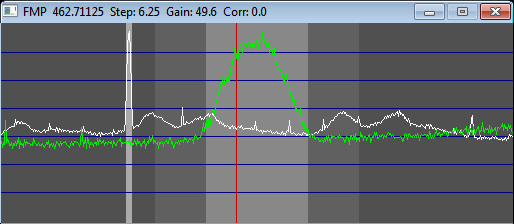
The latest version of Digital Speech Decoder+ (DSD+) has just been released, bringing it up to version 1.071. There appears to be no changelog, so we are unsure as to what is new, but one obvious change is that they now include a new program called FMP which is a simple NFM demodulator, similar to rtl_fm, although it does have a GUI with point and click tuning. FMP can be used as a replacement for SDR# or similar software, and is especially useful to use on low end devices such as netbooks.
An active discussion on the latest release of this software can be found in this thread on the RadioReference.com forums.
The FMP NFM demodulator tuned to a MotoTRBO signal.
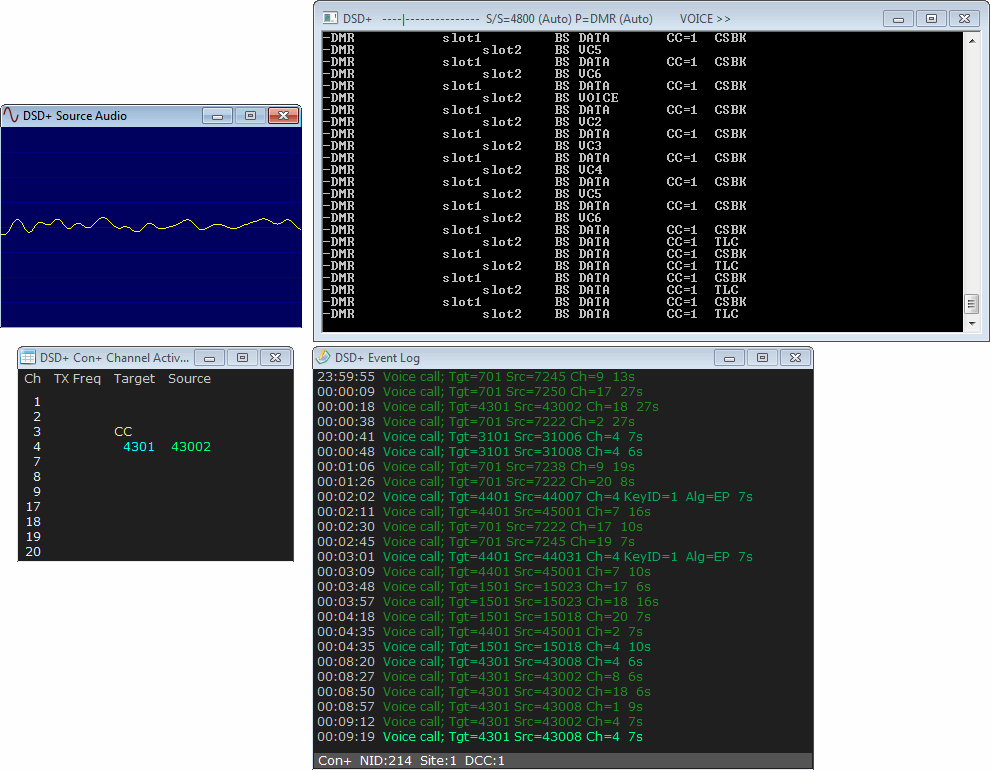
DSD+ is a Windows program which can be used to decode and listen to digital voice protocols such as D-STAR, NXDN4800, NXDN9600, DMR/MotoTRBO, P25 Phase 1, X2-TDMA and ProVoice with an RTL-SDR or other radio. On some DMR systems you may also be able to use the included LRRP software, which allows you to view the GPS locations of broadcasting radios. The last major release was version 1.05.
DSD+ GUI
The DSD+ team are now also offering a “fast lane” early access program, which for a small donation will allow you to have early access to new and upcoming DSD+ features. They aim to release a new update to donators every 7 to 30 days, while stable public releases will continue to be released every 4 to 6 months. The donation costs $10 for one year of early access, and $25 for lifetime updates. Some features they are currently working on include:
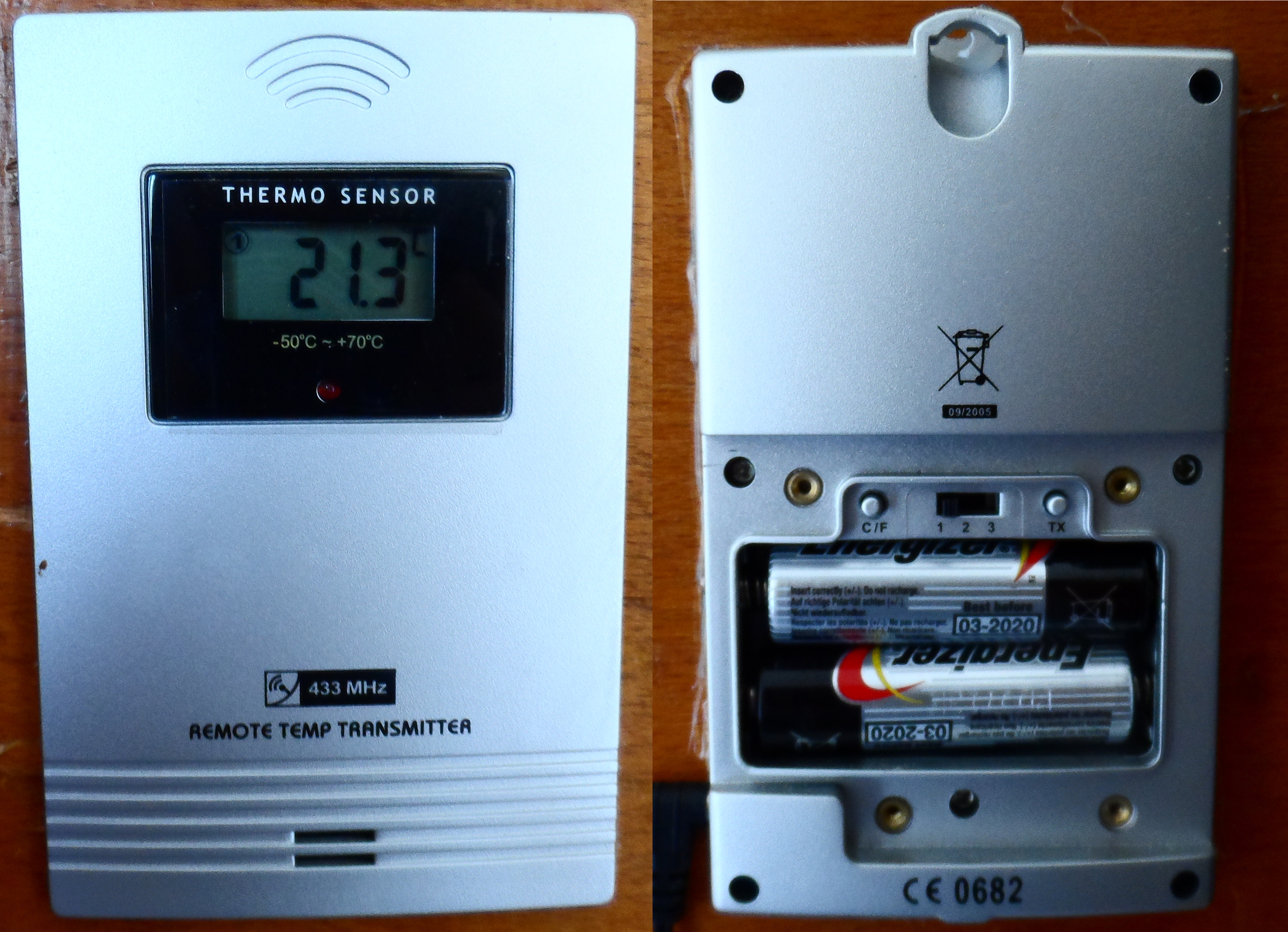
On his blog Josef Gajdysek has posted about his experience with using an RTL-SDR to reverse engineer the radio protocol used by his home weather station. Josef’s weather station is an ISM band device and transmits at 433 MHz. First he opened up GQRX and tuned to his weather station’s transmit frequency of 433.6 MHz and recorded some audio in AM mode. Josef initially assumed that the device would use on-off-keying (OOK) to encode the data. However, when he opened the sound file in Audacity and looked at it’s waveform he found that the weather station instead used Differential Pulse Position Modulation. In this modulation scheme the distance between pulses determines whether or not the binary bit is high or low.
Differential Pulse Position Modulation in Audacity
To decode this Josef then wrote a python script to measure the distance between pulses and thus convert the pulses into a binary string. Then by decoding and analyzing the captured packets he was able to isolate the checksum, temperature, channel, and status flags. Knowing all this information finally allowed him to create a real time decoder that uses rtl_fm. The python script can be downloaded from his post.
Back in December last year we posted about Jane feverlay’s work on his software called AISRec, which was a Windows AIS decoder for the RTL-SDR that he had developed.
AIS is an acronym for Automatic Identification System and is a system used by ships to broadcast position and vessel information. By monitoring AIS transmissions with the RTL-SDR we can build a boat radar system. We have a tutorial on this here.
Now from YouTube it looks as though Jane has developed a new Android version of AISRec which he describes as a high performance dual-channel AIS receiver for use with a single RTL-SDR dongle. The features of AISRec include:
1. Functions include AIS and GPS NMEA I/O, from/to USB devices and serial ports (special android devices with serial ports). 2. It supports TCP server and UDP forwarding jointly or independently for AIS and GPS. 3. It supports steaming in WIFI in AP or station modes and Ethernet. 4. It supports auto run on boot for especially rooted devices.
He also writes that AISRec also has companion implementations for Windows desktop and metro, Linux on Raspberry Pi 2 and the Radxa pro.
Unfortunately, at the moment there does not seem to be a link available to download the software and the video may only be a preview. The video does link to his Taobao shop at http://shop114459024.taobao.com/ (in Chinese use Google Translate), which is where he might release the software when it is ready.
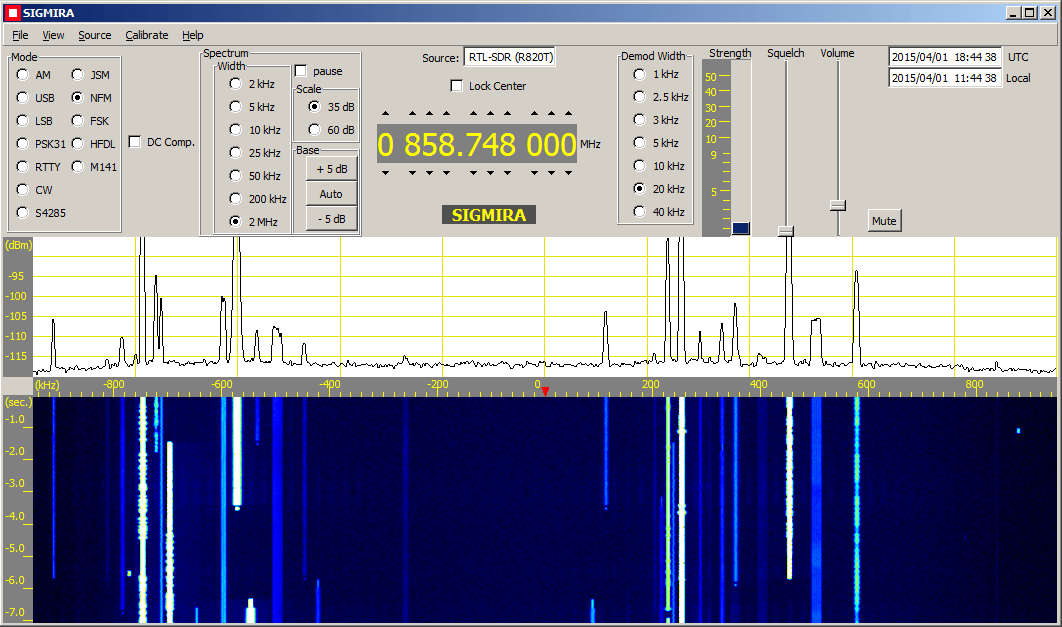
Sigmira is a popular free Windows software program which supports decoding of radio modes such as PSK31, RTTY, CW, STANAG 4285, Japanese Slot Machine, FSK, HFDL and M141 as well as standard modes such as NFM, AM, USB and LSB.
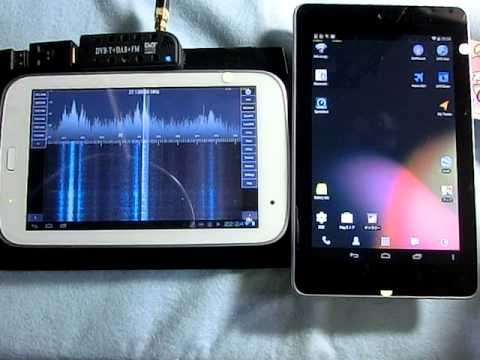
Over on YouTube user 2e26tenW has uploaded a video showing reception of the second harmonic of an NFC polling signal with his RTL-SDR. NFC stands for “Near Field Communication” and is a technology that enables smartphones and other devices to communicate with one another and some smart cards simply by bringing the two devices together.
In his experiment he uses a Nexus 7 tablet to poll an NFC enabled transportation card. As the RTL-SDR cannot receive the NFC frequency of 13.56 MHz directly without an upconverter or hardware or software direct sampling modified dongle, 2e26tenW instead tunes to the second harmonic at 27.12 MHz which allows him to receive the signal.