Category: News

New Low Power RTL-SDR’s for Stratux ADS-B Receivers

Stratux is an RTL-SDR based project that gives small plane pilots access to ADS-B data, without having to purchase an expensive commercial ADS-B installation. It consists of software that runs on a Raspberry Pi, and two RTL-SDR dongles to receive both 1090 MHZ ADS-B, and 978 MHz UAT. The decoded data is then streamed via WiFi to a tablet running navigation aide software with charts for pilots.

Typically Stratux kits come with two standard ‘Nano’ styled RTL-SDR dongles. However, users of the Stratux system have been reporting problems with overheating, and with the Pi struggling with the high current demands of a typical setup which includes two RTL-SDR dongles, active WiFi broadcasting, a GPS unit and an optional cooling fan. A typical RTL-SDR dongle draws 280 mA, so two dongles are already pulling 560 mA.

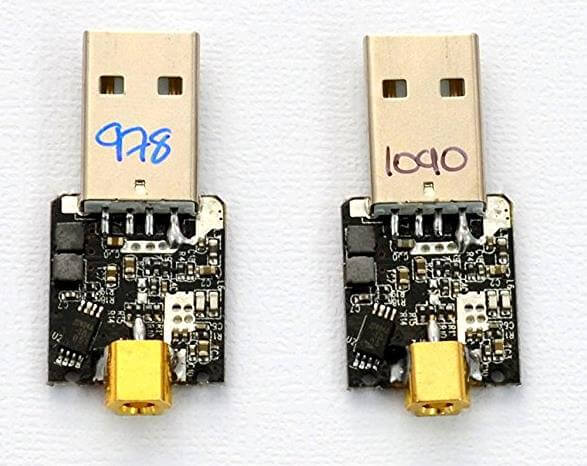
Chris, creator of the Stratux software and seller of Stratux kits has just released a new low power RTL-SDR dongle (kit with antennas). The cost is $35 USD for two dongles (one for 1090 MHz and one for 978 MHz). The dongle obtains its low power feature by using a switching regulator instead of a linear regulator as the main 3.3V power regulator on the PCB. Normally you would not want to use switching regulator for the main regulator in an RF device because they are very noisy in terms of RF interference generated. However switching regulators are much more efficient compared to linear regulators, and thus save a lot of current wastage. Other dongle manufacturers like ThumbNet have actually gone the other way, removing the secondary 1.2V switching regulator from the standard dongle design, and using a linear regulator instead. The ThumbNets end up with lower noise, but draw 400 mA of current. 

With the switching regulator the new Stratux dongles only draw about 185 mA, a saving of almost 100 mA. They also generate 0.5W less heat. Users of the Stratux system have so far been impressed with them and have not noticed any appreciable difference in ADS-B performance. We think that these low power dongles might also be of interest to people using them on mobile phones or battery/solar powered remote installations.

The new Stratux low power RTL-SDR dongles.

During testing, Chris found that there was no significant noise floor increase visible on the 978 MHz  & 1090 MHz frequencies. Most of the switching noise increase appears to be on the lower frequencies, but those frequencies are not relevant for the Stratux use case anyway.

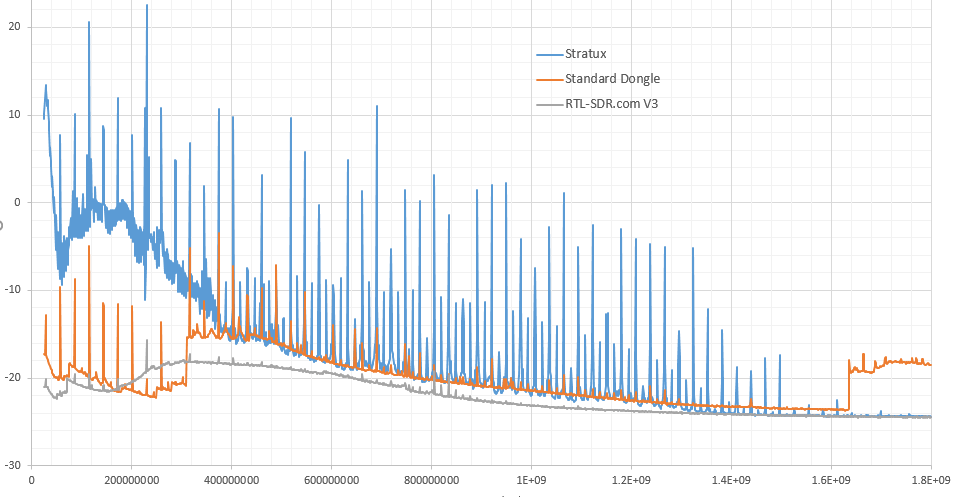
Chris was kind enough to send us some samples of the new low power dongles. First we ran a noise floor scan with rtl_power to determine the effect of the switching regulator. The results show that the spurs and noise floor readings have definitely increased by a significant amount, with an especially large noise floor rise below 400 MHz. In SDR# wandering switching noise spurs are also visible throughout the spectrum, but they tend to weaken in strength once an antenna is connected.

Stratux vs Standard Dongle vs V3 Dongle Noise Floor Scan

Fortunately, ADS-B is very tolerant to spurs and is generally not affected by this type of noise. We’ve only given the Stratux a quick test on ADS-B so far, but when compared against another ‘nano’ styled dongle the Stratux performed nearly identically (in fact even a little better) in terms of messages received. The two dongles were connected to the same antenna via a splitter and we logged the number of messages received in 10 minutes.

Quick ADS-B Reception Test

In conclusion the Stratux RTL-SDR set out to solve the mobile power issues suffered by people using the Stratux system. It has achieved that with an over 100mA saving in current use. The new Stratux dongle is much noisier, but the noise does not appear to significantly affect ADS-B reception as seen by our results and from the reports from Stratux users who beta tested this dongle.

Chris has also created a post on Reddit /r/stratux which talks a bit more about the new dongle.

SDRuno Updated to V1.1: Now supports up to 2.4 MSPS for the RTL-SDR

SDRuno is the official software for the SDRplay RSP software defined radio. Recently they’ve released version 1.1 which contains various new features and bug fixes for the RSP. The SDRuno Cookbook by NN4F & KD2KOG has also accordingly be updated with information about the new features.

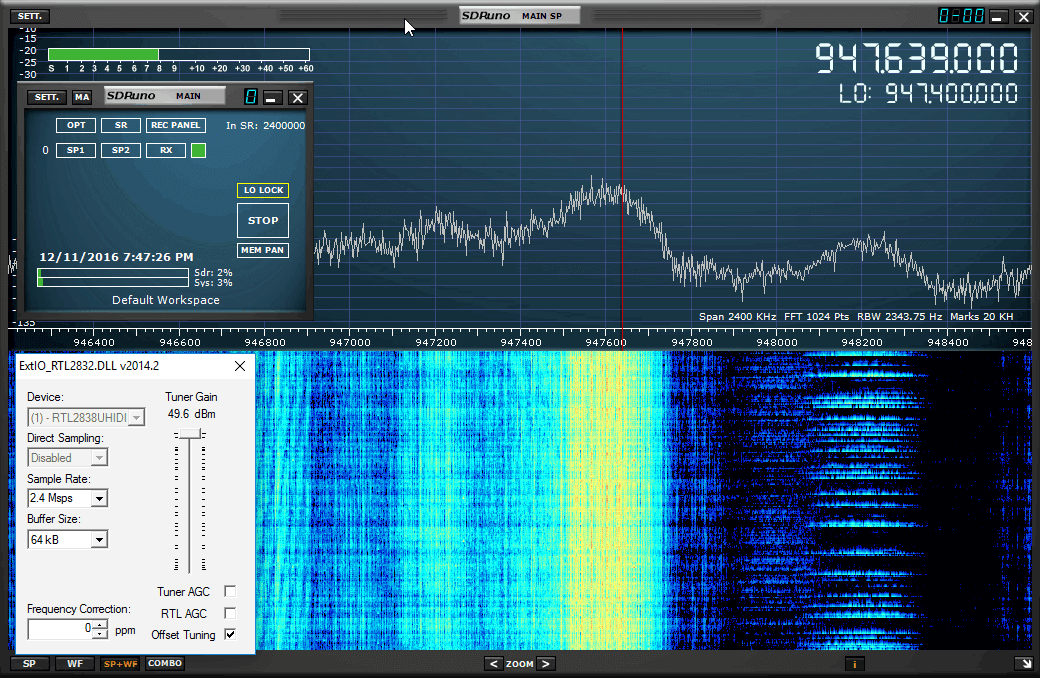
In addition they’ve also now increased the previous 0.96 MSPS sample rate limit which was enforced for all third party radios running via EXTIO drivers. The new limit is 2.5 MSPS (with 2.4 MSPS being the limit for the RTL-SDR). This is great news for RTL-SDR users as SDRuno for the RTL-SDR is now almost as functional as in other SDR software like SDR#, HDSDR and SDR-Console. The change log is pasted below:

Version 1.1 (11th November 2016)
Bug Fixes

  • 1.04.1 – fixed issue where highlighted filter wasn’t always the one loaded.
  • Waterfall in combo mode now flows the same direction as other modes

Updates (RSP only V1.1)

  • Tighter integration of RSP controls
  • Calibrated power measurement
  • Automatic S-Meter calibration
  • SNR meter
  • dBm scale for both SP1 and SP2 windows
  • Automatic frequency calibration
  • Support for IARU S-Meter standard
  • Zoom to VFO button in SP1 window
  • More improvements to AGC scheme
  • More improvements to DC offset compensation scheme
  • Reversed default mouse wheel scroll direction
  • Waterfall in combo mode direction can be reversed in the same way as other modes
  • Added extra frequency step sizes
  • LSB / USB filter presets back to being the same
  • USER filter preset renamed to DIGITAL
  • Support for both gain and gain reduction displays
  • Updated hardware driver – now reports as SDRplay device

Updates (EXTIO only V1.05)

  • maximum bandwidth changed to 2.5MHz
SDRuno Version 1.1 Running a RTL-SDR at 2.4 MSPS

The ThumbNet N3 is now Shipping

The latest RTL-SDR receiver from Thumbnet, the Thumbnet N3 is now shipping out. Back in October we received a sample of one of their prototypes and found it to have a very low noise floor since they have replaced the 1.2v switching regulator with a linear regulator.

ThumbNet is a company that is hoping to provide low cost satellite deployments, and make use of volunteers around the world with RTL-SDR’s to help track them. The RTL-SDR’s and antenna kits are provided to schools and educational institutions for free by ThumbNet, in exchange for students setting up and monitoring a satellite tracking station.

In their release email they wrote:

ThumbNet would like to send a very large “Thank You!!” to all of you who have supported us by purchasing one of our surplus N3 SDR receivers, and we wanted to take a second and let you know that we’re excited to announce that the N3’s have left the factory and will begin shipping.

The support has been tremendous and we have a backlog of many hundreds of receivers to get out. We will be working extremely hard, over the coming days to get them all delivered as quickly as possible (Orders will be shipped in the order they were received.).

Don’t forget that there are accessories in the ThumbSat Store (http://www.thumbsat.com/thumbnet-sdr-hardware/thumbsat-store-4 ) that may be of value to you, such as adapters, cables or power supplies to let you get the maximum performance from your ThumbNet N3. 

A handful of independent tests have been done on the Qualification Models of the N3, and the results have been quite positive.  If interested, you can read some of the reviews at the following links.

RTL-SDR.com – https://www.rtl-sdr.com/rtl-sdr-com-quick-review-of-the-thumbnet-n3-prototype/

RTLSDR4EVERYONE – http://rtlsdr4everyone.blogspot.com/p/thumbnet-n3.html

Thank you again for supporting ThumbNet and we hope the N3 exceeds all of your expectations!!

The Thumbnet N3 with its metal case add on.
 

HDSDR Beta 2.75 Released

A new beta version of HDSDR has recently been released. HDSDR hasn’t been updated since 2013, so it is good to see that the author is back in action. HDSDR is a free general purpose SDR receiver, similar in nature to other programs like SDR# and SDR-Console. It was one of the first programs to work with the RTL-SDR dongle and despite a lack of recent updates is still a very solid piece of software.

The new HDSDR is version 2.75 Beta1 and the changes include:

  • more recording options
  • support for 8bit sampling format
  • HDSDR runs without output soundcard
  • support for 8k display resolution (7680×4320)
  • extended ExtIO capabilities
  • many fixes and improvements

The main visual difference we’ve noticed so far is the addition of a text dBM meter under the S-Units meter. We also discovered some new color palettes.

HDSDR Beta running a new bright grayscale color palette.

FlightAware Release their Pro Stick Plus: An ADS-B Optimized RTL-SDR with LNA and 1090 MHz Filter Built in

Back in March of this year we posted about the release of the FlightAware "Pro Stick". The Pro Stick is FlightAware's ADS-B optimized RTL-SDR dongle. It uses a low noise figure LNA on the RF front end to reduce the system noise figure, thus improving the SNR at 1090 MHz. Because the added gain of the LNA can easily cause overload problems if there are other strong signals around, FlightAware recommend using one of their 1090 MHz ADS-B filters in front of the dongle to prevent overload.

FlightAware have just come out with the "Pro Stick Plus" which is the same as their Pro Stick, but now with the 1090 MHz filter built into the dongle itself. The Pro Stick Plus costs $20.95 USD on Amazon, which is a good deal cheaper than buying the standard Pro Stick ($16.95 USD) plus their ADS-B filter ($19.95 USD), which totals $36.90. Customers outside of the USA can purchase the Pro Stick Plus from seller "WiFi Expert" on eBay for $29.95 USD.

FlightAware.com is a company that specializes in live air travel tracking. Most of their data comes from volunteers running RTL-SDR ADS-B receivers.

The new Pro Stick Plus RTL-SDR based ADS-B Receiver from FlightAware.

Over on their forums and on Amazon, they announced the device and specs. They wrote:

FlightAware is excited to announce the next evolution of USB SDR sticks for ADS-B reception! The new Pro Stick Plus USB SDR builds on the popular Pro Stick by adding a built-in 1090 MHz bandpass filter. The built-in filter allows for increased performance and range of reception by 10-20% for installations where filtering is beneficial. Areas with moderate RF noise, as is typically experienced in most urban areas, generally benefit from filtering. By integrating the filter into the SDR stick, we are able to reduce the total cost by more than 40% when compared to buying a Pro Stick and an external filter.

Specifications:

  • Filter: 1,075 MHz to 1,105 MHz pass band with insertion loss of 2.3 dB; 30 dB attenuation on other frequencies
  • Amp: 19 dB Integrated Amplifier which can increase your ADS-B range 20-100% more compared to dongles from other vendors which can increase range 10-20% over a Pro Stick in environments where filtering is beneficial
  • Native SMA connector
  • Supported by PiAware
  • R820T2 RTL2832U chips
  • USB powered, 5V @ 300mA

Note that this dongle is only for ADS-B at 1090 MHz, and not for 978 MHz UAT signals, as the filter will cut that frequency out.

Back in April, we did a review of the original Pro Stick. We found its performance on ADS-B reception to be excellent, but only when a filter was used. The low NF LNA theoretically improves the SNR of ADS-B signals by about 7-8 dB, but in reality there is too much gain causing signal overload everywhere, thus making reception impossible without the filter. Rural environments may not need a filter, but in a typical urban or city environment strong FM/TV/GSM/etc signals are abundant and these signals easily overloaded the Pro Stick when no filtering was used. This new Pro Stick Plus dongle completely solves that problem at a low cost with its built in filter.

Remember that if you are using a run of coax cable between the LNA and RTL-SDR, then it is more optimal to use an external LNA, like the LNA4ALL. Only an external LNA mounted near the antenna can help overcome coax, connector, filter and other losses as well as reducing the system noise figure. The FlightAware dongles are the optimal solution when they are mounted as close to the antenna as possible. This is usually the case when running the FlightAware feeder software on a Raspberry Pi.

We hope to soon review the Pro Stick Plus, however we assume it will operate nearly identically to the Pro Stick + FlightAware ADS-B filter combination.

LimeSDR Production Progress

The LimeSDR is a RX/TX capable SDR with a 100 kHz – 3.8 GHz frequency range, 12-bit ADC and 61.44 MHz bandwidth. Back in June 2016 they reached their $500,000 goal on the crowdfunding site crowdsupply. They are now gearing up to enter mass production the final product. Recently they released  a production update which is quoted below.

Production Progress

Since the successful close of our funding campaign, We’ve been incredibly busy preparing to deliver LimeSDRs to all our backers. Just as we worked hard during the campaign – internally, with key partners, and with our fantastic beta testers in the community — creating a series of exciting demos, we continue to work to ensure backers will have a first-class experience upon receiving their hardware. In this update, we’ll review the state of the production schedule, hardware design, testing setup, documentation, app store, and more.

Production Schedule

To be upfront, our production schedule has slipped, but not by a lot. We discovered that some of the parts used in the original LimeSDR design have since entered end-of-life status, so we redesigned the board with replacement parts. In addition, we are still waiting on manufacturers for a few key components, such as the high-precision oscillators. We are in close contact with those manufacturers and our best guess right now is we will have all components by mid-November.

Once we have the components, our manufacturing partner in Taiwan can very quickly produce the entire lot of LimeSDRs. The assembled boards will then be sent to the UK for final quality assurance and packaging before heading off to Crowd Supply’s warehouse for delivery to all backers.

Given all this, we expect all LimeSDRs, including the Aluminum Kit version, to be delivered in December. Of course, we will update everyone as soon as have more information. In any case, we will post an update at least once a week between now and delivery.

Update Your Shipping Address

You will know your order has shipped when you receive a shipping confirmation email from Crowd Supply. The shipping confirmation email will contain a tracking number. If you need to change your shipping address, you can do so by logging into your Crowd Supply account. If you didn’t already have a Crowd Supply account, one was automatically created for you when you placed your order. We will post a separate update letting you know about the cutoff date for updating your shipping address.

Hardware and BoM

We have been contacting all the component suppliers and manufacturers and placing orders through our operation in Taiwan. As part of this work we wanted to make sure that no component will become end-of-life for at least 2 years. As a result, we have had to make minor changes to the board to replace some of the older parts. This was followed by another set of prototype runs to ensure that there is no impact on performance and manufacturability of the boards.

First batch of the Altera FPGA parts delivered to Lime headquarters yesterday.

Production Testing

A rigorous testing programme is essential with an advanced technology platform such as the LimeSDR and this work has just been completed. The LMS7002 production test had already been verified and running on industry standard Teradyne testers with RF test configuration. The program for the LimeSDR boards runs on x86-based workstations and provides an optimised test time while exercising all the functions, including frequency and bandwidth sweep across the full range.

Driver and Software Updates

We have already shipped over 100 boards to our community of beta testers for their feedback, before, during, and after the campaign. This enabled us to provide so many truly exciting updates during the campaign and, more significantly, we have been getting excellent feedback from the community, who have been simply outstanding in sharing their ideas for improving the user experience. We are making significant updates to the driver and calibration algorithms as a result, these are largely complete and will be pushed to Github before the end of November.

Documentation

We will continue to invest heavily in this area and see this as being key to demonstrating our steadfast commitment to the community. Giving you the best support begins with well structured documentation. Obviously, we rely here on your input and feedback. Making the process as smooth as possible is key, we have already started to publish data sheets and supporting documentation on the Myriad-RF Wiki, and will continue to do so as we gather your comments and suggestions.

LimeNET App Store

One of the key activities which we believe will set LimeSDR apart from other software-defined radio solutions is the concept of app-enabled SDR. With this, developers can provide their solution as a incredibly simple to install app, complete with all the various dependencies — with optional support and certification etc. — and publish it via the LimeNET app store. We envisage a rich ecosystem of many applications, resulting in a fantastic out-of-the-box user experience as the maturity and sophistication of the algorithms and software routines improves over time.

We are working very closely with Canonical (the organisation behind the immensely popular Ubuntu Linux distribution) to put in place the app store infrastructure and plan to have a basic service running and populated with a few initial apps by the time the first boards go out.

We are currently in the process of setting out the criteria for publishing an app in the LimeNET store, along with the associated terms and conditions. This is another area where we plan to seek input from you, our backers, to encourage the widest participation and cater for a variety of business and revenue models for developers. There will be numerous posts and updates on this topic, with plenty of opportunity for your input, comments, and feedback.

Last but not least, we shall be posting regular updates as we get closer to the deadline. This will be similar to during the campaign and with plenty of details, including things such as component delivery status, manufacturing progress, and delivery dates for the pledges made by you in all the different categories.

Thank you once again for your support and here’s to the exciting weeks ahead!

Ebrahim and the LimeSDR Team

A Multi-Channel Coherent RTL-SDR Product: For Passive Radar, Direction Finding and More

Coherent-receiver.com is a company which is a customer of our RTL-SDR V3 dongle and they have been working on creating a multi-channel coherent receiver product based on the RTL-SDR. An RTL-SDR multi-channel coherent receiver is at its most basic, two or more RTL-SDR dongles (multi-channel) that are running from a single clock source (coherent). A multi-channel coherent receiver allows signal samples from two different antennas to be synchronized against time, allowing for all sorts of interesting applications such as passive radar and direction finding.

The team at coherent-receiver.com have used the new expansion headers on our V3 dongles to create their product. In their receivers they attach a control board which has a buffered 0.1 PPM TCXO (buffered so it can power multiple RTL-SDR’s). They also added an 8-bit register and I2C connection capabilities which allows for control of future add-on boards. The I2C capability is useful because it means that several RTL-SDR dongles can be controlled and tuned from the same control signal. More information on the registers and build of the receiver control board can be seen on their technical support page.

A ten channel RTL-SDR coherent receiver.
The Coherent Receiver block diagram.

One example application of a multi-channel coherent receiver is passive radar. Coincidentally, we’ve just seen the release of new GUI based Passive Radar software by Dr. Daniel Michał Kamiński in yesterdays post. Passive radar works by listening for strong signals bouncing off airborne objects such as planes and meteors, and performing calculations on the signals being received by two antennas connected to the multi-channel coherent receiver.

A second example is direction finding experiments. By setting up several antennas connected to a multichannel coherent receiver calculations can be made to determine the direction a signal is coming from. An interesting example of direction finding with three coherent RTL-SDRs can be seen in this previous post. A third example application is pulsar detection which we have seen in this previous post

Coherent-receiver.com sent us a prototype unit that they made with four of our V3 dongles. In testing we found that the unit is solidly built and works perfectly. We tested it together with Dr. Kamiński’s passive radar software and it ran well, however we do not have the correct directional antennas required to actually use it as a passive radar yet. In the future we hope to obtain these antennas and test the coherent receiver and the software further.

Currently they do not have pricing for these models as it seems that they are first trying to gauge interest in the product. If you are interested in purchasing or learning more they suggest sending an email to [email protected]. It seems that they are also working on additional RTL-SDR ecosystem products such as filters, downconverters, antennas and LNAs.

We hope that the release of this product and Dr. Kamiński’s software will give a boost to the development of coherent multi-channel receivers as we have not seen much development in this area until recently.

SDRDue running on the coherent-receiver.com unit.

KiwiSDR Soon to Accept General Orders

Back in April 2016 the KiwiSDR was successfully funded on Kickstarter. Since then almost all the rewards have been mailed out and the number of worldwide receivers available on sdr.hu has increased. KiwiSDR is an SDR cape (add on) for the BeagleBone Black/Green embedded computer which covers 0 – 30 MHz with 30 MHz bandwidth. It’s main purpose is to be used as a web based remote receiver which can be publicly accessed by many users.

Over on the Kickstarter updates page we see news that Seeed Studio is taking over the production and distribution of the KiwiSDR, and soon you’ll be able to order the KiwiSDR cape directly from their online Bazaar. Seeed studio is the same company that produces several other capes for the BeagleBone and they also produce the BeagleBone Green which is needed to run the KiwiSDR. They write:

We are very pleased to announce an agreement for Seeed Studio to take over production and distribution of the KiwiSDR going forward. What does this mean? Until now Seeed only had a contract with us to produce the Kickstarter rewards and pre-orders. Now Seeed will add the KiwiSDR to their family of BeagleBone capes they manufacture and distribute. Very soon you’ll be able to order the KiwiSDR directly from Seeed’s online Bazaar, pay directly with a credit card or Paypal and use their shipping system.

For us, and you as Kiwi owners, this is a very positive development. It means soon we’ll be able to devote the majority of our time to software development and providing you support. And as you probably know there is a large list of bugs, feature requests, extensions, distributed experiments and educational material we’d like to be working on instead of worrying about shipping and manufacturing issues. Improving the software is the best way to differentiate ourselves in a crowded SDR marketplace.

We would appreciate it if you would continue to purchase from us until our stock is depleted. Seeed has already manufactured a significant number of units alongside our prior build and will be able to meet the demand immediately. We thank everyone at Seeed for their fantastic effort in making KiwiSDR a reality.

seeed_kiwi