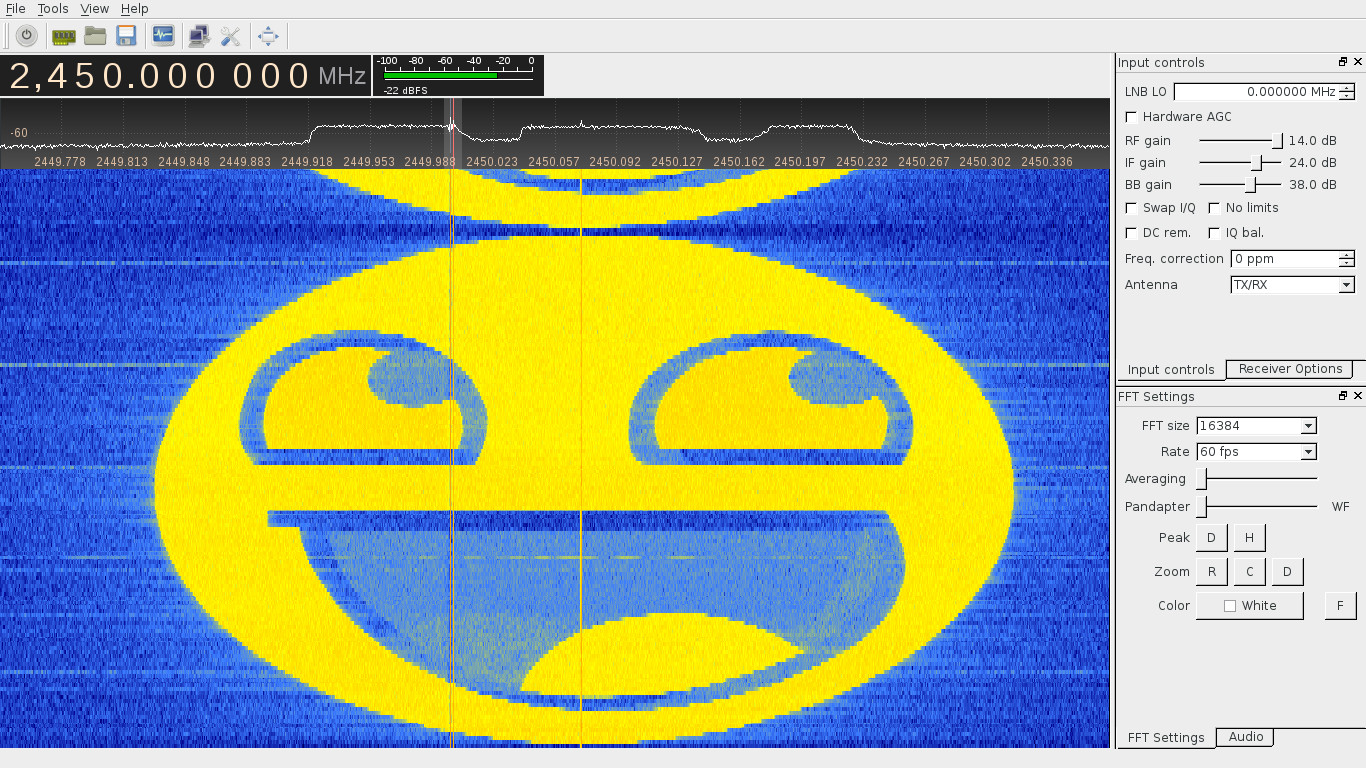
Last week several people from the Chaos Communication Camp conference and others on the #hackrf IRC channel were playing around with the idea of painting pictures on the RF spectrum with the HackRF – a low cost transmit capable software defined radio. This idea works simply by modulating a signal so that it produces a desired image pattern on a frequency domain waterfall display.
To make this easier to do, GitHub user polygon has authored a Python program called Spectrum Painter which easily converts an image into an IQ file which can be transmitted with a HackRF. In addition as described in the Reddit thread linked above, a Windows program called Coagula can also be used to convert images into .wav files, which can then be transmitted on any capable radio. The RF painted images can then be received on another SDR radio like the RTL-SDR.
As always remember to only transmit at a frequency you are licensed on, or at low power in a RF controlled environment.
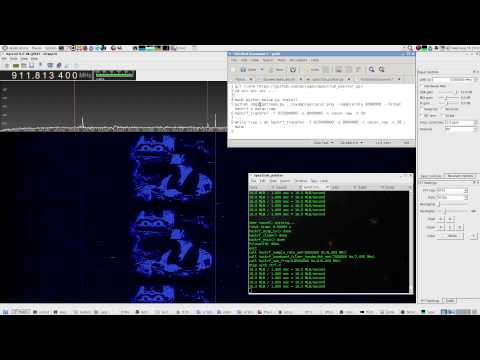
Below is an example image and video showing images being painted on the RF waterfall.
Spectrum painter transmitted output image
hackrf transmitting images in the frequency domain
The Chaos Communication Camp (CCC) conference was recently held in Germany this year. The conference is a five day event that focuses on topics such computer security, hacking, electronics and other similar related topics. The full list of talks can be found here, but on this page we list all the SDR related talks which we could find. If you know of any more SDR related talks from the CCC please let us know in the comments.
“The Rad1o: Listen to all the things”
This year participants of the CCC were all given a Rad1o badge, which is a HackRF variant. In this talk the creators of the Rad1o explain their experience with creating the Rad1o and give an overview of it’s hardware and software options.
“Satellite Open Ground Station Network: open source ground station, optimized for modularity, built from readily available and affordable tools and resources.”
(Audio broken until 2:50) The SatNOGS project aims to provide low cost satellite ground stations (where one critical component is currently an RTL-SDR dongle) along with free networking software in order to create a crowd sourced satellite coverage network. The SatNOGS project was also the grand prize winner of the 2014 Hackaday prize which saw them take away almost $200k US dollars of prize money. This talk introduces the SatNOGS project.
“Iridium Hacking: please don’t sue us”
Iridium is a satellite service that provides global communications. This talk discusses how the presenters were able to decode the Iridium pager network with a simple software defined radio like the RTL-SDR. At the end of the presentation they show a live demo of the Iridium signals being decoded.
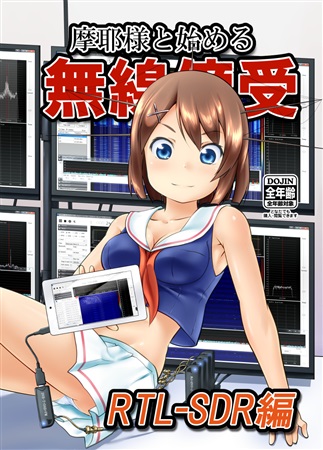
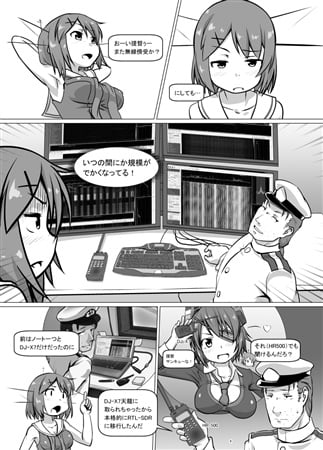
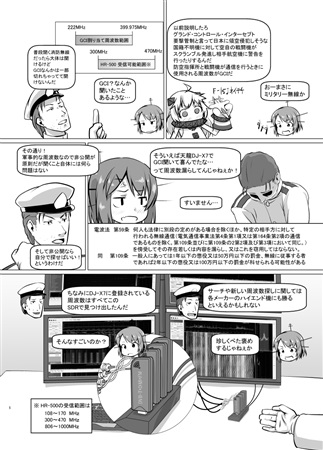
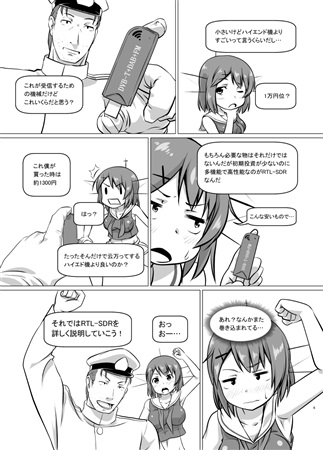
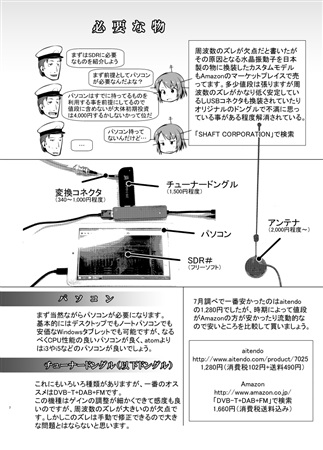
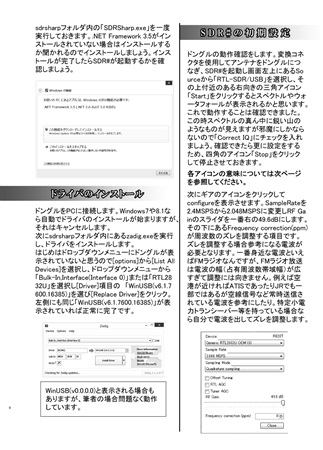
We’ve recently been informed that the RTL-SDR has become so popular that is now has it’s very own Japanese Manga comic book! If you don’t know what Manga is, it a type of Japanese comic book. The manga appears to be a one off self published work in a continuing series about military radio interception. Other popular technical manga books have been released before, such as the manga guides to statistics, physics, calculus, electricity, linear algebra, biochemistry, the universe and relativity, but this is the first one we’ve seen on the RTL-SDR.
The comic is written in Japanese and it looks like it explains what the RTL-SDR is as well as providing a tutorial on its installation and use. It is yet to be released but the release date is stated as mid August. The comic is sold on this Japanese web store (note that on the store it is possible to see some illustrated images that may be considered explicit by some so don’t click if you want to avoid that). It may be an interesting gift for RTL-SDR fans, or for Japanese readers who want a fun way to learn about radio. We’re not sure how to buy the comic if you reside outside of Japan, but this Japanese forwarding service might be able to buy it for you.
Below we’ve posted the cover image and the preview pages.
When decoding a digital signal with an RTL-SDR the digital audio is usually piped from receiver software like SDR# via stereo mix or software like Virtual Audio Cable/VBCable into the decoding software. The decoding software expects a clean audio signal with the volume levels set not too loud, but also not too quiet. Usually this can be achieved by trial and error.
The RTL-SDR is fully compatible with Windows 10. However with the recent release of Windows 10 some users have been having trouble using their RTL-SDR after upgrading. We thought that we'd announce that the simple solution to most problems is to reinstall the SDR drivers with Zadig. The latest version of Zadig can be downloaded from zadig.akeo.ie or if you use SDR# then it will already be in your SDR# folder. The process is:
Plug in the RTL-SDR.
Run Zadig as administrator by right clicking it and choosing run as administrator.
Go to Options -> List all devices and make sure it is checked.
In the drop down box choose Bulk-In, Interface (Interface 0). This may also sometimes show up as something prefixed with "RTL28328U". That choice is also valid.
Make sure that WinUSB is selected as the target driver and click on Replace Driver.
If you need more help see the Quickstart Guide. (NOTE: If you have come across this post before the quickstart guide, be sure to use the quickstart guide as your first point of reference for installing RTL-SDR drivers and software!)
The Windows 10 upgrade process appears to replace the WinUSB drivers with the Windows DVB-T ones, so reinstalling the SDR drivers is necessary. It shouldn't be necessary, but one user also reported the need to log in to Windows with an administrator account and to uninstall the current drivers before running Zadig, so try that if you continue to have problems.
As in our previous post we can confirm that several popular SDR apps such as SDR#, HDSDR, SDR-Radio, CubicSDR and Unitrunker all work fine in Windows 10.
The author writes that Skywave Linux is currently compatible with the RTL-SDR and HPSDR hardware. At the moment it seems that the first version has only very few preinstalled software programs. These include: QT Radio, CubicSDR, Fldigi, and Dump1090. The authors write about Skywave:
Welcome to the first release of Skywave Linux! This is an operating system designed to provide access to a growing network of software defined radios all over the world. With global SDR access, shortwave listeners can access broadcast, utility, amateur radio, military, and other signals from almost anywhere in the world – from state-of-the art radio servers. All you need to do is boot Skywave Linux on a computer with internet access.
Why was Skywave Linux created? The developer of this system was plagued by a lack of access to quality radio broadcasts due to his residence in a country practising tight media control and censorship. In addition, software defined radio is an exciting way to experience the hobby of shortwave listening. By connecting to remote radio servers on the internet, it is possible to enjoy bleeding edge radio operation without large antennas or setting up a station on-site. Installing SDR software can be difficult for many computer users, and Skywave Linux eliminates the hassle of downloading, compiling, and configuring apps for the SDR servers on the internet.
Parabolic microphones allow listeners to clearly hear sounds from far away. They are often used by bird call enthusiasts and also probably by spies. A parabolic microphone works by using a dish to concentrate distant sound onto an amplified microphone and they have been commercially available since the 60’s as demonstrated by this old Radioshack ad.
An old parabolic micrphone advertised in a radioshack catalogue from the ’60’s
Usually, the listener uses a pair of headphones directly tethered to the parabolic microphone and walks around with the dish in hand. However, this week electronics hobbyist Mario Fillipi wrote in to RTL-SDR.com to let us know about his project in which he created a wirelessly operated parabolic microphone.
To do this Mario connected a wireless FM transmitter to the headphone output of his home made parabolic mic, mounted the dish on a tripod, and then used his RTL-SDR to receive the FM transmission and demodulate the remote sounds. Of course reception can be done with any suitable radio, but the RTL-SDR provides the advantage of being able to easily manage, record and analyze the received audio.
The parabolic microphone with FM transmitter
Mario used his wireless parabolic microphone to record the sounds of finches in a bird house that was about 70 feet (21 meters) away. Then he writes that in HDSDR he was able to analyze the finches calls in the audio spectrum waterfall. He noticed that the calls were in the 2300 – 6000 Hz audio range and that each call’s “imprint” or audio signature was very similar and could be easily recognized. You can listen to the finches calls that were recorded by the RTL-SDR in the audio file below.
Looking at the Finch calls’ “imprints” in the audio spectrum waterfall in HDSDR
Mario writes that this can be done with any commercially available parabolic microphone, but if you want to know how to build your own wireless parabolic microphone then check out Make magazine’s article on Mario’s work. The article shows in detail how to build a parabolic microphone out of a squirrel baffle (a bowl shaped piece of plastic that prevents squirrels from eating bird feed), a Velleman Super Stereo Ear kit (microphone + amplifier kitset) and a standard wireless FM transmitter. Mario writes that the audio range of his home made parabolic mic is about 100 feet (30 meters). A video from Make magazine showing Mario’s home made parabolic mic is shown below.
The dxzone.com website has uploaded a post that lists five free virtual audio cable software programs. Virtual audio cable’s allow you to “pipe” or pass the audio from one application to another. For example, in order to pass the audio of a digital P25 signal received in SDR# into a decoding program such as DSD+, you need to use a virtual audio cable. The most commonly recommended software is Virtual Audio Cable, but this software is not free. See the dxzone.com post for their list of five alternatives for Windows, Linux and MaxOS.