Category: Other

New Signal Identification Guide Wiki: sigidwiki.com

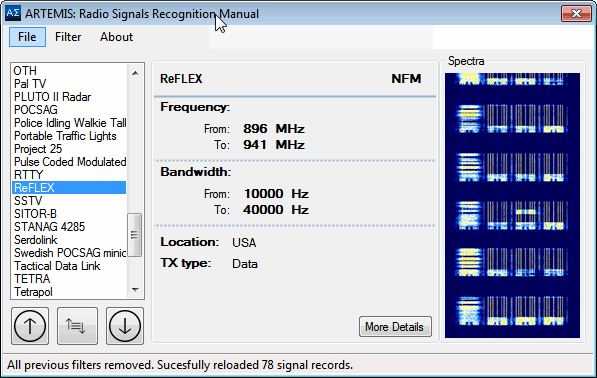
We’ve recently created a new radio signal identification guide over a www.sigidwiki.com. This is a wikipedia styled site which is editable by anyone. We hope that some readers will make a contribution by adding new reference signals, fixing mistakes or identifying unknown signals. Any comments or requests about the page are also welcome.

You can still contribute known or unknown signals to rtlsdrblog__AT__gmail__dot__com and I will add them to the sigidwiki myself.

SoftRock Lite II Build and Test Tutorial Video

The SoftRock Lite II is a (now fairly old) soundcard based software defined radio kitset that is capable of receiving on the HF bands. Over on YouTube user w2aew has uploaded a video showing the entire kitset build process for the SoftRock Lite II SDR radio. He also goes over the circuit blocks explaining their function and how they work.

This is an excellent video if you are interested in learning more about the components and circuits used in some SDRs.

#148: Software Defined Radio kit | Tutorial | Build | Test | Softrock Lite II

TeensySDR: SoftRock SDR On a Teensy Microcontroller

Amateur Radio Hobbyist VE3MKC has been working on a project involving running a SoftRock SDR on a Teensy 3.1 Microcontroller. The Teensy is a tiny microcontroller board that uses a 32-bit ARM processor and the SoftRock SDR is a HF only software defined radio kit.

VE3MKC wrote code to first digitize then multiply the signal with a digital VFO before finally applying a low pass filter. He found that the Teensy’s microcontroller has sufficient CPU power to have an LCD RF spectrum display and process the audio output at the same time. Two videos of his project have been uploaded to YouTube.

TeensySDR - a Simple Software Defined Radio using the Teensy 3.1

Teensy SDR IQ Signal Processing

Pranking Colleagues with the USRP B210 Software Defined Radio

The Ettus USRP B210 is an advanced $1,100 software defined radio that is capable of both transmit and receive. Balint, one of the researchers at Ettus, has posted a video showing how he was able to play a light hearted prank on some of his colleagues using the B210.

Earlier in the year we posted about how Oona Raisanen was able to use her RTL-SDR to receive and decode restaurant pagers (the wireless devices given out at some restaurants to notify you when your food is ready).

Balint used his USRP210 controlled by a mobile phone app to transmit a fake signal to his colleague’s pager, causing it to activate before his food was ready.

You Can Page Me Anytime - USRP B210 + GNU Radio (teaser)

Measuring the Frequency Response of a Bandpass Filter with the RTL-SDR

Lacking both an expensive signal generator and spectrum analyzer, Hans used his RTL-SDR together with a simple diode based wideband noise generator to measure the frequency response of a 137 MHz bandpass filter.

To do this he used the RTL-SDR Scanner software which allows you to create a composite spectrum over a frequency range wider than the maximum 3.2 MHz of bandwidth the RTL-SDR provides. The wideband noise generator was cleverly constructed out of a diode operating in it’s reverse breakdown mode.

Apart from the obvious excessive spurs, this method worked quite well and the shape of the filter is clearly visible.

Bandpass Filter Response
Wideband diode noise source

Ham it up Upconverter 3D Printed Case YouTube Giveaway

Over on YouTube Eric William has posted a video about his competition where he is giving away two 3D printed ham-it-up upconverter cases. The ham-it-up is an upconverter that can be used with the RTL-SDR to allow it to receive HF (0-30 MHz) frequencies. To enter the competition you simply need to go to Erics web forum and post about what you use SDR for in the competition thread. The competition is open only for North American viewers and ends on May 19 2014.

Radio Signal Identification “Encyclopedia” Paperback

Yesterday a reader wrote in to let us know about two comprehensive paperback books about radio signal identification that he’d found online. This reader thought the books would be relevant to RTL-SDR users wanting to know more about the vast number of signals available to them. The books are titled

Technical Handbook for Radio Monitoring VHF/UHF (PDF Excerpt) &
Technical Handbook for Radio Monitoring HF (PDF Excerpt)

Where each book is split into describing signals from VHF/UHF and HF respectively. More information on these books, and versions written in German can be found on the official book website. The author also has a book titled Signal Analysis for Radio Monitoring, which discusses techniques for analyzing unknown waveforms.

From the excerpts the book looks incredibly useful, so if our Radio Signal Identification Guide is not enough for you, we suggest trying a copy of these books.

Spotlight on Linrad

Recently a reader wrote in to correct some mistakes regarding the Linrad software on our big list of RTL-SDR supported software post. Along with those corrections this reader also wanted us to know how much of a superior receiver he believes Linrad and the special Linrad RTL2832U E4000 drivers are.

If you are unaware, Linrad is an RTL-SDR supported SDR receiver program (similar to SDR#/HDSDR/SDR-RADIO) with very advanced features, but also a relatively steep learning curve.

The reader who wrote in wants to remain anonymous, but we will say that as far as we can tell he is not affiliated with the development of Linrad, and is simply a Linrad user and fan.

The first point the reader would like to make is about the Linrad RTL-SDR drivers special linearity mode.

[The Linrad drivers] main advantage for RTL E4000 based dongles isn’t the weak signal mode. It’s actually the linearity mode that provides significant dynamic range improvements over the existing osmocom drivers (http://www.sm5bsz.com/linuxdsp/hware/rtlsdr/rtlsdr.htm).

The author of Linrad, Leif, is very knowledgeable in both RF and SDR technology. It is extremely rare to be skilled in both. Leif submitted his modified RTL drivers to the osmocom team, but as best as I could tell, it became quite apparent the osmocom team does not have a firm grasp of the concept of dynamic range, and receiver performance metrics. Leif’s code was rejected for cosmetic reasons. It is a large shame, but highlights the extremely poor understanding the SDR community has of basic receiver performance metrics.

Your readers should take a look at this video.

http://www.youtube.com/watch?v=cVU5X1d2XYU

Shortly after the 4 minute mark, a strong signal is introduced into all four dongles. This signal is swept across so at times it is not present in the frequency span the dongles are listening to. Two of the dongles are E4000 based RTL SDRs, and naturally the Linrad one is using properly optimized settings. Notice how the properly optimized Linrad drivers show a nice calm spectrum, free form spurs, harmonics, images and other offending signals when the signal generator is introducing a signal several MHz away from the listening frequency span.

Notice how the osmocom dongles are essentially trashed, where nothing but the strongest of strong of signals could be heard, and even then it’s likely to have distortion. This is what happens in the real world. For most people, when they connect their RTL to an outdoor antenna, their receive performance is not limited by the noise figure of the dongle, but rather by its dynamic range. Leif is the _only_ SDR program author that fully understands this.

Note that if you just want to try the modified Linrad E4000 drivers on SDR#, there is this modification that can help.

As well as the driver issue the reader also highlights some advanced features of the Linrad SDR program itself which are not present in most other similar software defined radio programs.

1) Proper I/Q calibration. Other programs at most only allow you to calibrate a SDR for a single part of the spectrum. This is not proper, because at a few kHz away, the I/Q balance will shift and the calibration will no longer be accurate. Linrad allows you to calibrate for many frequency intervals across the SDR’s bandwidth, resulting in a flat frequency response and true I/Q phase and amplitude balance calibration.

2) Due to frequency response calibration using a pulse generator (http://www.sm5bsz.com/linuxdsp/flat/sqrpulser.htm), Linrad has a phenomenal “smart” noise blanker to remove (blank) pulse noises. Signal with no blanker http://sm5bsz.com/linuxdsp/blanker/leon2001/leo-nob.mp3. Here is the same recording, but with the “magic” of a fully calibrated Linrad blanker. http://sm5bsz.com/linuxdsp/blanker/leon2001/linleo.mp3. No other SDR software’s blanker can produce results like this.

3) Linrad can multicast its output to multiple computers or directly to a single computer over the network. You can also run multiple instances of it on the same computer.

4) Linrad’s waterfall is effortlessly optimized to display signals ~10dB (or more) weaker than what you can hear. No other SDR program allows this “out of the box”. Some will achieve similar performance by adjusting various settings, but will require more averaging (slower water fall speed) to achieve a similar waterfall “visual” SNR as Linrad.

5) Linrad allows varying of various sample and time settings adjustments to make extremely precise measurements such as frequency stability (http://www.sm5bsz.com/lir/sdrcmp/jan14/stab432.htm and http://www.sm5bsz.com/lir/sdrcmp/fqstab/fqstab.htm) noise figure (http://www.sm5bsz.com/lir/nf/nf2.htm) and phase noise (http://www.sm5bsz.com/osc/osc-design.htm)

6) Linrad supports two RF channel input for diversity reception.

7) Linrad’s AGC is superior to that of other SDR programs and analog receivers, often vastly superior (http://www.sm5bsz.com/lir/agctest/agctest.htm)

8) Proper and adaptable AFC to place a narrow filter around a signal that drifts (http://www.sm5bsz.com/linuxdsp/afc/meteor.htm)

Finally, as a conclusion the reader writes

In short, if you want to listen to FM broadcast signals from 88-108 MHz, take your pick of SDR programs, it doesn’t matter when picking up a 50+ kW transmitter a few dozen kilometers away.  If you want top performance, learn about DSP, RF, performance metrics, and so forth, there is only one suitable program: Linrad. Nothing else comes close.