Category: Other

The BIG List of RTL-SDR Supported Software

There are now dozens of software defined radio packages that support the ultra cheap RTL-SDR. On this page we will attempt to list, categorize and provide a brief overview of each software program. We categorize the programs into general purpose software, single purpose software, research software and software compatible with audio piping.

If you know of a program that is missing please leave a comment in the comments section at the bottom of the page.

13/02/2014 - Added Sodira, gr-wmbus, rtlsdr-waterfall, QTRadio, multimon, sdrangelove, lte-scanner, rtl_tcp, rtl_sdr_FS20_decoder.
17/02/2014 - Updated the Linrad description.
28/04/2014 - Added Modesdeco and Trunk88.
30/05/2014 - Added RTL Panorama, RTL SDR Panoramic Spectrum Analyzer, Chrome Radio Receiver, SeeDeR, DAB Player, RTL SDR Installer, PD/Max Wrapper, SDRWeather, LTR Analyzer, softEOT/softDPU and ScanEyes.
26/07/2014 - Added PiAware, OOK-Decoder, rtl_fm_python, rtl_power heatmap viewer, RTL Bridge, threejs-spectrum, CANFI Software, PNAIS, FLARM Decoder, Xastir, RTLSDR-Airband, SDRTrunk.
13/11/2014 - Added Touchstone, RFAnalyzer, RTL1090 XHSI Interface, Parus Decoder, PlotRTL1090, LRPT Decoder.
05/02/2015 - Added rtl_tool_kit, CubicSDR, OregonWeather, FreqWatch.
15/04/2015 - Added ADSBox, YouSDR, FlightAware Flight Feeder, Frequensea, Track your flight EUROPE, QSpectrumAnalyzer, Doppler & Demod, Redsea, rtl_heatmap, gr-gsm, driveby, SDRecord.
23/12/2015 - Added Remote rtl_udp, AISRec, dump978, AISDeco2, SDRrecorder, OpenWebRX, dsame, RTL-Widespectrum, rtl_ais, rtl_gopow, ham2mon, rtl_ais_android, inmarsatdecoder, spektrum, qtcsdr, rtl_power_fftw, JAERO, GNSS-SDRLIB, SVxLink.
8/09/2017 - Added inspectrum, gr-isdbt, telive, tetra-listener, gr-iridium, SDRuno, luaradio, rx_tools, kukuruku, chronolapse, cloud-sdr, natpos, d3-waterfall, SDRDue, gqrx-ghostbox, ships, rtlmic, tsl-sdr, universal radio hacker, dumpvdl2, re-dected, aerial-tv, questasdr, welle.io, spyserver, dspectrumgui, atcsmonitor, NRSC5 HD Radio Decoder, leandvb, imsi-catcher, block stream receiver, salamandra, deinvert, RS.
6/11/2017 - qradiolink
15/06/18 - Zeus Radio
11/01/19 - SCEPTRE
13/01/20 - VDLM2DEC, Blockstream Satellite, TempestSDR, rtlsdr-wsprd, rtl_map, Radwave, radiosonde_auto_rx, XRIT Decoder, SATNOGS, SigintOS, RadioCapture, EMI_Mapper, xrit-rx (KOMSAT 2A), RTLion, WSJT-X, noaa-apt, rtlSpectrum, fingerprinting_radios_w_ML, mySdrPlayback, QO-100_SSB-WebSDR_DATV-WebSpectrum, goestools, SigDigger, Tekmanoid EGC, Scytale-C, PEPYSCOPE, iridium-toolkit, Electrosense, ORBCOMM-receiver, r2cloud, coole-radar, vor-python-decoder, IridiumLive, radio_analyser, DSDPlusUI, retrogram-rtlsdr, vortrack, rtl_power-fm-multipath, glrpt, Spektrum SV Mod, gammaRF, SegDSP, rtl-ultrasound, radiosondy.info, OP25, RS41 Tool, TETRA Trunk Tracker, meteor_demod, FreqShow, rtl_tcp SDR, PLSDR, SDR Receiver, Echoes, rtlmm, FM2TXT, cnn-rtlsdr, Meteor Logger.
04/03/21 - SDR++

General Purpose RTL-SDR Software

We define general purpose SDR software as programs that allow the RTL-SDR to work like a normal wideband radio receiver.

SDR# (Windows) (Free)

SDR#
SDR#

SDR# (pronounced "SDR Sharp") is the most popular free RTL-SDR compatible software in use at the moment.  It is relatively simple to use compared to other SDR software and has a simple set up procedure. We have a full overview of the installation procedure on our Quick Start Page. SDR# is designed to be use with the $199 Airspy SDR, but works just fine with the RTL-SDR.

SDR# is a simple to use program that also has some advanced features. It has a useful modular plugin type architecture, and many plugins have already been developed by third party developers. The basic SDR# download without any third party plugins includes a standard FFT display and waterfall, a frequency manager, recording plugin and a digital noise reduction plugin. SDR# also decodes RDS signals from broadcast FM.

HDSDR (Windows) (Free)

HDSDR
HDSDR

HDSDR is based on the old WinRAD SDR program. HDSDR supports the RTL-SDR through use of an ExtIO.dll module. To install HDSDR, download the program from the link on the main HDSDR page, then to use the RTL-SDR you will need to download the ExtIO_RTL2832.dll file an place it into the HDSDR folder. When opening HDSDR, select the newly copied ExtIO_RTL2832.dll. The other dlls that come with HDSDR will not work with the RTL-SDR, even though they have RTL-SDR in their filename. The official installation instructions can be found here.

Along with a FFT display and waterfall, HDSDR has some extra advanced features. Users will also find an Audio FFT and waterfall display on the bottom of the screen. The output audio can also be bandpass filtered by dragging the filter borders on the display. Bandpass filtering the audio can really help clean up a noisy signal. The audio processing also supports placing of notch filters either manually or automatically. There are also noise reduction and noise blanker features and an automatic frequency centering algorithm which will automatically center the signal, so you don't need to click exactly in the center of a signal. Traditional ham radio users will also enjoy the S-units signal strength meter and the built in frequency manager.

SDR-RADIO.COM V2/V3 (Windows) (Free)

SDR-RADIO.COM V2
SDR-RADIO.COM V2

SDR-RADIO.COM V2 and the newer V3 is a popular SDR program with many advanced features. As such is it a fair amount more difficult to learn and use compared to SDR# and HDSDR. Be sure you install version 2 and not V1.5 as only V2 has RTL-SDR support.

Once sdr-radio is installed, to get it working with the RTL-SDR you will need to compile or download three .dll files (SDRSourceRTL2832U.dll, rtlsdr.dll and libusb-1.0.dll) and place them into the sdr-radio folder. To compile your own dlls see the instructions here, otherwise download the dlls directly from the bottom of this link. If the dlls were placed in the correct folder you will be able to add your RTL-SDR as a receiver by clicking on the +Definitions button, and then finding and adding the RTL SDR (USB) option under the search drop down menu.

Like HDSDR, not only does sdr-radio have a RF FFT signal and waterfall display, but also an optional audio spectrum FFT and waterfall display. Built in are also several DSP features like a noise blanker, noise reduction filter, notch filter and squelch options. The EMNS noise reduction filter is particularly good at automatically cleaning up and clarifying voice signals.

To add to the feature list, sdr-radio also has built in PSK, RTTY and RDS decoders, and also comes with a satellite tracker. Furthermore, sdr-radio V2 (not V3 yet) has an excellent remote server which will allow you to easily set up and connect to a remote RTL-SDR server over a network or the internet. Finally, sdr-radio is capable of listening to up to 6 signals in the same chunk of visible spectrum at a time.

Continue reading

Competition: TCXO RTL-SDR Giveaway

As per the previous post, we recently received a sample of the TCXO modified dongle by Nobu Saitou. Nobu was kind enough to send over two samples, so we’ve decided to give one away to a lucky reader.

To go into the draw simply comment on this post with what you’ve been doing (or have been dreaming about doing) with software defined radio recently. Be sure to include your email in the commenting system so I can get in touch with you if you are the winner (your email address is kept private and only I can see it). The winner will be randomly selected on the 23rd of December 12pm GMT, and the prize sent out after Christmas. Please one entry per person.

Update: Thanks to all that entered. The competition has now ended and the winner has been notified. It has been very interesting to hear about all the amazing SDR projects by the RTL-SDR community. I would urge everyone to read through the comments to see what interesting things people are doing. Feel free to continue commenting about your projects even though the competition has finished.

Review of the TCXO Modified RTL-SDR Dongle

A few days ago we had a post about a modified RTL-SDR dongle for sale which has the low quality 28.8 MHz oscillator replaced with a high quality 28.8 MHz temperature controlled oscillator.

Nobu Saitou, the creator of these dongles has sent us a sample to review. On the inside of the dongle the 28.8 MHz crystal has been removed, and replaced with a 28.8 MHz temperature controlled oscillator. The desoldering of the old oscillator and soldering of the new TCXO appears to be neatly and professionally done.

TCXO Photo
TCXO RTL-SDR Dongle Photo

After plugging in the dongle and firing up SDR#, we tuned to a known trunking control channel at 152.850 MHz and measured the frequency offset. It turns out that with the TCXO no frequency correction was required at all. I believe that from Nobu’s blog post, this oscillator can have a max deviation of +-2 PPM, which is incredibly small.

TCXO Dongle with Zero PPM correction required

We compared this result to a standard dongle with the original oscillator and found the frequency offset required to be 44 PPM.

Standard Dongle Frequency Offset

As the dongle heats up from use, the oscillator will experience thermal drift, causing the frequency offset to change. The TCXO should be immune to this problem due to it’s temperature compensation circuitry. To test the temperature compensation, we cooled both a TCXO dongle and a standard dongle down in a refrigerator first to simulate cool climate conditions. We then measured the change in PPM offset after 30 minutes of dongle operation. As expected, the TCXO had almost zero drift after 30 minutes (<<1 PPM), whereas the standard dongle had a drift of about 6-7 PPM (approx. 1 KHz drift).

TCXO Oscillator: Frequency drift after 30 minutes
Standard Oscillator: Frequency drift after 30 minutes

The results of this simple test show that the TCXO used in these modified dongles is an accurate and stable frequency source as was expected. If you want one of these dongles they are for sale at the creators Amazon Store (direct link to TCXO product here). Currently it seems that Saitou’s products cannot be sent abroad outside of Japan, but he recommends this agent service for ordering internationally.

Edit: The TCXO can now be bought internationally from 1090mhz.com

Nooelec RTL-SDR Giveaway on AmateurRadio.com

AmateurRadio.com has teamed up with Nooelec.com to give away RTL-SDR packages to 10 hams. To be eligible to enter the competition, you must be a registered amateur radio operator, and you must comment on the competition page. The prizes are

Two (2)
Complete HF sets including:
NESDR Mini receiver
Ham It Up upconverter
SMA to MCX cable
SMA to BNC adapter
SMA to PL259 adapter
SMA to F adapter

Two (2)
Complete Touch SDR sets including:
NESDR Nano receiver
SDR Touch license (for Android tablets)
USB OTG micro & mini cables

Three (3)
NESDR Mini receivers

Three (3)
NESDR Nano receivers

The competition runs until the 11th of December.

Nooelec AmateurRadio.com Giveaway Prize

Elusive E4000 RTL-SDR Dongles

Over on the Gough’s Tech Zone blog, Gough has posted about his experiences in trying to obtain an E4000 RTL-SDR. He found that finding a real E4000 on ebay was tough, with most vendors claiming to have “upgraded E4000s” which were in fact R820T’s.

The E4000 tuner is becoming rare as Elonics, the manufacturer has shut down. The newer, still in production R820T tuner is in many ways better than the E4000, but the E4000 is still useful for some applications that require the higher frequencies that it can tune to.

If you want an E4000, we know for sure that Nooelec sells a Terratec version that has the E4000 chip.

HackRF vs. BladeRF vs. USRP

To help you decide which of the recently released software defined radios is right for you, blogger Taylor Killian has written an article discussing and comparing the HackRF, BladeRF and new USRP models.

The HackRF, BladeRF and USRP are all high end SDRs which range in cost from $300 (HackRF) to $1100 USD (USRP B210). They differ from the RTL-SDR in that each is specifically designed for the purpose of software defined radio, and they all have large bandwidths and transmit capabilities.

HackRF Jawbreaker Board with EnclosureBladeRFUSRP

Submit a Story/Contact

If you would like to submit something that relates to cheap SDR (a project, blog post, something interesting you have found), please email us at [email protected].

We will look at your submission and if we think it is a good fit for our blog make a summary post about it, making sure to link and credit your original source. If you don't have your own website or blog, don't worry, just write about your project in an email and we will host any images or documents related to your project for you. Usually we will get to your submission within a few days.

Please note that we will not accept payments or incentives in return for any type of post except for product samples for an honest review. If you are interested in writing a non-commercial guest post for us, please also contact us on the above email address.

Product/Shipping Support

If you have a general question about RTL-SDRs or SDRs or third party software we ask you to please ask in our forums. If you email us we may not respond to questions about third party software as this should be asked in the forum.

If you need troubleshooting support please first ensure that you have been through our Quickstart guide and the troubleshooting section on it, as well as our V3 users guide. Common questions like how to use the HF mode and how to activate the bias tee are explained on the V3 users guide. 

If you have a question about shipping of an item please first read the shipping policy on our store and see if it answers your question. The shipping information is just under our product listings. If it is a request for tracking details please first check your old/deleted/spam mails for the order confirmation email which contains the tracking details. There will have been two emails from our email at [email protected], the second of which contains the tracking details.

If you suspect a lost postal item please contact your local postal agency first and inquire there. They have more information than we have. If they confirm it as lost or not received after a long time then please let us know and we can open an investigation on this side as well. Usually we must wait at least 6 weeks from the date posted before we can open a lost parcel investigation.

For everything else such as confirmed lost postal items, warranty claims and support inquiries that aren't covered by the quickstart or troubleshooting guide then please contact us at [email protected]. We aim to always reply within 1-2 business days. If we don't respond within 3 business days then the mail may have gone to our spam folder. Please try to email again using different keywords. We do check our spam filter once a week just in case, but some messages could still be missed. Remember, if you have questions about third party software, please ask in the forums only.

SDR Soundcard Mod

Yesterday we got an email from a reader (Tom) about a soundcard capacitor mod that is useful for SDRs. Tom writes

First you buy one of these sound cards: Creative Soundblaster X-Fi Surround 5.1 Pro USB (various internet sources)

Then you make the following mods: http://www.rfsystem.it/shop/download/SB_Creative_XFi_Pro_USB.pdf

I did the capacitor mod and it makes a HUGE difference, and there is a bonus. Not only do you get an excellent, very low noise sound card, but the drivers include a “what u hear” mixer that works find on Windows 7 so you don’t need to buy a separate virtual audio cable.

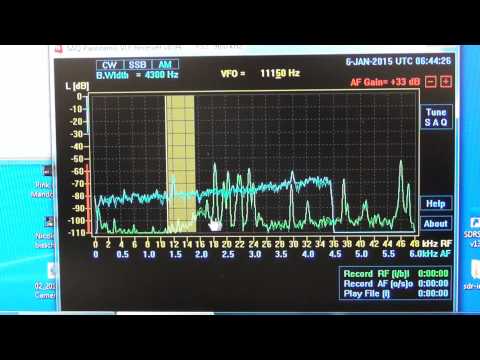
The unmodified  Soundblaster X-Fi had somewhat fewer noise spikes showing up across the spectrum on SDR# than my internal soundcard. However when I did the capacitor mod, they decreased by a drastic amount. Before I realized the extent of the original internal noise spikes, I wasted time trying to “decode” them – worked about as well as my attempts to communicate with aliens via my dental work.

So now my SDR# display looks really clean and most everything that looks like a signal is a signal. I don’t have before and after pictures, but the ones in the pdf file look like mine.

BTW the capacitor values are probably not all that critical. I used a couple I had laying around – a 1000 uF 16v and a 120 uF 16v. Anyone with some soldering experience and a reasonably small tip can do the mod but it’s a little tricky to position the caps and have the case close properly. The unwary might get polarity confused – the tantalum caps on the board are marked on the positive end and the electrolytics you add are marked on the negative end.

The capacitor mod essentially involves soldering in two more capacitors onto the soundcard PCB. The improvement is more useful for soundcard based SDRs such as the SoftRock, however, in Toms case he found that the capacitor mod also improved his RTL-SDR reception by removing numerous unwanted noise spurs he was seeing.

Since the RTL-SDR is not a soundcard based SDR, in Toms case the external soundcard was probably causing strong interference that the RTL-SDR was picking up, and the capacitor mod treated the noise source.

The mod may also help by giving you a cleaner audio signal, which may help when decoding digital signals.

SDR Soundcard Mod