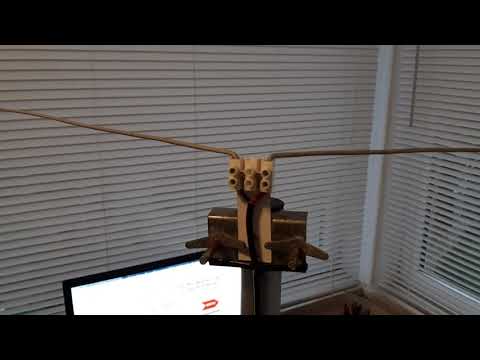
Back in 2017 we posted about Adam 9A4QV's simple V-Dipole antenna design which works very well for receiving NOAA and Meteor weather satellites at 137 MHz. This type of antenna is a lot easier to build compared to a QFH or turnstile, and it results in good performance if built and set up correctly. Over the years he notes that he's received a number of questions asking to clarify the design and so he's uploaded a YouTube video which explains the built and dimensions of the antenna clearly.
Thank you to Maksim for submitting news that the International Space Station (ISS) will be transmitting Slow Scan TV (SSTV) in late December to celebrate 20 years of amateur radio operations onboard the space station. The ISS periodically transmits SSTV images during special events throughout the year. You can keep up to date on the ISS SSTV schedule on the ARISS-SSTV site.
An ARISS Slow Scan TV (SSTV) event is scheduled from the International Space Station (ISS) for late December. This will be a special SSTV event to celebrate the 20th anniversary of ARISS operations on the ISS. The event is scheduled to begin on December 24 and continue through December 31. Details to follow later. Dates are subject to change due to ISS operational adjustments.
With an RTL-SDR and a simple V-Dipole from our RTL-SDR Blog V3 antenna kit it is possible to receive these images when the ISS passes over. ISS passes for your city can be determined online, and the SSTV images can be decoded with a program like MMSSTV.
An example SSTV image from an SSTV event held in previous years.
The FengYun-2 line of weather satellites are the Chinese equivalents to GOES, and they are positioned to cover parts of Europe, Africa, the Middle East, Asia, Russia, and Australia. So this is another geostationary weather satellite now available to Europeans which broadcasts in the L-Band at 1687.5 MHz. And unlike the weaker GOES-13 L-Band downlink, the FengYun-2 downlink is much stronger which means that reception with a 120cm satellite dish should be possible. We note that it has not yet been confirmed if the typical 90-100 cm WiFi dishes used with GOES-16 and 17 will be big enough to work. @aang254 writes:
Yesterday I successfully decoded the S-VISSR downlink from FengYun-2H thanks to a recording by @MartanBlaho. It is stronger than PDR on EWS-G1 (see Zbychu's signal https://twitter.com/ZSztanga/status/1329801728162754560…) meaning it should (untested) be doable with a 120cm (or smaller but no confirmation again) dish instead of 180cm.
It covers parts of Europe, Russia and down to Australia. FY-2G and FY-2E (no confirmation for this one yet) are also decodable in the same way. I released an early decoder, that currently is not suitable for automated setups but allows getting images already. A later version (that should come soon-ish) will allow live decoding / autonomous setups in a similar fashion to other satellites.
Also, the res is 2km/px on VIS and 8km/px on IR, so half that of GOES-13 with similar-ish coverage (Europe is less visible though).
(also forgot to say but the bandwidth is under 2Mhz, allowing a rtlsdr to be used)
Gave a go at a FengYun-2H animation with the data recorded by @MartanBlaho.
Sadly some scans focus only on the northen hemisphere but it still turned fine!
Visible channel pic.twitter.com/9FcZlD9oYi
For some time now many weather satellite enthusiasts have enjoyed the ability to relatively easily receive live high resolution images directly from the GOES-16, GOES-17 and GK-2A geostationary satellites (tutorial here). However, while much of the world can see at least one of these satellites, European's have been left out.
What may be of some interest to Europeans is that the older GOES-13 (aka EWS-G1) satellite was repositioned in February 2020, and it can now be received in Europe (as well as Africa, the Middle East, Asia, Russia and West Australia) until at least 2024 when it will be replaced.
The important catch however is that GOES-13 is not broadcasting the same easy to receive LRIT/HRIT signals that the other satellites use. The signal is still in the L-Band at 1685.7 MHz, however it is called "GVAR" and it is much weaker and uses 5 MHz of bandwidth. For GOES 16/17 and GK-2A a 1m WiFi grid dish, LNA and RTL-SDR was sufficient, but for GOES-13 you'll need a much larger 1.8m dish, and a wider band SDR like an Airspy. The big dish requirement significantly increases the reception challenge.
We also note that the decoder is being developed by @aang254 and u/Xerbot and it is not yet publicly released. However, they do intend to release it soon. Update:
My hardware is: 180cm prime focus dish, with a custom cantenna (120mm diameter). I'm using the SAWBIRD GOES LNA. I will be switching to the + version, because the setup is still lacking a few db SNR. The SDR is the one I use for HRPT: the airspy mini
I found that the USB connection on the airspy generates a lot of noise, so I removed the USB cable, by moving the airspy to the laptop. I use 2m of CNT-400 coax and it works much better now. I get about 2 db SNR more. Thought you might find it interesting.
@ZSztanga's GOES-13 Reception Setup, with 1.8m dish.
We note that there is some interesting differences with GOES-13 images. Since the image is less processed, it is higher resolution (a full resolution image can be found on this Reddit post), as well as not cropped, meaning that the Earth's atmosphere is visible. Please also follow @ZSztang on Twitter for more images.
According to the newest calculations performed (by me) on the EWS-G1 data, it has a stunning resolution of about 0.6x1 km/px on the VIS channel and about 2.5x4 km/px on the IR channels. I have yet to confirm my calculations with the doc, which is quite hard to get. pic.twitter.com/kLK8YPDyTV
What I really like about GOES-13 is that the data is unprocessed. That allows to see the atmosphere which is normally cut off on LRIT/HRIT. pic.twitter.com/BWJAVXFnUi
Thank you to Happysat for reviewing the QO-100 Bullseye LNB which we have available in our store, eBay and Aliexpress. The Bullseye LNB is an ultra stable TCXO (temperature compensated oscillator) based LNB which makes it very good at receiving the narrowband signals on the QO-100 amateur geostationary satellite.
Standard LNBs that are sometimes used for QO-100 are not designed for narrowband signals and hence do not have temperature compensated oscillator which can result in the signals drifting in frequency significantly as the ambient temperature fluctuates. Happysat also notes that the extra stability seems to have increased signal strength on the more wideband DATV reception as well.
First test's on Es-Hail Narrow SSB transponder compared to my old regular sat-tv LNB clearly is showing more signal stability overall.
It does need some time for both the tuner and LNB to get stable, but that's only a few minutes.
Weather conditions shows less "drifting" of the pll where the old LNB was very sensitive of temperature changes, clouds before the sun did have immediately effect on the signal stability.
Some days with storms reception was impossible on SSB Narrow band.
Winter is coming over here so it gets a lot colder and more storms, but I don't expect any problems with this LNB.
Wideband testing DATV reception also shows a more stable signal although its a wider signal then narrowband, it also did increase the signal, e.g. a signal lock happens much faster.
More information about Happysat's setup and his use of the Bullseye QO-100 LNB can be found on his QO-100 website.
NooElec have recently released for sale a GOES geostationary weather satellite reception bundle which includes a parabolic grid dish, feed, GOES LNA and RTL-SDR dongle. The bundle should be usable for the GK-2A satellite, as well as HRIT from polar orbiting satellites, although for HRIT you'll need some way to motorize or hand track the satellites.
Typically to receive GOES a 2.4 GHz WiFi grid dish has been used in the past. While the mismatch between 2.4 GHz and the 1.7 GHz used by GOES doesn't cause too much trouble, the dish provided by NooElec has a feed optimized for the 1.7 GHz which should make receiving the signal easier. The bundle also comes with their SAWbird+ GOES LNA, one of their always ON bias tee E4000 tuner based RTL-SDR dongles and a roll of 10m LMR400 cable.
The bundle is currently available on Amazon USA priced at US$179.95. Canadian customers can also order from Amazon.ca for CDN$259.95. Amazon shipping is free within the USA, however shipping this overseas will cost at least US$100 extra due to the weight + additional import fees. That said, the coverage area of GOES is mostly only for the USA, Canada and South America.
If you're interested in GOES or GK-2A satellite reception we have a tutorial written here.
In the past we've posted a couple of times about the NOAA-APT decoder software as it is a worthy alternative to the now abandonware software WXtoIMG. However, it lacks certain features which makes WXtoIMG still the go to program for NOAA weather satellite decoding.
As NOAA-APT is open source it has recently seen a few new updates from another contributor, as well as the original author. These changes make it quite a bit more useful, although admittedly not perfect. Hopefully we'll see continued refinement over time. Regardless, this is still a great piece of software which is open source and multi-platform. Martin Bernardi, the original contributor writes:
Although I wasn't planning to continue working in my program, the quarantine happened so I worked on the program a little. Later, a person (Arcadie Z) added more features too, so I created a new version in case you want to add a blog post about it.
Added features since the last blog post:
- Redesigned GUI. - Satellite prediction and map overlay (but has offsets I can't fix yet). - False color images - Histogram equalization (improves the contrast and brightness of images) - Automatic image rotation depending on pass direction
In the end, the map overlay and false color does not work very well, but it is better than nothing I guess.
Recently we posted about new updates to the Sanchez software. The updates allow users to combine images received from multiple geostationary weather satellites such as GOES 16/17, Himawari-8, GK-2A and Electro. The images can also be reprojected into a flat equirectangular image, and then optionally reprojected back into a disk view at any location on earth. Sanchez's original function is also still there which allows users to add a false color underlay image to grayscale infrared images received from the satellites.
Sanchez is a command line tool, so scripts are required to do anything interesting. Over on his page Carl Reinemann has uploaded a page with a number of Sanchez command line examples available. The page shows examples like how to stitch together multiple images, and how to create a stitched time lapse animation. The YouTube video below shows an example of an animation Carl created with Sanchez and GOES 16 and 17 images stitched together.
GOES 16-17 Composite imagery
And the image below is an example of an image of Himawari 8, GOES 16 and 17 he stitched together with Sanchez.
GOES 16 and 17 composite created by Carl Reinemann via Sanchez