Category: Satellite

Receiving the Chinese Space Station Tiangong-1 with the RTL-SDR

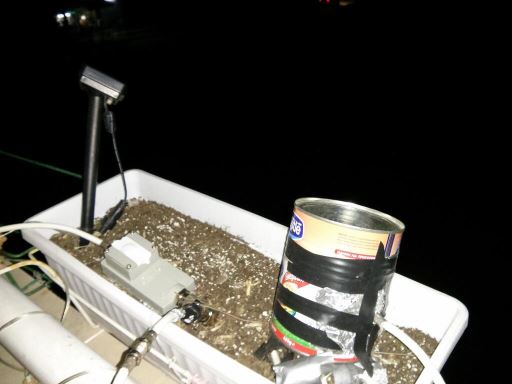
Blogger gat3way has created a post on his blog showing how he was able to receive the Chinese space station Tiangong-1 with the RTL-SDR and a simple cantenna antenna.

The Tiangong-1 station transmits a signal at 2232.15 MHz. To get this signal into a range receivable by the RTL-SDR gat3way used a LNB (Low Noise Block) to downconvert the frequency into one that the RTL-SDR can receive. Using this setup he was able to get a decent signal copy.

Cantenna setup for receiving the Tiangong-1 Chinese Space Station

Receiving SO-50 Saudisat 1C with the RTL-SDR

Over on YouTube user Orlando Lima shows reception of the SO-50 Saudisat 1C satellite. Saudisat is an amateur radio satellite with an FM radio repeater. Orlando listened to the downlink frequency at 436.795 MHz using an RTL-SDR, Yagi antenna and Orbitron software to track the downlink frequency in SDR#.

Video Tutorial: Setting Up Satellite Tracking with SDRSharp and Orbitron

YouTube user HamradioSat has put up a video tutorial showing how to connect SDR# and Orbitron together. By interfacing the two, Orbitron can then be used to automatically tune to the doppler corrected frequency of a satellite passing overhead in SDR#. Orbitron is a free satellite tracking software program.

This can be useful for simplifying the tracking of NOAA weather satellites and downloading their live images.

http://www.youtube.com/watch?v=z7Ut-HvnRb8&feature=youtube_gdata

Using the RTL-SDR as a Cheap TV Satellite Finder

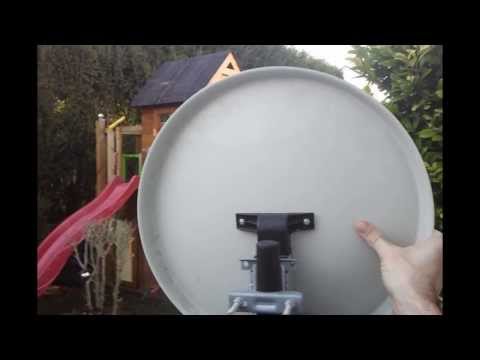
Finding the correct direction to point a satellite for TV reception can be difficult without the right equipment. YouTube user MegaOscarVideos shows us in the video below how he uses an RTL-SDR to accurately aim his satellite for TV reception.

He uses a TV satellite dish with an LNB connected to a bias-T circuit as the receiver, which is then connected to the RTL-SDR. As the satellite is moved he looks for the direction at which the signal level in SDR# increases the most.

RTL SDR as cheap TV Satfinder

Orbcomm Reception with the RTL-SDR

YouTube user Drvarnick has uploaded a video showing how he receives Orbcomm satellite data with the RTL-SDR. To do this he uses a a homemade 1/4 wave antenna, SDR# and the Orbcomm-Plotter software by COAA.

COAA describes Orbcomm satellites as

a satellite communication system (www.orbcomm.com) providing two-way data and positioning service to small, portable user terminals in the VHF frequency bands. You can use a simple VHF radio receiver (scanner) tuned to the band between 137 and 138 MHz to pick up the strong signals from these satellites. With OrbcommPlotter you can decode the telemetry and find out the positions of the satellites, their operational status and their uplink and downlink channels. Unlike most satellite signals, there are so many Orbcomm satellites that there is likely to be one within range of almost any spot on Earth at any time of the day or night.

Receiving ISS Data Comms with the RTL-SDR

YouTube user mutezone has uploaded a video showing some data communication packets from the International Space Station (ISS) being received with the RTL-SDR. To receive the packets he used SDRSharp, and piped the audio using a virtual audio cable to the Qtmm AFSK1200 Decoder.

I tried to get the ISS (International Space Station) data comms on 145.825 MHz while the satellite was in orbit close to my location & it worked, even though it can go off frequency due to atmospherics & such. On this day, I caught it when it orbited twice around my location in the space of almost three hours. The data comms was decoded on the 2nd attempt. The antenna I used was an omni placed outdoors, & also using a TV + radio signal booster.
For anyone interested in getting the ISS, you have to wait until it orbits close to your location, & I fully recommend a decent aerial that should be placed externally. You can check the ISS tracker websites to see live updates of when & where it will orbit. Here is a link to one website…

http://www.isstracker.com

List of frequencies link…

http://www.issfanclub.com/frequencies

Talk: Tracking of Low Earth Orbit Satellites with the RTL-SDR

Back in July we posted about Travis Goodspeed’s project on setting up a satellite dish that automatically tracks satellites in low earth orbit, where he uses an RTL-SDR for the radio. Travis gave a talk on this project at the Chaos Communication Congress conference, and the video has now been uploaded to YouTube.

Satellites in Low Earth Orbit have tons of nifty signals, but they move quickly though the sky and are difficult to track with fine accuracy. This lecture describes a remotely operable satellite tracking system that the author built from a Navy-surplus Inmarsat dish in Southern Appalachia.

The entire system is controlled through a Postgres database, fed by various daemons spread across multiple machines. So when I click on a satellite on my laptop or cellphone, it runs “UPDATE target SET name=’Voyager 1′;” and the motor daemon then begins to track the new target while the prediction daemon maintains accurate estimates of its position in the sky. Additional daemons take spectral prints or software-defined radio recordings of the targeted object for later review.

Receiving the Chinese Yutu Moon Rover with the RTL-SDR

Amateur radio hobbyist EB3FRN was able to use his RTL-SDR to receive the telemetry signal from the recently landed Chinese Yutu moon rover. The Yutu rover transmits at 8462.08000 MHz, which is outside of any RTL-SDRs frequency range, so he used a downconverter with a local oscillator at 8 GHz to convert the signal to 462 MHz.

For the software he used Baudline and rtl_fm as the receiver. He has posted a short audio clip of the received signal on his blog as well.

Chinese Yutu Moon Rover Received with RTL-SDR and Baudline