Category: Satellite

Using the RTL-SDR to listen to the Funcube Satellite

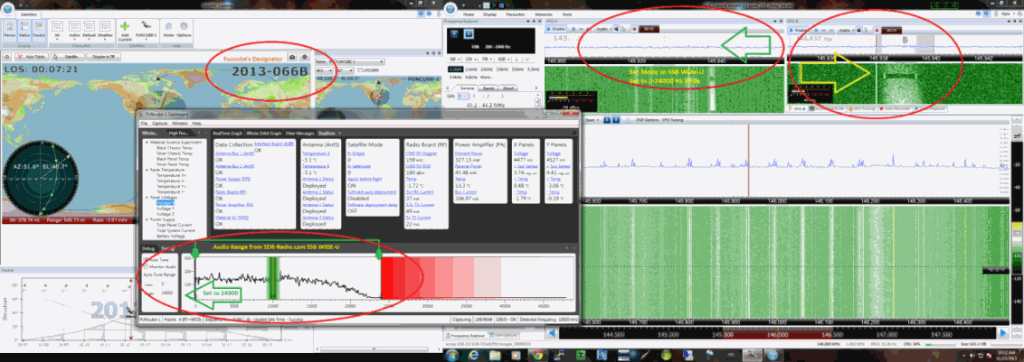
Recently, the FUNcube-1 satellite was successfully launched. The FUNcube is a CubeSat (a low cost miniature 10cm cube sized satellite) which is intended mainly for educating young people about radio, space, physics and electronics, but has also piqued the interest of amateur radio hobbyists.

Amateur radio hobbyist N4JTC’s has shared on his blog his experiences with receiving the FUNcube-1’s telemetry using his RTL-SDR dongle. By using the RTL-SDR to receive the telemetry beacon as the satellite passes overhead, he was able to use the FUNcube Dashboard software to record and decode and view the satellites telemetry data.

Receiving the FUNcube-1 Satellite

Visualizing Broadcast Satellite Signals with the RTL-SDR

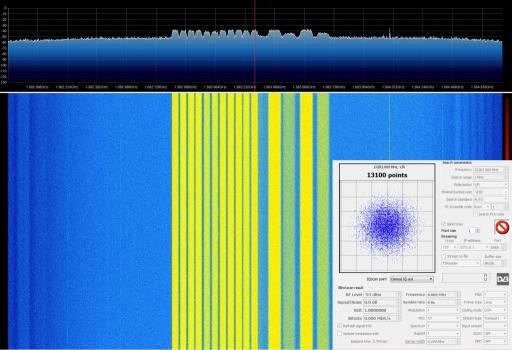
Over on Gough’s Tech blog, Lui Gough has posted about his experiences with visualizing broadcast satellite signals with the RTL-SDR. In his post he shows how to receive broadcast satellite signals by using a LNB, or low noise block downconverter, which allows the RTL-SDR to receive satellite frequencies which are typically out of the range of the RTL-SDR.

Later in the post he also shows what several broadcast satellite signals look like on the waterfall, as well as some of their telemetry signals.

Visualizing Satellite Signals

Using the RTL-SDR as a Software GPS Receiver

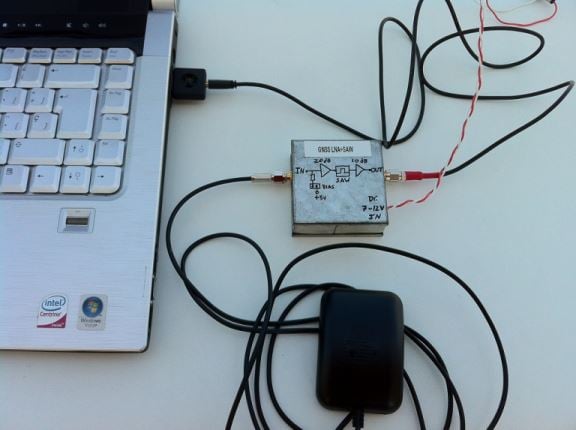
Dr. Carles Fernandez-Prades, Dr. Javier Arribas and Dr. Pau Closas have published an academic paper showing how they were able to implement an RTL-SDR based GNSS (Global Navigation Satellite System) receiver in software.

What they have done is use their open source GNSS software receiver program with a RTL-SDR connected to an active GPS antenna. An active GPS antenna requires DC power to be passed to the LNA in the GPS antenna through the antenna connection, so a Bias-T network is required to ensure DC power does not enter the RTL-SDR dongle.

More information can be found on their webpage here.

Rtlsdr_with_lna_patch_GA27

NOAA Weather Satellite Antenna and Software Guide

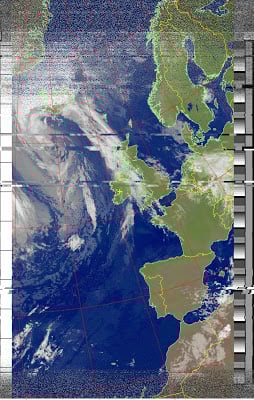
Over on the SDR for mariners blog, author Akos has written two new beginners posts on getting up and running with receiving and decoding NOAA weather satellite APT images.

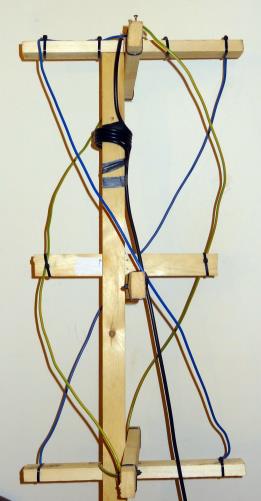
The first post discusses antennas that are useful for NOAA satellite reception, and shows how to build a homemade turnstile and QFH antenna. His second post shows a beginners guide to the software that can be used to decode the APT signal in order to obtain a live weather satellite image.

sdrformariners_apt_image QFH Antenna

HackRF Receiving HRPT Weather Satellite Images

On Twitter user @uhf_satcom has been using a HackRF software defined radio together with GNU Radio, a tracking L-Band antenna and this HRPT decoding software to receive and decode HRPT weather satellite images. He used GNU Radio to output to a .RAW16 file, which the HRPT decoding software was then able to use to produce an image.


HRPT is a picture transmission protocol which stands for High Resolution Picture Transmission. There are multiple satellites which broadcast weather images in this format including the NOAA, GOES, Metop-A and Feng Yun satellites. These satellites transmit HRPT at about 1.7 GHz.

@uhf_satcom also tried to receive these images with the RTL-SDR, but was unsuccessful. But you can still receive the lower resolution APT weather satellite images using the RTL-SDR.

Below are some examples of the images he was able to receive.

hrpt_hackrf1_thumb hrptdata_noaa19a_thumb

Update: This is an image of the L-band antenna he used.

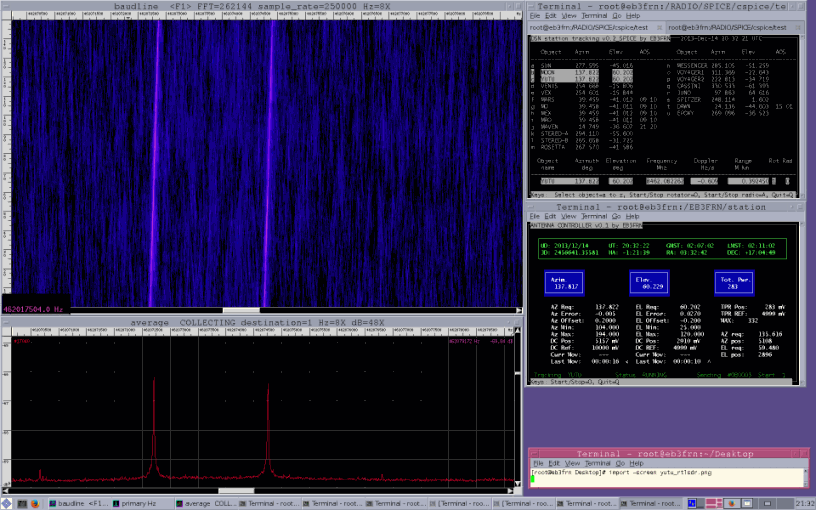
Tracking of Low Earth Orbit Satellites with the RTL-SDR

Over on travisgoodspeed.blogspot.com, Travis shows us an interesting project where he set up a satellite dish that automatically tracks and receives moving satellites, such as those in low earth orbit. Travis uses an old satellite dish salvaged from a maritime vessel as the receiving dish, a RTL-SDR for receiving the signal, and a BeagleBone for motor control and running rtl_tcp. The dish motors use satellite positional data from celestrak.com to automatically track a desired currently visible moving satellite.

tracking_satellite

Receiving the FO-29 Amateur Satellite with RTL-SDR

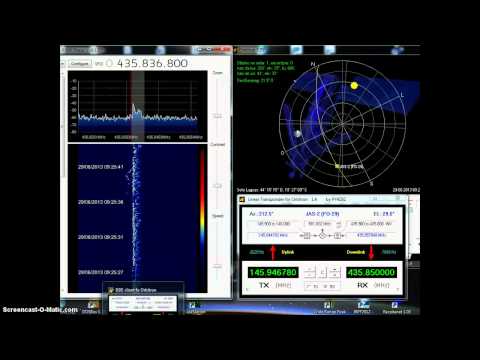
In this video YouTube user Roland Zurmely (PY4ZBZ) shows communications with the FO-29 amateur satellite using his RTL-SDR and a 6 element UHF Yagi antenna. The Fuji-OSCAR-29 (FO-29 a.k.a JAS-2) is an amateur radio satellite that allows voice communication via single side band, and has a voice downlink frequency of 435.8 MHz and uplink frequency of 145.9 MHz.

In this video, the RTL-SDR was used as the satellite receiver, and a conventional FT857 radio with 4 element VHF Yagi was used to transmit to the satellite uplink.

RTL-SDR Receiving ISS EVA Comms

Over on the Radio Antics blog, Andrew has posted about how he was able to receive Russian International Space Station communications during an EVA (Extravehicular Activity aka Spacewalk). He used a simple random wire antenna mounted in his loft and an RTL-SDR with SDRSharp tuned at 143.625 MHz.

See his recorded video below.

ISS - Russian EVA-33 Comms (RTL-SDR)