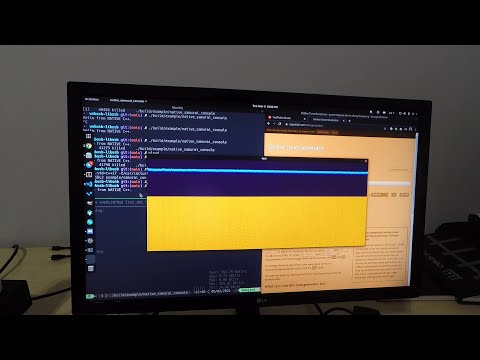
Vasili, author of several SDR# plugins has recently released a new APCO P25 plugin for SDR#. The plugin is easy to use, simply tune to a P25 voice signal, and it will automatically decode it into voice audio assuming that the signal is not encrypted. If the P25 signal is encrypted, you will hear garbled unintelligible voice. The plugin does not support trunking or any advanced talk group filtering features that you might find with DSD+, Unitrunker, SDR Trunk etc.
To install the plugin, simply download the zip file from rtl-sdr.ru and extra the .dll's into the SDR# folder. Then copy the text in magicline.txt file into the plugins.xml file inside the SDR# folder. The plugin should work with any SDR supported by SDR#, including the RTL-SDR.
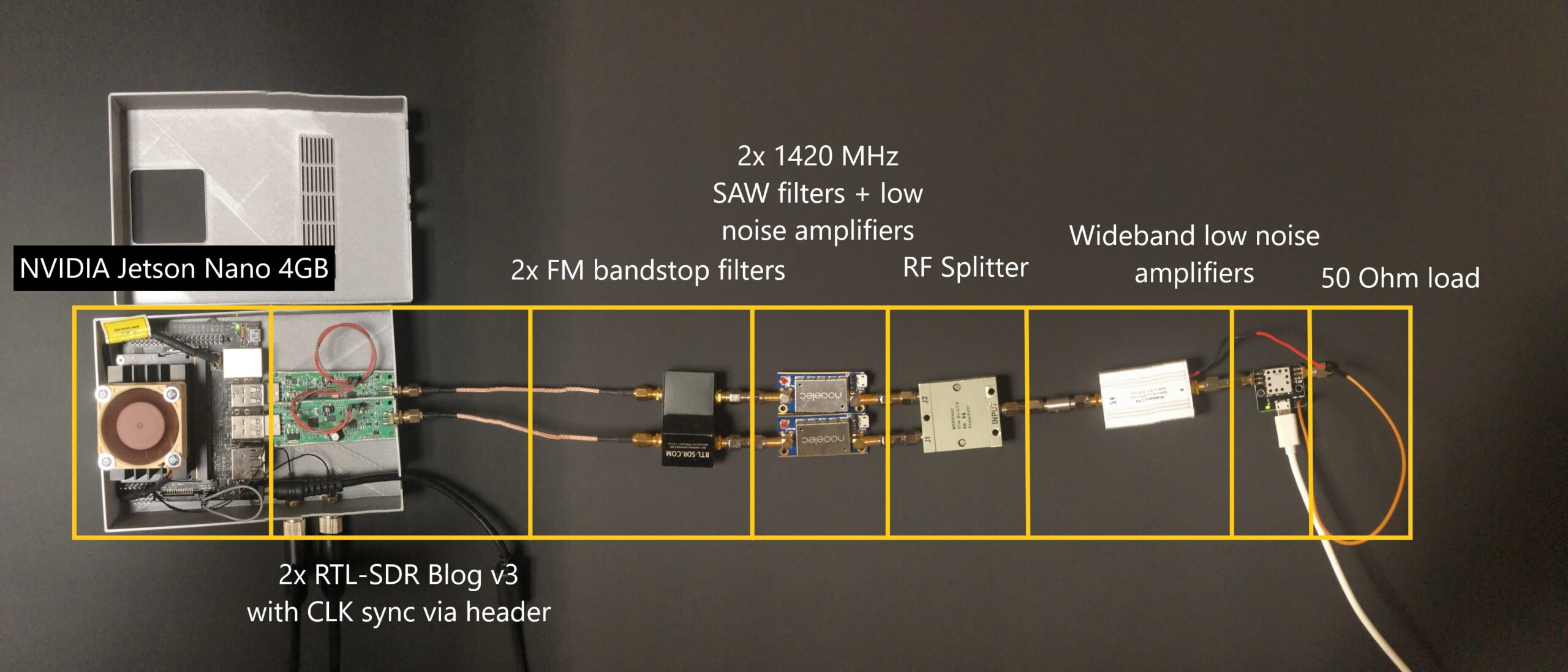
At this years FOSDEM 2020 conference Apostolos Spanakis-Misirlis has presented a talk on his PICTOR open source radio telescope project. We have posted about PICTOR in the past [1, 2] as it makes use of an RTL-SDR dongle for the radio observations. The PICTOR website and GitHub page provide all the information you need to build your own Hydrogen line radio telescope, and you can also access their free to use observation platform, where you can make an observation using Apostolos' own 3.2m dish radio telescope in Greece.
The PICTOR radio telescope allows a user to measure hydrogen line emissions from our galaxy. Neutral Hydrogen atoms randomly emit photons at a wavelength of 21cm (1420.4058 MHz). The emissions themselves are very rare, but since our galaxy is full of hydrogen atoms the aggregate effect is that a radio telescope can detect a power spike at 21cm. If the telescope points to within the plane of our galaxy (the milky way), the spike becomes significantly more powerful since our galaxy contains more hydrogen than the space between galaxies. Radio astronomers are able to use this information to determine the shape and rotational speed of our own galaxy.
Youssef, Author of the SDR# software has recently updated SDR#, now extending the Sharp Slicer functionality which we posted about earlier to RTL-SDR and other supported software defined radios. The latest version of SDR# can be obtained from the Airspy Downloads page as usual.
This feature allows SDR users to open multiple instances of SDR#, each able to tune to a seperate signal within the currently tuned frequency range of the SDR. This is somewhat similar to the old multi-VFO plugin from rtl-sdr.ru, however the advantage of Slicer is that you can have seperate spectrum and waterfall graphs for each signal.
Other recent changes include 'true dBFS' automatic scaling, where 0 dBFS now indicates that the ADC is likely saturated.
SDR# Sharp Slicer Monitoring 5 Broadcast FM Stations Simultaneously.
Passive Radar works by using already existing powerful transmitters such as those for TV/FM. A receiver listens for these signals being reflected off of objects like aircraft and vehicles, and compares the reflection with a signal received directly from the transmitter. From this information a doppler (speed) vs range graph of detected objects can be calculated and displayed.
By measuring the path an object travels across the range-doppler display some interesting information about the objects movement can be obtained. However, the display can be noisy, with the reflected object often coming in and out of view on the display. In order to track an object across the range-doppler display in the face of these uncertainties Max uses a Kalman filter to obtain smoothed results. A Kalman filter is an algorithm which combines actual data with predicted data, with the weighting depending on measurement confidence. The result is shown in the video below. A smooth and accurate track of an aircraft can be seen.
Max notes that in the future he'll be working on tracking multiple aircraft detected by the passive radar, and also incorporating direction finding data in his results in order to get cartesian coordinates which could be plotted on a map.
We note that Max's GNU Radio code should be compatible with our KerberosSDR unit, which already has the clock sharing hack built in to the hardware.
On September 15 we began our 33% off stock reduction sale for the Bullseye LNB. The Bullseye is an ultra stable LNB for receiving QO-100 and other Ku-Band satellites/applications. We'll be ending this sale on Wednesday, so if you'd like to purchase a unit please order soon to avoid missing out on the sale price. The current sale price is US$19.97 including free worldwide shipping to most countries.
To order the product, please go to our store, and scroll down until you see the QO-100 Bullseye TCXO LNB heading. Alternatively we also have stock via our Aliexpress storeor on eBay.
For more information about the Bullseye and some reviews please see the original sale post.
Back in June we posted about the release of Zbigniew Sztanga's NOAA-HIRS-Decoder which can decode HIRS instrument data which measures the vertical temperature profile of the Earth's surface. This HIRS signal is broadcast by NOAA satellites at the same time as their APT images and the HIRS frequency is close by at 137.350 MHz.
Recently Zbigniew has released a new decoder for the Microwave Humidity Sounder (MHS) instrument which is available on NOAA-19 only. This MHS instrument observes the Earth in the 89-190 GHz microwave band, which can be useful for measuring humidity levels. However, unlike the APT and HIRS signals which downlink data at around 137 MHz, the MHS data is broadcast in the L-band within the HRPT signal, so a motorized or tracked satellite dish will be required to receive it. Zbigniew writes:
The MHS (Microwave humidity sounder) is an instrument on NOAA-18 and NOAA-19. It replaced the older AMSU-B. It has a resolution of 90px per line and 5 channels.
Data from the instrument is present in HRPT and can be decoded with my new software. Unfortunately, only MHS on N-19 is working, because N-18's NHS is dead.
The instrument can be used to monitor low clouds, percipation and water vaopr in the atmosphere. I attached a sample image to the email.
Back in August we posted about the release of Sanchez, a tool originally designed to apply a color underlay image to grayscale infrared images received from geostationary weather satellites such as GOES 16/17, Himawari-8 and GK-2K. The tool has recently been updated with some very nice new features.
One of the new features is the ability to composite together images obtained from multiple satellites in order to form a full equirectangular image of the earth with live cloud cover. Another feature is the ability to use two or more images from different satellites to reproject back to geostationary projection at a specified longitude, essentially creating an image from a virtual satellite.
The KiwiSDR is a 14-bit wideband RX only HF SDR which has up to 32 MHz of bandwidth, so it can receive the entire 10 kHz - 30 MHz spectrum all at once. Notably, the KiwiSDR does not connect to a PC directly, rather it is a cape (add on board) for the Beaglebone single board computing platform which similar to a Raspberry Pi. With most of the DSP processing done on the KiwiSDR's onboard FPGA, the Beaglebone serves a custom OpenWebRX browser interface which can be accessed over a network connection from anywhere in the world. If you're interested our initial KiwiSDR review from 2017 is here.
Over the years the KiwiSDR has brought some very interesting software developments out such as several new demodulators. However, our favourite is the TDoA feature, which allows users to leverage multiple public KiwiSDRs to locate the source of an HF transmission with remarkable accuracy.
KiwiSDR Clones
This year we've seen a number of cloned SDRs come out on the market, with almost all using LTC2208 ADC chips that have most likely been recycled from discarded equipment. One of those clones is the RaspberrySDR, which is a clone of the KiwiSDR.
The RaspberrySDR is not a direct clone however, as it brings some improvements. The biggest change is that the LTC2208 chip has a 16-bit ADC, and can provide up to 62 MHz of real time bandwidth. Also instead of a Beaglebone single board computer, a Raspberry Pi 3B+ is used instead. At the time of this post the RaspberrySDR retails for roughly $70 less than the KiwiSDR.
KA7OEI's image of the RaspberrySDR
Comparison
Over on his blog KA7OEI has written up a comprehensive comparison between the KiwiSDR and RaspberrySDR. KA7OEI notes RaspberrySDR powers up and works with it's full 62 MHz bandwidth as expected. Measurements for sensitivity, dynamic range, image rejection are about the same.
However, there are some issues such as inconsistent RF level calibration, a broken s-meter at high SNR levels, "motorboating" on strong narrowband signals, and a broken firmware update button. Also interestingly, KA7OEI's tests show no improvement to the dynamic range. With two extra bits of ADC resolution on the RaspberrySDR we would have expected an improvement. Most of these issues are probably firmware bugs which could be fixed, but the dynamic range issue could be related to less care taken in the hardware design.
As the KiwiSDR source code is open source, it could be considered fair game to fork the code and make use of it in a derivative product. However, at the same time we should remember that the KiwiSDR developers have been working on this code and providing constant updates ever since the release. No funds from the clones will go to them and the success of a clone could spell the end of motivation for future software developments. In addition as KA7OEI notes, the code used on the RaspberrySDR seems to be somewhat obscured, and unlike the KiwiSDR, no open source schematic has been released. Any official long term support of the RaspberrySDR seems unlikely too.
John Seamons (ZL/KF6VO), the leader of the KiwiSDR project has announced that despite the clones KiwiSDR development will remain 100% open source with any future updates also being available to the cloners should they choose to implement them. He also mentioned to us that the clones will also be able to contribute to the TDoA service and can be listed on the KiwiSDR directory. However, the reverse proxy feature will be limited only for official products.