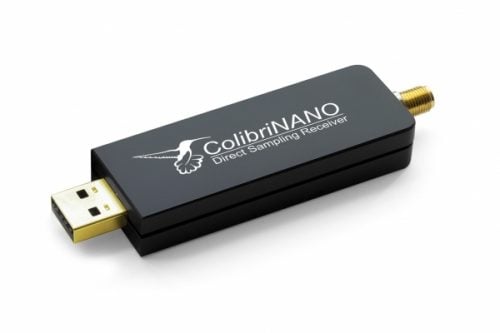
The ColibriNANO is a new software defined radio that is currently available for pre-order and is expected to be ready for delivery by the end of April 2017. The specs show that it is a direct sampling receiver (no tuner), which can receive from 10 kHz to 500 MHz in oversampling mode, and from 10 kHz to 55 MHz in standard mode. It uses a 14 Bit ADC which provides up to 110 dB’s of blocking dynamic range, and can run with a sampling rate of up to 3 MHz. The press release given to us reads:
New ColibriNANO SDR USB Receiver with a 14-bit ADC .01-500MHz
Kirkland, WA, USA —March 27 th , 2017 –
Vasily Vasiliev, Chief Hardware Engineer of Expert Electronics is pleased to announce availability of new ColibriNANO 0.01-500 MHz receiver in late April, 2017.
Notable features include the blocking dynamic range (BDR) ~110dB, native .01-55 MHz coverage with up to 500 MHz in oversampling mode, low pass filter (LPF) <60 MHz, full compatibility with HDSDR, legacy SDR#, and ExpertSDR2 software.
Supported platforms are Windows® XP-10, Linux and Web-client for HTML5 browsers.
No existing USB SDR receivers combine high sensitivity and broad dynamic range. Remote operation (TCP/IP) interface is built-in and offers plug-and- play solutions for Amateur, Commercial and Government applications.
For further information call (800)977-0448 or email [email protected]
https://www.nsiradio.com
Currently we see that the ColibriNANO is selling for $249.95 USD on the nsiradio.com website. We’ve also seen the following description on the sunsdr.eu website:
With the new ColibriNANO you will be able to enjoy LF, MW and Shortwave listening in many different ways. For example you can record the entire medium wave band using 1.5 MHz sampling rate, decode CW using CW skimmer, remote control the ColibriNANO by plugging it into our RPI server. There are an endless range of applications for this small SDR. All this in a tiny USB stick!
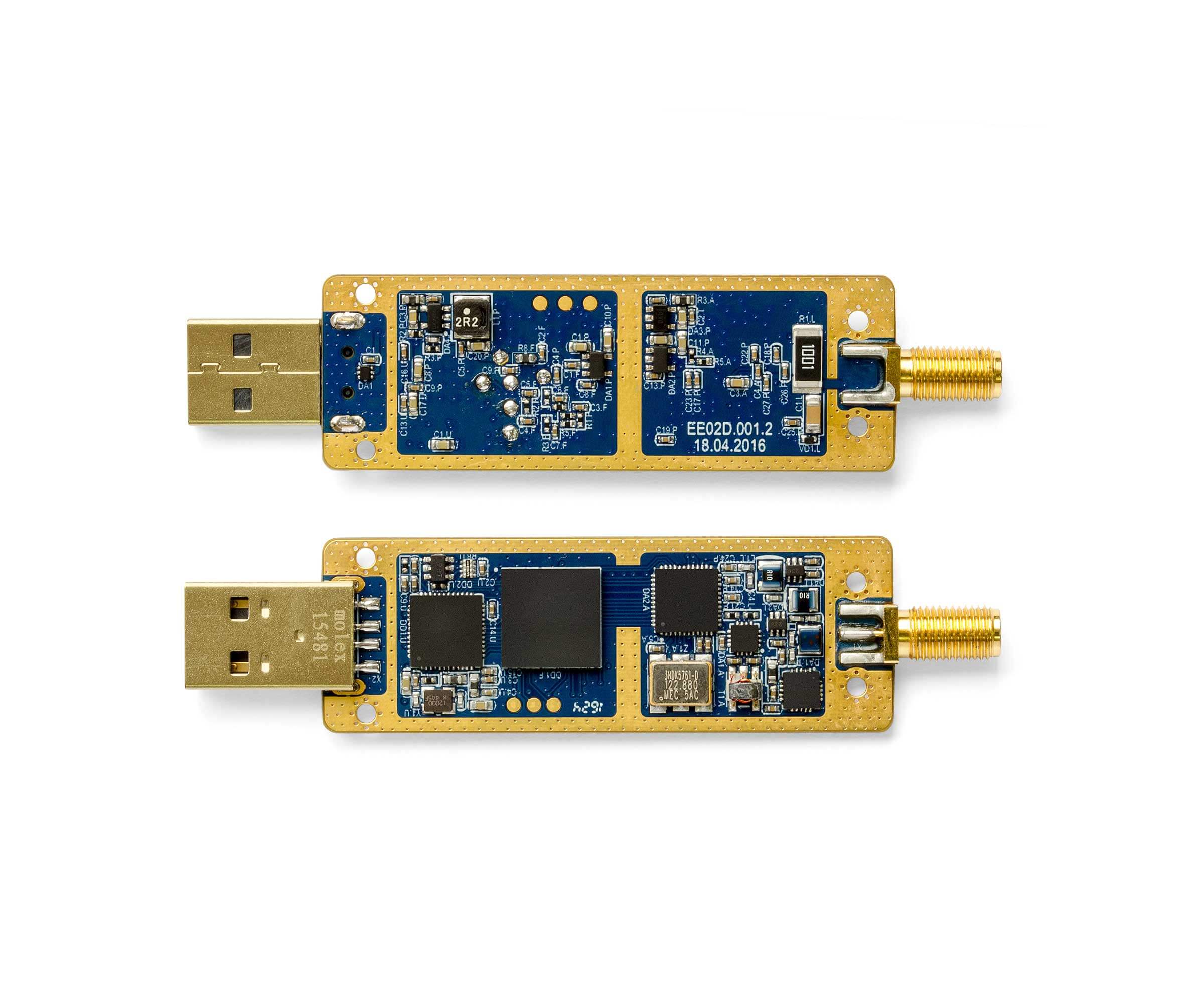
The ColibriNANO features a Texas Instruments ADS4145 14 bit direct sampling ADC and a built in low 55 MHz pass filter that can be bypassed to receive signals up to 500 MHz (external filters like the our 2m filtered preamp recommended).
CW skimmer and Skimmer With the external ExtIO library the ColibriNANO can be used with third party software like HDSDR etc.
This is not a cheap USB dongle found on Ebay, this high quality SDR receiver is developed by Expert Electronics and features a sturdy aluminium chassis, ESD protection, USB 2.0 interface and a quality SMA antenna connector.
Best of all, the ColibriNANO travels in your pocket and only needs your computer and an antenna! Its the ultimate portable SDR receiver!
Software support
- ExpertSDR2
- CW Skimmer
- Skimmer Server
- Third party software using ExtIO library
Specifications
- Receiving bandwidth: 0.1 – 55 MHz
- Oversampling receiving: 0.1 – 500 MHz
- Blocking Dynamic Range (BDR): 110 dB
- Sensitivity: 0.05 uV at 20M band, preamp = 0
- IMD3 Dynamic Range: 95 dB
- ADC resolution: 14-bit @ 122.88 MHz
- Sample rate: 48, 96, 192, 384, 768 kHz and 1.5, 3.0 MHz
- IQ resolution: 24 bit (16 bit at 1.5 and 3 MHz sample rates)
- RF Input: (SMA connector, up to 15kV ESD protection)
- Preamp range: from 31.5 up to +6 dB with 0.5 dB steps
- Operating temperature: -10°C to 60°C
- Dimensions: 90х25х17mm
- Weight: 0.043kg
It looks like that this receiver may compete somewhat with the also upcoming Airspy HF+. The Airspy HF+ claims similar specs including a frequency range of 0 – 270 MHz, 14 Bit ADC and 108 dB blocking dynamic range. But the target price for the HF+ is below $200 USD.