Radio Astronomy Tool rtl_power_fftw Updated

The rtl_power program allows you to use the RTL-SDR to perform a power scan over an arbitrarily large portion of the frequency spectrum (within the RTL-SDR’s supported frequency range) by hopping over ~2 MHz swaths of bandwidth. The updated rtl_power_fftw software was originally written by Klemen Blokar and Andrej Lajovic and is an update over the regular rtl_power program. It uses a faster FFT processing algorithm and has several other enhancements that make it more useful for radio astronomy purposes.

Recently Mario Cannistrà has released a new version of rtl_power_fftw which has several additional improvements applied. He intends to use it in his RTL-SDR based radio astronomy IoT project which is presented on his Hackster.io blog. He writes:

I added the following command line parameters:

  • -e param for session duration
    this allows to specify the recording duration in sec, mins… etc just like it was possible with rtl-power
  • -q flag to limit verbosity
    this will allow the various printouts to happen only the first time and not on every scan
  • -m param to produce binary matrix output and separate metadata file
    this will get a file name (no extension) and use it to store the power values in binary format within a .bin file + a metadata text file with .met extension

Summary of my requirements:

  • I wanted to leverage the ability of rtl-power-fftw to specify N average values to integrate for less than 1 second when needed. Plus running multi-MHz scans and storing for several minutes.
  • I wanted to use a binary format instead of the .csv one in order to obtain the smallest possible size since I’m logging all the night long (CSV’s blank delimiters and decimal dots were wasting my precious microSD space)
  • keep high the precision on decimal digits saving float values (could be important for other usages)
  • obtain a complete stream of binary values representing all the bins for each scan, one scan after the other, in a matrix like organization
  • …that would allow me to plot the waterfall extremely fast with gnuplot
  • …and then add specific annotations and file properties/metadata in a more convenient way using python
Example rtl_power_fftw output: A scan of Jupiter's radio emissions.
Example rtl_power_fftw output: A scan of Jupiter’s radio emissions.

Comparing ADS-B Reception with the RTL-SDR, Airspy and Beast Receivers

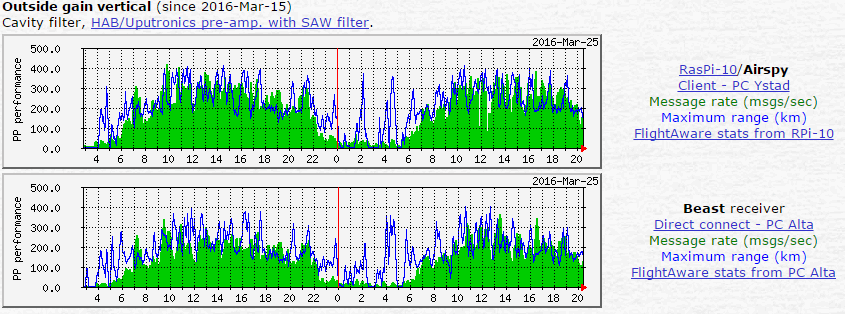
Over on satsignal.eu the author has set up a page showing live statistics of his ADS-B reception for the RTL-SDR and Airspy software defined radios, and also for the Beast ADS-B receiver. The Airspy is a $199 software defined radio that many consider as a next stage up from the RTL-SDR, and the Beast is a ~$270 USD dedicated ADS-B receiver.

Unsurprisingly the results clearly show that the Airspy receives ADS-B signals significantly better than the RTL-SDR. However, what comes as a surprise is that it is actually appears to be outperforming the dedicated Beast receiver. In the tests with the outside vertical antenna, the Airspy running on a Raspberry Pi appears to receive a significant higher number of messages and also sees planes out to a further range.

Not too long ago the Airspy team released their ADS-B software for the Raspberry Pi 2. They write that this software uses the full 10 MHz bandwidth and can even decode messages that are overlapping one another. We’ve also been told by the Airspy team that the Airspy is already in professional use as an ADS-B receiver amongst several small airports.

In the future we hope to compare the Airspy against the RTL-SDR on ADS-B reception ourselves, and also compare it against the 8 MHz bandwidth SDRplay whose development team have also recently released a new ADS-B decoder, as well as the recently released FlightAware ADS-B Prostick RTL-SDR.

Beast and Airspy comparison on ADS-B Reception.

FlightAware ProStick: A new ADS-B optimized RTL-SDR with built in LNA

The FlightAware team have today announced the release of the "ProStick", an RTL-SDR dongle that they write has been modified for improved ADS-B reception. The new FlightAware RTL-SDR's main defining feature is that it comes with a built in low noise amplifier (LNA) on the front end. The built in LNA is optimized for the ADS-B frequency of 1090 MHz and has 19 dB of gain with a 0.4 dB noise figure and an OIP3 of +39dB. They claim that the new unit will give a 20-100% performance boost in terms of range for Mode S reception when compared to a standard RTL-SDR.

As the increased gain and amplifier non-linearities can cause overload and intermodulation to more easily occur, the FlightAware team stresses that you must use the new device with a 1090 MHz filter, such as their FlightAware filter. In a previous post we reviewed the FlightAware filter and antenna and found that they performed very well and are great value for money.

The new unit is priced cheaply at $16.95 + shipping on Amazon for US buyers, and $24.95 + shipping on eBay for international buyers.

So far we haven't seen any circuit photos or news about which LNA chip has been used, but we intend buy a unit and do a review when it arrives.

One criticism about this unit that we can already see is that it should be understood that good RF design teaches us to always place the LNA as close to the antenna as possible to overcome cable loss and keep the noise figure low. Placing the LNA at the antenna vs at the receiver makes a huge difference in performance, depending on how long and lossy your coax cable run is. Furthermore, integrating an LNA into the receiver ruins the system for optimal performance with an LNA placed by the antenna due to the reduced linearity caused by the additional internal LNA. The post at http://ava.upuaut.net/?p=836 explains optimal LNA placement very well. We think that perhaps selling an external LNA and bias tee module would have been a significantly better idea to optimize ADS-B reception. However, the additional LNA should help to reduce the noise figure of the dongle by a few dBs which will result in improved ADS-B reception as long as signal saturation does not occur. 

The new FlightAware ADS-B optimized RTL-SDR.
The new FlightAware dongle running on a PiAware Raspberry Pi system.
The new FlightAware dongle running on a PiAware Raspberry Pi system (actual unit uses SMA).

Meteor M-N2 now active again

According to various reports the Russian Meteor M-N2 satellite appears to be active again once more. The Meteor M N-2 is a polar orbiting Russian weather satellite that was launched in July 2014. It transmits with the LRPT protocol which allows us to receive weather satellite images with an RTL-SDR that are of a much higher resolution than the NOAA APT satellites. 

Unfortunately late last year Meteor M N-2 had some problems and LRPT transmissions were turned off for the time being. During this downtime the Russian space agency switched the LRPT transmitter on the older Meteor M N-1 satellite back on, even though the satellite was tumbling in orbit. Currently people are not reporting any signal from Meteor M N-1, so this may have been turned off, perhaps temporarily.

Now however, it seems that Meteor M N-2 has been switched back on again and various people have already successfully received its signal. If you want to receive these Meteor M N-2 weather images with an RTL-SDR dongle or other SDR then you can view the tutorial written by Happysat here.

Another Sample LRPT Image
A Sample LRPT Image from Meteor M N-2

Michael Ossmann’s Talk on RF Circuit Design

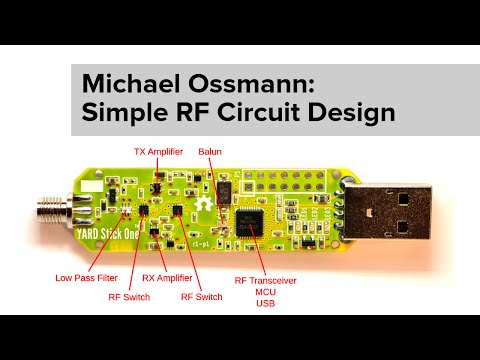
At the 2015 Hackaday super conference Michael Ossmann (designer of the HackRF SDR and various other RF products) gave a talk called “Simple RF Circuit Design”. His talk explains in very simple terms how to successfully create RF circuits without the need to do any complicated calculations. The workshop blurb reads:

This workshop on Simple RF Circuit Design was presented by Michael Ossmann at the 2015 Hackaday Superconference. It sold out almost immediately and for good reason. He has designed numerous popular tools like the the HackRF One and YARD Stick One. Michael’s depth of knowledge and experience make him a leader in a field that is often called a dark art. There is no reason to fear RF design. Follow his recommendations and remove some of the mystery from the topic.

Essentially his talk boils down to 5 rules:

  1. Use Four Layers
    You’ll have less RF trouble and design work with four layers than on a two layer board. Four layers allows you to have unbroken power planes which helps to reduce ground loops.
  2. Use the Most Integrated Component Possible
    Instead of designing your own RLC circuits and filters and taking into account various factors like Q values, just use an integrated circuited with defined parameters. 
  3. Design for 50 ohms Everywhere
    Keep every thing matched to the standard 50 Ohms for optimal impedance matching.
  4. Follow Manufacturer Recommendations
    Use the layouts specified by the manufacturer.
  5. Route the RF Parts First
    Route the most critical part, the RF section first and keep digital lines away.
Michael Ossmann: Simple RF Circuit Design

Building a 28.8 MHz TCXO for the RTL-SDR

For accurate frequency tuning even amongst large temperature in an SDR, a Temperature Compensated Crystal Oscillator (TCXO) should be used as the main oscillator. Standard RTL-SDR dongles used a frequency of 28.8 MHz and do not come with a TCXO, but for some time now we have been selling our own branded dongles that come with a TCXO built in (out of stock at the moment sorry – back in the first half of April!). If you have an older or other dongle that does not have a TCXO it can be an interesting exercise to hack one in yourself. The biggest problem though, is that 28.8MHz TCXO oscillators are not commonly found for sale in low quantities.

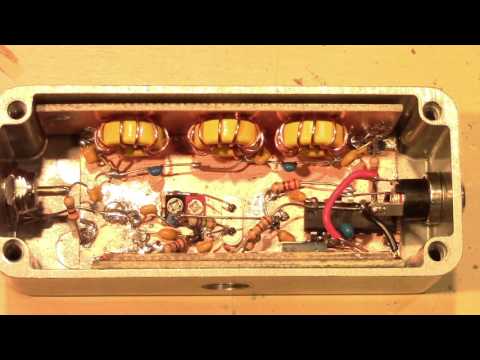
Over on YouTube user devttys0 (Craig) has uploaded a video that thoroughly explains the theory behind creating a home brew 28.8 MHz TCXO out of a standard non-temperature controlled 19.2 MHz oscillator. The build involves halving the frequency, and then filtering and using the third harmonic as the clock signal (19.2/2 * 3 = 28.8 MHz), as well as creating the temperature compensation circuitry.

On his blog Craig has also uploaded schematics and a frequency temperature curve he measured from his home brew TCXO.

If you wanted to make something a little easier to build then we recommend looking at our previous post which shows how an experimenter used an SI5351A voltage controlled oscillator on the RTL-SDR.

A GNU Radio Based ISDB-T and RTL-SDR Compatible 1Seg Decoder

In most parts of the world the DVB-T standard is used to air digital HDTV. In the USA the ATSC standard is used, and in China DTMB is used instead. In other countries such as Brazil, Peru, Argentina, Chile, Honduras, Venezuela, Ecuador, Costa Rica, Paraguay, Philippines, Bolivia, Nicaragua and Uruguay a third standard called “ISDB-T International” is used which is based on the Japanese ISDB-T standard. 

Digital broadcast standards used in each country.

Recently a team from Uruguay has been working on creating a ISDB-T receiver in GNU Radio. With this decoder ISDB-T signals can be received with a wide bandwidth SDR (needs to be 6MHz or larger) and then decoded into a video file. Because ISDB-T is so similar to DVB-T they have based much of their code on gr-dvbt which is a GNU Radio based DVB-T decoder.

In addition to the ISDB-T decoder, they have also implemented a 1-seg decoder. 1-seg is a mobile HDTV service that exists in Japan, Argentina, Brazil, Chile, Uruguay and Peru. It runs on the ISDB-T system, and is called “1-seg” because it’s data occupies 1-segment of the 13-segment based ISDB-T bandwidth. It is used in small mobile TV receivers, many of which are now built directly into mobile phones sold in countries that use ISDB-T. Due to it’s much lower bandwidth requirement the 1-seg decoder can be used with an RTL-SDR dongle, and has already been tested to work.

A typical 1-seg capable Japanese mobile phone receiving digital mobile TV.
A typical 1-seg capable Japanese mobile phone receiving digital mobile TV. With the GNU Radio 1-seg decoder these transmissions can be received with an RTL-SDR.

ADS-B Decoder for the SDRplay RSP Now Available

A new ADS-B decoder for the SDRplay RSP has recently been released by the SDRplay programmers. The SDRplay is a $149 USD software defined radio with a 0.1 – 2000 MHz range, 12-bit ADC and up to 8 MHz of bandwidth. In a previous review we compared it against the Airspy and HackRF.

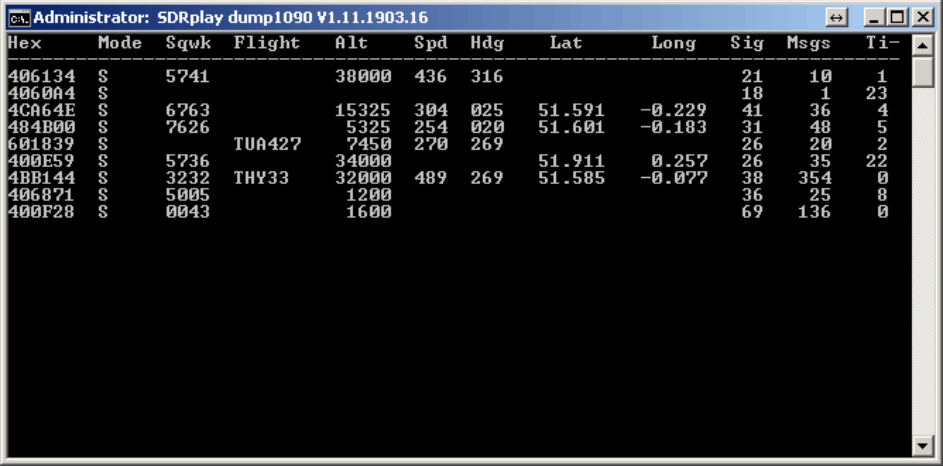
The SDRplay team have based their new decoder on the multi-platform compatible dump1090 code, which is an ADS-B decoder that was originally written for the RTL-SDR. The Windows version can be be downloaded from http://www.sdrplay.com/windows.html, and the code for other platforms can be downloaded from https://github.com/SDRplay.

To help with the installation procedure the SDRplay has also provided a manual (pdf) which shows exactly how to download and set up the required ADS-B software on a Windows system. They also write that the software is fairly new and is still being optimized for best performance.

In the future after the software is further optimized we hope to compare the RSP against the RTL-SDR and Airspy on ADS-B reception.

The SDRplay compatible version of dump1090 deceiving ADS-B data.