RTL-SDR DSD Call Log Recorder

Programmer Tyler Watt has been working on software that automatically logs each call from an RTL-SDR running DSD (Digital Speech Decoder) and then stores it in a time stamped database as an mp3 file. There is also a web front end for the database which allows public users to search and play recorded calls.

Recently Tyler updated his code by rewriting it in PHP and making it multiplatform.

The old version of his web front end in action for his local P25 calls can be viewed here, and the newer one can be found here.
Reverse Engineering Radio Controlled Power Outlets with Help from the RTL-SDR

Radio controlled electricity power outlets are outlets that can be turned on or off using a wireless radio controlled remote. Over on the blog leetupload.com the author has written an article showing how he was able to reverse engineer the wireless power outlets radio protocol.

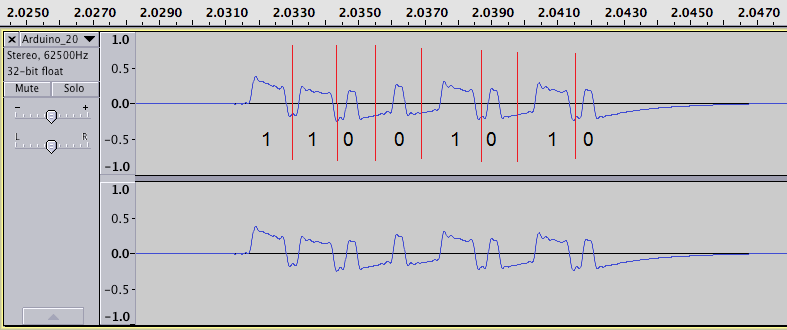
The author used an RTL-SDR and SDR# to listen to the outlets wireless AM transmissions at 434 MHz. He then recorded the signal audio and then used audacity to view the waveform. By analyzing the audio output he discovered that the signal was a Non-Return-To-Zero (NRZ), pulse width modulated (PWM), Amplitude Shift Keying / On Off Keying (ASK/OOK) signal.

Later he was also able to use the RFCat USB dongle to transmit an on off signal from his computer. RFCat is an USB dongle that is capable of transmitting on 433 MHz.

RTL-SDR Software Radio used to Reverse Engineer the Wireless Power Outlet
RTL-SDR RTL2832U Software Radio Audio output Analyzed in Audacity for Reverse Engineering a Wireless Power Outlet
Remote Control Outlet Replay With RFCat

Source Hackaday

Coaxial Cable Loss

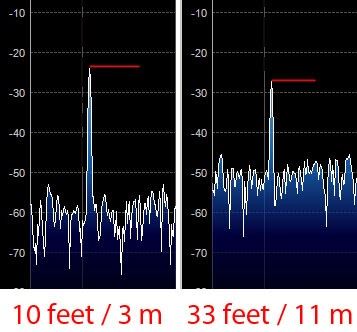
Akos from the SDR for Mariners blog has posted an article that highlights the effects of coaxial cable attenuation. Long runs of coaxial cable between the antenna and RTL-SDR can significantly attenuate signals. This means that strong signals at the antenna will become weak signals at the receiver. The solution to this is to either reduce the cable length or to use higher quality cable. A preamp like an LNA may also help to overcome long runs of coaxial cable. Akos’ article discusses these issues.

Results from Akos' test on different lengths of coax cabling
Results from Akos’ test on different lengths of coax cabling

Chinese and Russian Custom RTL-SDR Kits

There are now some custom RTL-SDR kits available from Chinese and Russian manufacturers. These kits are essentially the standard RTL-SDR laid out on a custom PCB with extra upconverter (or direct sampling) circuitry on board.

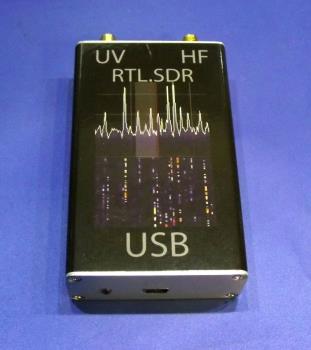
This is a 100 KHz to 1 GHz RTL-SDR kit (~$23 USD), and this is another 100 KHz to 1 GHz pre made custom RTL-SDR in a nice box (~$40 USD) (alternative Chinese seller). The Chinese sellers page shows some examples of the performance on Youku (Chinese YouTube)

Custom RTL-SDR with 100 KHz to 1 GHz range in box
Custom RTL-SDR Kit with 100 KHz to 1 GHz range

Decoding APRS with SDR#, APRSISCE32 and an RTL-SDR

Over on YouTube user k2nccvids has posted a video showing how he was able to decode APRS signals and plot them on a map using APRSISCE32. APRSISCE32 is an advanced Automatic Packet Reporting System (APRS) decoder which has mapping capabilities and can also connect to the internet as an iGate. APRS is used by amateur radio hobbyists to send data like messages, announcements and also GPS coordinates.

Real Time GPS Positioning with the BladeRF

Over on YouTube user taroz1461 shows real time GPS positioning done in software using a BladeRF. The BladeRF is a ~$400 software defined radio which similar specs to the HackRF and compared to the RTL-SDR is capable of receiving much larger bandwidths and transmitting.

To do this decoding he used RTKLIB and his own GNSS-SDRLIB software which is a Windows GUI program. We aren’t sure if this software will work with the RTL-SDR, but we note that other people have had success with GPS positioning and the RTL-SDR.

Real-time GPS positioning with bladeRF

Controlling a Remote Control Car with the HackRF

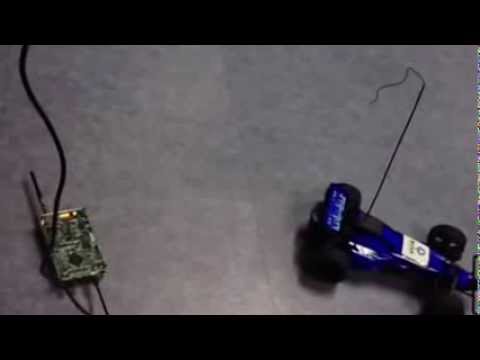
On YouTube user 王康 has been working with his HackRF One to create a computer keyboard controlled interface for his remote control car. The HackRF is a ~$300 software defined radio similar to the RTL-SDR, but with transmit capabilities.

To control the car he wrote a GNU Radio program to generate a control signal that is transmitted by the HackRF and a GUI to listen to keyboard presses on the PC.

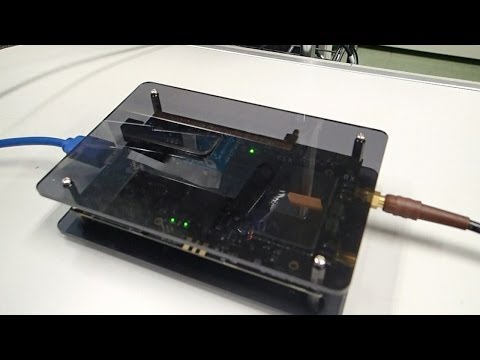
HackRF One with gr-remotecar

RTL-SDR with Frontend Bandpass Filter

Over on YouTube Adam Alicajic has posted a video showing how much a bandpass filter at the front end of an RTL-SDR can significantly improve reception. He points out that it is a myth that modern software receivers do not need preselector filters at the front end for best performance.

He tests the RTL-SDR with and without a front end 2m triple helical bandpass filter on a CW beacon at around 144 MHz. With the filter on there is almost a 10dB improvement in signal reception.

DVB T SDR dongle with the BPF