Register your interest in Airspy

You can now register your interest in purchasing an AirSpy software defined radio dongle on the new AirSpy website. AirSpy is a new software defined radio similar to the RTL-SDR currently under development by the creator of SDR#.

AirSpy promises to be an improvement on the RTL-SDR with its large 10 MHz bandwidth, 24-1750 MHz tuneable range, 12-bit ADC and a programmable Cortex M4F @ 204 MHz on board CPU. In comparison the typical RTL-SDR has ~2.4 MHz of usable bandwidth, a 24-1750 MHz tuneable range and an 8-bit ADC. A higher bit ADC can help in receiving weaker signals. AirSpy is expected to sell at around the $100-$150 mark, with it being on the cheaper end if there is greater interest.
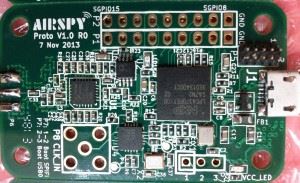

AirSpy Dongle
AirSpy Software Defined Radio Receiver

Receiving 10m RTTY with the RTL-SDR

YouTube user Łukasz Kosson has uploaded a video showing how he was able to decode RTTY signals on 10m (28 MHz). RTTY is an acronym for Radio Teletype, and is a method used to transmit text. To decode RTTY he used HDSDR and piped the audio output to fldigi.

Monitoring APRS with the RTL-SDR

YouTube user Troy McQuinn has uploaded a video showing how he is able to decode amateur radio APRS signals. APRS is an acronym for Automatic Packet Reporting System and is used by ham radio users to send data like messages, announcements and also GPS coordinates. To decode APRS he uses SDR# and pipes the audio to QTMM AFSK 1200 Decoder.

Studying VOR Signals with the RTL-SDR

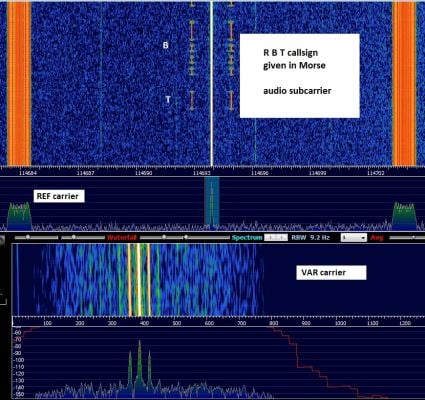
VHF Omni Directional Radio Range (VOR) signals are used in aviation as a short range radio navigational system. Amateur radio hobbyist F4GKR decided to study these VOR signals by recording them using his RTL-SDR, and then analyzing them in MATLAB. On his post he shows his method of analysis and discusses his results.

VOR Spectrum and Waterfall

RTL-SDR + Upconverter vs. Portable Shortwave Receiver

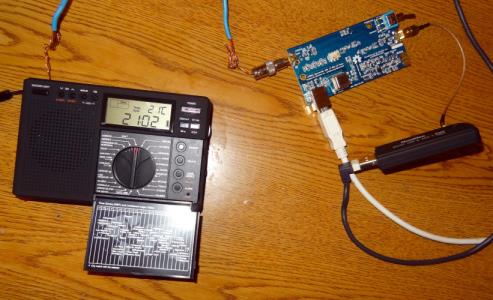
Akos from the SDR for Mariners blog has put together an article doing a comparison between the RTL-SDR + ham-it-up upconverter and a Grunding G8 Traveler II Digital conventional portable hardware shortwave radio.

His results show that the RTL-SDR and portable receiver are comparable in terms of performance, with a slight edge to the RTL-SDR. He adds that software tweaks available in SDR# can improve the voice quality for the RTL-SDR. However his final recommendation for general shortwave listening is that the portable is still the better option due to it’s ease of use.

RTL-SDR + Upconverter vs. Portable Shortwave Radio

RTL_FM_Python: An API and web interface for controlling RTL_FM

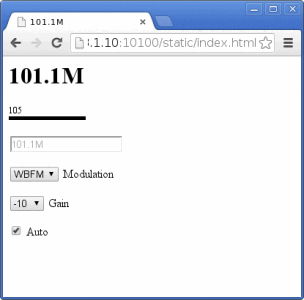
Th0ma5w has released his rtl_fm_python program which is a modification of rtl_fm. The added feature is an API and web interface which allows interaction with a running instance of rtl_fm. The API and web interface allows you to change the frequency, modulation and gain settings while rtl_fm is running. This may be useful for remote devices running rtl_fm such as a Raspberry Pi.

rtl_fm_python web interface

Building a Homemade LNA for RTL-SDR

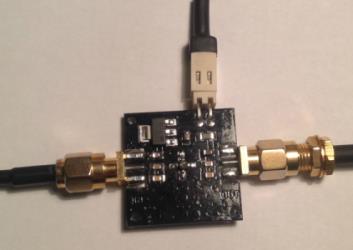
Over on Reddit user soooooil has posted about his work in building an LNA, including etching the PCB. On his imgur page he shows the design and construction process through images, before showing the final result in SDR#. For the LNA he used a ERA-3SM+ MMIC which has 17-23 dB of gain and a NF of 2.6-2.8 dB. While the noise figure is fairly high for an LNA, it is still likely lower than the RTL-SDRs internal amplifier noise figure which is around <4.5 dB.

Homemade LNA
Homemade LNA

NRF905 RTL-SDR Decoder

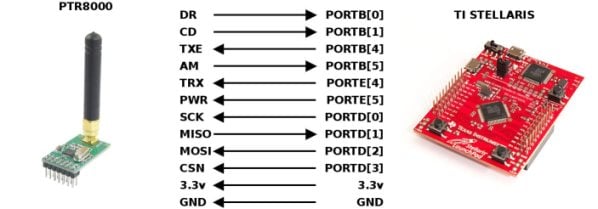
The NRF905 is a multiband RF tranceiver IC that uses frequencies in the ISM bands. Fabien le mentec posted about a project where he wanted to remotely monitor his garage door status using a microcontroller and the PTR8000 wireless module which contains the NRF905 chip.

In order to validate that his hardware settings were set correctly and that the NRF905 was transmitting correctly, he used an RTL-SDR and his recently written NRF905 decoder program to check the output frames.

Recently, we posted a similar project involving the NRF24L01+ wireless tranceiver where a decoder for that had been written as well.

PTR8000 Wireless Transceiver with the NRF905 Chip