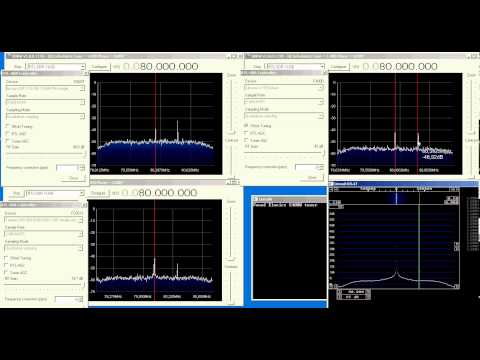
Perseids Meteor Reflection Observations with the RTL-SDR

In this video YouTube user ek6rsc shows a timelapse of meteor reflection observations during the yearly Perseids meteor shower which occurred in 2013 during August 10-15. To do this he uses an R820T RTL-SDR tuned to 59.25 MHz, and the HROFFT software to do the recording.

Meteors entering the atmosphere can cause radio frequency reflections which may allow extremely distant radio signals to be received briefly. Reception of such a signal may be a good indicator that a meteor has fallen. A good informational guide on meteor scatter with the RTL-SDR can be found in this pdf file by Marcus Leech.
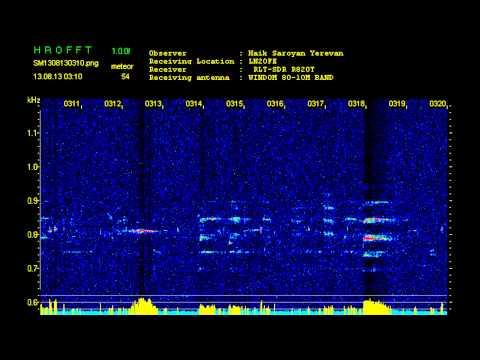
2013 Perseids Aug10-15 radio observations Meteor reflection 59.25Mhz

Replacing the Low Quality 28.8 MHz Oscillator on the RTL-SDR

The 28.8 MHz crystal oscillator on the RTL-SDR is known for being low quality. A low quality crystal means that the frequency tuning can be off by a few KHz and can cause the tuned frequency to drift over time.

In this article of the GBPPR ‘Zine (kindly mirrored by superkuh), the authors show a tutorial on how a cheap high quality 14.4 MHz temperature compensated crystal oscillator can be combined with a frequency doubler circuit to create a high quality 28.8 MHz clock source, which can then be used to replace the low quality oscillator on the RTL-SDR. A 14.4 MHz oscillator is used as high quality 28.8 MHz oscillators appear to be rare.

Frequency Doubler Circuit

Setting up an APRS iGate with the RTL-SDR

Over on Pawel Janowski’s blog (SQ7MRU) a writeup on how to set up an APRS iGate receiver with an RTL-SDR and cubieboard mini computer has been posted. The article has been written in Polish, but can be translated using Google Translate.

APRS stands for Automatic Packet Reporting System and is usually used by Amateur radio operators to broadcast the current GPS coordinates of something such as a transmitter site/car/boat or high altitude amateur balloon. These APRS packets are received by an iGate and then put onto the internet. Check out aprs.fi for an example.

To create an APRS iGate, Pawel runs a RTL-SDR compatible python program called pymultimonaprs which is used to receive and broadcast the APRS data on to the internet.

aprs_fi_rtlsdr

Video Comparison Between E4000, R820T, FC0013 and Comparison with SDR# and Linrad

On YouTube sm5bsz has uploaded a video showing a comparison between the E4000, R820T and FC0013 tuners, and also comparing the receive performance of SDRSharp and Linrad. In the video Linrad showed superior receive performance with the E4000 when compared to SDRSharp due to some custom gain profiles which are enabled in Linrad only (but can also be enabled in SDRSharp with a plugin/mod).

Note that the reason Linrad showed better performance is purely due to the fact that he used a modified librtlsdr driver in Linrad which has the custom gain profiles. However, in a previous post we posted about a modification/plugin to SDRSharp which allows this modified librtlsdr to be used, which will allow SDRSharp to perform as well as Linrad for the E4000.

Linrad is another software defined radio program which is much more difficult to use, but was the first program to support the modified librtlsdr. Some people prefer Linrad due to it’s advanced GUI which has a lot of signal information on display.

HackRF Receiving HRPT Weather Satellite Images

On Twitter user @uhf_satcom has been using a HackRF software defined radio together with GNU Radio, a tracking L-Band antenna and this HRPT decoding software to receive and decode HRPT weather satellite images. He used GNU Radio to output to a .RAW16 file, which the HRPT decoding software was then able to use to produce an image.


HRPT is a picture transmission protocol which stands for High Resolution Picture Transmission. There are multiple satellites which broadcast weather images in this format including the NOAA, GOES, Metop-A and Feng Yun satellites. These satellites transmit HRPT at about 1.7 GHz.

@uhf_satcom also tried to receive these images with the RTL-SDR, but was unsuccessful. But you can still receive the lower resolution APT weather satellite images using the RTL-SDR.

Below are some examples of the images he was able to receive.

hrpt_hackrf1_thumb hrptdata_noaa19a_thumb

Update: This is an image of the L-band antenna he used.

Software Defined Radio for Mariners: AIS Antenna Design Review

On a new blog called ‘Software Defined Radio for Mariners‘ aimed at mariners wanting to get into cheap software defined radio with the RTL-SDR, the author has posted an article for beginners on choosing a type of AIS antenna to build.

He reviews the performance of multiple homemade AIS antennas with his RTL-SDR, and finds that a Monopole antenna with two radials gave the best value/performance trade off.

He has also written a hardware guide article, explaining some of the most common antennas adapters and cable ends that might be found.

AIS Monopole Antenna

Version 5.0 of the CT1FFU Upconverter Now Available

Version 5 of the popular CT1FFU HF upconverter which is often used with the RTL-SDR and Funcube software defined radios has been made available for sale. A ready built and tested version 5 CT1FFU upconverter will cost you 55 Euros. See the circuit diagram and technical specs in this pdf file.

The upgrades include

– Smaller size PCB

– 4 new holes for screwing PCB

– MiniUSB connector

– 2 led 5V indication USB/ Phantom Power

– It runs with phantom power directly from Fun Cube Dongle’s SMA cable

– USB power for generic RTL TV dongle sticks

– Separeted antenna inputs HF/6m and VHF/UHF

– Automatic internal relay antenna switch: HF or Bypass VHF and UP

– WFM broadcast filter avoiding saturation of SDR front-end

– LED indication for converter running

– DBM diode ring mixer 7 dBm: This ensures exellent HF reception performance

– LO on 106.250 Mhz or 65.520Mhz: This avoids interference from WFM radios

– Tests made by hams worldwide reveal exceptional clean reception on HF

– Technical assistance after selling

– Either ready built and tested or as KIT easy to build by yourself

– Worldwide shipping and tracking is included in advertised price

– You can now choose the LO freq: 106.250Mhz or 65.520Mhz models

Exploring Unintentional Radio Emissions with the RTL-SDR

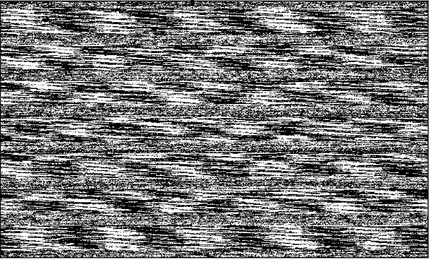
Melissa Elliot (0xABAD1DEA), an infosec security researcher has uploaded slides on the topic of investigating unintentional radio emissions from various electronic devices, and the security issues these emissions can cause. She used the RTL-SDR as the radio receiver to show that sophisticated equipment isn’t needed. One interesting experiment she performed was trying to recover a checkerboard image displayed on an LCD screen entirely via its unintentional radio emissions received with the RTL-SDR. She got close, as you can sort of make out the checkerboard pattern on the recovered image below. Update: Tomsguide have written an article on Melissa’s talk.

LCD Recover from Unintentional Radio Emissions