Tagged: hackrf

Reverse Engineering a Wirelessly Controlled Adjustable Bed with a HackRF and Logic Analyzer

Over on his blog Chris Laplante has written up a post showing how he was able to reverse engineer his wirelessly controlled adjustable "TEMPUR-Contour Elite Breeze" bed. Originally the bed did have an Android App for smartphone control, however it was never updated since 2014 and so it no longer works on his modern Google Pixel device. So in order to have it controllable by his home automation system Chris decided to reverse engineer the wireless signal used by the bed's remote control. 

He first searched the FCC filing, finding that it transmitted in the ISM band at 433.050 to 434.790 MHz. Then using his HackRF he was able to capture the signal and determine that it used Gaussian frequency shift keying (GFSK) modulation.

The GFSK signal from the Tempur Pedic wireless remote control.

While the HackRF got him this far, he decided to follow a new line of investigation next, instead now using a logic analyzer to probe the SPI bus which talks to an Si4431 RF transceiver on the remote control. From this he was able to determine the important properties of the signal such as the frequency, data rate, frequency deviation, channel mapping and packet structure.

With all this information Chris was in the end able to create a product called "Tempur Bridge" that he is now selling on Tindie. It consists of an ESP32 WiFi connected microcontroller and a Si4463 RF transceiver chip. With his product Chris is now able to control his bed through a WiFi connection in Home Assistant.

Chris's TemperBridge product for WiFi control of a Tempur Pedic adjustable bed.

[This story was also seen on Hackaday]

Bouncing LoRa Signals off the Moon with a HackRF

One part of the amateur radio hobby is 'EME', or Earth-Moon-Earth. The idea is to bounce radio signals off the surface of the moon, and have them received over a vast distance. Typically weak signal amateur radio modulation schemes such as JT65 are used due to their ability to be decoded even with the very weak signals that come back from the moon bounce.

Recently a group of students from the College of New Jersey are attempting to bounce signals off the moon using the LoRa modulation scheme. LoRa is a modulation scheme designed to be used with IoT devices, however it also has great performance when signals are weak so it's a good candidate for moon bounce.

The students are using a HackRF and the SDR-Angel software with the signal being transmitted in the amateur radio bands at 1296 MHz. The antenna hardware consists of an 1296 MHz feedhorn attached to an 8-meter dish. They hope that the use of LoRa modulation can reduce the power requirements for EME.

The main goal of this project is to establish Earth-Moon-Earth communication with LoRa modulated signals. There are three main goals that this project is trying to accomplish. The three goals of our project are to reflect a signal off the Moon and receive it back here in New Jersey, transmit a signal from here in New Jersey, bounce it off of the Moon, and then receive the signal on a dish located in Alaska, and our final goal for this project is to establish two way communication between New Jersey and Alaska.

Our initial approach to this project is to use SDRAngel to modulate and demodulate our signal. SDRAngel is a free, open-source software that we can use to transmit and receive signals via SDR (Software Defined Radio).

Our modulation technique, LoRa, uses Chirp Spread Spectrum modulation that allows for low power, long range transmissions at the cost of a low data rate.

The peripheral of choice for this project is the HackRF One, a SDR peripheral that allows us to send and receive signals.

This story was also presented on Hackaday.

Bouncing LoRa Signals Off the Moon - TCF 2023, track 5, TCNJ student presentations

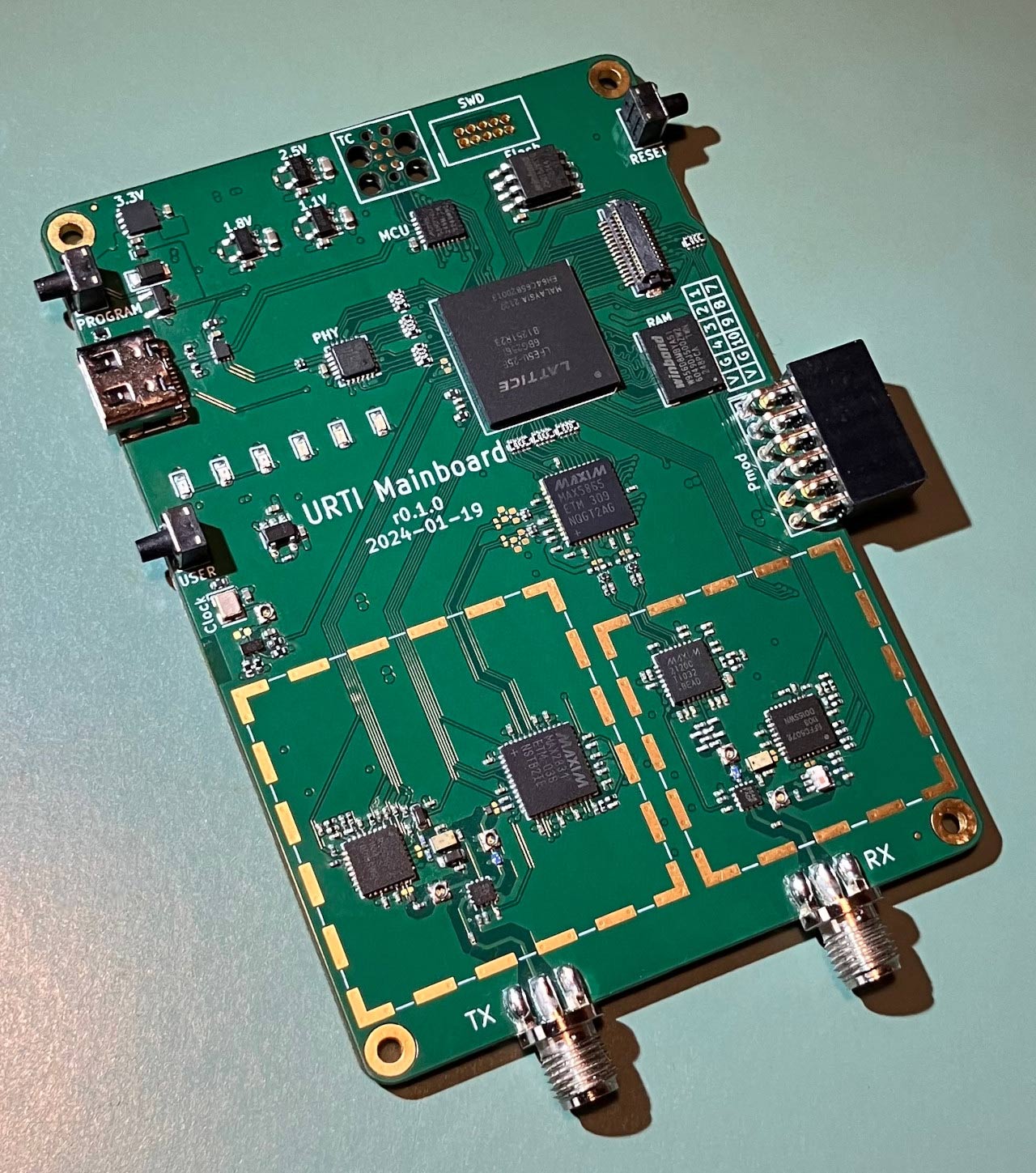
Great Scott Gadgets to Develop a Universal Radio Test Instrument (URTI)

Great Scott Gadgets (GSG), creators of the HackRF, YARD Stick One and Great FET (among other products) have announced that they are developing a device called a "Universal Radio Test Instrument (URTI)". They note that:

URTI will offer radio amateurs, researchers, educators, and professionals an affordable, compact RF test tool that could be used in place of multiple expensive pieces of traditional radio test equipment.

Our goal for URTI is to design a single hardware platform capable of serving as many popular types of one-port or two-port RF test instruments. We plan to build a directional coupler into a wideband, full-duplex SDR platform to enable URTI to function as a:

  • spectrum analyzer
  • vector network analyzer
  • vector signal generator
  • vector signal analyzer
  • antenna analyzer
  • power meter
  • frequency counter
  • full-duplex SDR transceiver

The design and hardware of the URTI appear to still be in the very early stages, with nothing other than early component lab tests released yet. However, given the track record of GSG products, we expect that they will release a high quality and completely open source product in time. We look forward to tracking the progress of the URTI.

More information about the device is available at https://greatscottgadgets.com/2023/05-04-development-of-a-universal-radio-test-instrument

Hacking Beepers at a Fish & Chip Shop with an RTL-SDR and HackRF

Over on YouTube Paul from "Tall Paul Tech" has uploaded a video showing how he was able to reverse engineer the wireless protocol used by a simple restaurant beeper (aka 'burger pager') notification system that is used to let customers know when their food is ready.

By reading the label on the base unit, Paul found that the beeper system transmits at 433 MHz. He was then able to record it's transmissions with an RTL-SDR. Then using Inspectrum, he was able to determine the bit string and the symbol period.

From there he was able to use a GNU Radio program to replicate the signal, allowing him to use a HackRF to activate the beepers on demand.

In the past we've posted similar stories [1][2][3].

Hacking A Fish & Chip Shop

Tech Minds: Testing an RTL-SDR Wideband Scanner with WebUI

Over on YouTube Matt from the Tech Minds YouTube channel has put up a video demonstrating an open source program released on GitHub called "RTL SDR Scanner", or "rtl-sdr-scanner-cpp". This program is compatible with RTL-SDR and HackRF software defined radios, and allows users to record multiple analogue FM audio channels within the active bandwidth simultaneously. 

To get a wider bandwidth, you can use a HackRF as your SDR, or you can also use multiple RTL-SDR dongles, or a device like the KrakenSDR which has multiple RTL-SDRs built into it. Alternatively, you can also have the software scan a much larger swath of bandwidth, however this could result in some transmissions being missed. 

The audio is recorded as a wav file, and can be accessed through a web UI. We note that currently only FM recordings are supported but AM may be supported in the future.

RTL SDR Scanner - FULL Bandwidth Recording With WEB UI

HackRF Opera Cake Released: A Rapid RF Switching Board

Back in 2016 Michael Ossmann, founder of Great Scott Gadgets and creator of the HackRF released schematics for 'Opera Cake', a rapid RF switching add on board for the HackRF. We also saw back in a January 2018 post how Opera Cake was capable of being used as the switching hardware for Pseudo-Doppler direction finding. Up until now Opera Cake has only been available as a schematic, for advanced hackers who could produce and build the board themselves.

Earlier this week Opera Cake was released for sale via various resellers in the US, UK and EU. The pricing from the US reseller is US$190.

Opera Cake is an antenna switching add-on board for HackRF One that is configured with command-line software either manually, or for automated port switching based on frequency or time. It has two primary ports, each connected to any of eight secondary ports, and is optimized for use as a pair of 1x4 switches or as a single 1x8 switch. Its recommended frequency range is 1 MHz to 4 GHz.

When HackRF One is used to transmit, Opera Cake can automatically route its output to the appropriate transmit antennas, as well as any external filters, amplifiers, etc. No changes are needed to the existing SDR software, but full control from the host is available.

Opera Cake also enhances the HackRF One’s use as a spectrum analyzer. Antenna switching works with the existing hackrf_sweep feature, which can sweep the whole tuning range in less than a second. Automatic switching mid-sweep enables the use of multiple antennas when sweeping a wide frequency range.

Opera Cake connected to multiple antennas

Software Defined Radio Academy 2022 Conference Talks

Videos of talks from the Software Defined Radio Academy 2022 (SDRA22) conference have recently been uploaded to YouTube. SDRA22 was held during the HAMRadio World Fair in Friedrichshafen, Germany during June 2022. The talks include topics on:

  • Usage of SDR in a contest
  • HackRF Supercluster
  • PLLs in software defined radios
  • M17 Project: A new digital voice mode for VHF and up
  • RM Processor to Xilinx FPGA Connection for SDR
  • User-Assisted Spectrum Labeling
  • The perfect HF Receiver. How would it look like today?
  • FutureSDR: An Async SDR Runtime for Heterogeneous Architectures
Playlist: SDR Academy 2022 @HAM Radio Fair

Fissure: An Open Source RF Reverse Engineering Framework

FISSURE (Frequency Independent SDR-Based Signal Understanding and Reverse Engineering) is a recently released open source framework that runs on Linux, and includes a whole suite of previously existing software that is useful for analyzing and reverse engineering RF signals. On top of that it includes a custom GUI with a bunch of custom software that ties everything together in a full reverse engineering process.

Recently the developers spoke at this years Defcon conference, and the talk video is supplied at the end of this post. In their talk they explain the purpose of FISSURE, before going on to demonstrate it being used to reverse engineer a wireless X10 doorbell. FISSURE makes analyzing the signal easy, starting with spectrum analysis to find the signal, then signal recording, signal cropping, signal replay, crafting packets and crafting attacks.

News and developments about FISSURE can also be seen on their Twitter.

FISSURE is an open-source RF and reverse engineering framework designed for all skill levels with hooks for signal detection and classification, protocol discovery, attack execution, IQ manipulation, vulnerability analysis, automation, and AI/ML. The framework was built to promote the rapid integration of software modules, radios, protocols, signal data, scripts, flow graphs, reference material, and third-party tools. FISSURE is a workflow enabler that keeps software in one location and allows teams to effortlessly get up to speed while sharing the same proven baseline configuration for specific Linux distributions.

The framework and tools included with FISSURE are designed to detect the presence of RF energy, understand the characteristics of a signal, collect and analyze samples, develop transmit and/or injection techniques, and craft custom payloads or messages. FISSURE contains a growing library of protocol and signal information to assist in identification, packet crafting, and fuzzing. Online archive capabilities exist to download signal files and build playlists to simulate traffic and test systems.

The friendly Python codebase and user interface allows beginners to quickly learn about popular tools and techniques involving RF and reverse engineering. Educators in cybersecurity and engineering can take advantage of the built-in material or utilize the framework to demonstrate their own real-world applications. Developers and researchers can use FISSURE for their daily tasks or to expose their cutting-edge solutions to a wider audience. As awareness and usage of FISSURE grows in the community, so will the extent of its capabilities and the breadth of the technology it encompasses.

FISSURE RF Framework - Griffiss Institute & AIS Monthly Lecture + Education Series