Tagged: Software-defined radio

SDR Makerspace Conference to be Held in Switzerland in November

SDR Makerspace is a community based in Greece that is run by the European Space Agency and Libre Space Foundation (who are responsible for the SatNOGS project). It provides funding and resources for Software Defined Radio based space communication projects.

On November 28-29 2019 they are holding the SDR Makerspace Conference in Payerne, Switzerland. The conference is free to register although spaces are limited.

The technical talks during the first day will be:

  • Open-Source SDR Software for Satellite Communications - Alexandru Csete
  • LimeSDR as an enabler for Satellite TV Transmissions - Dave Crump
  • How wide band data converters enable SDR in Satcoms - e2v
  • Teaching SDR: EPFL experience - Bixio Rimoldi
  • Xilinx’s adaptive solutions for SDR application - Georg Hanak
  • SDR Makerspace: Evaluation of SDR Boards and Toolchains - Sheila Christiansen
  • SDR and Amateur radio in space - Michel Burnand
  • SDR Makerspace lightning talks - Multiple Authors

The second day will consist of workshops on using SDRs for satellite communications, and on using the LimeNET Micro and LimeRFE for SDR satcom development.

Exhibitors who will be at the conference.

XYNC: A Massive MIMO SDR with up to 32×32 TX/RX Channels

Back in 2017 we posted about the crowd funding of the Fairwaves XTRX, a small PCIe based TX/RX capable software defined radio that back then cost US$199 (now only the XTRX Pro is available for US$599). The XTRX is based on the same RF chips that are used in the LimeSDR and each unit has 2 x 2 MIMO (multi-input, multi-output), 120 MSPS SISO / 90 MSPS MIMO, 30 MHz to 3.7 GHz tuning range and comes with an on board GPSDO.

Recently Fairwaves have begun crowdfunding a new software defined radio called the XYNC. The XYNC is essentially a motherboard for connecting up to 16 XTRX boards together which results in an SDR with 32 TX and 32 RX channels.

If you’re working on a massive MIMO system or have a large swath of spectrum you need to monitor, XYNC (pronounced iks-sync) is right for you. XYNC builds on the success of the Octopack SDR we offered during the XTRX campaign and takes into account feedback from the original Octopack users.

You can connect two XYNC boards, either to increase the number of RX/TX channels (e.g., two XYNC Octos give you 32 TX and 32 RX channels) or to increase throughput per channel (e.g., two XYNC Quadros give you twice the throughput of a single XYNC Octo). Connecting more than two XYNC boards is also possible, but requires an external clock and 1 pps signal distribution circuitry, neither of which is provided as part of this campaign.

While advertised as low cost, the pricing is probably out of reach for most hobbyists, with the quad 8x8 unit coming in at US$4500 and the top 16 board 32x32 unit priced at US$13,000. Still, these prices are very good for a massively MIMO SDR and pricing is set to rise once the crowdfunding campaign ends in 39 days.

The XSYNC Massively MIMO SDR with up to 32x32 TX/RX Channels

Andreas Spiess Explains Software Defined Radio in YouTube Video

Over on YouTube Andreas Spiess has uploaded a video titled "How does Software Defined Radio (SDR) work under the Hood?". The video is an entertaining introduction to how software defined radio works and begins from the beginning by explaining how basic analogue radios work with components such as modulators, demodulators, frequency generators, mixers and filters. After the basics he goes on to explain the digitization of radio signals that occurs in SDRs, and gives an introduction ADCs and how IQ sampling works.

Later in the video Andreas shows various applications for SDRs, discusses various SDRs on the market like RTL-SDR, HackRF, SDRplay, LimeSDR and PlutoSDR and introduces GNU Radio Companion and other SDR programs from our big list of software post.

#286 How does Software Defined Radio (SDR) work under the Hood? SDR Tutorial

GR-Oscilloscope: Using an Oscilloscope as a Software Defined Radio

A modern digital oscilloscope uses an analogue to digital converter (ADC) and digital signal processing (DSP), just like a software defined radio does, so it stands to reason that with some software hacks an oscilloscope could be turned into an SDR.

To facilitate this, jmfriedt has just released his new software called "gr-oscillioscope" over on GitHub. GR-Oscilloscope allows you to use a digital oscilloscope as a software defined radio source in the latest GNU Radio 3.8. It has been tested with a Rohde & Schwarz RTO2034 and RTE1054, and should work on any RT series oscilloscope. The software works by using the VXI11 RPC protocol which is a protocol designed for connecting instruments like oscilloscopes to computers.

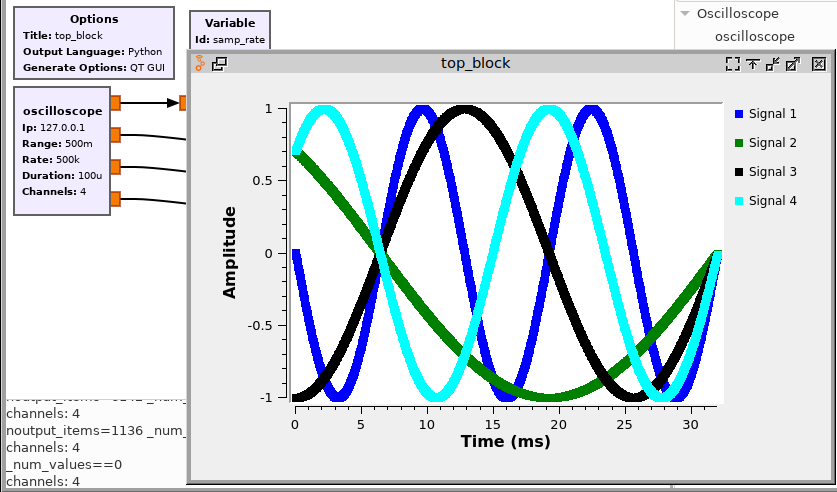
GR-Oscilloscope Screenshot from GNU Radio.

Signals and Bits A New SDR Podcast by the President of the GNU Radio Project

[Ben Hilburn] the president of the [GNU Radio Project] has recently started a new podcast called [Signals and Bits]. If you were unaware, GNU Radio is the defacto open source framework for implementing digital signal processing code. Without it, many SDR programs that we take for granted may have never been developed as it is responsible for a lot of community DSP knowledge and algorithm development.

This podcast is scheduled for a new release every Wednesday and will be composed in an interview style focusing on a multitude of topics from Software Defined Radio to Spectrum Enforcement, Radio Astronomy and so much more.

In the first episode Ben interviews Harold Giddings AKA Corrosive of [Signals Everywhere] where they discuss the state of Software-Defined radio and how he got started with radio communications having come from an IT/Computer Networking background.

Ben has already pre-recorded several episodes which will ensure great content is always just around the corner. Ben would love it if you could also send feedback his way over on the [Signals and Bits Twitter] page.

Ben Hilburn President of GNU Radio (Left), Harold Giddings AKA Corrosive of Signals Everywhere (Right)

Online Course: Software Defined Radio From 0 to 1

Back in March we posted about Qasim Chaudhari and his recently released book titled "Wireless Communications From the Ground Up - An SDR Perspective". The book covers advanced University level wireless topics, but he noted how he's attempted to keep the math at school complexity (although for most people we'd say it's still more at undergraduate Engineering school complexity).

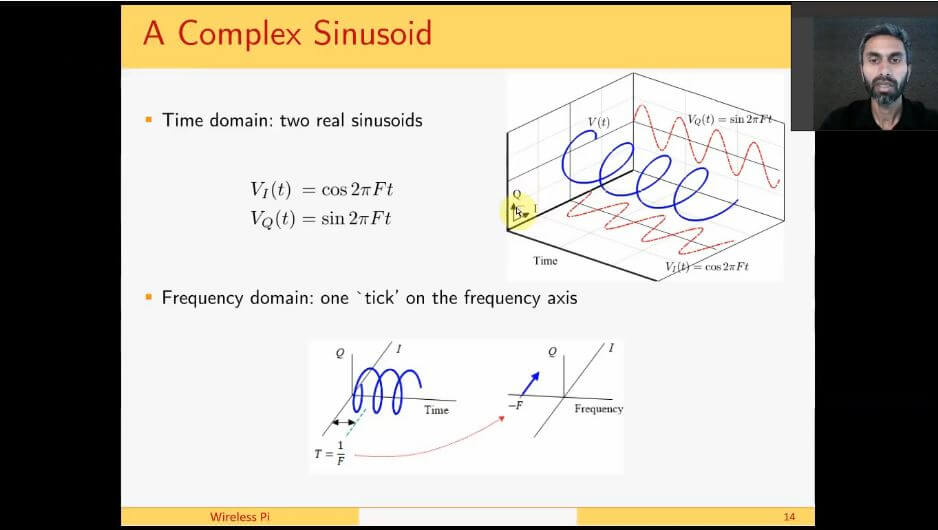
Since the last post Qasim has received a lot of feedback from radio amateurs asking for a much simpler introduction to DSP concepts, without the use of University level math. Recently Qasim wrote in and noted how he's now created a set of online lectures that is intended for either professionals who want an overview of physical layer algorithms, or radio hobbyists and general technical persons who want to expand their knowledge.

The course costs US$37 (currently discounted by 20% to $29.50 via this coupon link) and has a sampling of free videos for you to watch.

A sample slide from Qasim's Lectures

DIY Software Defined Ham Transceiver With eBay Parts

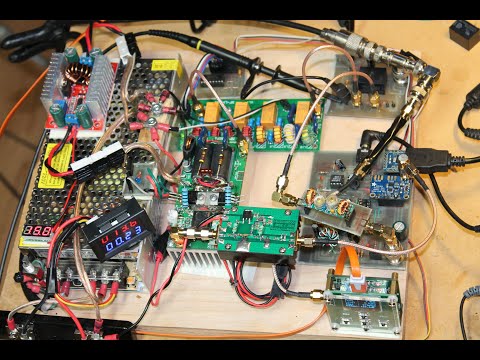
YouTuber jmhrvy1947, has recently uploaded a number of videos giving an overview of how he built his own HF SDR transceiver using what he calls the “Lego build method”. The idea of the Lego build method was to build a transceiver with parts picked and pulled from eBay so that it could be easily reproduced by others. There are a few scratch made components however those designs are available on his GitHub page. The SDR only functions within about 100 kHz of spectrum at a time however for amateur radio HF work this is more than sufficient. Bare bones the radio puts out a mere 100 mW and although the output power is small, he’s made contacts up to 450 miles away using CW (Morse code). You also have the option of adding an amplifier on  your output if you are looking for more power than that. His final revision currently puts out 100 Watts.

Using modified versions of fldigi and Quisk he is able to easily work various digital modes and sync the transmitter and receiver together. The only real down side to this radio is that you must switch out your receive and transmit filters whenever you wish to operate on different bands, a process that really only takes a moment or two.

Check out his videos on the project – it’s really amazing to see what can be done with a small budget these days in radio and with how far software defined concepts have brought us.

DIY SDR CW Xcvr Project

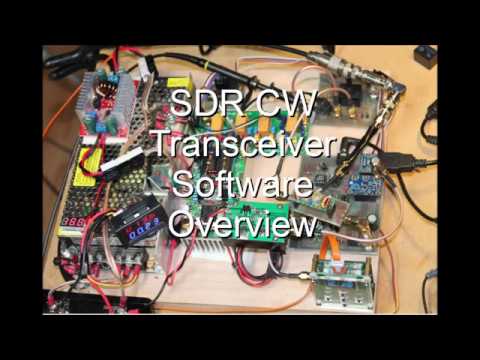
In the video below you’ll see an explanation of the software involved in this build.

DIY SDR CW Software


New Technical Textbook on SDR and Communications: “Wireless Communications From the Ground Up – An SDR Perspective”

Thanks to author Qasim Chaudhari for writing in and sharing with us that his new book titled "Wireless Communications From the Ground Up - An SDR Perspective" has been released. Qasim is a research fellow in the Electronic and Telecommunications Engineering department at RMIT University in Australia and has been giving presentations and talks each month at Cyberspectrum Melbourne for more than 3 years.

His book covers University level wireless communications and digital signal processing (DSP) topics with a focus on SDR. Qasim writes that most DSP books that he's seen in the past were written for professional academics which made them difficult to for other technical (but non-mathematical) persons to understand. You can't explain DSP without equations, but Qasim notes that his book aims to keep the math content at school level only, and with plenty of figures to help with visualization. The description reads:

There are different angles from which this book contributes to the understanding of wireless communication systems from the perspective of a Software Defined Radio (SDR).

  1. In my opinion, any language, including that of mathematics, is an unnatural mode of communication. For example, I can write the words darwaza, porte, puerta, umnyango, ovi and only certain people will understand what I mean. However, if I show you an image of a door, almost every single person on the planet will immediately get the concept. A figure imprints a massive amount of parallel information in our brains that is much easier to process and recall later. Since a human mind handles images very well, I try to visualize equations through beautiful figures which you will encounter throughout the text with logical and intuitive explanations.
     
  2. If you are not a pure wireless communications academic, you would have found that the mainstream textbooks on this topic are filled with heavy mathematical details which makes this field an exclusive membership club for those who can understand several types of frequency variables and their corresponding Fourier transforms, probability and random processes and detection and estimation theories. While this is true for becoming a master, the Software Defined Radio (SDR) revolution and subsequent projects like GNU Radio have made it possible for anyone to sit down and construct their own unique radio by writing code. Many even do not need to know most of the above mentioned topics. All they need to understand is why an algorithm does what it does so that they know how to write its code, or modify it in an even better way. For this purpose, I have only relied on school level mathematics to explain all the concepts. You will not find any e or j of complex numbers here, nor will you encounter any integrals, probability theory and detection or estimation theory. The only things to know are a sine, cosine and a summation as well as a derivative (which I have occasionally used).
     
  3. The best books written on implementing digital communication systems using Digital Signal Processing (DSP) algorithms are by fred harris (Multirate signal processing for communication systems) and Michael Rice (Digital communications – A discrete-time approach). As often happens with the grandmasters, they walk on a trail without exactly clarifying it for others. After reading their books, I started to feel that fred harris has mainly focused on `how' of communication systems in an unprecedented detail while Michael Rice has mainly covered `what' of communication systems in his simple and beautiful style. In this process, there were many `why' generated in my mind for which I had to find satisfactory answers. This book is a collection of those simple answers.
     
  4. An extra little bonus is a one page summary of the crux of Rx algorithms, clarifying the role of particular parameters in the signal waveform. Most of the algorithm design can be understood by just grasping the concepts on this one page.

A common theme in this text is that some concepts seem easier in time domain and some others are simpler in frequency domain, while their mathematical derivations reinforce the idea. It is fun to grasp a concept covering all three sides. Finally, the book contains a few examples from GNU Radio that explain how to set the parameters in some blocks (e.g., Costas loop, band edge FLL, polyphase clock sync, etc.).

The book is currently available on Amazon, and on Amazon you can see a preview of some pages from the book. Qasim also has a website for the book here.

Wireless Communications from the Ground Up: An SDR Perspective by Qasim Chaudhari