Category: Airspy

Comparing the Ham-It-Up Upconverter with the SV1AFN Upconverter

Over on YouTube user Mile Kokotov has uploaded a video showing a comparison between the ham-it-up and SV1AFN upconverters. An upconverter allows reception of VLF to HF signals with SDR dongles such as the Airpsy and RTL-SDR.

Mile shows that both the ham-it-up and SV1AFN upconverters use the same core component, a double balanced mixer ADE-1. However, the ham-it-up comes with the option for a noise circuit to be populated. A noise circuit is useful if you want to measure the response of a filter or antenna for example. With the ham-it-up the noise source components are sold seperately and need to be carefully soldered on.

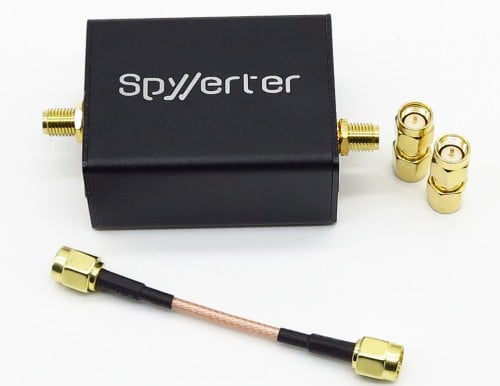
On the other hand the SV1AFN upconverter comes with a built in selectable LNA and better filtering circuitry. The SV1AFN upconverter also uses the ADE-1 in a slightly different design compared to the ham-it-up which allows for much improved performance at VLF frequencies.

In the results Mile uses his Airspy and shows that the SV1AFN upconverter is significantly better at receiving VLF frequencies, and also better at receiving a 28.205 MHz beacon. The results are summarized in the table captured from the video shown in the image below. In the second video Mile also compares the local oscillator drift of each upconverter.

Upconverter comparison results.
Upconverter comparison results screencap.
RF Upconverters Comparison: Ham it Up vs SV1AFN - part1

Airspy Reception Tips and Tricks: Receiving Weak Signals with Strong Nearby Signals

Over on YouTube user Mile Kokotov has uploaded a video showing how he optimizes reception of weak signals in the presence of strong signals on the Airspy software defined radio. He writes:

Using Airspy SDR, I find the interesting way to improve SNR (Signal to Noise Ratio) of the receiving signal, especially in case when very weak signal, which is signal of interest, is close to strong unwanted signals making nonlinear distortion in the receiver front end.

There are two cases:

1. If the weak signal frequency is higher than strong unwanted signals, than you can place the weak signal to the left edge of spectrum window, just before the receiving signal levels goes down to the left. Then you can increase the IF-Gain, Mix-Gain and LNA-Gain so you can improve SNR of weak signal without getting nonlinear distortion from the strong signals with lower frequency.

2. If the weak signal frequency is lower than strong unwanted signals, than you can place the weak signal to the right edge of spectrum window, just before the receiving signal levels goes down to the right. Then you can increase the IF-Gain, Mix-Gain and LNA-Gain so you can improve SNR of weak signal without getting nonlinear distortion from the strong signals with higher frequency.

Of course, the best possible way to improve SNR in wide-band receivers sach is Airspy, Funcube, RTL-SDR and others, is by using narrow filter before Airspy front end, but you will loose wide-band possibilities in that way…

The Wide Dynamic range LNA at the antenna side is strongly recommended for VHF/UHF !

AIRSPY SDR - Tips & Tricks Receiving Weak signals with Strong ones near by

Airspy Direct Digital Converter (DDC) Modification

The Airspy software defined radio comes with breakout pins that connect directly to the analogue to digital converter (ADC) inputs. By connecting an antenna to these inputs together with experimental software it is possible to receive frequencies between 0 – 10 MHz. This is the same trick used in the RTL-SDR direct sampling mod. However, to get decent reception and to keep the Airspy circuitry safe, a low pass filter and isolation transformer are required.

Over on YouTube W9RAN discusses this mod in his latest YouTube video.

Airspy GNU Radio Script for Receiving LRPT Meteor-M2 Weather Satellite Images

Previously we posted about receiving LRPT weather satellite images from the Russian Meteor-M2 weather satellite using the RTL-SDR. Now on GitHub, developer otti-soft has uploaded a LRPT decoder GNU Radio script for the Airspy. The script appears to be a modified version of the GNU Radio based real time decoder for the RTL-SDR, but optimized for the Airpsy and it’s 10 MSPS or 2.5 MSPS sampling rates. Note that although this is a real time receiver, the final image still needs to be processed on a Windows PC using LRPToffLineDecoder.

Also over on Twitter otti-soft has been uploading some images that he has received with his Airspy.

Real time LRPT Receiver for the Airspt
Real time LRPT Receiver for the Airspy

Screening Mods for the Airspy

The programmer of Linrad, Leif (sm5bsz) has recently been experimenting with some modifications to the Airspy metal case. He discovered that the USB and RF input connections on the Airspy were not making good electrical connections to the metal case because of the paint on the case. These bad connections caused interfering broadcast FM to be received by the Airspy through the USB cable even when the antenna input was terminated with a dummy load. By sanding down the paint on the metal box to improve the connection he was able to significantly reduce the interference. He writes:

It is a good idea to make sure that both the SMA connector and the USB screen have a good electrical contact with the box. Grounding only the USB screen causes a severe degradation of the NF.

The findings here may also be useful for improving shielded RTL-SDR dongles.

http://www.youtube.com/watch?v=fXGMEdeGkbg

Airspy Vs RTL-SDR on VLF and Broadcast FM

Over on YouTube user Mile Kokotov has uploaded two videos showing a comparison between the Airspy and RTL-SDR software defined radios. The Airspy is a high performance SDR that costs $199 USD.

The first video shows a comparison between the two SDR’s and two hardware radios on receiving a very weak broadcast FM station amongst several very strong ones. Mile first tested his hardware radios and found that his Onkyo radio was able to clearly receive the weak station, whilst his Pioneer radio could not at all. Then he tested his SDR’s and found that his Airspy was able to receive the station, but the RTL-SDR could not and suffered from intermodulation when the gain was turned up because of the nearby strong stations. This shows how the 12-bit Airspy ADC vs the 8-bit ADC on the RTL-SDR can make a difference.

The second video shows a comparison between the RTL-SDR and Airspy on a VLF time signal at 60 kHz using a ham-it-up upconverter. His video shows that the Airspy signal is about 8dB stronger the the RTL-SDR.

http://www.youtube.com/watch?v=OgU7Gv3lca8#t=118

Airspy vs RTL SDR receiving VLF

Airspy Second Batch of Preorders Available

The Airspy software defined radio recently completed its first round of 400 pre-orders. Now the second round of pre-orders has become available over on the manufacturers web store. It is priced at $199 USD and they expect the orders to be shipped around the middle of December.

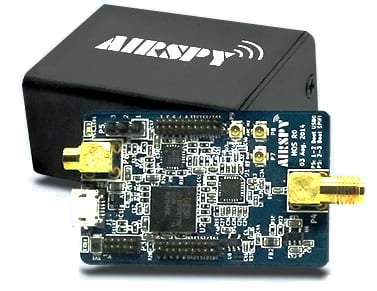
If you were unaware the Airspy is an RX only SDR developed by the author of the SDR# software. It has a tuning range of 24 MHz to 1.7 GHz, up to 10 MHz of instantaneous bandwidth and a 12-bit ADC. The full list of features is shown below.

  • Continuous 24 – 1750 MHz RX range with no gaps
  • 3.5 dB NF between 42 and 1002 MHz
  • Tracking RF filters
  • 35dBm IIP3 RF front end
  • 12bit ADC @ 20 MSPS (80dB Dynamic Range, 64dB SNR, 10.4 ENOB) – Yeah, size does matter.
  • Up to 80 MSPS for custom applications
  • Cortex M4F @ up to 204MHz with Multi Core support (dual M0)
  • 1.5 ppm high precision, low phase noise clock
  • 1 RTC clock (for packet time-stamping)
  • External clock input (10 MHz to 100 MHz via MCX connector) – Ideal for phase coherent radios
  • 10 MHz panoramic spectrum view with 9MHz alias/image free
  • IQ or Real, 16bit fixed or 32bit float output streams
  • No IQ imbalance, DC offset or 1/F noise at the center of the spectrum that plagues all the other SDRs
  • Extension ports: 16 x SGPIO
  • 1 x RF Input (SMA)
  • 1 x RF Output (Loopthrough, U-FL)
  • 2 x High Speed ADC inputs (up to 80 MSPS, U-FL)
  • 4.5v software switched Bias-Tee to power LNA’s and up/down-converters

The Airspy was recently reviewed in two videos by W9RAN, the second video showing some sensitivity measurements. There are also various other videos of the Airspy in action now on YouTube.

Airspy Software Defined Radio

Airspy Sensitivity Measurements and HF Performance

Over on YouTube user ranickel (aka W9RAN) has uploaded a video discussing and reviewing the sensitivity of the Airspy software defined radio. In the video he uses a signal generator to generate a reference signal and shows what the effect of software decimation has on the signal to noise ratio. His results show that the Airspy is a very sensitive and low noise receiver that is comparable to some very expensive hardware.

Airspy Sensitivity Measurement by W9RAN

In another new video W9RAN shows a quick sneak peak at the performance of the Airspy on the 20 meter CW band when using a prototype HF upconverter that he is developing.

Airspy HF Converter Sneak Peek by W9RAN