Over on YouTube user hubmartin has uploaded a video showing how to use an RTL-SDR and the Universal Radio Hacker (URH) software to reverse engineer and clone a 433 MHz remote control. URH is used to extract the signal timing and modulation characteristics as well as the binary/hex code.
Then in order to clone the signal hubmartin uses a cheap IoT microcontroller with button and 433 MHz transmitter attachments. Some C code is then used to program the microcontroller and 433 MHz transmitter with the extracted signal information and to transmit on a press of the button. In his example hubmartin uses his cloned dongle to control a wireless power plug and a motorized projector screen.
Universal Radio Hacker SDR Tutorial on 433 MHz radio plugs
Over on YouTube Corrosive from channel SignalsEverywhere has uploaded a new video in his series on Digital Amateur Television (DATV). The new video shows us how to use a transmit capable SDR like a LimeSDR or PlutoSDR to transmit DATV with a free Windows program called DATV Express.
In the video he explains the various transmit and video encoding settings, and then demonstrates the signal being received on SDRAngel with an RTL-SDR (which he explained in his previous video)
DATV DVB-S Transmitter With a LimeSDR or Pluto SDR and DATV Express
Es'hail 2 was launched last November and it is the first geostationary satellite to contain an amateur radio transponder. The satellite is positioned at 25.5°E which is over Africa. It's reception footprint covers Africa, Europe, the Middle East, India, eastern Brazil and the west half of Russia/Asia.
Although the satellite was launched last year, turning on the amateur transponders has been slow because the commercial systems of the satellite have higher priority for testing and commissioning. However, within the last day the Es'hail 2 team have now begin testing the amateur transponder, and the test signal has been successfully received by several enthusiasts (just check out the Twitter feed). There also appears to have already been a suspected pirate CW signal broadcasting "WELCOME DE ES2HAIL". Actual uplink use of the satellite is not currently wanted, and from the Amsat forums one of the engineers writes:
Before the IOT starts there will be a TRR (test readyness review) in front of the customer. All the testplans and test-specifications will be reviewed. When the test is done there will be a TRB (test readyness board). In the TRB they have to show/present all the measurement results (e.g. inband performance like Gainflatness, Groupdelay... aso.) and compare these results with the specification in the contract. Each unwanted signal makes the measurement difficult and needs to be explained or leads to a so named NCR (non conformance report).
The IOT will be done in shifts/nightshifts and with unwanted signals (if not explain able) some measurements needs to start again and again and leads in addition to a delay for the handover and operation of the satellite.
Maybe that helps to understand why it is really important to have only the IOT uplink signal.
To measure the pattern of each antenna the satellite will be moved east/west by the propulsion system of the DS2000 Bus and the signal level is measured by the IOT station on ground (some cuts) .
The commercial beacon can maybe be switched from LEOP Omni antenna to on station antenna when the satellite is placed in the final slot. This should be the reason for the change of the commercial Ku Band beacon signal level the last days.
If you are interested in receiving Es'hail 2, but live outside the footprint, or don't have a receiver then you can use Zoltan's OpenwebRX live stream of the narrow band portion of the Es'hail 2 downlink. At the moment the beacon doesn't appear to be transmitting, but we expect it to be on and off during the next few days. In his set up he uses an RTL-SDR V3, Inverto LNB, 90cm dish, a DIY bias tee and a Raspberry Pi 3.
He also took a recording of the pirates CW transmission shown in the video below.
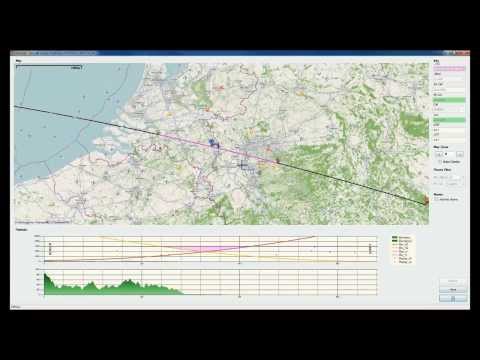
Over on the SWLing post, Thomas has shared an interesting video showing aircraft scatter reception in action. Alps DX [FR] shows on his YouTube channel a broadcast FM signal coming in clearly as a plane passes by, then fading away to nothing as it leaves. This effect is due to the scattering of radio waves that occurs when radio waves reflect off aircraft.
In order to predict when the scattering occurs he uses the free AirScout software which allows you to do the following:
Calculate a propagation path as a cross circle path between two QSO – partners
Calculate a path profile between both QSO – partners using a Digital Elevation Model
(DEM)
Calculate the mutual visibility of an aircraft from both QSO – partners for each point on the path using their elevation and any possible obstruction between them
Calculate a “hot area” in which an aircraft is mutually visible from both QSO –
partners where a reflection is theoretically possible
Show calculated path and aircrafts in real time on a map
Predict Aircraft Scatter potential for each single aircraft according to position, track and altitude
Over on YouTube Corrosive has uploaded a new tutorial video showing us how we can demodulate DVB-S DATV (Digital Amateur TV) on a Windows PC with SDRAngel. DATV is a mode used by hams to transmit and receive digital video, and SDRAngel is a multiplatform SDR software platform that supports multiple SDRs such as the RTL-SDR, HackRF, PlutoSDR, LimeSDR and more.
SDRAngel comes with a built in DATV demodulator, but it is necessary to install the FFMPEG video decoder yourself. Corrosive's tutorial shows where to download the decoder, and how to install it into SDRAngel. He then goes on to show how to use SDRAngel to begin receiving and demodulating a DATV signal.
We note that in a previous post Corrosive also showed in another video how to transmit and receive DATV with a LimeSDR and a modified $20 DVB-S receiver.
WSPR is an amateur radio digital HF mode designed to be decodable even if the signal is transmitted with very low power and is very weak. It can be used to help determine HF radio propagation conditions as WSPR reception reports are typically automatically uploaded to wsprnet. Direct sampling mode on the RTL-SDR V3 allows you to receive HF signals without the need for an upconverter. For best results it is recommended to use a simple bandpass filter for the band of interest.
Zoltan's tutorial comes with a companion YouTube video where he demonstrates his set up. He uses a random wire antenna on his roof directly connected to an RTL-SDR V3, which is connected to a Raspberry Pi 3. The Pi 3 communicates to his home network via an Ethernet cable.
Making a standalone WSPR receiver with RPi and RTL-SDR V3 using rtlsdr-wsprd
Back in early 2017 we posted about Manuel's (aka DO5TY / Tysonpower) design for a single band 140 MHz 3D printed carbon fibre Yagi antenna. Today he's submitted a new video about creating a dual band 3D printed carbon fibre cross Yagi antenna for only 20€. Note that the video is narrated in German, but there are English subtitles. He's also uploaded an English text tutorial to his blog, which includes links to the 3D printer STL files.
The antenna is designed to be a low cost replacement for the commonly used Arrow dual band 2m/70cm antenna which is designed for receiving and transmitting to amateur radio satellites. Many amateur radio satellites have an uplink frequency set at around 145 MHz, and a downlink frequency around 435 MHz (and some satellites have the frequencies reversed). So a dual band Yagi is ideal for these satellites. Manuel writes that with his 5W Baofeng handheld he's already made several successful contacts with his new antenna.
Manuel's antenna consists of several 3D printed joints, with a carbon fibre rod used as the main boom. Aluminum rods make up the receiving and transmitting elements. The video also discusses impedance matching and how he uses a diplexor so that there is only one connection required to the radio. The advantage of his antenna over the Arrow is that it is significantly cheaper, and also much lighter in weight.
[EN subs]Carbon Arrow Yagi Antenne - leichte Dual Band Yagi für 20€ bauen
The Reverse Beacon Network is a project that monitors the amateur radio bands by using volunteer stations to continuously and autonomously collect data on what/when stations are being received, and how good the signal is. The data is made public on the internet and this allows amateur radio operators to easily determine overall propagation conditions. It is currently working mostly with CW (morse code) stations, and mostly on HF, although it is expanding to VHF+ as explained below.
During October, John Ackermann (N8UR) did a talk at the "Microwave Update 2018" conference held in Dayton, Ohio. His talk was about setting up a VHF+ reverse beacon network monitoring station, using multiple RTL-SDR dongles for monitoring. The RTL-SDR dongles run on a Raspberry Pi which runs the rtl_hpsdr software. This allows multiple RTL-SDR dongles to emulate a multi-band HPSDR receiver over Ethernet. They can then be accessed on a PC by the CW Skimmer program which decodes the received CW signals, and then logs it online on the reverse beacon network's website.
The talk slides can be found here, and the video is shown below. More talks from the conference can be found on this YouTube playlist.
Four RTL-SDR.COM V3 dongles used in a VHF+ Reverse Network Setup
John Ackermann, N8UR - The VHF+ Reverse Beacon Network




![[EN subs]Carbon Arrow Yagi Antenne - leichte Dual Band Yagi für 20€ bauen](https://www.rtl-sdr.com/wp-content/plugins/wp-youtube-lyte/lyteCache.php?origThumbUrl=https%3A%2F%2Fi.ytimg.com%2Fvi%2FTch40KB0T94%2F0.jpg)