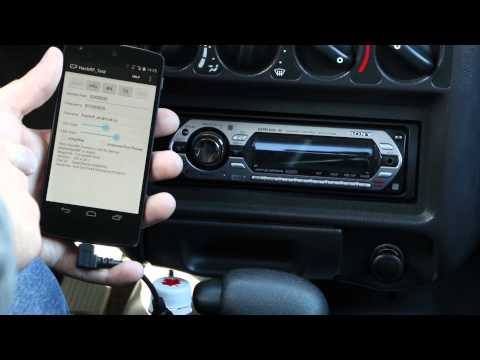
Micheal Ossmann’s HackRF Linux library has recently been ported to Android by programmer Dennis Mantz. Dennis has also made a blog post showing how to use the library. In addition he’s uploaded a YouTube video showing off the library using an example app. The app is capable of recording an RF signal and replaying it via the HackRF’s TX capabilities. In the video Dennis shows the example app recording a broadcast FM station and then retransmitting the recording to his car radio.
On this episode of Hak5, a popular YouTube technology channel, Shannon shows two Android based ADS-B RTL-SDR apps that we have mentioned on this blog previously. One is “ADS-B on USB SDR RTL” and the other is Avare ADS-B. Both are ADS-B apps that will display real time airplane positions on a map.
To run these apps you need a RTL-SDR dongle, a USB OTG cable and an Android phone.
Cellular Testing Tools and Mobile SDR Apps, Hak5 1708
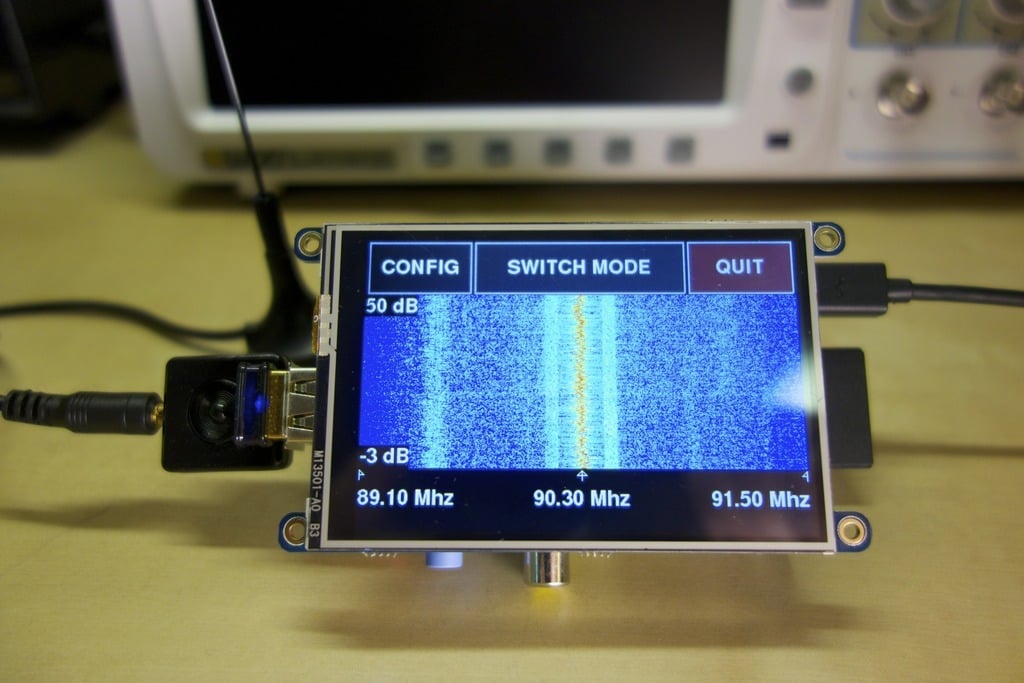
Adafruit has released a tutorial showing how to build a portable TFT screen based Raspberry Pi RTL-SDR spectrum analyzer that was inspired by the HackRF portapack. Construction of the project is very simple and the “FreqShow” python software is provided as a simple download that is ready to run once the RTL-SDR is installed on the Raspberry Pi.
The FreqShow software appears to be fully featured with the ability to change the center frequency, sample rate, and gain. It can show on the TFT screen the real time RF spectrum of the currently tuned area or it can be switched to show a waterfall of the spectrum as well. Below is a video of the finished project that shows the software in action.
“Freq Show” Software in action on a Raspberry Pi with TFT Screen
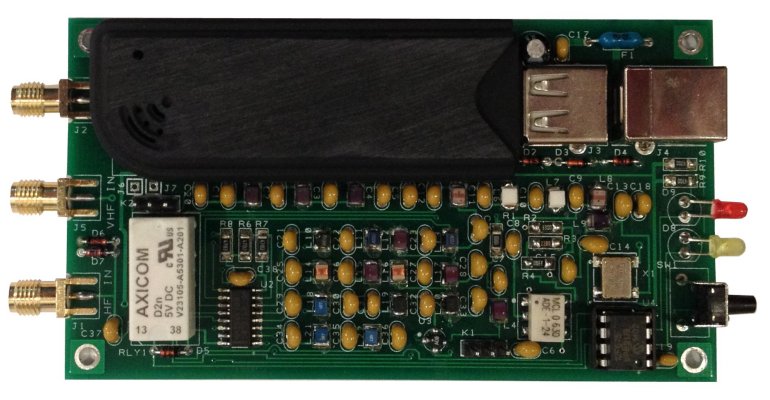
A new UK designed and manufactured upconverter that goes by the name SDR(X) has recently become available for purchase. This upconverter connects to a RTL-SDR dongle and allows it to receive from 100 kHz up till 1850 MHz. Some of its features include:
Four user selectable HF pre-filters (0-2, 2-6, 6-11 and 11 to 30MHz) or single 0-30MHz pre-filter.
Band pass filter after mixer and band pass filter after Oscillator
User selectable MMIC 18db amplifier external to RTL chip set (lower noise level, than RTL chip and compensates for pre-filters).
User selectable HF and VHF/UHF mode (HF 0-30MHz, VHF/UHF mode 24MHz to 1850MHz).
Microchip PIC controller for above.
Diode protection on RF input.
The board comes as a prebuilt kit which is currently selling for 79.95 GBP which includes an RTL-SDR dongle. The device also comes with complete documentation. The SDR(X) can be purchased from 6v6.co.uk.
Note: This post is now old (written in 2014). As of mid 2015 the latest version of DSD+ can be downloaded from www.dsdplus.com. Also note that in 2015 DSD+ changed their version numbers for some reason, so 1.5 is actually older than 1.1.
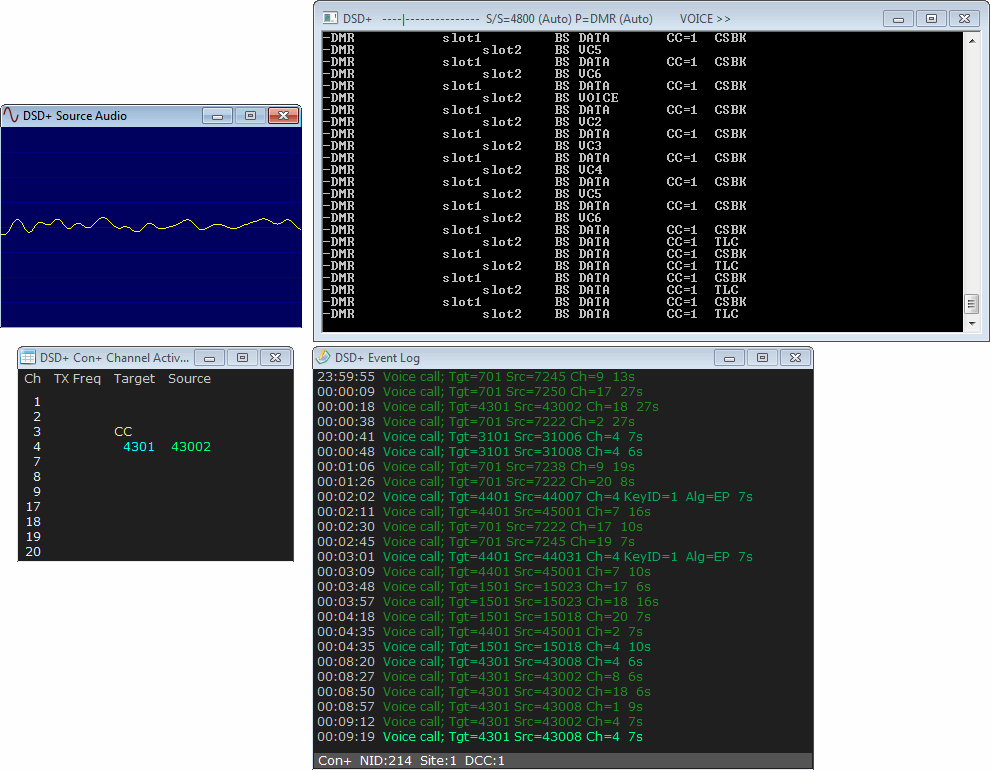
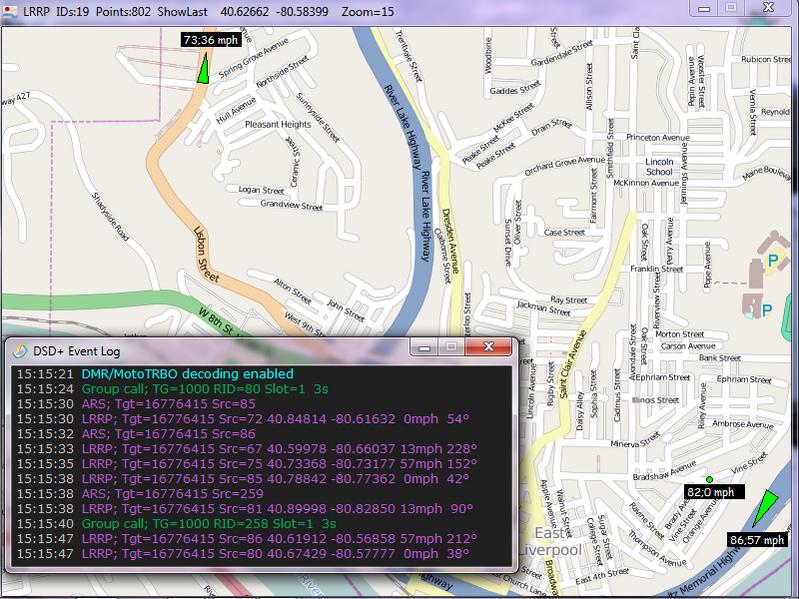
Version 1.5 of Digital Speech Decoder Plus (DSD+) has been released. DSD+ is a popular Windows software tool used for decoding digital speech such as P25 with the RTL-SDR. The latest version comes with a simple GUI interface that has an event log that shows call target and source ID history and an audio waveform plot which can help determine if DSD+ is receiving audio correctly. This version of DSD+ has the ability to decode the following protocols.
D-STAR
NXDN4800
NXDN9600
DMR/MotoTRBO
P25 Phase 1
X2-TDMA
ProVoice
In addition to the above, the new version comes with an LRRP decoder and display program which should allow you to see on a map the GPS location of broadcasting radios.
DSD+ V1.51 can be downloaded from this link (UPDATE: dead link, use www.dsdplus.com now). The forum thread on RadioReference where the developer releases and discusses the DSD+ software can be found here.
This version of DSD+ comes with all the files needed to make it run already. To use DSD+ V1.5 simply extract the zip file into a folder and double click on DSDPlus.EXE. DSD+ will listen to your default audio device that is set in the Windows sound recording properties. Simply tune to a digital voice signal in SDR# or any other SDR receiver and set the output audio settings accordingly. To start the LRRP display program simply open LRRP.exe.
Over on Reddit, user tautology2 has linked to his project which is software that can create a heatmap of signal strengths. His software uses the data that is output from RTLSDR Scanner which is a program that will collect signal strength data over any desired bandwidth and at the same time also record GPS coordinates using an external GPS receiver. RTLSDR Scanner can also create a heatmap by itself, but tautology2’s heatmap is much clearer and has good web controls for choosing the heatmap signal frequency.
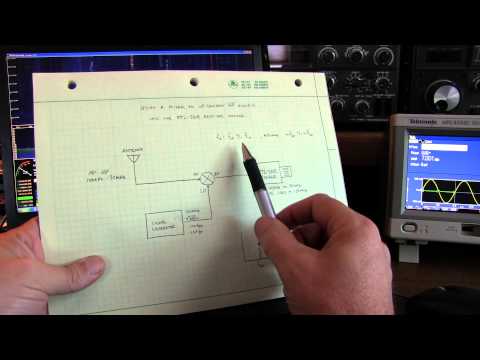
Over on YouTube user w2aew has uploaded a tutorial video that clearly explains the theory behind upconverters. Upconverters are commonly used with the RTL-SDR to receive the HF (0 – 30 MHz) bands. In the video he shows how to make a simple homemade double-balanced diode ring mixer for the RTL-SDR and shows its performance in HDSDR.
#174: Using a mixer to listen to HF, shortwave, ham, etc. on RTL-SDR dongle