Category: Other

KiwiSDR Soon to Accept General Orders

Back in April 2016 the KiwiSDR was successfully funded on Kickstarter. Since then almost all the rewards have been mailed out and the number of worldwide receivers available on sdr.hu has increased. KiwiSDR is an SDR cape (add on) for the BeagleBone Black/Green embedded computer which covers 0 – 30 MHz with 30 MHz bandwidth. It’s main purpose is to be used as a web based remote receiver which can be publicly accessed by many users.

Over on the Kickstarter updates page we see news that Seeed Studio is taking over the production and distribution of the KiwiSDR, and soon you’ll be able to order the KiwiSDR cape directly from their online Bazaar. Seeed studio is the same company that produces several other capes for the BeagleBone and they also produce the BeagleBone Green which is needed to run the KiwiSDR. They write:

We are very pleased to announce an agreement for Seeed Studio to take over production and distribution of the KiwiSDR going forward. What does this mean? Until now Seeed only had a contract with us to produce the Kickstarter rewards and pre-orders. Now Seeed will add the KiwiSDR to their family of BeagleBone capes they manufacture and distribute. Very soon you’ll be able to order the KiwiSDR directly from Seeed’s online Bazaar, pay directly with a credit card or Paypal and use their shipping system.

For us, and you as Kiwi owners, this is a very positive development. It means soon we’ll be able to devote the majority of our time to software development and providing you support. And as you probably know there is a large list of bugs, feature requests, extensions, distributed experiments and educational material we’d like to be working on instead of worrying about shipping and manufacturing issues. Improving the software is the best way to differentiate ourselves in a crowded SDR marketplace.

We would appreciate it if you would continue to purchase from us until our stock is depleted. Seeed has already manufactured a significant number of units alongside our prior build and will be able to meet the demand immediately. We thank everyone at Seeed for their fantastic effort in making KiwiSDR a reality.

seeed_kiwi

YouTube Tutorial about using the BladeRF for Several Experiments

On YouTube user CrazyDanishHacker has been uploading some tutorial videos showing how to perform several experiments with the BladeRF. Some things he shows are GPS spoofing, broadcasting digital TV, getting 124 MHz bandwidth, using spectrum painter and how to use the BladeRF on Windows 10, Kali Linux and Ubuntu.

You might remember CrazyDanishHacker from our previous post where we posted about his in depth YouTube tutorial on GSM sniffing and cracking. That series now appears to be complete ending on episode #16 of his software defined radio series. The BladeRF tutorials start on episode #17.

The bladeRF is a $420 software defined radio which is capable of transmit and receive. It uses a LimeMicro LMS6002D chip, which has a 12-bit ADC and a tuning range of 300 MHz – 3.8 GHz. Along with the HackRF we eventually expect that it will be superseded by the upcoming LimeSDR.

BladeRF + SDR# on Windows 10 - Software Defined Radio Series #17

FPGAs for DSP and Software-Defined Radio: Short Course at UCLA

The University of California, Los Angeles is hosting a 3-day hands on short course on using SDR’s like the RTL-SDR with FPGA hardware and MATLAB Simulink. This is a course with a high knowledge pre-requisite, so you will likely need qualifications and/or knowledge equivalent to a bachelors in Electrical/Computer Engineering to be able to understand the material. It is mainly intended for DSP and Communications Engineers, HDL designers, FPGAs engineers, RF engineers, and systems engineers. The course runs for 3 days between 10 – 12 October. The main blurb of the course is described below:

One of the main aims of this course is to demonstrate the workflow required to take floating point Simulink receivers (such as the ones presented in the book) and target them onto SDR hardware. This means converting to fixed point, generating HDL code, and then packaging it into something that can be deployed to ZynqSDR hardware.

In this short course we will present, review, simulate then implement real-time DSP enabled software defined radios (SDR) on laptops, Raspberry Pis, Xilinx (Zynq) SoC FPGAs with RF transceivers. The design, simulation and implementation will take the form of a complete model based design work-flow from within MathWork’s MATLAB and Simulink software tools. The course will ensure attendees are educated in key relevant multi-rate DSP algorithms and techniques, in communications modulation methods, quadrature/QAM transceiver designs, and timing and synchronisation. The first part of the course will educate on DSP and communications, followed by a second part on FPGA systems implementation (focussing on Xilinx Zynq SoC) and introduce MathWorks Embedded and HDL Coder methods for hardware targeting. In the third and final part of the course we will develop real-time ‘desktop’ implementations of SDR transceivers using a model based design flow. We will start with floating point designs, which will evolve to fixed point, and then undergo final code generation stages with the Embedded and HDL Coder packages prior to FPGA deployment..

All attendees on the course will use (and take home!) an RTL-SDR device (which tunes from 25MHz to 1.75GHz) and have access to a Raspberry Pi and Zynq SDR kits in class hosting the RTL-SDR device and a wideband FMComms RF card respectively. The class format will be 40% lecture, 20% live SDR demonstration and 40% hands-on ‘desptop SDR’ using software and SDR hardware. 

This course is related to the desktopsdr.com text book which was released September 2015. The physical copy of the book can be purchased on Amazon, or downloaded for free in pdf form on their desktopsdr.com website.

Download the book at desktopsdr.com

Titus II Expression of Interest Form Available Now

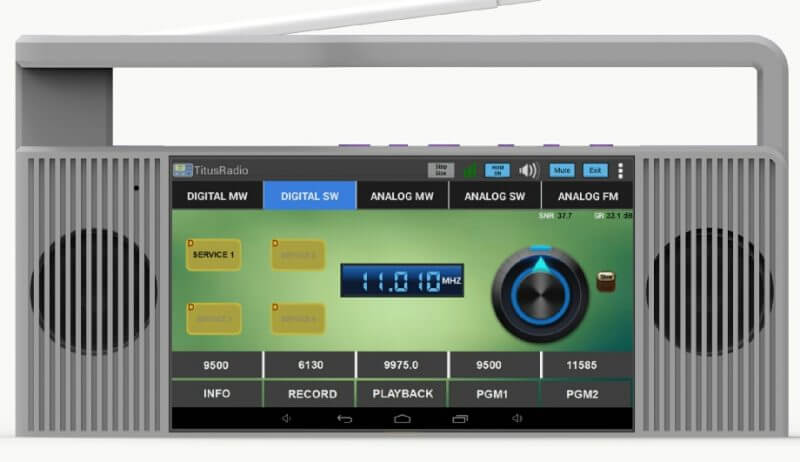
Earlier in the month we posted about the Titus II SDR. The Titus II is an upcoming full SDR solution, including a wideband 100 kHz to 2 GHz SDR, Android tablet with touchscreen and speakers. They write that the price will be under $100 USD.

The High Frequency Co-Ordination Conference (HFCC) is a group active in informal co-ordination of frequency channels used in short wave broadcasting. The HFCC appear to be helping with the release of the Titus II, and they now have an online expression of interest form available on their Titus II page. The form is labelled “Pre-order”, but there is no payment or contract present, so it is more like an expression of interest. They write:

The Titus II – an Android tablet computer with wideband SDR receiver – was unveiled for the first time at the B16 HFCC/ASBU conference in Miami, Florida, 22-26 August 2016.

The receiver has been the result of cooperation between Trans World Radio (TWR) and PantronX.

The HFCC is assisting in collecting the demand/pre-orders.

Availability: Pre-production batch – 4Q/2016, regular production – 1Q/2017

Price: Under 100USD plus shipping and local duty/taxes not included

Payment methods: Wire transfer for larger quantities, PayPal works too, but the buyers would need to add PayPal bank fees

An initial order sufficient to start the production has already been placed and production will start irrespective of the amount pre-ordered via this page. Pre-order is not binding and you are NOT asked to send any advanced payment or credit card number to secure the pre-order.

titus-2-big

[First seen on swling.com]

The Titus II Complete SDR Solution

Recently we’ve heard news of a new portable SDR called the PantronX Titus II which is currently in development. The receiver is a full SDR solution, including the computer, speakers, antenna and SDR all in a single boombox styled enclosure. The computer appears to be based on an Android tablet, and comes with a Quad-core ARM A53 @ 1.2 GHz CPU, 1 GB RAM, 8 GB Flash memory, 7″ TFT screen, touch screen, 5 watt stereo audio, li-poly battery. HDMI output, microUSB OTG connector, WiFI/Bluetooth connectivitiy as well as having an optional camera. 

The frequency range extends from 100 kHz to 2 GHz, and the built in software is capable of decoding AM/FM/SSB and DRM. Since it is essentially an SDR with an Android tablet, it should also be capable of decoding any other signal, as long as software decoders are written for it. We are unsure what SDR is used on the inside, but judging by its frequency range we speculate that it may be the same Mirics chips that are used inside the SDRplay RSP.

Rumour currently has it from word of mouth of the developers that this unit will priced “well below $100 USD”.

The promotional PDF can be found here.

titus-2-big

Introduction to Signal Analysis Class in Baltimore-DC

A four week free class on signal analysis using SDR’s like the RTL-SDR will be taking place in the “Unallocated Space” technology community center in Baltimore-DC area. It starts on Tuesday September 20, 2016 at 7pm to 10pm. The class will help participants set up their systems, and cover locating, identifying, demodulating, and decoding common RF signal types. On the final week they will host a wireless capture the flag competition, where students will use their skills to solve problems and earn points.

You will need to bring your own SDR hardware such as an RTL-SDR, as well as an omnidirectional antenna and a PC/laptop capable of running your SDR.

Creating a Long Term Averaged Waterfall on HDSDR with Chronolapse

While tools like rtl_power and rx_power now exist for creating long term averaged waterfalls for many SDR’s, another option is to use a screenshot grabber to grab screenshots of the waterfall every few seconds on an SDR program like HDSDR.

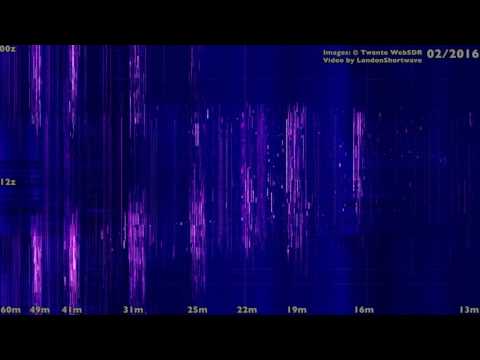
This is what the admin of the coolsdrstuff.blogspot.com blog has done. The author used the program Chronolapse which was set to take a screenshot every 60 seconds. The waterfall in HDSDR was then set to a speed so that the waterfall would complete one cycle every 60 seconds. Then after collecting images all night he used Irfanview to bulk resize all the images to be 1 pixel high. Finally he then combined all the 1 pixel high images into a nice waterfall image.

The waterfall speed in HDSDR can also be set to a very slow update speed, but the problem with this as noted by the author is that this does not average the data, meaning that data in between waterfall updates is lost. 

An overnight averaged waterfall from HDSDR.

Las Vegas CyberSpectrum: Streaming Live August 4

Every month SDR evangelist Balint Seeber hosts the Cyberspectrum Meetup in San Francisco, where many SDR fans come together to listen to various presentations. This months meetup is a special event that will be held in Las Vegas during the week of the big DEFCON and Black Hat conferences which are also being held in Las Vegas.

The talks will be presented at the SYN Shop Hackerspace in Las Vegas, and will also be live streamed via YouTube as usual (probably on balints YouTube Channel). The meetup begins on Thursday, August 4, 2016 at 6:30 PM Las Vegas time.

This month the talks include:

• “SlackRadio: Turning your Slack channel into a radio station” with Nate Temple

Slack is a popular real-time messaging system designed for team use. I will demo a small application built with GNU Radio and the Slack API that turns your Slack channel into a real radio station for your office.

slack_radio

• “Pothosware” with Josh Blum

Pothosware: An open-source software stack for the SDR community including the Pothos framework for creating interconnected topologies of processing blocks, Pothos GUI for graphical designing, controlling, and visualizing topologies, and SoapySDR – a SDR abstraction layer. The talk will present and overview of the software, cover the inner workings of the framework, and demonstrations with the GUI.

pothosware

• FPGA-based ADS-B SDR Receiver with Brian Padalino

Brian will discuss the design and implementation of an ADS-B receiver in the FPGA over the BladeRF.

bladerf_adsp_fpga

BIOS

Nate Temple:

I am software engineer, SDR Enthusiast, Maker and Amateur Radio operator. I previous presented the “Etch-a-SDR” at Cybserspectrum #11.

Josh Blum:

Josh has been crafting open source tools for the SDR community for over 10 years, starting with the GNU Radio companion back in 2006. He has been heavily involved in USRP FPGA and driver development, and now operates as an independent contractor.

Brian Padalino:

Brian has 11 years of experience working on signal processing in FPGA’s and has implemented multiple modems for real time performance. He is also the co-founder of Nuand and helped create the bladeRF.