Category: Radio Astronomy

Radio Astronomy Tool rtl_power_fftw Updated

The rtl_power program allows you to use the RTL-SDR to perform a power scan over an arbitrarily large portion of the frequency spectrum (within the RTL-SDR’s supported frequency range) by hopping over ~2 MHz swaths of bandwidth. The updated rtl_power_fftw software was originally written by Klemen Blokar and Andrej Lajovic and is an update over the regular rtl_power program. It uses a faster FFT processing algorithm and has several other enhancements that make it more useful for radio astronomy purposes.

Recently Mario Cannistrà has released a new version of rtl_power_fftw which has several additional improvements applied. He intends to use it in his RTL-SDR based radio astronomy IoT project which is presented on his Hackster.io blog. He writes:

I added the following command line parameters:

  • -e param for session duration
    this allows to specify the recording duration in sec, mins… etc just like it was possible with rtl-power
  • -q flag to limit verbosity
    this will allow the various printouts to happen only the first time and not on every scan
  • -m param to produce binary matrix output and separate metadata file
    this will get a file name (no extension) and use it to store the power values in binary format within a .bin file + a metadata text file with .met extension

Summary of my requirements:

  • I wanted to leverage the ability of rtl-power-fftw to specify N average values to integrate for less than 1 second when needed. Plus running multi-MHz scans and storing for several minutes.
  • I wanted to use a binary format instead of the .csv one in order to obtain the smallest possible size since I’m logging all the night long (CSV’s blank delimiters and decimal dots were wasting my precious microSD space)
  • keep high the precision on decimal digits saving float values (could be important for other usages)
  • obtain a complete stream of binary values representing all the bins for each scan, one scan after the other, in a matrix like organization
  • …that would allow me to plot the waterfall extremely fast with gnuplot
  • …and then add specific annotations and file properties/metadata in a more convenient way using python
Example rtl_power_fftw output: A scan of Jupiter's radio emissions.
Example rtl_power_fftw output: A scan of Jupiter’s radio emissions.

Radio Astronomy with an RTL-SDR, Raspberry PI and Amazon AWS IoT

Recently amateur radio astronomer Mario Cannistrà wrote in and showed us a link to his project. Mario has been doing some interesting experiments with an RTL-SDR that involve receiving emissions originating from the Sun, the planet Jupiter, and one of its moons Io.

Jupiter and its satellites like Io sometimes interact to create “radio storms” which can be heard from earth at frequencies between 3 to 30 MHz. The radio storms can be predicted and Mario uses the Windows software Radio Jupiter Pro to do this. This helps to predict when are the best times to listen for emissions. On his Raspberry Pi Mario has also written a python script that can do the predictions too. 

To make the radio emissions measurements, Mario uses an RTL-SDR dongle and upconverter together with rtl_power to gather FFT frequency power results and waterfall plots. To measure the emissions Mario writes that he keeps the frequency scan running for at least several hours a night with a Raspberry Pi as the receiving computer. For his antenna the low Jupiter frequencies necessitate a large 7 meter dipole tuned for receiving at 20.1 MHz.

For the Internet of Things side of the project, Mario envisions that several amateur radio astronomers around the world could run a similar setup, with all sharing the data to an Amazon AWS data storage server. Mario has already written software that will do the scan and automatically upload the results to the server. To participate you just need to write to him to receive the AWS IoT authentication certificate files.

Some example Jupiter spectographs stored on the AWS server can be found at http://jupiter-spectrograms.s3-website.eu-central-1.amazonaws.com/?prefix=Jupiter/20160130/.

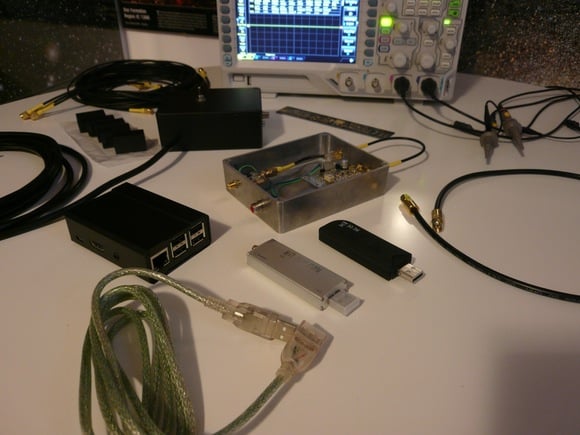
Mario's setup including RTL-SDR dongle, upconverter and Raspberry Pi.
Mario’s setup including RTL-SDR dongle, upconverter and Raspberry Pi.
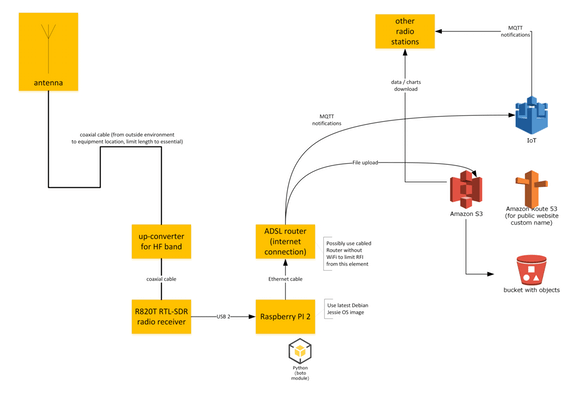
Overall design of the receiver and IoT side.

Detecting Pulsars (Rotating Neutron Stars) with an RTL-SDR

The RTL-SDR has been used for some time now as an amateur radio astronomy tool. Radio astronomers Peter W East and GM Gancio have recently uploaded a paper that details their experiments with detecting Pulsars with an RTL-SDR (doc file).

A pulsar is a rotating neutron star that emits a beam of electromagnetic radiation. If this beam points towards the earth, it can then be observed with a large dish antenna and a radio, like the RTL-SDR. The abstract of the paper reads: 

This project sought to determine the minimum useful antenna aperture for amateur radio astronomers to successfully detect pulsars around the Hydrogen line frequency of 1420MHz. The technique relied on the collaboration with GM Gancio, who provided RTL SDR data of the Vela pulsar (B0833-45, J0835-4510) and others, collected with a 30m radio telescope. This data was processed to determine the achievable signal-to-noise ratio from which, the minimum useful dish size necessary for some effective amateur work, could be calculated. Two software packages were developed to do synchronous integration, a third to provide a power detection function and a fourth for spectrum analysis to recover pulsar rotation rate.

With their system the authors were able to detect and measure the rotation period of the Vela pulsar. Also, from their data they were able to estimate that the minimum dish aperture required to observe the Vela pulsar would be 6m, noting that the Vela pulsar is probably the strongest pulsar ever detected. They also write that by utilizing 5 RTL-SDRs to gather 10 MHz of bandwidth together with some processing that the minimum required dish aperture could be reduced to 3.5m.

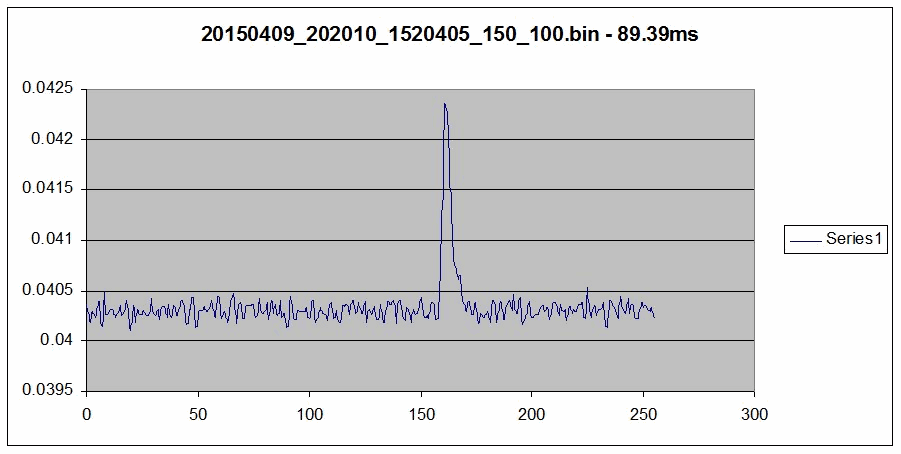
The Vela pulsar pulse power integrated over a 50 second 100MB file, combining some 560 pulsar pulses
The Vela pulsar pulse power integrated over a 50 second 100MB file, combining some 560 pulsar pulses.

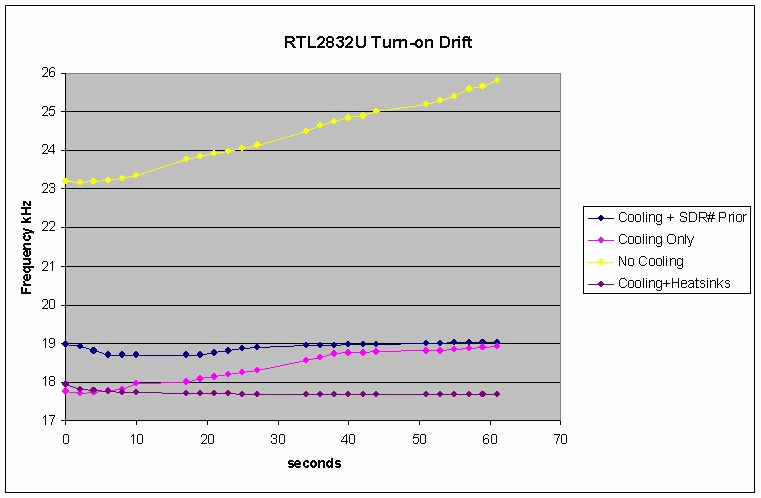
In addition to these Pulsar experiments, Peter has also uploaded new papers about improving his Hydrogen Line RTL-SDR Telescope (pdf), and has updated his paper on improving the frequency stability of RTL-SDR’s with air cooling (doc file). Peter found that the frequency stability of the RTL-SDR (with standard oscillator) could be significantly improved by adding heat sinks and aircooling them. The graph from his paper below summarizes his results.

Results from air cooling the RTL-SDR.
The air cooled and heatsinked RTL-SDRs
The air cooled and heat sinked RTL-SDRs

All of Peters papers can be found on his website at y1pwe.co.uk/RAProgs/index.html. He has many RTL-SDR radio astronomy related resources there, so check it out if you are interested.
Creating a low cost Ozone Spectrometer out of RTL-SDR’s to measure mesospheric winds and tides

Over at the MIT Haystack Observatory in Westford Massachusetts, researchers O.B Alam and A.E.E Rogers have been working on creating a low cost ground based Ozone spectrometer out of RTL-SDR dongles (pdf warning). An Ozone spectrometer is used by scientists to measure the concentration, velocity and temperature of the ozone gasses in the mesosphere (50 – 85 km above the ground) and lower thermosphere (85 km+) at the Ozone line frequency of 11072.4545 MHz.

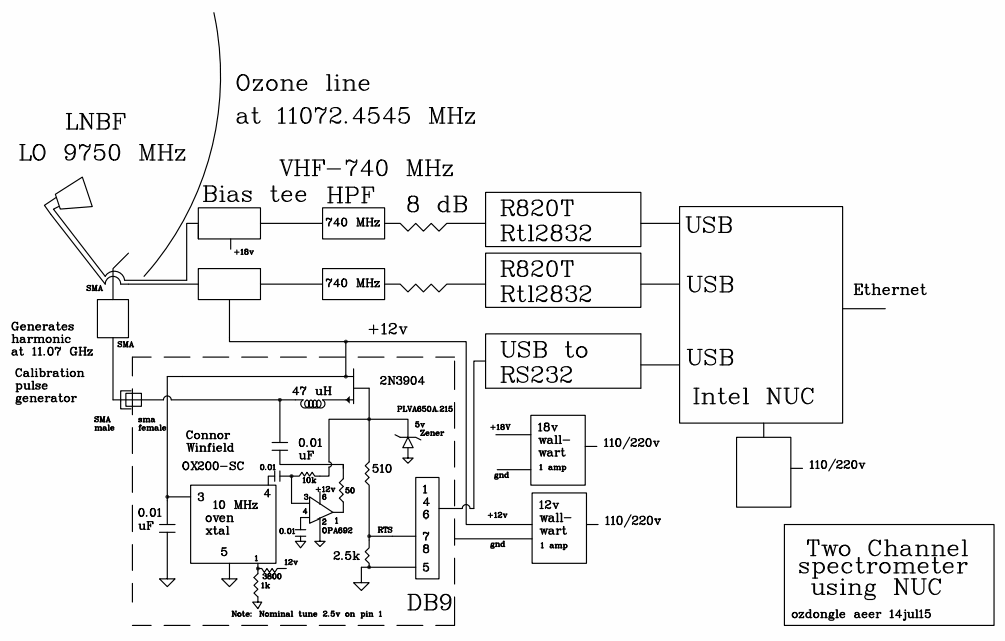
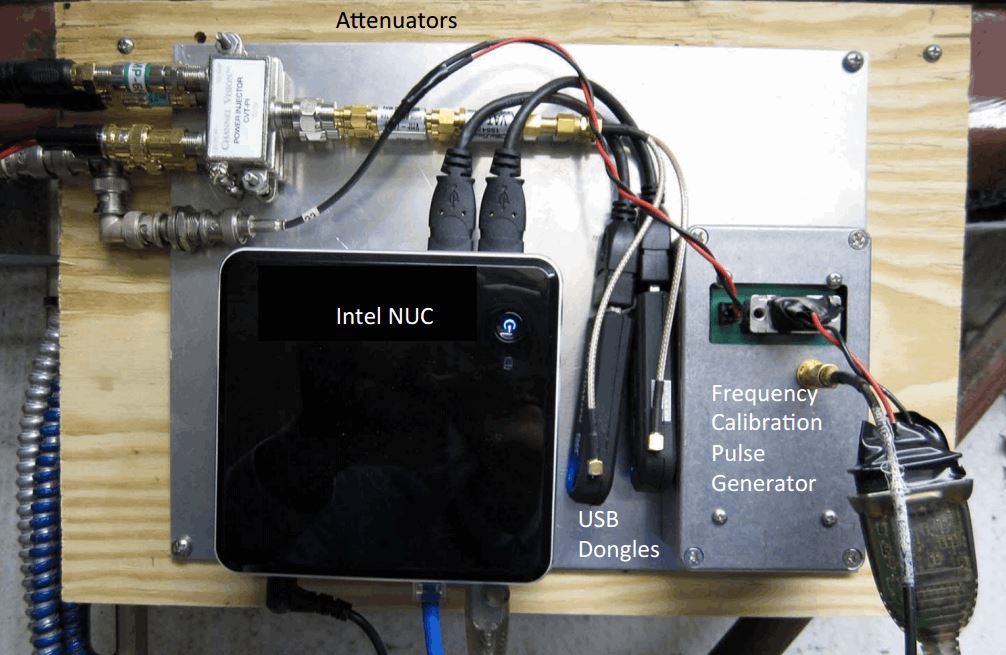
The spectrometer the researchers built consists of a satellite TV parabolic reflector dish with 46.72cm diameter, 9750 MHz LNBF, two Bias Tees, two 740 MHz high pass filters, two 8dB attenuators, a calibration pulse generator, an Intel NUC mini PC and three R820T RTL-SDR dongles.

RTL-SDR based Ozone Spectrometer block diagram from the MIT Haystack Observatory.
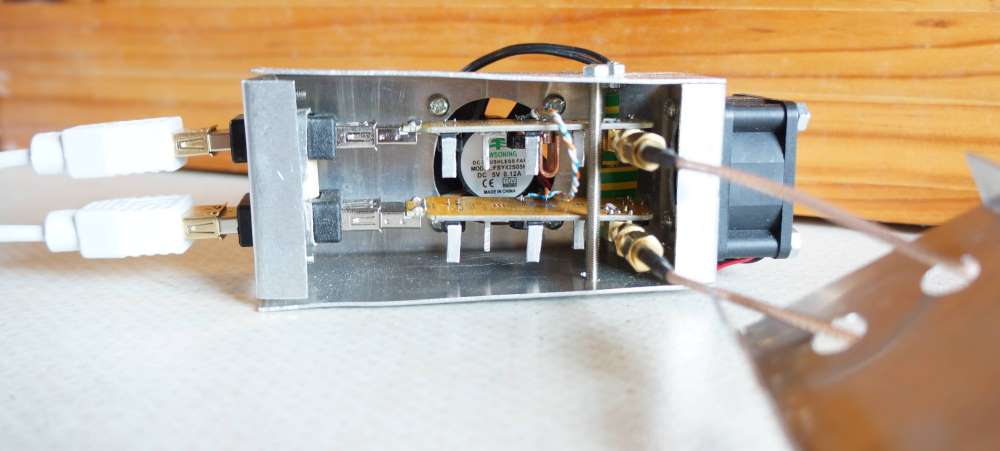
Photo of some of the components of the ozone spectrometer.

Live: Perseids Meteor Shower with RTL-SDR

The annual Perseids meteor shower is peaking right now (this Wednesday and Thursday), and with the right equipment (and location) you can detect these meteors with an RTL-SDR dongle and appropriate antenna. When a meteor enters the atmosphere it leaves behind a brief trail of ionized air which is highly reflective to RF signals. These trails can reflect carrier waves from distant transmitters towards your antenna, allowing you to detect a meteor entering the atmosphere. This is called meteor scatter.

If you live in Europe, you can use the powerful Graves radar at 143.050 MHz as the transmitter. In other locations and the USA you can also use analogue TV broadcasts like in this post where the observer uses a TV tower in Canada. For Graves all you’ll need is a dipole antenna and perhaps LNA, but for TV transmissions you may need a directional Yagi antenna. More information can be found in our previous posts about meteor scatter and is this document.

But for now if you just want to observe others then currently there is this temporary live stream (now offline) shown below from Poland on YouTube and this always running live stream from the USA.

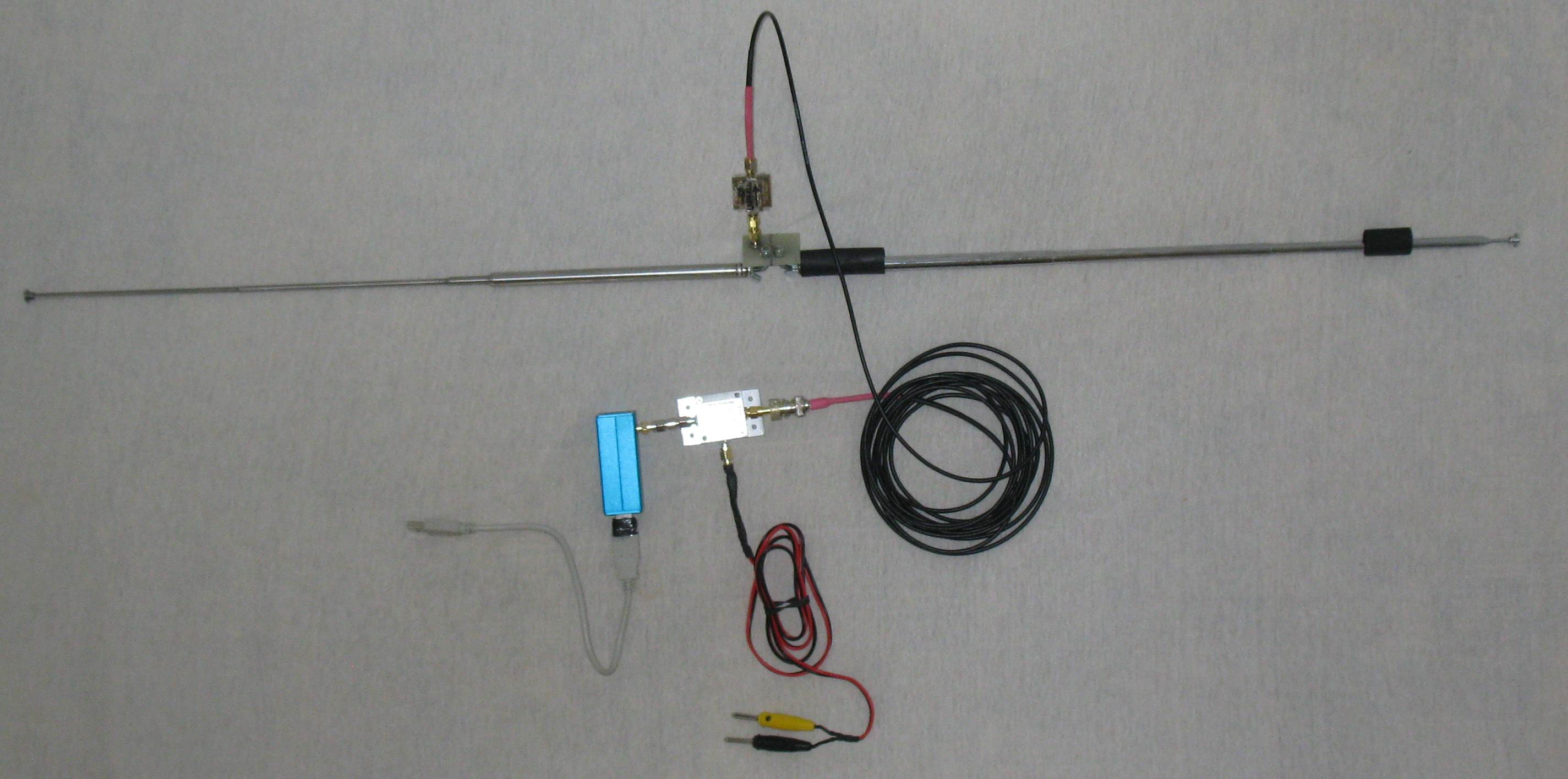
Equpment used by Reddit user Maxworm to detect Perseids meteors using the Graves radar: Dipole, LNA, Bias-Tee RTL-SDR.
Equipment used by Reddit user Maxworm to detect Perseids meteors using the Graves radar: Dipole, LNA, Bias-Tee and RTL-SDR.
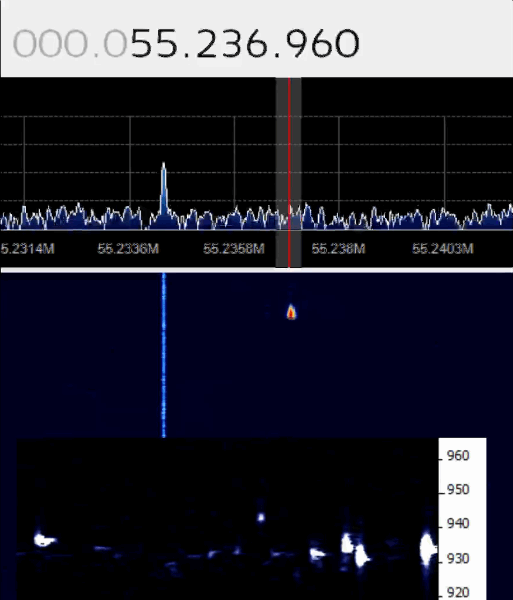
Meteor detected by MaxWorm.
Meteor detected by MaxWorm

Detecting meteor radio echoes using the RTL-SDR USB dongle

At the recent 2015 Society of Amateur Radio Astronomers (SARA) Conference Ciprian Sufitchi (N2YO) presented a paper titled “Detecting meteor radio echoes using the RTL/SDR USB dongle” (pdf). His paper introduces the RTL-SDR, the theory behind forward scatter meteor detection as well as the practical application of the RTL-SDR to meteor detection. Ciprian summarizes meteor scatter as the following:

When a meteor enters the Earth’s upper atmosphere it excites the air molecules, producing a streak of light and leaving a trail of ionization (an elongated paraboloid) behind it tens of kilometers long. This ionized trail may persist for less than 1 second up to several minutes, occasionally. Occurring at heights of about 85 to 105 km (50-65 miles), this trail is capable of reflecting radio waves from transmitters located on the ground, similar to light reflecting from a mirrored surface. Meteor radio wave reflections are also called meteor echoes, or pings.

In the paper he explains how analog TV transmissions are the best for meteor scatter, but unfortunately these been discontinued within the USA. Instead he has been able to use analog TV transmitters from Canada, who still transmit this type of signal. He shows that about half of the USA could use the transmitter he is using for meteor scatter, which is based in Ontario, Canada.

Ciprian is also running a very cool live meteor detection stream on his website at livemeteors.com. His setup is located in the DC Metropolitan area and uses a directional Yagi antenna pointed at the Canadian analog TV tower which is broadcasting at 55.237 MHz. The receiver is an RTL-SDR dongle coupled with SDR# and the ARGO software.

Live meteor detection stream from livemeteors.com

Two New SDR# Plugins for Passive Radar and IF Signal Averaging

March 2019 Update: Website appears to be down now. But the DropBox download links are still active.

Passive Radar Plugin: https://www.dropbox.com/sh/tqjycu9nxdfhk0u/AAA9KSE6-mRUwV10s0F9v7Jpa?dl=0

IF Average Plugin: https://www.dropbox.com/sh/tqjycu9nxdfhk0u/AAA9KSE6-mRUwV10s0F9v7Jpa?dl=0

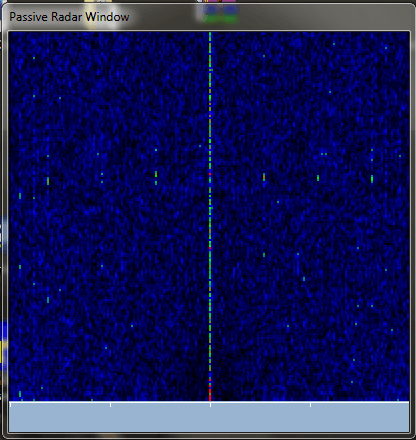
Recently Dr. Daniel Kaminski wrote into RTL-SDR.com to let us know about two very interesting new SDR# plugins that he has developed to use with the RTL-SDR dongle. The first plugin is called "Passive Radar". Passive Radar allows you to use an existing strong transmitter such as an FM station to detect reflections from things like aircraft and meteors. Dr. Kaminski writes about his plugin:

The first one is Passive Radar which bases on the signal from only one dongle. The ambiguity function is the same as in advanced projects with the difference that  I implemented self-correlate function instead of cross-correlate one which is used in 2 dongles projects. Such solution theoretically should works as can be found in internet. It should be noticed that for proper work of such passive radar the direct signal should be comparable in strength to the reflected  one. This plugin is still under development.

In the future he hopes to be able to support two dongle passive radar as well.

The Passive Radar plugin by Dr. Kaminski in SDR#.
The Passive Radar window.

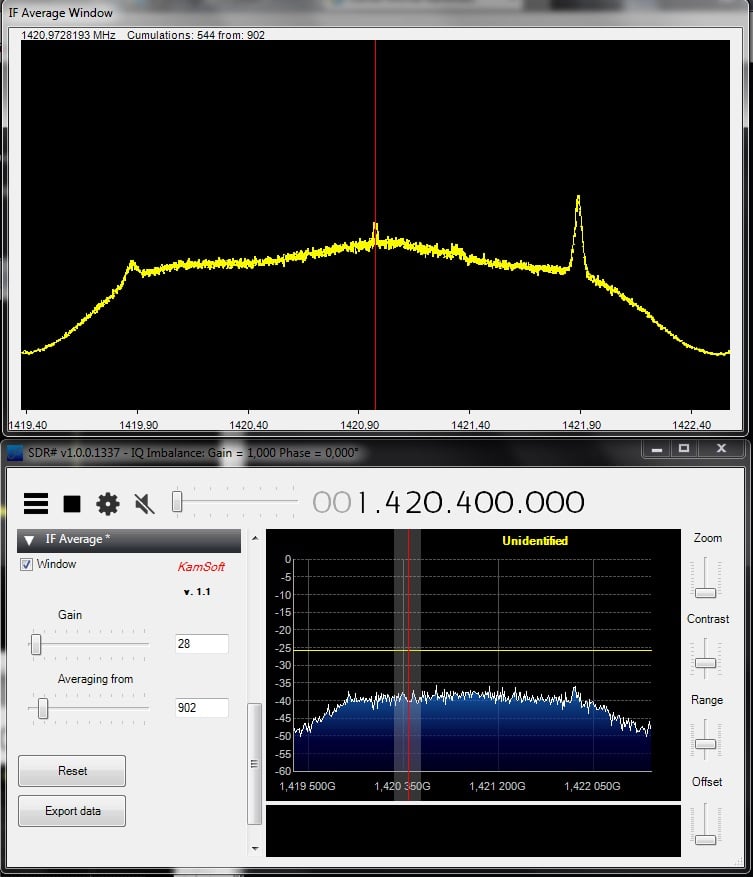
The second plugin is called "IF Average". This plugin allows the IF signal (the entire active bandwidth is what he seems to be referring to) to be averaged which is useful for many applications including radio astronomy projects such as detecting the Hydrogen line. He writes:

The second plugin which is finished is for IF signal averaging. It is important in case of radio-astronomical observations. It allows to cumulate signals (up to 10000 samples in real time), present them in friendly way and save for further work.

The IF Average plugin by Dr. Kaminski.

The plugins require the installation the XNA Framework Redistributable 3.1.

Some new RF filters from Adam 9A4QV

Adam 9A4QAV is mostly known as the manufacturer of the popular LNA4ALL, a low cost low noise amplifier which is often used together with the RTL-SDR to improve reception of weak signals. He also sells an ADS-B bandpass filter and an ADS-B antenna, the latter of which we reviewed in a previous post.

Now Adam has come out with two new RF bandpass filters which are for sale. RF filters are used to block unwanted interference from other strong signals which can cause trouble, especially with low cost receivers such as the RTL-SDR. 

The first new filter that he has developed is for FLARM (FLight Alarm System). FLARM broadcasts at 868 MHz and is a protocol similar to ADS-B. It is used by Gliders and some Helicopters for collision avoidance. It is possible to decode FLARM with an RTL-SDR which allows you to track gliders on a map, as discussed in one of our previous posts.

Characteristics of Adam's FLARM Filter.
Characteristics of Adam’s FLARM Filter.

The second filter is for amateur radio astronomers who wish to detect the Hydrogen Line at 1420 MHz. Hydrogen molecules in space occasionally emit a photon at 1420 MHz. A single emission can’t be easily detected, but space and the galaxy is full of Hydrogen and the net result is an observable RF power spike at 1420 MHz. This can be detected with a high gain antenna, LNA, RF filter and radio like the RTL-SDR. The Hydrogen line can be used to measure things like the rotation and number of arms in our galaxy. Filters are very important for radio astronomy work as man made interference can easily drown out the relatively weak cosmic signals.

Characteristics of Adam's Hydrogen Line Filter.
Characteristics of Adam’s Hydrogen Line Filter.

Adam sells all his fully assembled filters for 20 euros, plus 5 euros worldwide shipping.

One of the ADS-B/FLARM/HLine Filters by Adam 9A4QAV.