Category: Radio Astronomy

Building a Passive Radar System with RTL-SDR Dongles

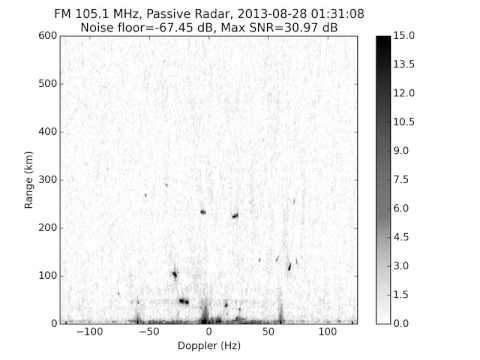
Back in 2013 we posted about Juha Vierinen’s project in which he created a passive radar system from two RTL-SDR dongles, two Yagi antennas, and some custom processing code. Passive radar can be used to detect flying aircraft by listening for signals bouncing off their fuselage and can also be used to detect meteors entering the atmosphere. The radar is passive because it does not use a transmitter, but instead relies on other already strong transmitters such as FM broadcast radio stations. Juha writes:

A passive radar is a special type of radar [that] doesn’t require you to have a transmitter. You rely on a radio transmitter of opportunity provided by somebody else to illuminate radar targets. This can be your local radio or television station broadcasting with up to several megawatts of power. 

How passive radar works

His previous write up was brief, but now over on Hackaday Juha has made a detailed post about his RTL-SDR passive radar project. In the post he explains what passive radar is, shows some examples of his and others results, shows how it can be done with an RTL-SDR dongle, and finally briefly explains the signal processing required. In his next post Juha aims to go into further detail on how passive radar works in practice.

Below we show a video that shows an example of one of his passive radar tests that was performed with a USRP software defined radio and two Yagi antennas. 

This video shows a lot of airplanes around the New England area detected using a simple passive radar setup, consisting of: one USRP and two yagi antennas, a quad core linux PC. Every now and then an occasional specular meteor echo is observed too.

In his other tests shown on YouTube Juha also used two RTL-SDR dongle’s with a shared clock and was able to get similar results.

FM Radio Passive Radar, WWLI 105.1 MHz

New method for generating wideband spectograph’s with Radio-Sky and an RTL-SDR

Radio-Sky Spectrograph is a software application that is designed to produce waterfall displays similar to other software, but with a focus on observing radio astronomy phenomena. 

Radio-Sky Spectrograph displays a waterfall spectrum. It is not so different from other programs that produce these displays except that it saves the spectra at a manageable data rate and provides channel widths that are consistent with many natural radio signal bandwidths. For terrestrial, solar flare, Jupiter decametric, or emission/absorption observations you might want to use RSS [Radio-Sky Spectrograph].

Last year, we posted about the release of RTL_Bridge, which is a program designed to interface an RTL-SDR dongle with Radio-Sky Spectrograph. One limitation with RTL_Bridge was that it was limited to the dongles maximum bandwidth of about 2.4 MHz. Now Raydel Abreu Espinet (CM2ESP) has written a new application called RTL-WideSpectrum which allows for wideband spectral sweeps in Radio-Sky Spectrograph by using the RTL-SDR to quickly switch between frequencies and combine the outputs. It is similar to how rtl_power works.

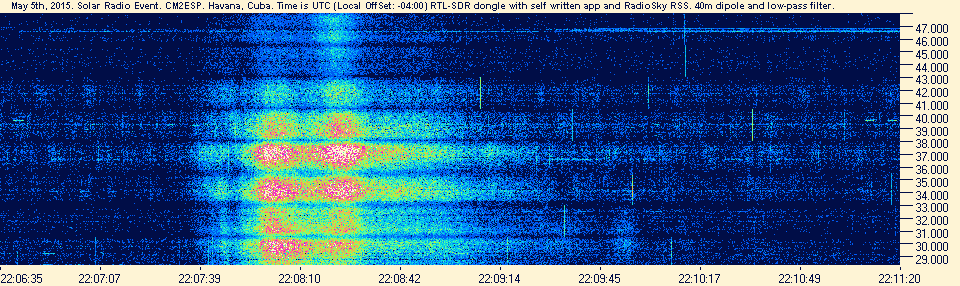
With RTL-WideSpectrum and Radio-Sky Spectrograph, Raydel was able to capture this solar burst shown below which occurred between 28-48 MHz.

A solar burst between 28 - 48 MHz captured with an RTL-SDR dongle, RTL-WideSpectrum and Radio-Sky Spectrograph.
A solar burst between 28 – 48 MHz captured with an RTL-SDR dongle, RTL-WideSpectrum and Radio-Sky Spectrograph.

Determining the Radiant of Meteors using the Graves Radar

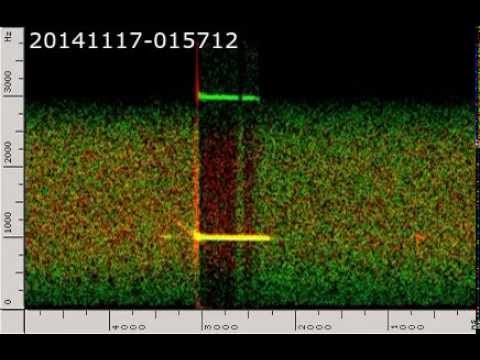
With an RTL-SDR or other radio it is possible to record the echoes of the 143.050 MHz Graves radar bouncing off the ionized trails of meteors. This is called meteor scatter and it is usually used to count the number of meteors entering the atmosphere. Amateur radio astronomers EA4EOZ and EB3FRN decided to take this idea further and synchronised their separate receivers and recordings with a PPS GPS signal in order to determine the radiant of the meteors they detected. They write:

The idea was to analyze the Doppler from the head echoes and and see if something useful can be extracted from them.

We detected a meteor from two distant locations and measured Doppler and Doppler slope at those locations. The we tried to find solutions to the meteor equation by brute force until we obtain a big number of them. Then we plotted those solutions in the sky and we see some of them pass near a known active radiant at the time of observation. Then, we checked the velocity of those solutions near the known radiant and found they are quite similar to the velocity of the known radiant, so we concluded probably they come from that radiant.

But they can come from everywhere else in the sky along the solution lines! There is not guarantee these meteors to be Geminids, although probabilities are high. Once all the possible radiants of a meteor are plotted into the sky, there is no way to know who of all them was the real one. Doppler only measurement from two different places is not enough to determine a meteor radiant. But don’t forget with some meteors, suspect to come from a known shower, the possible results includes the right radiant at the known meteor velocity for that radiant, so there seems to be some solid base fundamentals in this experiment.

Initially they ran into a little trouble with their sound cards, as it turns out that sound cards don’t exactly sample at their exact specified sample rate. After properly resampling their sound files they were able to create a stereo wav file (one receiver on the left channel, one receiver on the right channel) which showed that the doppler signature was different in each location. The video below shows this wav file.

Double station meteor head echoes

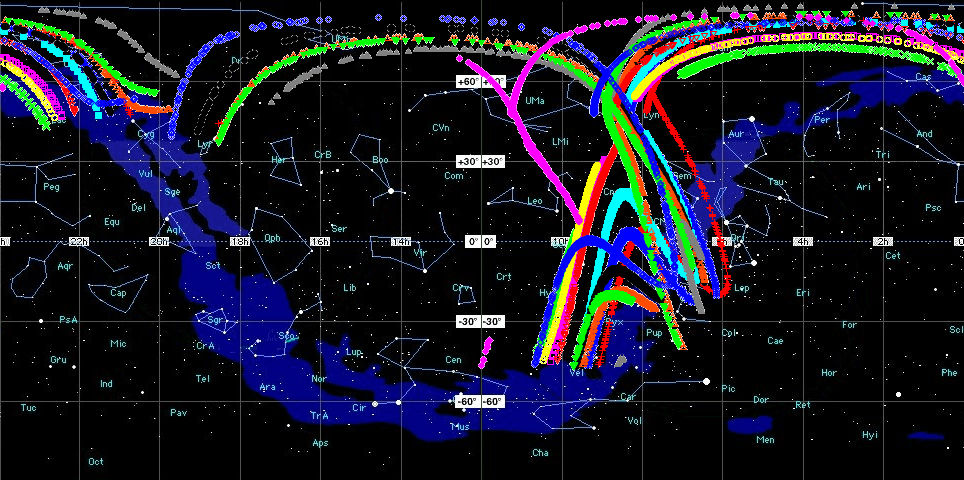
Using the information from their two separate recordings, they were able to do some doppler math, and determine a set of possible locations for the radiant of the meteors (it was not possible to pinpoint the exact location due to there being no inverse to the doppler equation). The radiant of a meteor shower is the point in the sky at which the meteors appear to be originating from. Although their solution couldn’t exactly pinpoint the location, some of the possible solutions from most meteors passed through the known radiant of the Geminids meteor shower. With more measurement locations the exact location could be pinpointed more accurately.

Possible solutions for the radiant of the Geminids meteor shower.
Possible solutions for the radiant of several meteors detected during the Geminids meteor shower.

RTL-SDR Tests: R820T vs R820T2 Stability Tests for Radio Astronomy

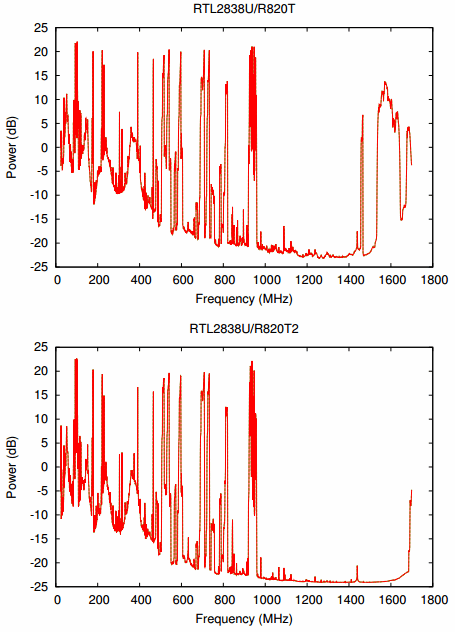
Amateur Radio astronomer Peter Kalberla recently wrote in to let us know about a paper he has written exploring stability issues and comparing the R820T and R820T2 RTL-SDR tuner chips (pdf warning). The R820T2 tuner is an upgrade to the R820T tuner which is used in the most commonly found RTL-SDR dongles.

Peters first results show that the R820T2 has better reception and less spurious features at frequencies above about 1.45 GHz and improved frequency stability (with the newer R820T2 dongles that use the SMD oscillator). His second set of results explore issues that are more closely relevant to radio astronomy including observed spectra, Allan variance (frequency stability) tests and determining the shape of the R820T/2 internal bandpass filter.

In the conclusion of the paper Peter writes:

Two Newsky RTL2838U dongles were tested, the R820T2 device against the R820T. The evaluation results in a clear preference for the new RTL2838U/R820T2 dongle. In the L-band the new dongle is at least 2.7 dB more sensitive. According to the radiometer equation the effective system temperature is reduced by almost 50%. Most important for reliable radio astronomical observations are stability issues. Allan variance tests have shown that the R820T2 dongle is far better then the older version. The stability is comparable to that of professional radio astronomical devices. The tests have shown that using the full bandwidth of the RTL-SDR devices results in spurious baseline ripples. For a good performance it is recommended to use the dongles at reduced bandwidth. rtl power with the crop option -c 0.5 appears to be a good choice.

Broad band performance of the R820T dongle (top) and R820T2 (bottom)

Capturing Noise Bursts from Jupiter with an RTL-SDR

Recently amateur radio astronomer Jim Brown used an RTL-SDR dongle together with a Ham-it-up upconverter and preamp to capture noise bursts from the planet Jupiter. Not much information about his observations are available yet as he has not yet made a write up, but he has given the image of the noise burst shown below to Jim Sky, programmer of RTL Bridge and Radio-Sky Spectograph which is some of the software used to capture the noise bursts. We will make another post in the future if Jim Brown does a write up.

Jim Sky has also updated his RTL Bridge software to use Oliver Jowetts patched drivers, which allow the RTL-SDR to receive below its usual 24 MHz limit.

Noise burst from Jupiter captured with an RTL-SDR

Techniques for using the RTL Dongle for Detecting Meteors

Back in 2013 we posted about a Dr. David Morgan who had written a tutorial paper discussing how he used the Funcube Dongle Pro+ for radio astronomy. Recently Dr Morgan has also written another paper showing how to use the RTL-SDR together with the Spectrum Lab software to detect meteors.

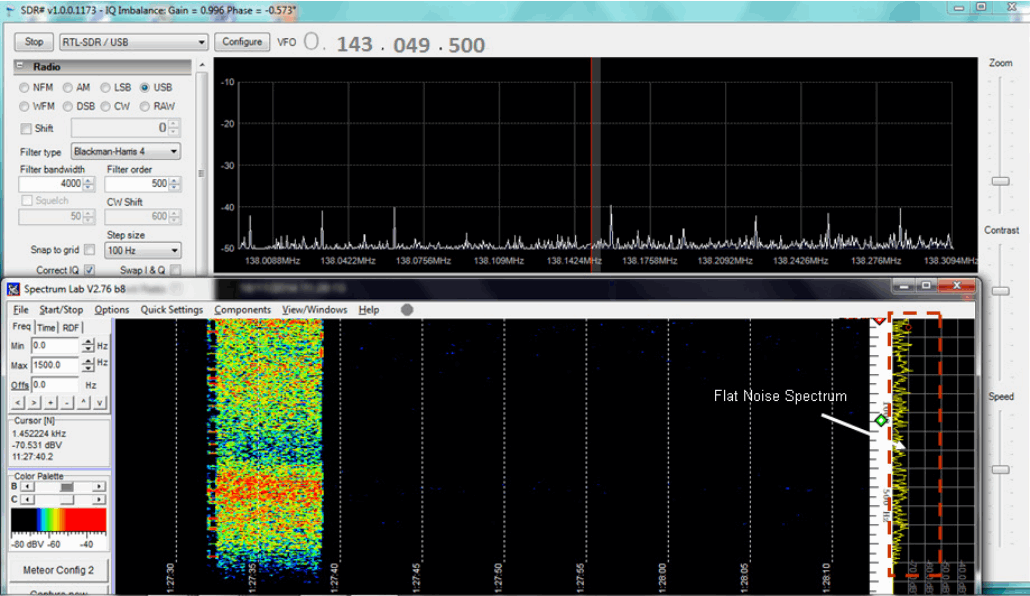
A software defined radio can be used to detect and count meteors entering the earth’s atmosphere by detecting strong radio waves reflected by ionized trails left by the meteor. If you are unfamiliar with how to detect meteors using radio waves, you should consult Dr Morgans older papers called Detection of Meteors by RADARMeteor Radar SDR Receiver (Funcube Dongle), and Antennas for Meteor Scatter. The tutorial shows how to set up SDR# and Spectrum Lab to work together to detect meteors using the Graves Radar in France at 143.050 MHz.

Meteor Scatter Detection in Spectrum Lab

Radio Astronomy using a Differential Radiometer and Interferometer with an RTL-SDR

Amateur radio astronomer Marcus Leech often makes use of RTL-SDR dongles for his amateur radio astronomy experiments. Recently Marcus wrote a technical paper discussing a modern SDR implementation of a Dicke Radiometer, which is a type of radio telescope that is designed to significantly reduce the effects of receiver noise. Marcus has also developed an RTL-SDR approach to another similar system called the Phase-Switched Interferometer.

Using his new SDR based approach together with GNU Radio, a 10ft satellite dish and two RTL-SDR dongles he was able to plot a transit of the Milky Way Galaxy as shown below.

Milky Way Galaxy Transit

Observing the 21cm Hydrogen Line with Linrad and an RTL-SDR

Over on YouTube user S53RM has uploaded a video showing his and S53MM’s observation of the 1420 MHz galactic hydrogen line with an RTL-SDR. Hydrogen atoms randomly emit photons at a wavelength of 21cm (1420.4058 MHz). Normally a single hydrogen atom will rarely emit a photon, but since space and the galaxy is filled with many hydrogen atoms the average effect is an observable RF power spike at 1420.4058 MHz. By pointing a radio telescope at the night sky, a power spike indicating the hydrogen line can be observed in a frequency spectrum plot.

In the video they rotate their 3.6m parabolic mesh antenna dish along the Milky Way. As the dish rotates doppler shifted hydrogen line peaks can be observed on Linrad, each peak representing a different arm of the galaxy. The galaxy consists of several spinning arms, some spinning faster than others which causes the hydrogen line peaks produced by the arms to be doppler shifted by different amounts.

They used Linrad to plot the RF spectrum as they were able to use it together with a pulse generator to calibrate the RTL-SDR for a flatter frequency response.

More information about their project can be found at http://lea.hamradio.si/~s53rm/Radio%20Astronomy.htm.

Linrad showing Galactic Arm Hydrogen Line Peaks
Hydrogen 21cm lines with DVB-T dongle