Category: Radio Astronomy

Funcube SDR Radio Telescope

A Radio Astronomer by the name of Dr David Morgan has released a tutorial/paper he wrote detailing how he uses the Funcube dongle Pro+ as a tool for radio astronomy. The Funcube dongle Pro+ is a software defined radio similar to the RTL-SDR, with higher cost, but better performance in some areas.

Dr Morgan uses his Funcube dongle with the SpectrumLab Windows software, which is a specialized audio analyzer. For the hardware, David uses a 3m focal plane dish antenna and a 1200 MHz high pass filter.

The paper goes into good detail about some of the technical side of radio astronomy, shows how to calibrate the telescope using the sun and also shows several measurements made. We note that the same procedures could also likely be done with the RTL-SDR.

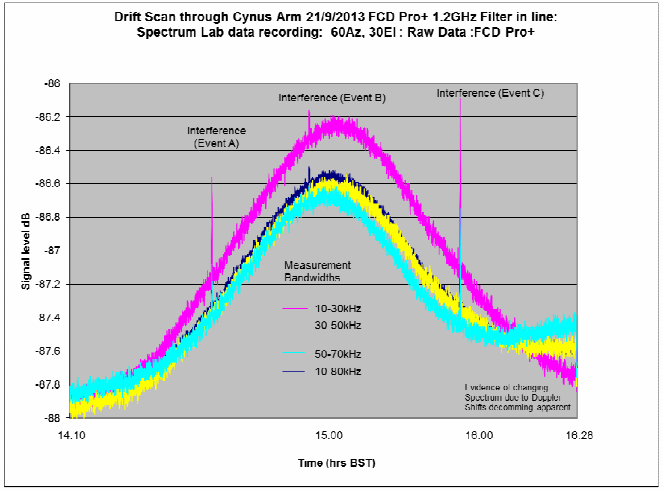
Signal Intensity during Drift Scan through Cygnus Spiral Arm

RTL-SDR Spectrometer for a Small Radio Telescope

Marc Higginson-Rollins of the University of Kentucky has published an academic styled paper in conjuction with Dr. Alan E.E. Rogers of the MIT Haystack Observatory showing how they used an RTL-SDR to implement a Small Radio Telescope (SRT).

In the paper they discuss how they dealt with the frequency drifting and offset problems common in the RTL-SDR. They also show how they dealt with the center spur by correcting the bias that it introduced and how they filtered out RFI noise from a nearby radar station and electronics.

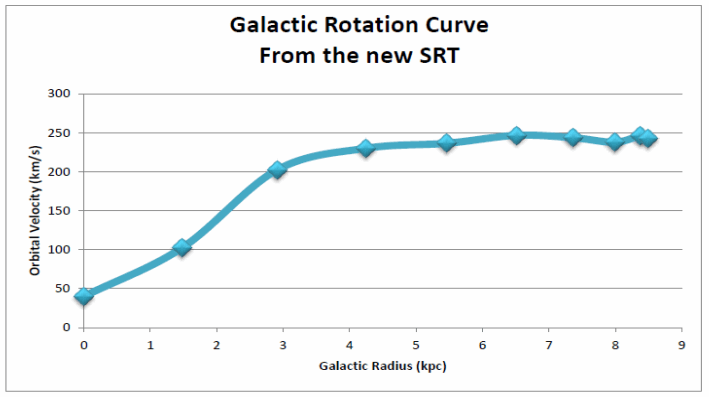
Using the RTL-SDR and SRT they were able to measure the spectra of several well known regions of neutral hydrogen emissions, and measure the galactic rotation curve shown below.

Galactic Rotation Measurements with the SRT
Galactic Rotation Measurements with the SRT and RTL-SDR

Horn Antenna for RTL-SDR Radio Astronomy

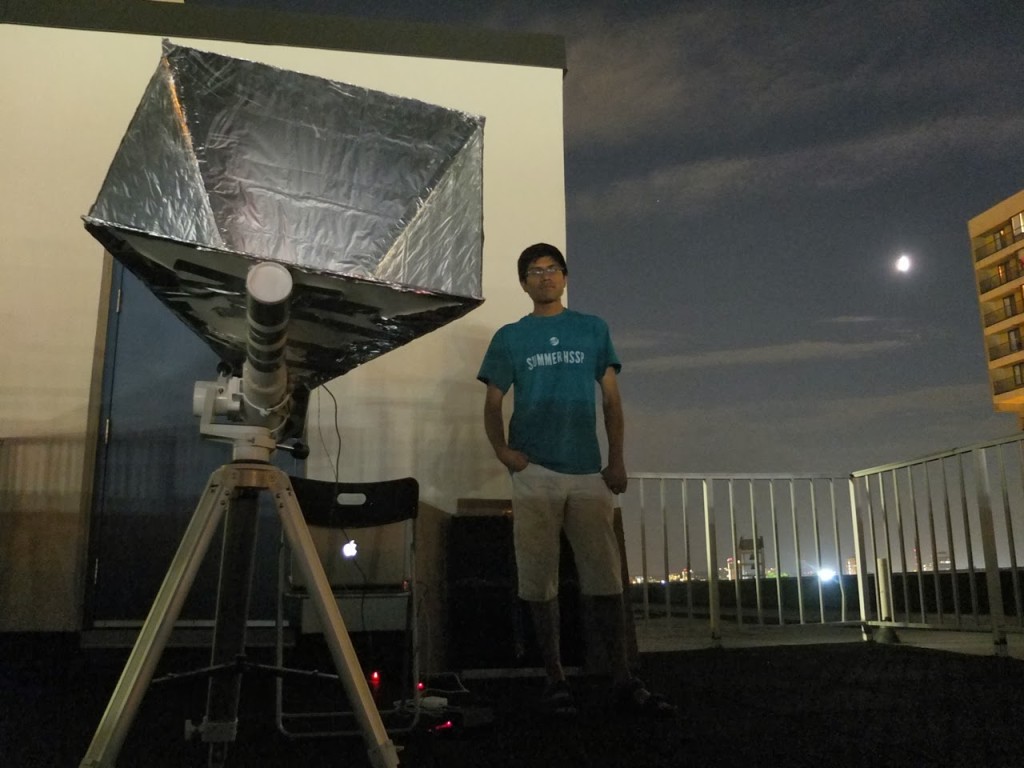
Rishi Patel has written on his blog about his radio astronomy project which involves an RTL-SDR and an impressive homemade horn antenna.

The horn antenna is constructed from cardboard foam and aluminium foil and is mounted on a telescopic mount. The horn then connects to a waveguide feed which is constructed out of a large metal can. The antennas waveguide then connects to a microstrip filter and LNA before finally connecting to an RTL-SDR. Rishi then uses a simple python program to gather the IQ samples from the RTL-SDR, and then draw the power spectral density plots.

Horn Antenna
Homemade Horn Antenna for Radio Astronomy

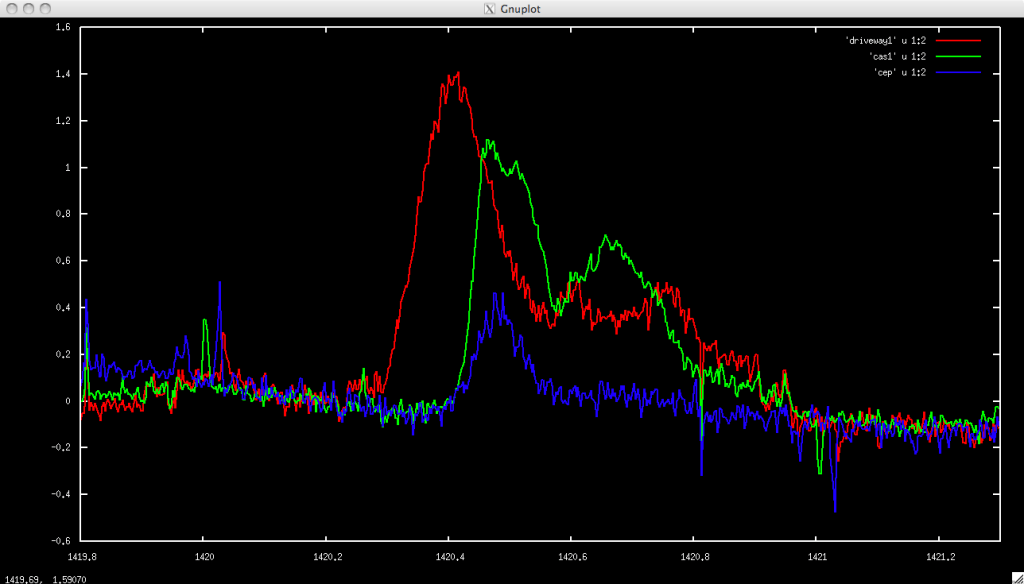
With this setup Rishi was able to detect the Hydrogen line. Rishi also used a second even larger horn with a different design to plot the spectrum shown below of the Cygnus (red), Cassiopeia (green), and Cepheus (blue) constellations.

largeHornSpectra
Spectral Plots of Cygnus (red), Cassiopeia (green), and Cepheus (blue) constellations.

Detecting the Perseids Meteor Shower with an RTL-SDR Passive Radar

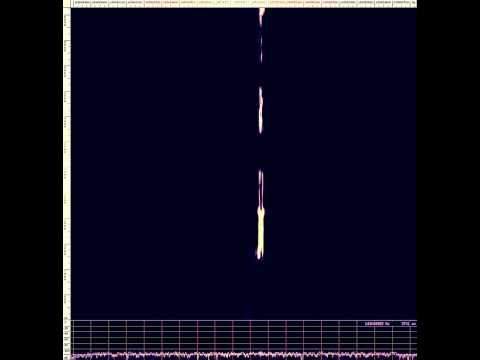
Amateur radio hobbyist EB3FRN has made a post on his blog showing how he was able to use an RTL-SDR to act as a passive radar and detect meteors from the Perseids meteor shower. To do this he tuned to 143.050 MHz which is the the frequency of the Graves radar, a French space surveillance radar used to spot satellites and detect their orbits. He then used the Baudline software to record the radar signal scatters which occur when a meteor reflects the Graves radar signal.

Graves Radar - 2013 Perseids Meteor Shower

Passive RADAR With a Dual Coherent Channel RTL-SDR

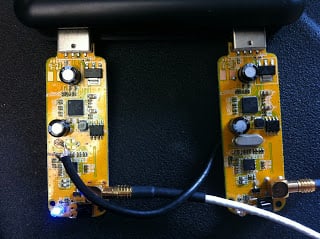
Juha Vierinen from the Kilpisjarvi Atmospheric Imaging Receiver Array has been working on a Dual Coherent Channel RTL-SDR modification. This modification essentially involves using the same clock source for two RTL-SDR dongles, which can be done by desoldering and removing the clock on one dongle, and then using a cable to connect the clock from another dongle to the clock input of the desoldered dongle.

RTL-SDR Dual Coherent
Dual Channel Coherent RTL-SDR Receiver

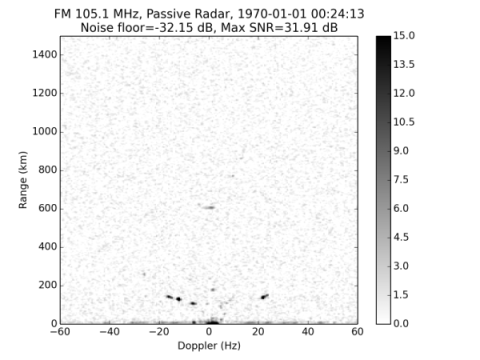
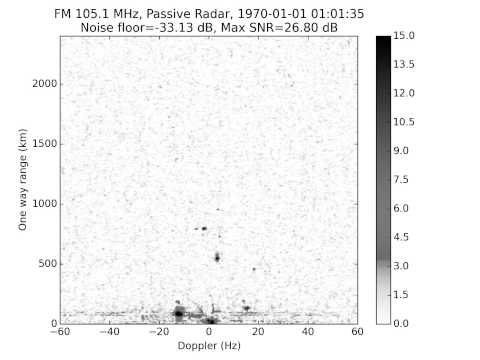
Juha then was able to use his new dual coherent channel RTL-SDR to create a passive RADAR system. To do this, he connected the two RTL-SDRs to two log periodic Yagi antennas. From this setup he was able to detect airplanes and meteor echoes. An image cap and video showing RADAR detections over time is shown below.

Passive RTL-SDR RADAR
Longer rtlsdr fm radio passive radar video

Perseids Meteor Reflection Observations with the RTL-SDR

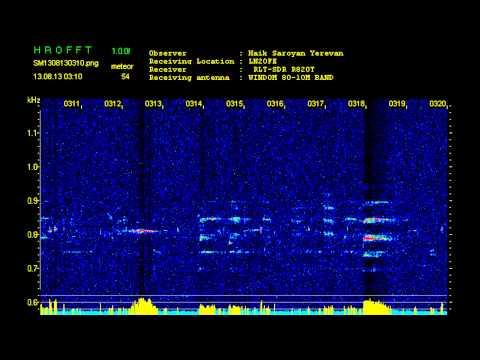
In this video YouTube user ek6rsc shows a timelapse of meteor reflection observations during the yearly Perseids meteor shower which occurred in 2013 during August 10-15. To do this he uses an R820T RTL-SDR tuned to 59.25 MHz, and the HROFFT software to do the recording.

Meteors entering the atmosphere can cause radio frequency reflections which may allow extremely distant radio signals to be received briefly. Reception of such a signal may be a good indicator that a meteor has fallen. A good informational guide on meteor scatter with the RTL-SDR can be found in this pdf file by Marcus Leech.

2013 Perseids Aug10-15 radio observations Meteor reflection 59.25Mhz

RTL-SDR for Budget Radio Astronomy

With the right additional hardware, the RTL-SDR software defined radio can be used as a super cheap radio telescope for radio astronomy experiments such as Hydrogen line detection, meteor scatter and Pulsar observing.

Hydrogen Line

Marcus Leech of Science Radio Laboratories, Inc has released a tutorial document titled “A Budget-Conscious Radio Telescope for 21cm“, (doc version) (pdf here) where he shows:

Two slightly-different designs for a simple, small, effective, radio telescope capable of observing the Sun, and the galactic plane in both continuum and spectral modes, easily able to show the hydrogen line in various parts of the galactic plane.

He uses the RTL-SDR as the receiving radio with an LNA (low noise amplifier) and a couple of line amps, a 93cm x 85cm offset satellite dish (potential dish for sale here, and here), and GNU Radio with the simple_ra application. In his results he was able to observe the spectrum of the Galactic Plane, and the Hydrogen Line. Some more information about this project can be found on this Reddit thread.

Here is a link to an interesting gif Marcus made with his RTL-SDR, showing a timelapse of recorded hydrogen emissions over 24 hours. Reddit user patchvonbraun (a.k.a Marcus Leech) writes on this thread an explanation of what is going on in the gif.

Interstellar space is “full” of neutral hydrogen, which occasionally emits at photon at a wavelength of 21cm–1420.4058Mhz.

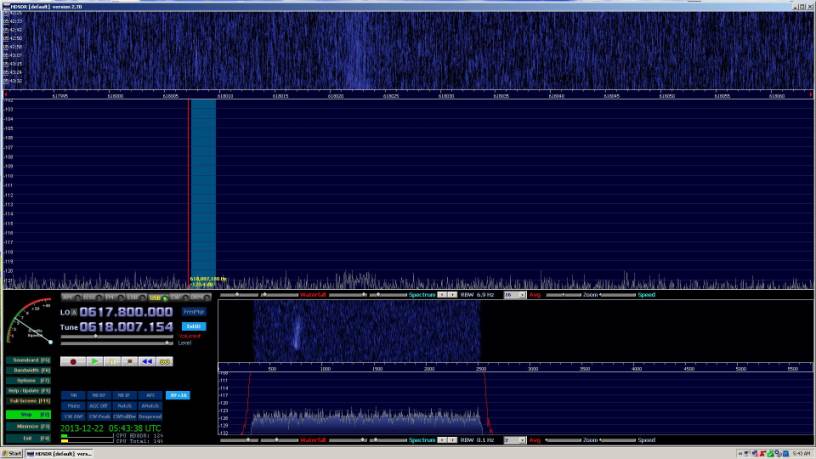
If you setup a small dish antenna, and point at a fixed declination in the sky, as that part of the sky moves through your beam, you can see the change in spectral signature as different regions, with different doppler velocities move through your beam.

This GIF animation shows 24 hours of those observations packed into a few 10s of seconds.

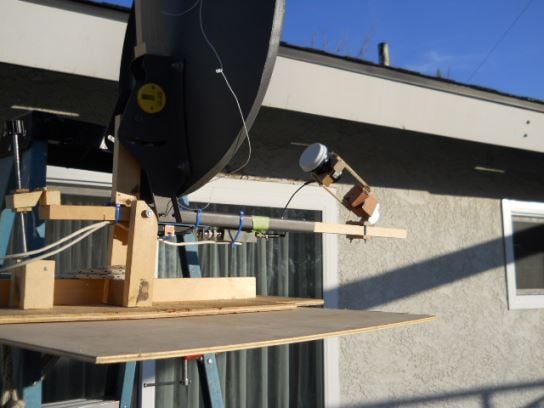
 Marcus’ setup is shown below.

RTL-SDR Radio Telescope Setup

And here is just one of his many resulting graphs shown in the document showing the Hydrogen line.

RTL-SDR Radio Telescope Hydrogen Line

A similar radio astronomy project has previously been done with the Funcube. More information about that project can be found in this pdf file. In that project they used the Funcube, a 3 meter satellite dish and the Radio Eyes software.

However, in this Reddit post patchvonbraun explains that the Funcube’s much smaller bandwidth is problematic, and so the rtl-sdr may actually be better suited for radio astronomy.

This image is from the Funcube project document.

Funcube Radio Telescope Project

Another related project is the Itty Bitty Telescope (IBT), which does not use SDR, but may be of interest.

Meteor Scatter

Meteor scatter works by receiving a distant but powerful transmitter via reflections off the trails of ionized air that meteors leave behind when they enter the atmosphere. Normally the transmitter would be too far away to receive, but if its able to bounce off the ionized trail in the sky it can reach far over the horizon to your receiver. Typically powerful broadcast FM radio stations, analog TV, and radar signals at around 140 MHz are used. Some amateur radio enthusiasts also use this phenomena as a long range VHF communications tool with their own transmitted signals. See the website www.livemeteors.com for a livestream of a permanently set up RTL-SDR meteor detector.

In Europe typically the Graves radar station can be used for meteor scatter experiments. Graves is a space radar based in France which is designed to track spacecraft and orbital debris. If you are in Europe you can also make use of the Graves radar simply by tuning to its frequency of 143.050 MHz and listening for reflections of its signal bouncing off things like meteors, planes and spacecraft. Since Graves points its signal upwards, it’s unlikely that you’ll directly receive the signal straight from the antenna, instead you’ll only see the reflections from objects.

In other countries old and distant analogue TV stations can be used or FM transmitters can also be used.

To set meteor scatter up, simply use an outdoor antenna to tune to a distant transmitter. It should be far enough away so that you can not be receive the transmitter directly, or the signal should be weak. If you detect a meteor the signal will briefly show up strongly at your receiver. Performance can be enhanced by using a directional antenna like a Yagi to point upwards at the sky in the direction of the transmitter.

We have several post about meteor scatter available on the blog here. Read through them to get a better understanding of the ways in which it can be monitored. You may also be interested in Marcus Leech’s tutorial where he uses the RTL-SDR to detect forward meteor scatter. (doc here) (pdf here)

Pulsar Observing

A pulsar is a rotating neutron star that emits a beam of electromagnetic radiation. If this beam points towards the earth, it can then be observed with a large dish antenna and a radio, like the RTL-SDR. 

Pulsars create weakly detectable noise bursts across a wide frequency range. They create these noise bursts at precise intervals (milliseconds to seconds depending on the pulsar), so they can be detected from within the natural noise by performing some mathematical analysis on the data. Typically a few hours of data needs to be received to be able to analyze it, with more time needed for smaller dishes.

One problem is that pulsar signals can suffer from ‘dispersion’ due to many light years of travel through the interstellar medium. This simply means that higher frequencies of the noise burst tend to arrive before the lower frequencies. Mathematical de-dispersion techniques can be used to eliminate this problem enabling one to take advantage of wideband receivers like the RTL-SDR and other SDRs. The more bandwidth collected and de-dispersed, the smaller the dish required for detection.

Pulsar detection requires some pretty large antennas, and a good understanding of the techniques and math required for data processing so it is not for the beginner. See the previous Pulsar posts on this blog for more information.


If you enjoyed this tutorial you may like our ebook available on Amazon.

The Hobbyist’s Guide to the RTL-SDR: Really Cheap Software Defined radio.