Category: RTL-SDR

Shielding the RTL-SDR

Over on Reddit user will1384 has posted about his imgur photo album that clearly documents some well researched steps that he took in an effort to shield the RTL-SDR dongle from interference. Interference is caused by strong out of band signals that can sometimes show up even when no antenna is connected to the dongle. Shielding the dongle helps to remove this interference.

The main steps he took were the following:

  1. Buy an aluminium case from ebay and put the dongle inside it.
  2. Remove the USB connector and ground the dongle ground to the aluminium casing using a 1M Ohm resistor and a 47nf ceramic disk capacitor.
  3. Connect the USB data lines to a USB extension cable and wrap a toroid around the 5v and GND lines and twist the two data lines together.

There is a discussion about this shielding project on Reddit.

Shielding Wiring Diagram

Receiving Hellschreiber with the RTL-SDR and an Upconverter

Over on YouTube user BSoD Badgers has uploaded a video showing reception of Hellschreiber on HF at 20m. To receive the HF frequencies he used a ham-it-up upconverter. He used SDR# to receive the signal and the Fldigi decoding software to decode the signal.

Hellschreiber is a fax-like communications mode used by amateur radio hobbyists.

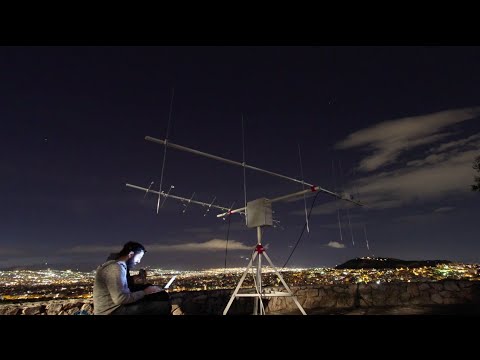
Tutorial Video Showing How to Receive Meteor M2 Weather Satellite Images with the RTL-SDR

Recently we posted about a tutorial showing how to receive LRPT weather satellite images from the new Russian Meteor M2 satellite. Now over on YouTube user Tom Mladenov has uploaded a tutorial video showing all the tutorial steps.

The reception process is to essentially record an IQ file of an LRPT transmission using SDR#, reduce the sample rate of the IQ file using audacity and then decode the file using LRPTrx.exe. Then finally the decoded data can be imported into LRPTofflineDecoder to produce an image.

University Lab Sheet Explaining RTL-SDR and Demodulation Theory

A reader of our blog has recently written in to let us know about a lab sheet from the University of Colorado College of Engineering and Applied Science which clearly explains software defined radio theory with the aide of an RTL-SDR dongle.

The lab sheet starts off by showing how the RTL-SDR works at a high level, then goes on to explain the function of the R820T tuner chip and RTL2832U chip. The lab then shows a behavioural level model of the RTL-SDR which becomes useful for mathematical analysis. Finally, the lab also explains demodulation theory for FM and FSK signals and sets several lab exercises that involve writing FM and FSK demodulators in MATLAB or Python.

The zip files mentioned in the lab sheet can be downloaded from http://www.eas.uccs.edu/wickert/ece4670/lecture_notes/.

RTL-SDR Behavioural Model

Another TCXO RTL-SDR for Sale And Aluminium Cases

Recently we posted about a new US based source for modded TCXO RTL-SDR dongles. Now Nooelec, one of the most popular sellers of standard RTL-SDR dongles have started selling their own version of TCXO modded dongles as well. Their dongles come with a 0.5 ppm TCXO oscillator as well as an external aluminium casing for interference shielding.

A TCXO is a temperature controlled oscillator. Its advantage over a standard oscillator like the one used in a normal RTL-SDR is that its frequency will not drift as the temperature of the dongle changes.

Nooelec are also selling the aluminium casing by itself in silver and in blue for use in shielding dongles that you already have.

Nooelec TCXO Dongle
Nooelec TCXO Dongle

Hak5: Mobile SDR Apps

On this episode of Hak5, a popular YouTube technology channel, Shannon shows two Android based ADS-B RTL-SDR apps that we have mentioned on this blog previously. One is “ADS-B on USB SDR RTL” and the other is Avare ADS-B. Both are ADS-B apps that will display real time airplane positions on a map.

To run these apps you need a RTL-SDR dongle, a USB OTG cable and an Android phone.

Cellular Testing Tools and Mobile SDR Apps, Hak5 1708

Visualizing ADS-B Data in 3D using MATLAB

Over on Reddit user JorgeGT has posted an animated 3D visualization of his local ADS-B air traffic data using a MATLAB script he wrote. The script collects data from a dump1090 server. If you have a copy of MATLAB, his code can be downloaded from Github here. To run the code JorgeGT writes that you’ll need to do the following.

  • Get dump1090 running on an accessible server: http://url:8080.
  • Get countries/states/provinces SHPs from Natural Earth if you want them to show them and store them in a folder called 10m_cultural.
  • Have a look at my MATLAB script and try to run it.
MATLAB Visualization of ADS-B Data
MATLAB Visualization of ADS-B Air Traffic Data

ADS-B Front-End with LNA and SAW Filter for Improved Reception

Japanese blogger and RTL-SDR experimenter ttreftech has had an ADS-B front end kit (In Japanese, use Google Translate) consisting of a low noise amplifier (LNA) and SAW filter available for sale in Japan for a few months now. The LNA helps to push weak signals through the coax feed line and the SAW filter is a bandpass filter that helps to remove interference outside of the 1090 MHz ADS-B region. If you are interested in building your own version, ttrftech has also posted a schematic. Another recent post about the front-end can be found here.

Another Japanese blogger, “pup” has posted about his results with the ADS-B front end kit (Also in Japanese, use Google Translate). His results show that the front end does significantly improve ADS-B reception. The image below shows an ADS-B signal with the front end turned off (top) and with it turned on (bottom). Pup has also posted a video showing the kit and its performance on HDSDR.

Japanese ADS-B Front End
ADS-B AMPキットの実験