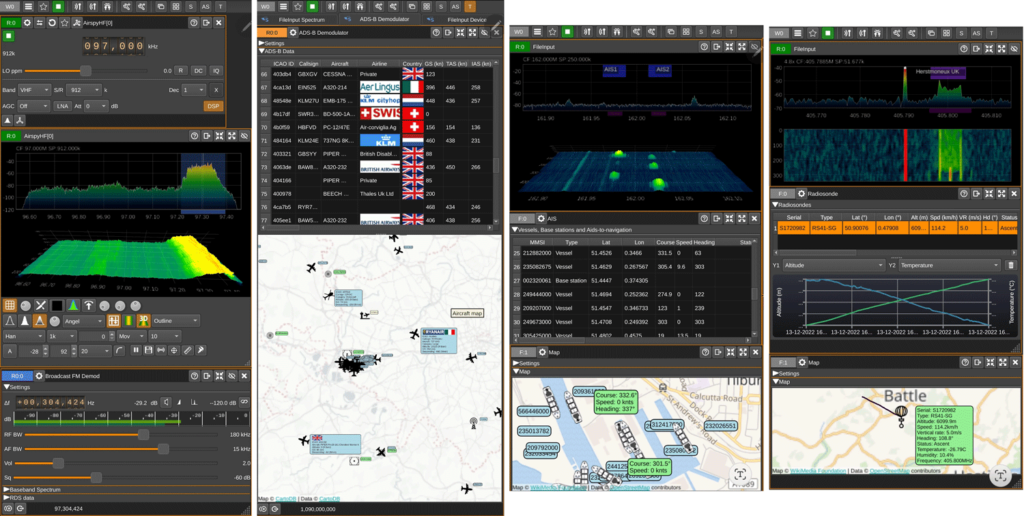
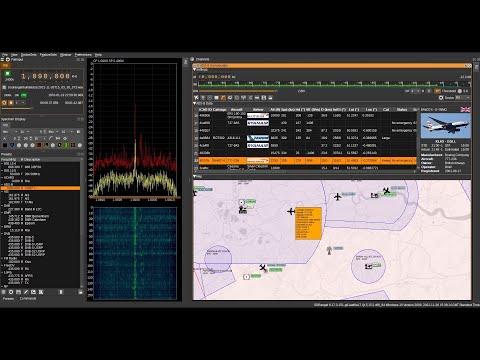
SDRangel is a free open source software defined radio program that is compatible with many SDRs, including RTL-SDRs. SDRAngel is set apart from other programs because of it's huge swath of built in demodulators and decoders.
Thank you to reader Jon for writing in and noting that SDRangel has recently been released for Android as a free Google Play download. This is an amazing development that could open up many doors into portable decoding setups as the Android version supports almost every decoder implemented on the desktop version. Jon writes:
It includes most of the functionality of the desktop version of SDRangel, including:
AM, FM, SSB, Broadcast FM and DAB, AIS, ADS-B, Digital Voice (DMR, dPMR, D-Star, FreeDV), Video (DVB-S, DVB-S2, NTSC, PAL), VOR, LoRa, M17, Packet (AX.25), Pager (POCSAG), Radiosonde (RS41), Time signal (MSF, DCF77, TDF and WWVB) modems.
RTL SDR, Airspy, Airspy HF, LimeSDR, HackRF and SDRplay support via USB OTG as well as networked SDRs
2D and 3D signal analysis in both time and frequency domain with statistical measurements of SNR, THD, THD+N, SINAD, SFDR and channel power
Satellite tracker, star tracker, maps and rotator controller
It should work on Android 6 and up. It’s a straight port of the desktop application, so although it will run on a phone, probably best used on a large tablet with a stylus or mouse.
Weather satellites that transmit HRPT give you high resolution uncompressed images of the earth. With an SDR, L-band feed, 60 cm or larger satellite dish and LNA+filter these images can be received by anyone. Derek OK9SGC has the definitive HRPT reception tutorial available here. However, as these are low earth orbit satellites, the user is required to find a way to track the satellite as it moves across the sky. With some skill and experience, hand tracking can work, but a motorized solution is really what is desired. Other applications such as ham satellite communications as well as radio astronomy projects may also benefit from motorized tracking .
Antenna rotators that rotate in azimuth and elevation can be used to track satellites moving across the sky. The problem is that antenna rotators are typically very expensive, or are a major task to DIY, involving circuit construction and 3D printing of parts.
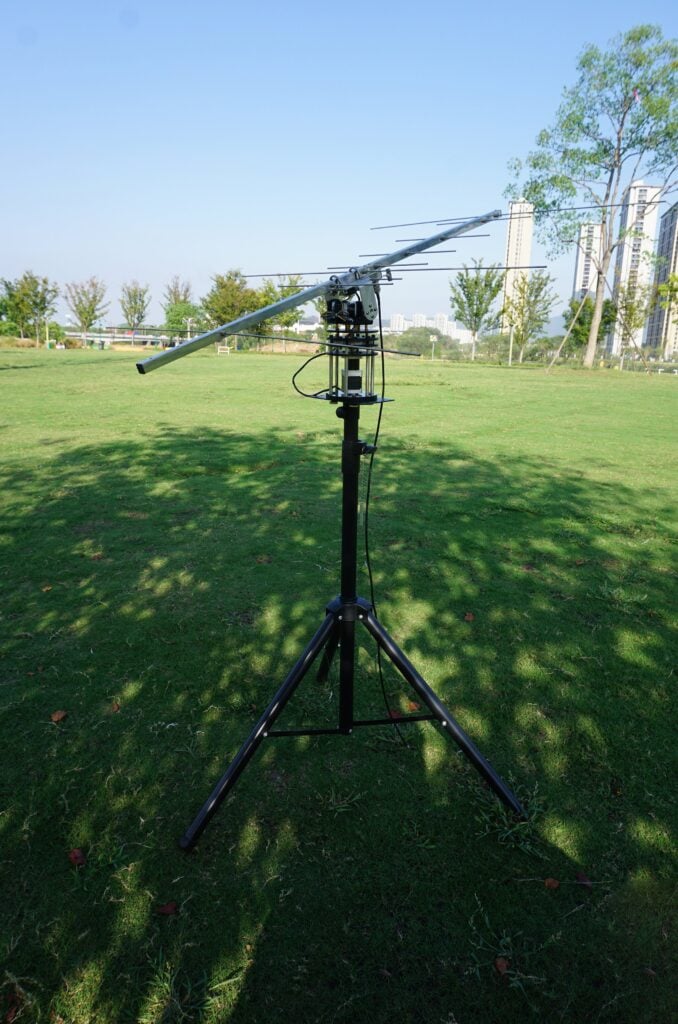
Recently on Tindie we came across the "AntRunner" which is a relatively low cost portable antenna rotator from China coming in at US$325 with free shipping to most countries (VAT is added for the EU as $50 in shipping fees).
AntRunner is based on two geared stepper motors, a motor controller PCB and an open frame. AntRunners code is open source, as well as some partial hardware schematics.
It can be interfaced via a USB serial connection or through WiFi via it's onboard ESP32 chip, and it relies on the Hamlib 'rotctl' software library running on either the controlling PC, or another intermediary device like a Raspberry Pi. Once setup, software like Gpredict on the PC or Look4Sat on Android devices can be used to control the rotator.
The AntRunner: Low cost antenna rotator
AntRunner Tests
We ordered an AntRunner for testing with our own funds. Our setup involved a USB connection from the AntRunner to a Raspberry Pi, 12V plug pack and a 60cm dish. We installed hamlib on the Raspberry Pi, and used Gpredict (PC) and Look4Sat (Android) on networked devices to send the desired elevation and azimuth commands to hamlib on the Raspberry Pi for particular satellites.
(Note that if you are installing hamlib for the AntRunner, you should do so from source as the packages in Ubuntu 22.04 appear to be out of date. And the older version of hamlib installed via Ubuntu does not support the AntRunner).
Overall the AntRunner works as expected and was easily able to follow HRPT satellites across the sky. It was also great for easily pointing and switching between geostationary satellites like GOES and GK-2A. It easily held and moved a 60cm dish and feed which weighs about 3 kg. The specs of the AntRunner indicate 5 kg max load (although the GitHub specs note 10kg), so it should be able to hold larger diameter dishes as well.
However we did have an issue with the advertised WiFi connection which is an alternative to the USB serial connection. When connected to WiFi the connection would always drop after a single movement command was sent, and it would never reconnect unless rebooted twice. For this reason we abandoned WiFi and only used the USB serial connection, and communicated wirelessly via the Raspberry Pi. There is also a WiFi web interface available for testing movement commands and setting up the WiFi connection, but it is only in Chinese.
It's possible that RF noise from the motors was causing the WiFi disconnection, but on the frequencies that L-band satellites operate at, we did not notice any motor interference.
The AntRunner is advertised as a portable rotator, so that means it is not suitable for use in poor weather as it has no cover to protect the motor circuit board and motors themselves from rain. However, it is certainly small and light enough to be portable. You just need a portable 12V power supply as well.
Another issue is that when power is lost, the motors will spin freely, resulting in the antenna coming crashing down fast. So care must be taken when powering down with someone there to hold the antenna. The user is also required to physically hold the antenna level at 0 degrees elevation before powering up the AntRunner, so that it will reference 0 degrees elevation. Once powered the antenna holds in place.
There are also no limit switches on the device, so if an erroneous command is sent, it could send the motors into a position that could damage something.
AntRunner (Image from Tindie) (NOTE: The tripod stand is not included)
Conclusion
Overall if you want something cheap and pretty much ready to use out of the box for tracking HRPT or other LEO satellites, the AntRunner is a good budget choice if you intend to only setup temporary stations. It is not suitable for permanent satellite receiver setups, at least not without some modifications.
A similar product is the SATRAN MK3 which was a 3D printed kit costing 175 Euros + shipping, but unfortunately this product appears to no longer be sold.
The ultimate in low cost rotators is probably the SatNOGS V3 rotator, but as mentioned this is a DIY project that requires a significant time commitment as it involves 3D printing multiple parts, sourcing components, building PCBs and constructing everything together. We have found one company offering a SatNOGs hardware kit, containing all of the parts required for US$445.
A commercial option might be the Yaesu G-5500DC which goes for US$759.95 on HRO, however you also need the GS-232 Rotator Computer Controller for computer control which is an additional US$589.95. Update: We've been informed that there are also cheaper third party computer controllers for Yaesu rotators, such as the CSN Technologies S.A.T Rotator Controller which sells for US$278.
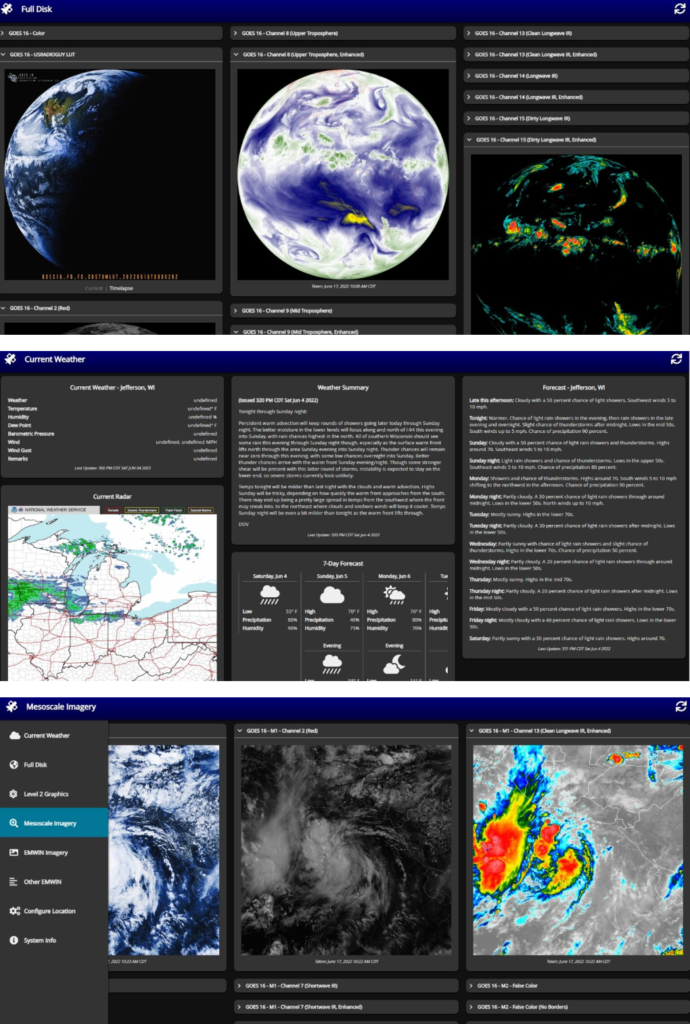
Thank you to Carl Reinemann (aka usradioguy) for submitting his article about Vitality GOES. Vitality GOES is an open source tool that displays the weather satellite images received by SatDump and/or goestools in a user friendly web interface that is accessible over a network connection.
SatDump and goestools are decoders that can be used to decode images from GOES and other satellites, when combined with a PC or single board computer, satellite antenna and RTL-SDR or similar SDR dongle. What they lack however is an easy way to display the received images, as the images are simply dumped to folders. If you're interested in getting started with GOES reception, we have a tutorial here.
Carl's article explains the purpose of Vitality GOES in detail and shows a few example screenshots. He notes how it can be used to display full disk images, composite together Meteor M2 images, present EMWIN data such as forecasts and warnings, and more.
Carl also notes that Vitality GOES was recently updated to V1.2 with the main update being added support for SatDump. SatDump can decode dozens of different weather satellites, not only GOES, so this opens up a wide range of possibilities.
Vitality GOES - Feature Overview
Vitality GOES: Example screenshots from Carl Reinemann (usaradioguy)
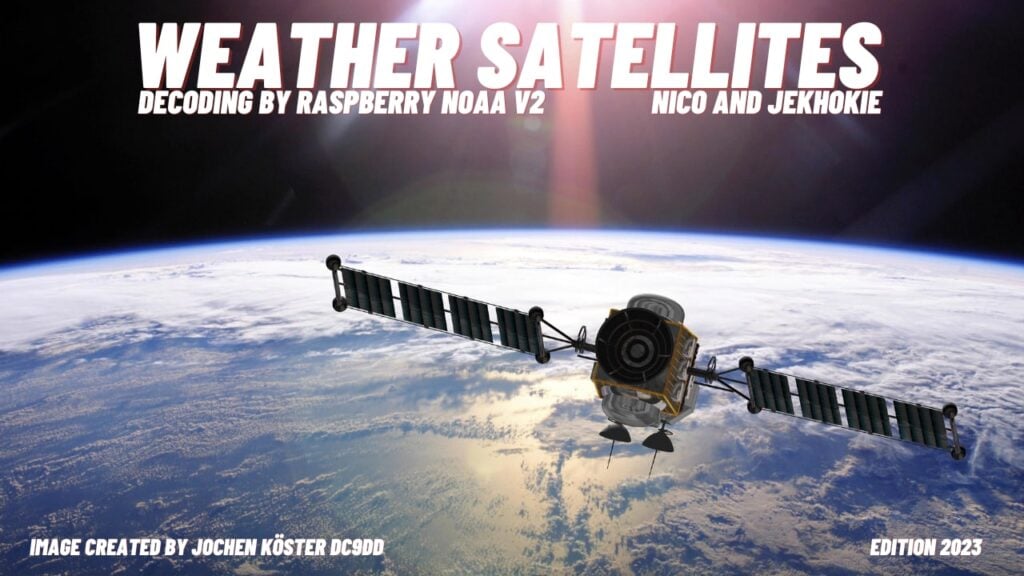
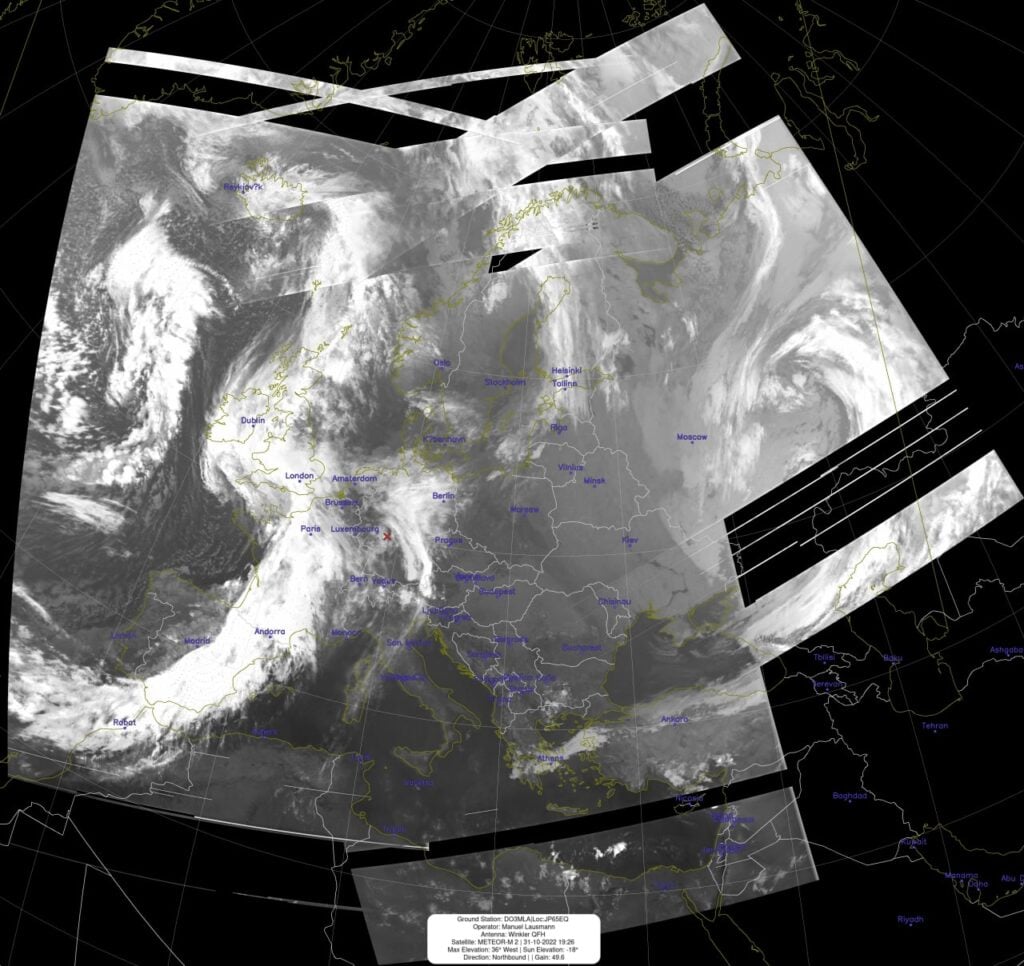
Thank you to Manuel Lausmann for submitting news about the release of the "Raspberry NOAA V2 Edition 2023" image for Raspberry Pi's. This image has been created by Jochen Köster (DC9DD), and contains a few enhancements over the previous image, mainly by including a program that allows users to create composite images of images from the Meteor weather satellites. Manuel writes:
This is based on the well-known Raspberry Noaa V2. In this image, however, the latest MeteorDemod has been added, which makes it possible to generate composite images, which was previously only possible under Windows with Meteorgis.
Furthermore, the image has an additional FTP uploader. The image was created by Jochen Köster DC9DD. It's available from today. This image is also part of my off-grid station in Northern Norway.
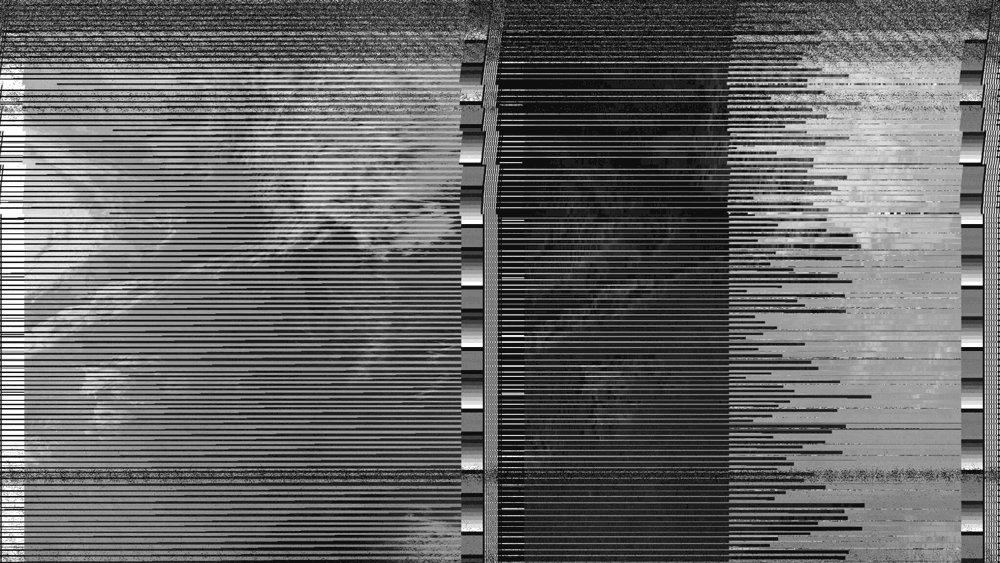
In his post Carl discusses in detail the technical aspects of the AVHRR Scan Motor failure, shows plots of the AVHRR motor current increasing, provides multiple examples of corrupt images being recently received and notes the history of previous failures which were eventually resolved.
He also notes that even with the AVHRR failure the other sensors on the satellite will remain functional, however a failure of this instrument would mean the end of the easy to receive APT images at 137 MHz from NOAA-15. We note that there is still the opportunity to receive NOAA-18 and NOAA-19 which are the remaining operational satellites that transmit APT at 137 MHz.
NOAA have now also released an official notice about the failure which reads:
Product Outage/Anomaly: NOAA-15 AVHRR degraded image data issued by NESDIS NSOF Date/Time Issued: Oct 22, 2022 1947Z
The NOAA-15 AVHRR Scan Motor current began showing signs of instability on Oct 18 at approximately 1800Z, when the current began to gradually rise from about 205 mA to about 250 mA, where it remained until Oct 24. At about 0000Z on Oct 24, the current began rising again throughout the day, peaking at about 302mA on Oct 25. Scan motor temperature began rising about the same time and is currently steady at ~29°C. The instrument is still producing data, but it is highly degraded. This behavior may be a sign of an impending scan motor stall but requires further investigation. Options for recovery are limited.
The NOAA APT weather satellites are popular because they fly over most places on earth frequently, and they are easy to receive images directly from with modest hardware such as an RTL-SDR and v-dipole antenna.
Three NOAA APT satellites currently operational include NOAA-15, NOAA-18 and NOAA-19. The satellites are however long past their rated mission age, with NOAA-15 being almost 25 years old now.
Unfortunately NOAA-15 appears to be having trouble with it's image scanning motor at the moment, and it is producing corrupted images. This problem has occurred in the past in 2018 and 2019, before fixing itself, so the hope is that it will fix itself again this time.
NOAA does not appear to have released any information about the outage yet on their General Satellite Messages page.
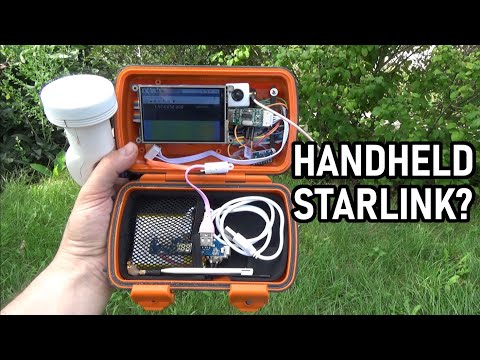
Over on his YouTube channel "saveitforparts" has in the past created a portable homemade 'tricorder' which was a boxed up Raspberry Pi with multiple sensors including an RTL-SDR. One new application he's found for the tricorder is the ability to detect the beacons from Starlink satellites using the RTL-SDR and an LNB.
Starlink beacons typically transmit at around 11.325 GHz, so to receive them with an RTL-SDR a downconverter and antenna such as an LNB is required.
In the video he demonstrates the hardware in use, and shows some of the beacons being received on the spectrum, via the tricorders built in LCD screen.
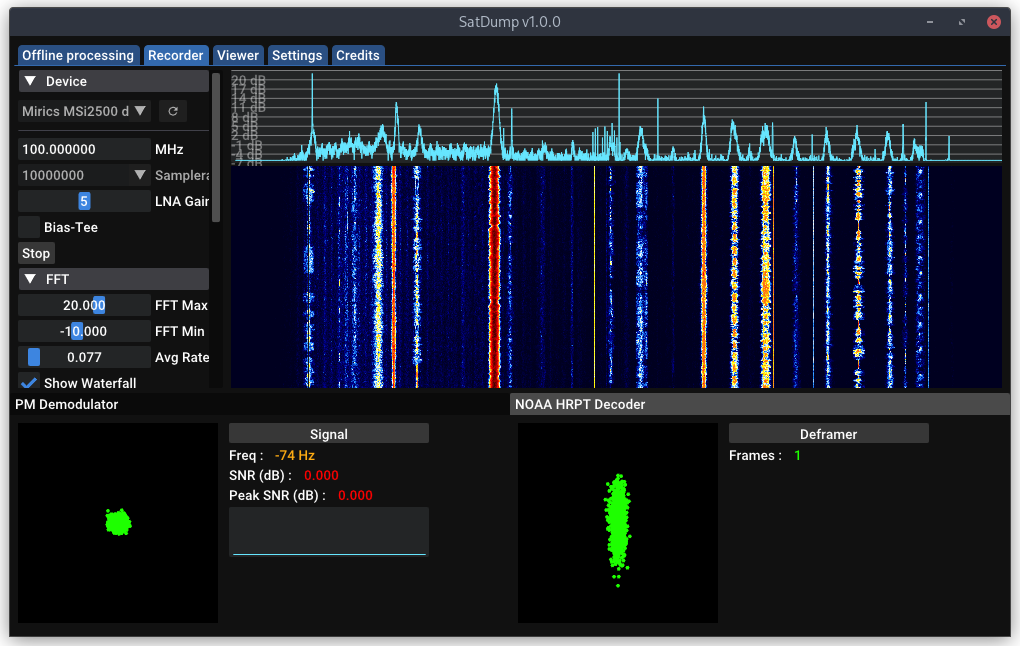
SatDump is a popular piece of software that can be used with RTL-SDRs and other software defined radios for decoding images from a wide array of weather imaging satellites including GOES, GK-2A, NOAA HRPT, FengYun, Electro-L and Meteor M2 LRPT + HRPT, and many others (note: there is no APT support at the moment, but it is planned for the future). It is compatible with Windows, Linux and even has an Android APK available.