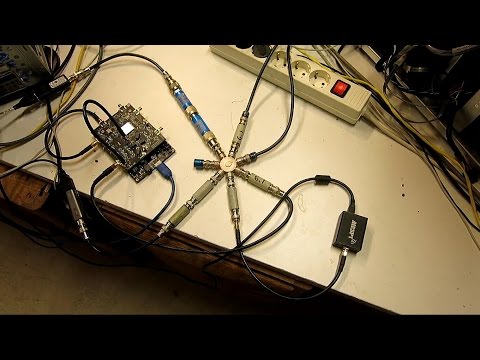
Over on YouTube user sm5bsz (aka Leif, programmer of Linrad) has uploaded a video showing an in depth technical comparison between the Airspy, Funecube, E4000 RTL-SDR and BladeRF software defined radios. His test focuses on the dynamic range when each SDR is used as a narrowband receiver at 144 MHz with appropriate filtering applied. The video is quite long and technical, but most of the results are summarized at 4:41.
Keenerd (aka Kyle Keen) recently ran a fundraiser to support him to work on improving the RTL-SDR driver and related software. A few months ago he released an update to the driver which made some improvements including some tweaks by another programmer teejeez that optimized the R820T’s filters which may help with out of band aliasing. The list of issues he is working on and has completed can be found at http://igg.kmkeen.com/.
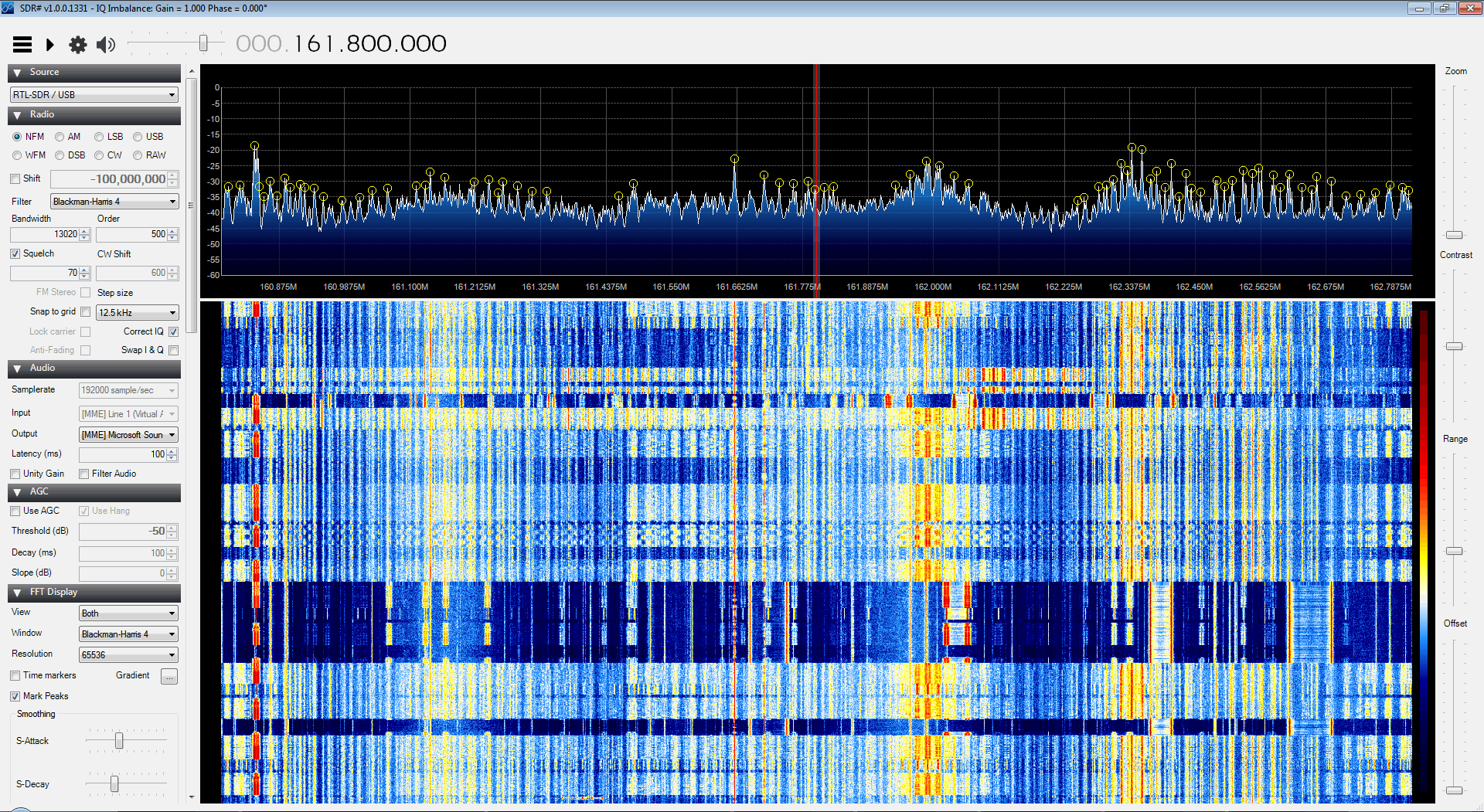
To use keenerds drivers on Windows with SDR# you can go to http://igg.kmkeen.com/builds/, and download the latest build zip file. Then simply copy all the non .exe files into the SDR# folder and rename librtlsdr.dll to rtlsdr.dll. We recently tested the new drivers and show screenshots of the difference below. Nearby to the marine weather report frequency used in the screenshots is a very strong pager signal which causes significant interference. With the gain turned up on the original drivers the entire band is wiped out when the pager signal is transmitting. With keenerds drivers most of the band is usable and the weather signals can be heard. There do seem to be some issue with what looks like WFM interference appearing now however. Testing at other frequencies with nearby strong signals also seem to show that aliasing is significantly reduced. We also noticed a lower noise floor at some frequencies resulting in about a 2-3 dB better signal. However, we also noticed that the noise floor was raised slightly at some other frequencies. We suggest you give keenerds drivers a try and comment with any improvements or issues you see.
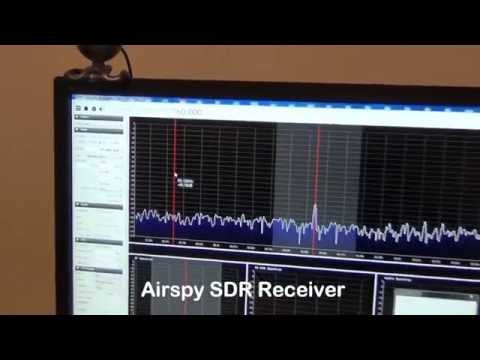
Over on YouTube user Mile Kokotov has uploaded two videos showing a comparison between the Airspy and RTL-SDR software defined radios. The Airspy is a high performance SDR that costs $199 USD.
The first video shows a comparison between the two SDR’s and two hardware radios on receiving a very weak broadcast FM station amongst several very strong ones. Mile first tested his hardware radios and found that his Onkyo radio was able to clearly receive the weak station, whilst his Pioneer radio could not at all. Then he tested his SDR’s and found that his Airspy was able to receive the station, but the RTL-SDR could not and suffered from intermodulation when the gain was turned up because of the nearby strong stations. This shows how the 12-bit Airspy ADC vs the 8-bit ADC on the RTL-SDR can make a difference.
The second video shows a comparison between the RTL-SDR and Airspy on a VLF time signal at 60 kHz using a ham-it-up upconverter. His video shows that the Airspy signal is about 8dB stronger the the RTL-SDR.
Over on the rtl-sdr.ru blog the programmer of many well used SDR# plugins has released a new one which allows you to have up to two extra VFO’s in SDR# (note in Russian, use Google Translate). In order words this means that you can now listen to up to three signals simultaneously if they are in the same swath of live bandwidth. Previously on Windows only the SDR-Radio V2 software was capable of doing multiple VFO’s.
Listening to multiple frequencies simultaneously has many uses including the ability to now monitor multiple ACARS, AIS, pager and other data frequencies at the same time. However, as of yet it seems that the ability to output to other audio devices such as a virtual audio cable is not yet implemented.
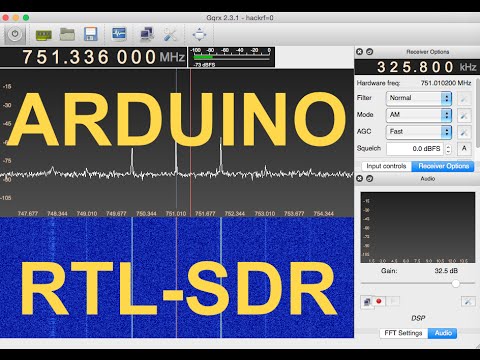
Over on YouTube user Samy Kamkar has uploaded a video showing how he was able to use an RTL-SDR to copy his friends wireless doorbell signal and prank him by replaying it using an Arduino and 433 MHz transmitter. His video goes through the entire reverse engineering process he used from recording the wireless doorbell signal with the RTL-SDR, to analyzing and understanding the signal and finally to programming the Arduino with the code to replicate the doorbell signal. If you don’t like video explanations, Samy has also done a write up of the same material on his website.
Digital Ding Dong Ditch Prank - hacking wireless doorbells w/Arduino and RTL-SDR
The online store Nooelec has recently started selling two new RTL-SDR related products.
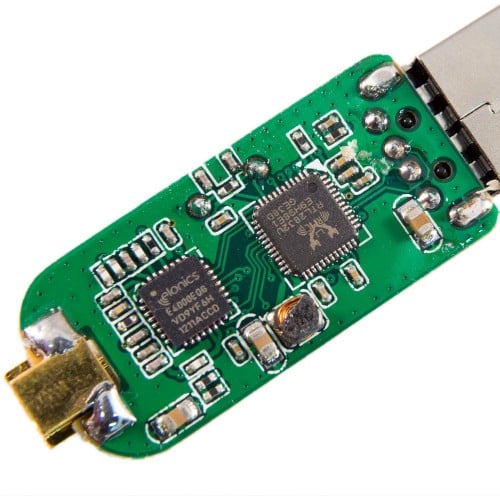
The first product is a lower cost RTL-SDR dongle with the E4000 tuner. The E4000 tuner was one of the original tuner chips used in RTL-SDR dongles when they were first discovered. Unfortunately Elonics, the company that owned the rights to the chip went under and the production of E4000 chips stopped, making them rare and expensive. The E4000 tuner has a tuning range of approximately 55 MHz - 2300 MHz, compared to the R820T tuner which has a range of around 24 – 1766 MHz. The cheaper R820T is better in most cases, but if you need the higher frequencies the E4000 may be an option. The new E4000 dongle is currently selling for around $50 USD, compared to the other E4000 models which went for around $100 USD.
E4000 Dongle from Nooelec
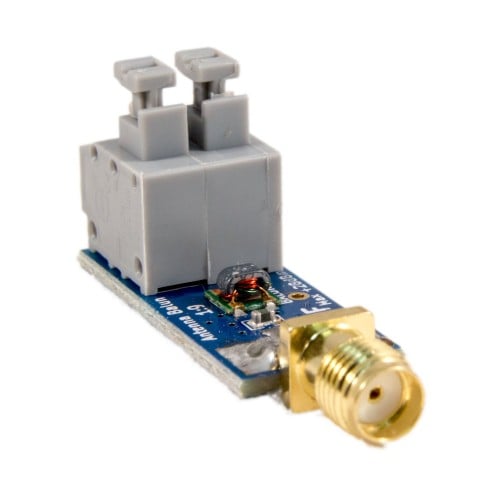
They have also begun selling a low cost 9:1 balun for about $10 USD which can be used with a long wire (or random wire) antenna when receiving HF on the RTL-SDR with an upconverter. The impedance of a long wire antenna is approximately 450 Ohms (very approximate, impedance varies with frequency and length). A 9:1 balun allows a match with a 50 Ohm receiver, which is close enough to the 75 Ohm input of the RTL-SDR.
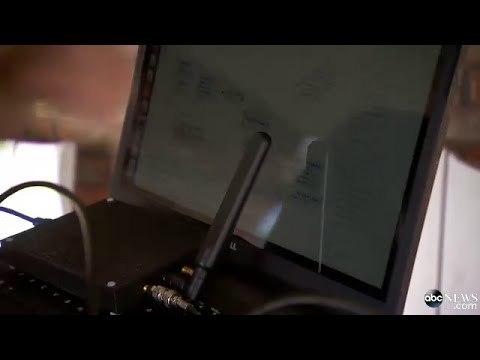
Earlier this year the American TV show Good Morning America featured a segment on software defined radios being used to break into houses with wireless alarm sensors. The story is based on a Defcon 2014 paper “Home Insecurity: No Alarms, False Alarms, and SIGINT” by Logan Lamb. In the TV segment Logan shows how he uses a USRP software defined radio to send a false alarm signal, jam a wireless sensor and finally to record sensor activation data from the alarm system.
Although Logan used a USRP, the same attack could be done with the cheaper HackRF.
SDR HackRf: Home Insecurity: No Alarms, False Alarms, and SIGINT
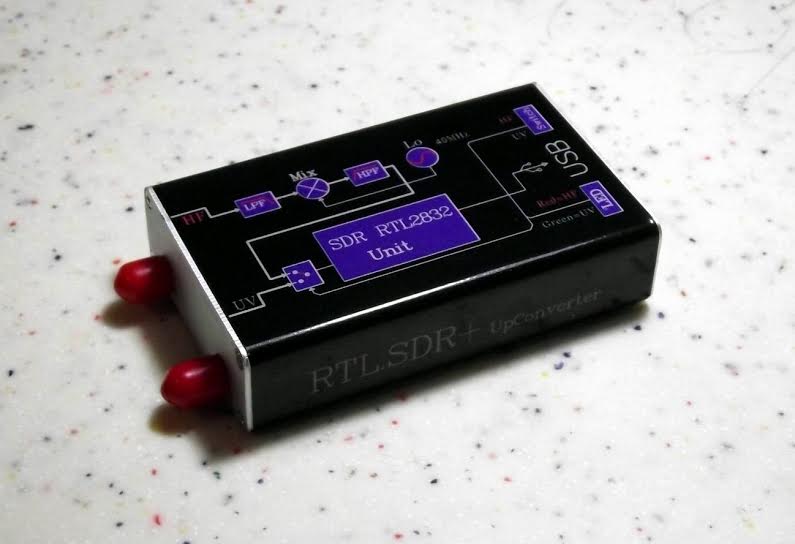
BA5SBA, the creator of the Chinese direct sampling kit (and fully assembled version) recently wrote in to let us know about a product that he is now building. His new product is a fully assembled RTL-SDR + Upconverter. The upconverter design uses a DBM balanced ring mixer design which he writes makes less noise and has greater dynamic range. He also writes that compared to direct sampling the upconverter model should have greater sensitivity as it allows use of the R820T LNA. His design uses a 40 MHz local oscillator, comes with increased RF input protection and comes in an aluminium case.
BA5SBA's new upconverter can be found for sale on eBay for around $80 USD.